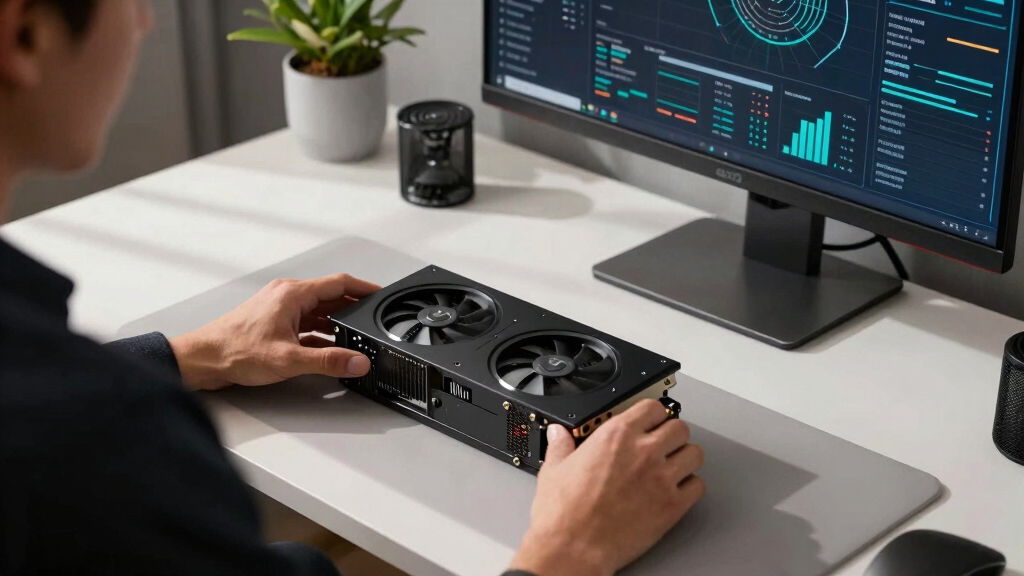

📊 Full opportunity report: The Real Cost of a Local-Inference Rig in 2026 on ThorstenMeyerAI.com — validation score, market gap, and execution plan.

Get business pricing on monitors, keyboards and dev gear
- Business-only prices and quantity discounts
- Tax-exempt purchasing
- Multiple users, one account, clear invoices
TL;DR
In 2026, building a local AI inference rig involves significant hardware costs, with VRAM capacity being the key factor. Used GPUs like the RTX 3090 offer high VRAM-per-dollar value, while flagship cards are less cost-effective for inference. The choice of hardware depends on model size and workload needs.
Building a local AI inference rig in 2026 involves substantial hardware costs, with VRAM capacity and memory bandwidth being the critical factors. While high-end GPUs like the RTX 5090 are capable, their cost-effectiveness for inference tasks is limited, and many users find better value in older, used cards such as the RTX 3090.
The core constraint for local inference is the VRAM cliff: models must fit entirely within GPU memory to run efficiently. For example, a 70B model requires approximately 43GB of VRAM at full precision, making it necessary to use multiple GPUs or high-capacity cards for larger models. The bottleneck is memory bandwidth, not raw compute power, meaning faster GPUs do not always translate into faster inference.
Cost-effective options include used RTX 3090 cards, which offer 24GB of VRAM at a fraction of the price of newer flagship models. Four used 3090s can pool VRAM to handle models up to 120B at Q4 precision, providing significant value for those aiming to run large models locally. Conversely, flagship cards like the RTX 5090, costing around $2,000, are optimal only if a single card suffices for the workload.
Model size directly correlates with hardware needs: 7–8B models run comfortably on most modern GPUs, while 26–32B models require a 24GB card, and 70B+ models demand multi-GPU setups or large unified memory systems. The best value for inference hardware is a 24GB GPU, which unlocks the full range of models in the 26–32B class.
The real cost of a local-inference rig
Owning beats renting for steady AI work — so what does a local rig cost in 2026? The unintuitive, good news: the most expensive build is almost never the smartest one. It all comes down to one rule.
The difference is only whether the weights fit. LLM inference is memory-bandwidth-bound — VRAM capacity is the hard limit you build around. Compute specs are mostly noise.
The squeeze reframes the rig like everything else in this series: discipline beats maximalism. VRAM is exactly the memory under most pressure, so over-buying it is the 128GB-“to-be-safe” trap, only worse per gigabyte. Take the cheap, high-value step to 24GB (the gateway to the 30B class), reach for used 3090s and MoE models, and use quantization to climb a tier without buying silicon. Sized right, the rig pays for itself against the cloud’s ever-rising hidden bill. Next: Apple Silicon’s quiet memory advantage.
Implications for Cost-Effective AI Deployment in 2026
Understanding the true costs of a local inference setup helps organizations and individuals decide whether to invest in hardware or rely on cloud services. With the right hardware choices, especially used GPUs, users can significantly reduce operational expenses while maintaining control over data privacy and latency. This shift impacts the economics of AI deployment and could democratize access to large models outside commercial cloud environments.
Products Worth Considering

Amazon Kindle Scribe Colorsoft 64GB (1st Generation)

Logitech MX Keys S Wireless Keyboard, Graphite

Apple iPad Air (4th Generation, 10.9-inch, Wi-Fi, 256GB) – Space Gray
As an affiliate, we earn on qualifying purchases.
Hardware Trends and Model Size Requirements in 2026
In 2026, the AI hardware market has shifted toward VRAM capacity as the primary constraint for inference. The community recognizes the VRAM cliff: models must fit entirely in GPU memory for efficient operation. Older GPUs like the RTX 3090, despite being a generation behind, offer excellent VRAM-per-dollar ratios, especially when used in multi-GPU configurations. The focus has moved from raw compute power to memory capacity and bandwidth, influencing buying decisions.
Recent developments include the rise of Mixture-of-Experts models, which optimize VRAM usage by activating only parts of the model at a time, and the emergence of Apple Silicon with unified memory, enabling large models on consumer Macs. These trends highlight a shift toward maximizing memory efficiency rather than raw GPU speed, shaping the landscape of local inference hardware.
“Buying used GPUs like the RTX 3090 can dramatically lower costs while providing enough VRAM for most models, making local inference feasible for many.”
— Tech industry expert
Unresolved Questions About Long-Term Hardware Viability
It is not yet clear how hardware prices will evolve over the coming years, especially as demand for AI inference hardware increases. The longevity of used GPUs like the RTX 3090 remains uncertain, and potential supply chain disruptions could impact availability and prices. Additionally, the future of dedicated AI accelerators and their cost-performance ratio in 2026 is still developing.
Upcoming Hardware Releases and Market Trends in 2026
Next steps include monitoring the release of new GPU models, potential shifts in used hardware pricing, and advancements in AI-specific accelerators. As the hardware landscape evolves, users will need to reassess their configurations, balancing cost, VRAM, and bandwidth to optimize local inference setups. Industry experts anticipate a continued focus on memory efficiency and multi-GPU solutions for large models.
Key Questions
Is building a local inference rig cost-effective in 2026?
Yes, especially when using used GPUs like the RTX 3090, which offer high VRAM at a lower cost. The key is matching hardware to model size and workload needs to maximize value.
What is the most important hardware consideration for local inference?
VRAM capacity and memory bandwidth are critical. Models must fit entirely in GPU memory to run efficiently, making VRAM the primary constraint.
Can I run large models on consumer hardware?
Yes, with multi-GPU setups or high-memory systems like Apple Silicon Macs. For models above 70B parameters, multi-GPU or specialized hardware becomes necessary.
How do used GPUs compare to new flagship cards for inference?
Used GPUs like the RTX 3090 provide better VRAM-per-dollar and can be pooled via NVLink for large models, making them a more cost-effective choice than new flagship cards for inference tasks.
What hardware upgrades are worth considering for local inference?
Upgrading to a 24GB VRAM GPU unlocks the full range of 26–32B models, offering the best balance of cost and capability for most users in 2026.
Source: ThorstenMeyerAI.com