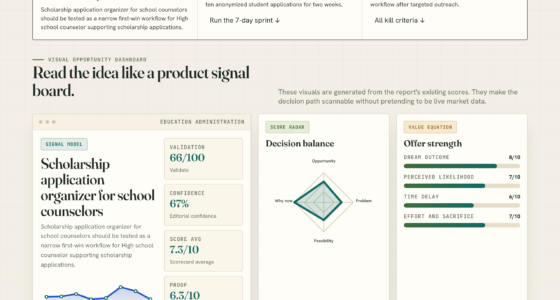
📊 Full opportunity report: The Future Is Now: 5 AI Tools For Student Organization In 2026 on ThorstenMeyerAI.com — validation score, market gap, and execution plan.

Get business pricing on monitors, keyboards and dev gear
- Business-only prices and quantity discounts
- Tax-exempt purchasing
- Multiple users, one account, clear invoices
TL;DR
In 2026, five AI tools are revolutionizing student organization, including research guides, note-taking devices, and productivity workflows. These tools support learning, research, and managing academic tasks effectively.
Five AI tools for student organization have gained prominence in 2026, offering new ways for students to manage research, note-taking, and workflows more efficiently. These tools, including comprehensive guides and innovative devices, are already being adopted by students aiming to boost productivity and learning outcomes. Learn more about the top AI tools in Lead Smarter: 7 AI Tools Every Student Organization Should Use In 2026. The development reflects a broader integration of AI into academic routines, making it a key trend for this year. For a comprehensive list, see 2026’S Best AI Tools For Enhancing Student Organization Efficiency. For a detailed overview, see the original analysis.
The five leading AI tools identified for 2026 include Google Notebook LM 2026, a research and note-taking device requiring some technical familiarity but highly effective at streamlining information gathering. Google Notebook LM User Guide 2026 provides step-by-step instructions to maximize its features. AI Fundamentals – A Beginner’s Guide offers accessible foundational knowledge for students new to AI, emphasizing practical understanding without technical complexity. The Complete Notion AI Guide focuses on boosting productivity through workflow automation and collaboration. Lastly, Integrating AI in the Classroom offers strategies for educators to implement AI tools effectively, indirectly benefiting student organization. These tools cater to different needs—whether learning about AI, applying it in research, or enhancing productivity—highlighting a versatile AI ecosystem for students.
The 5 picks
- 1
 The Complete Notion AI Guide: Boost Productivity, Creativity, and Workflow fo…View on Amazon →
 - 2
 Integrating AI in the Classroom: Innovative Methods to Optimize Lesson Planni…View on Amazon →
 - 3
 Google Notebook LM User Guide 2026: A Step-by-Step Guide to Mastering AI-Powe…View on Amazon →
 - 4
 Google Notebook LM 2026 User GuideView on Amazon →
 - 5
 AI Fundamentals – A Beginner’s Guide: Unlock the Power of Artificial Intellig…View on Amazon →
Impact of AI Tools on Student Academic Management
The adoption of these AI tools in 2026 signifies a shift toward more efficient, tech-driven student workflows. They help students save time on research, improve note organization, and facilitate collaboration, ultimately enhancing academic performance. As AI becomes embedded in educational routines, students and educators alike can leverage these technologies to foster more effective learning environments and better manage increasing workloads.
2026 Trends in AI for Student Productivity
Over the past few years, AI integration in education has accelerated, with tools evolving from basic applications to sophisticated research and workflow solutions. In 2026, new devices like Google Notebook LM and comprehensive guides such as the Notion AI Guide have emerged to meet the growing demand for AI-driven student support. Prior developments included AI-powered research assistants and note-taking apps, setting the stage for the current wave of specialized tools designed explicitly for student organization and productivity enhancement.
“These AI tools are transforming how students approach research and organization, making academic routines more efficient and accessible.”
— Thorsten Meyer, AI expert
Unresolved Questions About AI Tool Adoption and Effectiveness
It is not yet clear how widely these AI tools are being adopted across different educational institutions or how they impact academic outcomes in the long term. There is limited data on user satisfaction, technical limitations, or potential challenges like technical support and integration issues. Additionally, the effectiveness of these tools in diverse learning environments remains to be fully evaluated.
Next Steps for AI Integration in Student Workflows
Further research and user feedback will clarify the real-world impact of these tools. Developers are expected to release updates enhancing usability and integration capabilities. Educational institutions may begin formal adoption programs, and educators will likely explore best practices for incorporating AI into curricula. Monitoring these developments will be key to understanding how AI continues to shape student organization in 2026 and beyond.
Key Questions
How do these AI tools improve student research and organization?
They automate and streamline tasks like note-taking, information gathering, and workflow management, saving time and reducing manual effort, which enhances overall productivity.
Are these AI tools suitable for students with limited technical skills?
Yes, guides like ‘AI Fundamentals’ are designed for beginners, and many tools offer user-friendly interfaces, although some familiarity with digital platforms can be helpful.
Will these tools replace traditional study methods?
They are intended to complement existing methods, not replace them, by making research, note-taking, and organization more efficient.
Are there risks associated with adopting AI tools for student work?
Potential risks include technical issues, limited reviews, and over-reliance on automation. Careful evaluation and gradual integration are recommended.
What should students consider when choosing an AI tool?
Students should assess their technical comfort, specific needs—such as research, learning, or productivity—and the availability of support and tutorials.
Source: ThorstenMeyerAI.com
Halloween Picks
halloween
As an affiliate, we earn on qualifying purchases.