
📊 Full opportunity report: Revolutionizing Restaurant Safety Checks Using Vision-Model Software on IdeaNavigator AI — validation score, market gap, and execution plan.

Get business pricing on monitors, keyboards and dev gear
- Business-only prices and quantity discounts
- Tax-exempt purchasing
- Multiple users, one account, clear invoices
TL;DR
A restaurant technology company is testing an AI vision model that automatically verifies safety compliance during kitchen walk-throughs. This development aims to improve accuracy and accountability in food safety inspections, replacing manual checklists with verifiable photographic evidence.
A new AI-powered vision-model software is being tested to automatically verify compliance during restaurant kitchen safety walk-throughs. This development could significantly improve the accuracy and accountability of food safety inspections, which traditionally rely on manual checklists that often lack verifiable evidence.
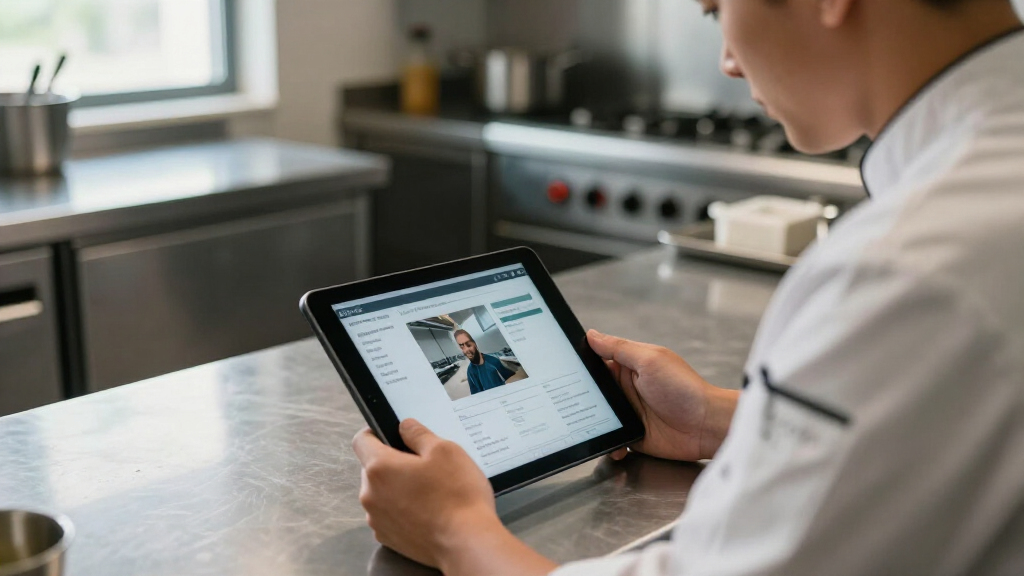
The software, developed for use by operations or quality assurance (QA) leads at multi-unit restaurant groups, captures images during morning inspections of key areas such as prep stations, walk-in refrigerators, handwash sinks, and storage areas. The vision model analyzes these photos to detect violations like uncovered containers, propped cooler doors, and missing date labels, and assigns severity ratings. It then generates timestamped reports that track violations across locations, providing a data-driven overview of safety compliance.
According to an anonymous researcher involved in the pilot, the system relies on existing smartphone cameras—no additional hardware is required—and can reliably flag violations in ordinary photos. The initial validation involves comparing the model’s flagged issues against findings from a hired health-inspection consultant over a two-week period at five restaurant locations. The goal is to verify the model’s accuracy before broader deployment.
Revolutionizing Restaurant Safety Checks Using Vision-Model Software
AI-powered image analysis is being tested as a verifiable layer for kitchen walk-throughs—turning ordinary smartphone photos into timestamped evidence, severity-rated findings, and cross-location compliance data.
From walk-through to evidence trail
Operations or QA leads photograph key kitchen areas during routine morning inspections. The vision model reviews each image, identifies visible risks, assigns severity, and organizes the findings into a timestamped report.
Capture
Staff use existing smartphone cameras during the normal kitchen walk-through.
Analyze
The vision model examines ordinary photos for recognizable safety violations.
Classify
Detected issues receive a category, severity rating, timestamp, and location.
Report
A structured record replaces an unsupported checkbox with visual evidence.
Track
Teams compare locations and identify recurring risks across the group.
What the model is looking for
The pilot focuses on visually observable conditions that can be captured during ordinary inspections—without specialty sensors, fixed cameras, or additional scanning equipment.
Uncovered containers
Flags exposed food or ingredients that appear to lack required covers or protection.
Severity assignedPropped cooler doors
Identifies walk-in or refrigeration doors visibly left open during the inspection.
Timestamp recordedMissing date labels
Detects containers that appear to be missing expected preparation or discard dates.
Evidence attachedSink readiness
Reviews handwash areas for visible accessibility, supply, or obstruction concerns.
Area categorizedWork-area conditions
Surfaces and prep zones can be checked for visible deviations from operating standards.
Finding prioritizedPlacement risks
Storage photographs provide a record for spotting repeated organization or handling issues.
Location trackedChecklist versus vision verification
The key change is not simply digitizing an inspection form. It is linking every recorded condition to observable evidence that can be reviewed, compared, and audited.
| Inspection capability | Manual checklist | Vision-model workflow | Operational effect |
|---|---|---|---|
| Proof of actual condition | ✗ Often absent | ✓ Photo attached | Reviewable evidence |
| Consistent issue classification | ~ Staff-dependent | ✓ Model-assisted | Reduced subjectivity |
| Severity prioritization | ~ Variable | ✓ Automatically assigned | Faster escalation |
| Cross-location comparison | ✗ Difficult | ✓ Structured reporting | Portfolio-wide visibility |
| Recurring-issue detection | ~ Manual review | ✓ Trend-ready records | Targeted corrective action |
| Human oversight | ✓ Primary control | ✓ Still required | AI augments inspection |
Initial validation design
Expected operational value
Promising—but not yet proven at scale
The technology could improve consistency and accountability, but broader adoption depends on validation across varied kitchens, reliable workflow integration, staff acceptance, and appropriate controls for stored images.
Objective compliance records
Photographic evidence can make safety findings easier to verify, audit, and communicate.
Multi-unit consistency
Restaurant groups could apply a more uniform inspection standard across many locations.
Real-world accuracy
Performance across different lighting, layouts, cuisines, and operating conditions remains uncertain.
Privacy and adoption
Image storage, access controls, employee trust, and workflow friction still require clear policies.
What happens next?
The current phase is designed to determine whether model-generated findings align closely enough with professional inspection results to justify a broader deployment.
Will AI replace human inspectors?
Not in the current design. The software is intended to supplement inspections with verifiable data; full replacement would require much stronger validation.
What do operators gain?
More consistent checks, fewer unsupported entries, streamlined reporting, and better visibility into repeat issues across locations.
When could it become available?
A successful pilot could support broader deployment within the following year, subject to accuracy results and integration work.
What must deployment address?
Data security, image retention, privacy, staff adoption, false flags, and escalation procedures all require clear governance.
Compare AI findings with expert inspections → measure accuracy and reliability → refine the model → integrate with restaurant systems → expand cautiously.
Potential Impact on Restaurant Food Safety Monitoring
This technology could revolutionize how restaurants conduct safety inspections by providing verifiable, objective data rather than relying solely on manual checklists. It offers the potential to reduce human error, improve compliance tracking, and streamline reporting processes. For restaurant groups, this means more consistent safety standards and easier identification of recurring issues across multiple locations. Additionally, the software’s subscription-based model could generate new revenue streams for providers of restaurant operations software.
As an affiliate, we earn on qualifying purchases.
Background on Inspection Challenges and AI Solutions
Traditional restaurant safety inspections depend on manual checklists completed by staff or inspectors, which are often subject to oversight or intentional omission. These inspections typically record whether a task was checked off, not whether the actual condition was compliant. Recent advances in AI vision models have demonstrated the ability to analyze ordinary photos for violations, creating opportunities to automate and verify safety checks. The current pilot aims to test whether these models can reliably replace or augment human inspections in a real-world restaurant setting, a step that could address longstanding issues of accuracy and accountability.
“The system can reliably flag violations in everyday photos taken during routine inspections, turning subjective checklists into objective, verifiable data.”
— an anonymous researcher
restaurant safety inspection camera
As an affiliate, we earn on qualifying purchases.
As an affiliate, we earn on qualifying purchases.
Uncertainties About Model Accuracy and Deployment
It is not yet clear how well the vision model will perform across diverse restaurant environments or over longer periods. The pilot is ongoing, and results comparing flagged violations with expert inspections are still being analyzed. Additionally, questions remain about how the system will integrate with existing restaurant workflows and whether staff will adopt the technology seamlessly.
As an affiliate, we earn on qualifying purchases.
Next Steps for Validation and Broader Adoption
The initial pilot will conclude after two weeks of data collection, with results to be analyzed for accuracy and reliability. If successful, the software could be rolled out more broadly across participating restaurant groups and potentially expanded to include other safety checks. Further development may also focus on refining the model’s detection capabilities and integrating with existing restaurant management systems.
As an affiliate, we earn on qualifying purchases.
Key Questions
How does the AI vision model detect violations?
The model analyzes photos taken during inspections to identify issues such as uncovered food, propped cooler doors, and missing labels, assigning severity ratings based on detected violations.
Will this replace human inspectors entirely?
The current focus is on supplementing manual inspections with verifiable data. Full replacement depends on further validation of the model’s accuracy and reliability.
What are the benefits for restaurant operators?
Operators can achieve more consistent compliance, reduce errors, streamline reporting, and potentially lower inspection-related costs through automated verification.
When might this technology become widely available?
If the pilot proves successful, broader deployment could occur within the next year, depending on validation results and integration efforts.
Are there privacy or security concerns?
The system uses existing smartphone cameras and stores timestamped images; data security and privacy will be addressed during deployment, but specifics are still under development.
Source: IdeaNavigator AI
Halloween Picks
halloween
As an affiliate, we earn on qualifying purchases.