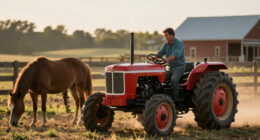

🔍 Read the full analysis: From Farm Labor To Artificial Intelligence: How Work Evolves on ThorstenMeyerAI.com

Get business pricing on monitors, keyboards and dev gear
- Business-only prices and quantity discounts
- Tax-exempt purchasing
- Multiple users, one account, clear invoices
TL;DR
A November 3, 2026, article from ThorstenMeyerAI.com uses agriculture’s long shift from labor-intensive work to mechanization and higher yields to examine how work changes. It reports that about 928 million people still work in agriculture worldwide, while arguing that this history offers a test case for debates about AI and jobs. The article’s forecast that automation could affect up to 90% of a sector is the author’s thesis, not an established projection.
In a November 3, 2026, article, Thorsten Meyer of ThorstenMeyerAI.com traces how farming’s share of work fell over roughly two centuries as tools, fertilizer and crop breeding raised output, and uses that history to frame questions about automation and artificial intelligence. The article says about 928 million people still work in agriculture worldwide, citing a 2025 International Labour Organization estimate; its suggestion that automation could affect up to 90% of a sector is Meyer’s thesis, not a forecast established by the cited figures, a topic explored in AI job retraining efforts.
Meyer’s account starts with the United States around 1800, when an estimated 73.7% of the labor force worked in agriculture. That estimate comes from economic historian Stanley Lebergott’s historical series, later published by the U.S. Census Bureau. It covers a labor force of about 1.9 million people aged 10 and older, including roughly 530,000 enslaved people. Because figures before 1840 are estimates, Meyer describes the proportion as about three in four rather than treating it as a precise census count.
The article presents agricultural change as a sequence rather than a single breakthrough: improved equipment, industrially produced fertilizer and higher-yield crops. Among its examples are John Deere’s steel plough, developed in 1837, and the spread of short-straw wheat in India and Pakistan in the 1960s. India’s wheat harvest rose from 12.3 million tonnes in 1964–65 to 26.4 million tonnes in 1971–72, according to the official statistics cited by Meyer. These examples show changes in output and production methods; they do not, by themselves, establish how many jobs any one innovation eliminated.
Meyer also emphasizes that agriculture’s share of the workforce can decline before the number of farm workers does. In the United States, the number of agricultural workers continued to rise until about 1910, reaching an estimated 11.8 million. For Germany, the article cites a decline in agriculture’s share from 43% to 25% between 1882 and 1939, while the number of farm workers remained between 8 million and 10 million. The figures illustrate that workforce shares, headcounts and productivity are different measures.
What Farming’s Shift Shows About Automation
Agriculture offers a historical case in which a sector’s share of employment fell sharply while food production increased. Meyer cites global cereal harvests growing 4.2-fold since 1961, compared with population growth of 2.7-fold over the same period. He also reports that U.S. farm output in 2023 was nearly three times its 1948 level, with only a small rise in total inputs. These comparisons support the point that higher output need not require a workforce growing at the same rate.
For readers weighing claims about AI and employment, the history is relevant but not a direct prediction. Farming’s transformation unfolded through many changes over a long period, and people’s movement out of agricultural work was tied to changes across the wider economy. Meyer argues that automation could affect a very large share of work in a sector, but the article does not establish that AI will follow agriculture’s timetable or produce the same employment outcomes. Its central lesson is a question for businesses and workers: how quickly can work change, and what new jobs or industries absorb displaced labor?
The present-day figures also matter. The article cites an ILO estimate of 928 million agricultural workers in 2025, roughly one in four workers globally. Agriculture remains a large source of employment in some countries: Meyer gives India at 43%, compared with about 1.5% in the United States and about 1% in Germany. Those differences warn against assuming that a pattern observed in a highly industrialized economy applies everywhere at once.
Products Worth Considering

Samsung 34-Inch Odyssey G5 Ultra-Wide Curved Gaming Monitor

Apple MacBook Air 13-inch with M5 chip, 16GB memory, 512GB SSD, and 12MP Center Stage camera

Bose QuietComfort Headphones (2nd Gen), Wireless Over-Ear Noise-Cancelling Headphones, Hazelnut Taupe
As an affiliate, we earn on qualifying purchases.
From Hand Labor to Higher Yields
In economies that relied mainly on human and animal muscle to produce food, farms could supply only limited surpluses. Meyer’s article describes a chain of changes that loosened this constraint. A steel plough could work sticky soil more effectively than earlier designs; mechanized reapers, threshers and tractors later altered field work; fertilizer supplied plant nutrients at industrial scale; and crop breeding produced varieties capable of yielding more grain under suitable conditions.
The fertilizer example begins with chemist Fritz Haber’s 1908 ammonia-synthesis patent, followed by industrial production. In the 1960s, short-straw wheat varieties associated with plant breeder Norman Borlaug were introduced in India and Pakistan. Meyer cites the Nobel Foundation for that history and Indian official harvest data for the wheat figures. The article describes these developments as part of a longer shift, not as a single cause of falling farm employment.
The story’s wider comparison includes Japan, China and India, where historical estimates also show large shares of workers in agriculture or the primary sector. The methods and dates differ: some numbers are reconstructions by economic historians, while others come from later official statistics. Meyer notes that early German occupational counts may have undercounted women working on family farms. Those differences make the figures useful as broad historical indicators, not perfectly comparable measurements.
“My thesis, not a fact: automation could become a sector of up to 90% within a decade or a few decades.”
— Thorsten Meyer, ThorstenMeyerAI.com
Limits of the AI Comparison
The article does not specify what it means by a sector becoming “up to 90%” automated: the share of tasks, roles, working hours or jobs affected is not defined. Nor does it identify a particular sector, provide a forecasting method, or cite evidence establishing that this change will occur within a decade or a few decades. That figure should be read as Meyer’s stated thesis rather than a measured result or consensus forecast.
The historical figures also have limits. Some early workforce shares are estimates or economic historians’ reconstructions, and the countries’ measures and dates are not identical. The article describes agricultural employment trends and output, but does not provide a complete account of where every worker went or isolate the employment effect of each technology. Its broad comparisons cannot establish that AI will reproduce the same transition.
The Series Turns to Machines
The article is the second episode in Meyer’s “Work After Work” series, which examines how the economy is built. It says the next episode will cover mechanical reapers, threshers and tractors. That installment may add detail to the account of how farm machinery changed agricultural labor, but the published article does not announce a release date.
For the AI comparison, the next step is not a guaranteed outcome but better evidence: clearly defined measures of automation, reliable data on tasks and jobs, and observations of whether workers move into other forms of employment. Until those are available, the farm’s history can inform the debate without deciding what AI will do.
Key Questions
What is the news in this article?
Thorsten Meyer published an analysis on November 3, 2026, using agriculture’s long decline as a share of employment to discuss how automation may change work. It is a historical argument, not a report that a new AI system or policy has been introduced.
How many people still work in agriculture worldwide?
The article cites an International Labour Organization estimate of 928 million workers in 2025, about one in four workers worldwide. The figure is attributed to that estimate and refers to agricultural employment, not the number of farms.
Does the article show that AI will eliminate 90% of jobs?
No. Meyer calls the possibility of automation affecting up to 90% of a sector his thesis, not a fact. The article does not define the measure or provide evidence that AI will eliminate that share of jobs.
Did farming employment decline as soon as new tools appeared?
Not necessarily. Meyer says the U.S. number of agricultural workers continued to rise until about 1910, even as the longer-term share of workers in agriculture eventually fell. A declining employment share and a declining headcount are not the same measure.
What happens in the next episode?
Meyer says the next installment will examine mechanical reapers, threshers and tractors. The article does not give a publication date for that episode.
Source: ThorstenMeyerAI.com