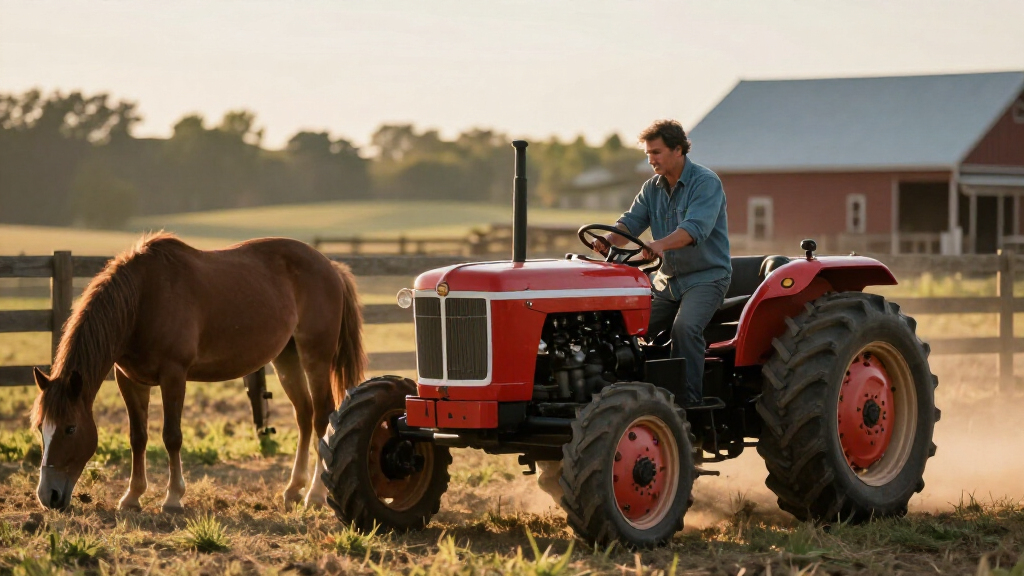
🔍 Read the full analysis: Why Farms Turned To Tractors And Away From Horses on ThorstenMeyerAI.com

Get business pricing on monitors, keyboards and dev gear
- Business-only prices and quantity discounts
- Tax-exempt purchasing
- Multiple users, one account, clear invoices
TL;DR
U.S. farms moved from horse power to tractors over roughly one generation, driven by machines that could work without year-round feed and by expanding mechanized equipment. Farm horses and mules fell from 26.7 million in 1918 to 3.1 million in 1960, while farm employment also declined as productivity rose. The figures describe a major economic shift, but the comparison with modern automation has limits.
A November 4, 2026, report traces how U.S. farms replaced horses and mules with tractors during the first half of the 20th century, shrinking a working-animal population that peaked at 26.7 million in 1918 to 3.1 million by 1960. The shift freed farmland previously used to grow animal feed and helped raise farm output per worker, while farm employment fell as workers moved into other parts of the economy.
The change was rapid by the standards of farm technology adoption. The source, drawing on U.S. historical statistics, estimates that farms had about 1,000 tractors in 1910, 246,000 in 1920, 920,000 in 1930 and 4.69 million in 1960. Horses and mules numbered 24.2 million in 1910 and 25.7 million in 1920 before falling to 19.1 million in 1930, 7.8 million in 1950 and 3.1 million in 1960. The source puts the crossover at around 1955, when tractor numbers slightly exceeded the number of horses and mules.
Feed requirements were a major part of the economic calculation. In 1915, about 93 million acres of harvested U.S. cropland—more than a quarter of the reported 340 million harvested acres—grew feed for farm horses and mules. The source says that area had fallen to about 5 million acres by 1960. Unlike working animals, tractors did not require crops to be grown and stored as food throughout the year, making more land available for crops for people and markets.
Mechanization extended beyond tractors. The number of combines on U.S. farms rose from about 4,000 in 1920 to 190,000 in 1940 and more than 1 million by 1960, according to the source’s historical series. Corn pickers, balers and milking machines also spread. The U.S. Department of Agriculture series cited in the article estimates that one farm worker supplied 7.1 people in 1910 and 47.1 in 1970; the 1970 figure includes people abroad supplied by exports.
Land and Labor After the Tractor
The shift changed more than the equipment farmers used. Replacing animal power reduced the acreage devoted to feed and increased the amount of work that could be done by fewer people. The cited USDA estimate of people supplied per farm worker rose from 7.1 in 1910 to 47.1 in 1970, reflecting mechanization alongside other changes, including improved seed, fertilizer and harvesting equipment.
Those productivity gains came with a major change in rural employment. U.S. farm employment peaked at 13.6 million in 1916 and stood at 4.5 million by 1970, according to the source. The account says the overall U.S. labor force doubled over that period and that many new jobs were in cities, requiring workers and families to move. The figures show the scale of the employment shift, but do not by themselves explain each worker’s experience or how much of the decline was caused by tractors alone.
The history is often used as an analogy for automation’s effect on people. The report treats that comparison cautiously: it can illuminate how a technology can reshape work and land use, but it is not proof that modern machines will produce the same results for human workers.
Products Worth Considering

DJI Osmo Mobile 7P Smartphone Gimbal Stabilizer with Mic Mini Transmitter, Infinity Black

Samsung 34-Inch Odyssey G5 Ultra-Wide Curved Gaming Monitor

Apple MacBook Air 13-inch with M5 chip, 16GB memory, 512GB SSD, and 12MP Center Stage camera
As an affiliate, we earn on qualifying purchases.
How the Farm Transition Unfolded
Tractors existed before World War I, but the report describes early models as heavy, costly and better suited to large farms. A change came in 1917, when Ford introduced the Fordson. The Henry Ford museum describes it as “the first mass-produced and inexpensive lightweight tractor”, designed to meet small farmers’ needs, and says it quickly became popular in the United States. On February 21, 1920, the 100,000th Fordson left the assembly line.
Adoption did not immediately eliminate animal power. The reported counts show horses and mules still increasing between 1910 and 1920, even as tractors spread. The combined working-animal population reached its peak in 1918; horses alone had peaked in 1915. By about 1955, tractors had overtaken horses and mules in number, and by 1960 the animal count had dropped by almost 90% from its peak.
The account says farmers did not retrain horses for a different role on a comparable scale. Instead, they stopped breeding replacements, and the working population declined over time. The report also connects the period to economist Wassily Leontief’s 1983 comparison between workers and horses displaced by tractors. It notes that Leontief himself identified a limit to the analogy: horses could not vote.
““The first mass-produced and inexpensive lightweight tractor””
— The Henry Ford museum, describing the Fordson
Limits of the Horse Comparison
The historical numbers establish a broad change in U.S. farm equipment, animal populations and employment, but they do not isolate tractors as the cause of every change in productivity or jobs. Other developments—including combines, improved seed, fertilizer and changes in markets—also affected farming. The source notes that some historical series use different census dates and that, from 1951, horses and mules were counted together, so year-to-year comparisons require care.
The article also discusses current farm automation, including a John Deere autonomy kit described as using 16 cameras for tillage on selected large tractors, and a Chinese government figure that about 74% of ploughing, sowing and harvesting was mechanized in 2023. Those are limited indicators, not evidence that all farm work is autonomous. The source does not provide independent evaluations of the kit’s performance, details of the Chinese measure, or a basis for comparing the two figures directly. It remains unclear how widely newer autonomous systems will be adopted or how their effects on farm employment will compare with the tractor era.
What Modern Farm Automation Shows
The next stage depends on how farm automation develops beyond specific tasks and large machines. The source describes the present use of autonomous equipment as real but narrow: the cited John Deere system handles tillage on selected large tractors, rather than every task on every farm. Wider adoption, costs, reliability and the range of jobs the technology can perform will shape its practical effects.
The historical comparison is most useful as a record of how a technology can alter both work and land use—not as a forecast with a guaranteed outcome. Future evidence will need to show which tasks machines take over, what new work develops and whether affected workers can move into those roles. The report does not identify a specific next milestone for either the U.S. or Chinese systems.
Key Questions
Why did farms replace horses with tractors?
Tractors provided power without requiring farms to grow and store feed year-round. The shift also enabled more land to be used for crops for people and markets. Cost, farm size and access to equipment affected how quickly individual farms changed.
When did tractors outnumber farm horses and mules?
The source places the crossover at around 1955, when it reports about 4.35 million tractors and 4.31 million horses and mules on U.S. farms.
How much did the farm horse and mule population fall?
The combined count peaked at 26.7 million on January 1, 1918, and was 3.1 million in 1960, a decline of almost 90% from the peak, according to the historical figures cited in the report.
Did tractors alone cause farm employment to decline?
The source records a fall in U.S. farm employment from 13.6 million in 1916 to 4.5 million in 1970, but it does not attribute the entire decline to tractors. Other machinery, farming practices, markets and wider economic changes also formed part of the transition.
Does the horse story predict what automation will do to workers?
No. The report presents the comparison as an analogy, not a law. It notes differences between animals and people and says current farm robots handle a limited range of tasks; their long-term effects on employment remain unclear.
Source: ThorstenMeyerAI.com