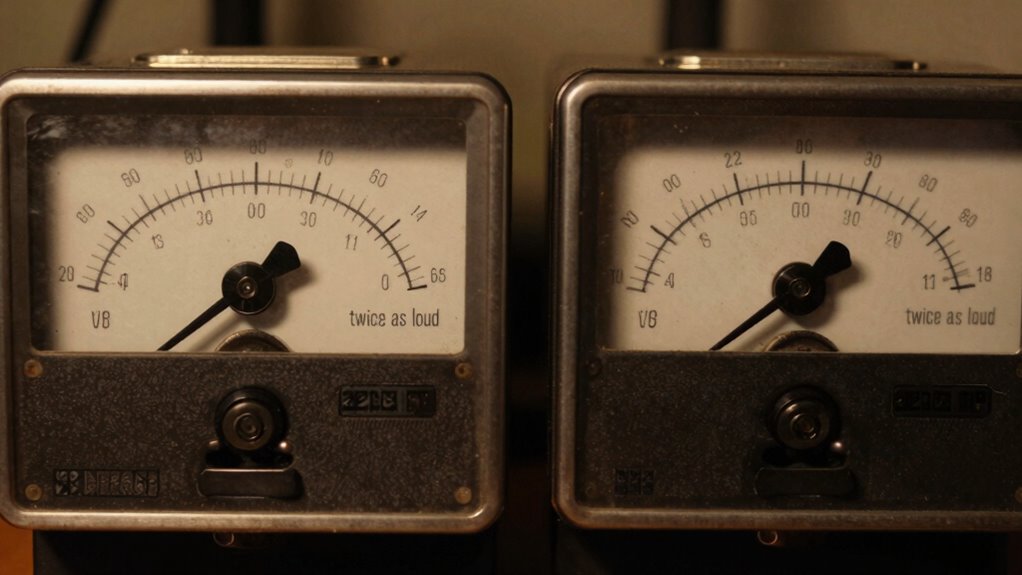
Decibels measure sound intensity on a logarithmic scale, which means that a 10 dB increase roughly doubles perceived loudness, not the actual energy. While adding decibels is straightforward mathematically, our ears interpret loudness nonlinearly. Doubling the decibel level doesn’t mean sounds are twice as loud; it’s more complex. To really understand how perception relates to decibel changes, explore the math behind sound and loudness more closely.

Get business pricing on monitors, keyboards and dev gear
- Business-only prices and quantity discounts
- Tax-exempt purchasing
- Multiple users, one account, clear invoices
Key Takeaways
- Doubling perceived loudness requires approximately a 10 dB increase, due to the logarithmic relationship between decibels and sound intensity.
- Decibels measure ratios of sound intensity, not perceived loudness directly, which explains why a 10 dB increase sounds roughly twice as loud.
- The logarithmic scale compresses wide sound intensity ranges into manageable numbers, linking perceived loudness to a 10-fold increase in intensity.
- Because of the nonlinear nature of hearing, small dB increases at low volumes are perceived as more significant than the same increase at high volumes.
- Understanding that every 10 dB roughly doubles perceived loudness clarifies the math behind “twice as loud” in sound measurement.
Products Worth Considering

Bose SoundLink Flex Bluetooth Speaker (2nd Gen), Portable Waterproof Speaker, Black

Logitech MX Master 4 for Mac, Ergonomic Bluetooth Mouse with Haptic Feedback, Ultra-Fast Scrolling, USB-C Charging, for MacOS, iPadOS, Windo

Bose TV Speaker (2nd Gen) Compact Soundbar with Bluetooth and HDMI Connectivity
As an affiliate, we earn on qualifying purchases.
What Are Decibels and Why Are They Important?

Have you ever wondered how we measure loudness or sound intensity? That’s where decibels come in. They help us quantify sound levels by comparing a specific sound’s pressure to a reference point. When considering the frequency spectrum, decibels show how different frequencies contribute to overall loudness. This measurement is essential for audio engineering because sound wave propagation varies across frequencies—some travel farther, others are absorbed quickly. Decibels provide a universal way to understand these variations, making it easier to analyze and compare sounds. sound wave propagation varies depending on frequency, and decibels help capture these differences accurately. Without them, describing loudness would be vague and inconsistent. Decibels simplify complex sound data, giving you a clear picture of how loud a sound truly is, regardless of its frequency content or how it travels through different environments. Additionally, understanding sound pressure levels is crucial for designing audio systems that deliver consistent and safe listening experiences. Moreover, tools designed to detect and correct passive voice can help improve clarity and engagement in explanations like this.
How Do Our Ears Perceive Loudness Compared to Actual Sound Intensity?
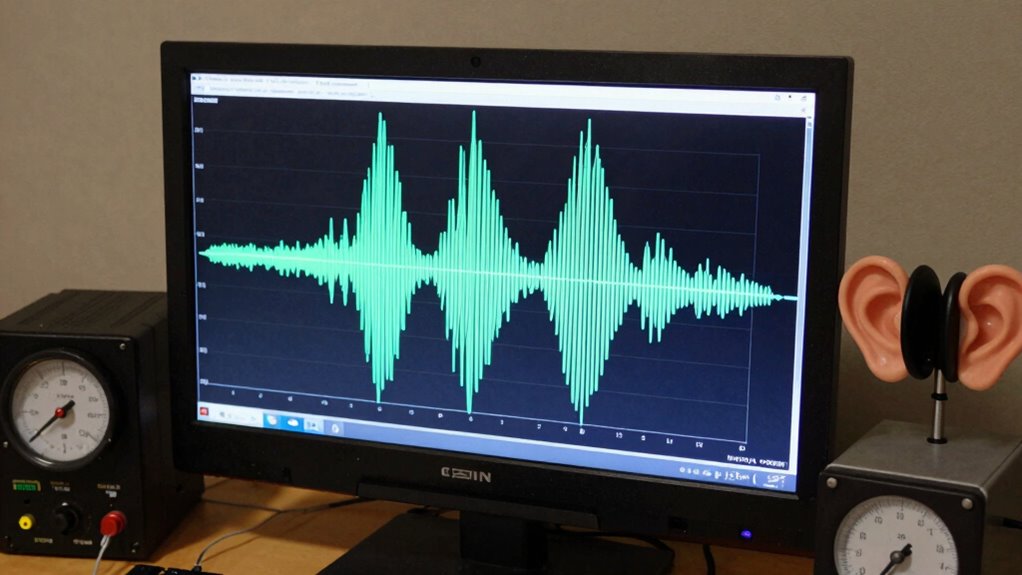
While sound intensity is measured in straightforward numerical values, your ears perceive loudness in a way that doesn’t always match these measurements. Your perception thresholds vary; sounds below a certain level are often imperceptible, while others seem disproportionately loud. This is due to auditory scaling, where your ears and brain interpret changes in sound differently than raw decibel levels suggest. For example, doubling the sound intensity doesn’t necessarily make it seem twice as loud. Instead, your ears process loudness on a nonlinear scale, meaning small increases at low volumes can seem more noticeable than larger increases at high volumes. This complex perception highlights why decibels are useful for quantifying sound but don’t fully capture how loudness feels to you. Additionally, auditory perception involves complex neural mechanisms that influence how we interpret loudness beyond simple measurements. The nonlinear response of our auditory system explains why the perceived difference in loudness isn’t directly proportional to the actual change in decibel levels. Moreover, neural processing plays a crucial role in how we experience variations in loudness, emphasizing the importance of understanding auditory perception beyond raw data.
The Math Behind Sound Intensity and Decibels
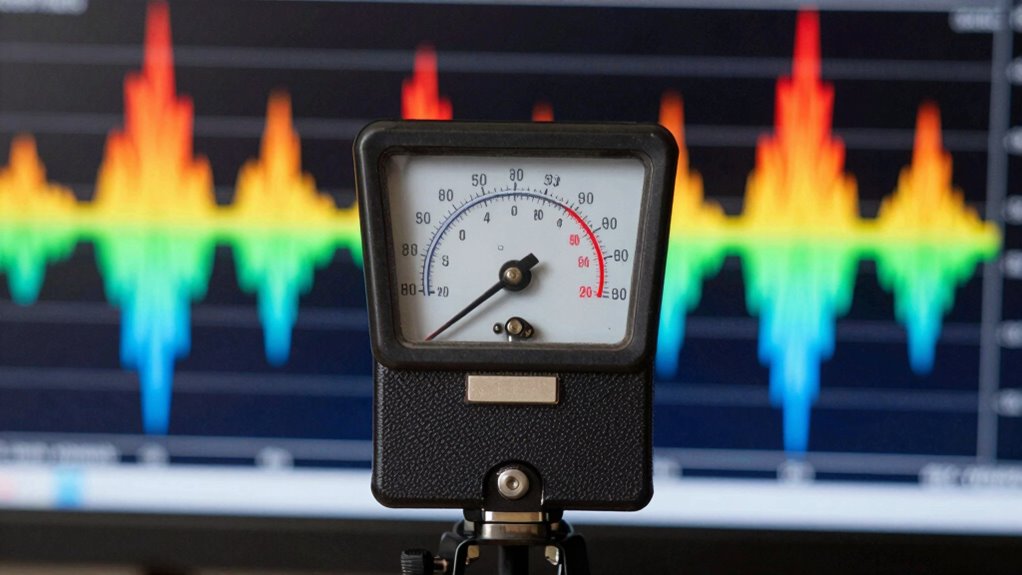
Understanding the math behind sound intensity and decibels requires recognizing that decibels are a logarithmic unit, meaning they measure ratios rather than absolute values. When analyzing sound wave properties, the decibel scale interpretation helps you grasp how small changes in sound intensity affect perceived loudness. Decibels relate to the ratio of a sound’s intensity compared to a reference level, often the threshold of hearing. Additionally, understanding the logarithmic nature of decibels helps explain why perceived loudness doubles with every 10 dB increase. This logarithmic relationship underscores how our perception of loudness is not directly proportional to actual sound intensity. Recognizing the measurement scale is essential for accurately comparing different sound levels and understanding auditory experiences. Moreover, the perceived loudness can be influenced by individual hearing sensitivity, which varies among people. The dynamic range of human hearing further illustrates how decibel differences impact our auditory perception.
Does Doubling Decibels Make Sounds Twice as Loud?
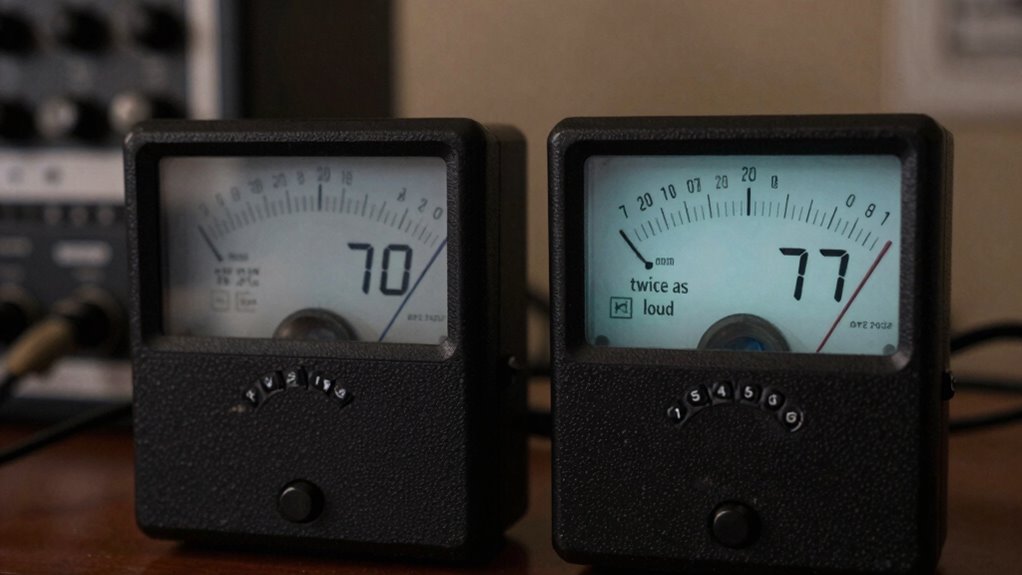
Doubling the decibel level does not mean the sound becomes twice as loud. The decibel scale is logarithmic, so increasing by about 10 dB roughly doubles perceived loudness, not doubling the actual sound intensity. When you see a 3 dB increase, it’s a smaller change in loudness, but it can still impact your perception depending on sound frequency. Higher sound frequencies are often more noticeable and can cause hearing damage more quickly. So, a 10 dB increase feels twice as loud to your ears, but doubling decibels alone doesn’t make sounds twice as loud. Instead, it’s about how your brain interprets these changes, especially at dangerous sound levels that threaten hearing health. Understanding the sound perception process helps clarify why the decibel scale is designed the way it is. Additionally, auditory processing plays a crucial role in how we perceive loudness changes beyond mere decibel measurements. Recognizing the logarithmic nature of the scale can aid in better understanding sound level differences and their effects. Recognizing that perception varies among individuals is important, as personal sensitivity can influence how loud a sound seems. Moreover, sound intensity is just one factor, as the context and environment can also affect perceived loudness.
Calculating Decibel Levels From Sound Intensity
To understand how to calculate decibel levels from sound intensity, you need to grasp the relationship between intensity and decibels. This involves using a logarithmic calculation method that compares sound levels effectively. By mastering this, you’ll be able to accurately compare different sound levels and analyze how changes in intensity affect perceived loudness. Additionally, understanding the power output of electric bikes can help you appreciate their performance capabilities relative to sound levels and other factors. Recognizing the sound intensity differences between various environments can also aid in selecting appropriate noise masking solutions for better sleep or concentration. An awareness of fandom’s perception of loudness can also influence how fans respond to different sound environments during events. Moreover, understanding sound measurement techniques can deepen your grasp of how decibel levels are quantified in various settings. For example, certain cultural beliefs about noise can affect how loudness is perceived in different communities.
Intensity and Decibel Relationship
Calculating decibel levels from sound intensity involves using a straightforward formula that relates the two quantities. You start by measuring sound pressure, which influences how loud a sound appears to your ears. The decibel scale is logarithmic, so even small changes in sound intensity lead to noticeable differences in decibel levels. When you convert intensity to decibels, you account for the logarithmic nature of human hearing and factors like frequency response, which affects how loud different sounds seem at the same energy level. This relationship helps you understand that doubling sound intensity doesn’t mean doubling loudness; instead, it increases the decibel level by about 3 dB. Additionally, understanding Sound Measurement Techniques can improve accuracy in calculating and interpreting decibel levels. By grasping this connection, you better appreciate how sound energy translates into perceived loudness.
Logarithmic Calculation Method
When you want to determine the decibel level from a given sound intensity, you use a logarithmic formula that captures the exponential growth between the two. This method involves the logarithmic scale, which compresses wide-ranging sound intensities into manageable numbers. The key formula is:
- Take the ratio of the sound intensity to a reference level.
- Apply the base-10 logarithm to this ratio.
- Multiply the result by 10.
- The outcome is your decibel level, reflecting how sound intensity relates to perceived loudness.
This calculation emphasizes the logarithmic scale’s role in translating exponential growth into a linear, understandable measurement. It helps you see how small changes in intensity can produce large differences in perceived loudness.
Comparing Sound Levels
Once you’ve learned how to calculate the decibel level from a sound’s intensity, comparing different sound levels becomes straightforward. You can see how variations in sound intensity translate into decibel differences, which relate directly to perceived loudness. When comparing sounds, consider the frequency response, as it affects how we perceive loudness at different pitches. Additionally, sound wave interference can influence the actual sound level; constructive interference amplifies sound, while destructive interference diminishes it. By understanding these factors, you can better interpret decibel differences, whether evaluating noise pollution or choosing audio equipment. Remember, a small decibel change can signify a significant difference in perceived loudness, especially when interference or frequency response plays a role.
Real-World Examples: Comparing Everyday Sound Levels

Have you ever wondered how everyday sounds compare in loudness? Understanding sound level comparison helps you grasp the differences in common noises. Here are some everyday noise examples:
- Whispering: around 30 dB
- Normal conversation: about 60 dB
- City traffic: roughly 85 dB
- Rock concert: near 110 dB
These examples show how sound levels vary dramatically. A whisper is barely audible, while city traffic can be loud enough to cause discomfort. A rock concert surpasses safe listening levels, highlighting the importance of hearing protection. Recognizing these differences helps you make informed choices about exposure to loud sounds and better understand sound level comparison in daily life.
Common Misconceptions About Decibels and Loudness

Many people assume that decibels directly measure how loud a sound feels, but this isn’t entirely accurate. Perception myths often lead to the belief that a certain decibel increase equals a proportional increase in loudness, which isn’t true. Our perception of loudness is influenced by loudness illusions, where sounds of different intensities can seem similar or vastly different depending on context. For example, a small increase in decibels might feel much louder due to how our ears interpret sound, not because of actual loudness change. These misconceptions can cause you to misjudge sound levels. Remember, decibels quantify sound intensity mathematically, but your perception of loudness involves complex psychological factors that can distort how loud a sound truly feels.
Frequently Asked Questions
How Do Decibels Relate to Perceived Pitch Differences?
Decibels don’t directly measure perceived pitch differences, but they relate to how loud sounds seem. Your ears use frequency discrimination to identify pitch changes, which can influence how you perceive loudness. When sounds differ subtly in pitch, it may feel like a difference in loudness, though decibels mainly quantify sound intensity. So, while decibels measure loudness, your perceived pitch is shaped by your ear’s ability to distinguish frequency variations.
Can Decibel Measurements Vary Between Different Sound Measurement Devices?
Yes, decibel measurements can vary between different sound measurement devices. You need to take into account calibration accuracy, which ensures each device measures correctly, and device consistency, which maintains uniform performance over time. When these factors differ, measurements might not be directly comparable. To get reliable results, always calibrate your equipment regularly and use devices with proven consistency. This way, your decibel readings stay accurate and meaningful across different instruments.
What Factors Affect the Human Ear’s Sensitivity to Loudness?
Your ear’s sensitivity to loudness depends on factors like ear canal shape, which influences sound transmission, and the health of your auditory nerves, essential for processing sound signals. Additionally, your age, noise exposure history, and even ear wax can impact perception. When these elements are ideal, your ear detects sound more accurately, allowing you to perceive loudness levels more precisely.
How Do Environmental Conditions Influence Sound Decibel Levels?
Environmental conditions act like a filter, shaping how loud sounds seem. Urban noise adds layers of sound, making decibel levels feel higher, while atmospheric attenuation dampens noise over distance. You’ll notice that in a busy city, sounds seem louder and more chaotic, whereas open areas have softer echoes. These conditions influence your perception, making it essential to understand how environment impacts sound levels, especially in noisy or quiet settings.
Are Decibels Used to Measure Other Forms of Energy Besides Sound?
Yes, decibels measure other forms of energy like electrical signals and radio frequency. You use decibels to compare the strength of electrical signals in circuits or radio waves in communication systems. Since decibels are logarithmic, they help you easily understand large variations in energy levels. Whether in audio, telecommunications, or electronics, decibels provide a consistent way to quantify and compare different energy intensities effectively.
Conclusion
Understanding decibels reveals that doubling the level doesn’t mean sounds are twice as loud—you’re often surprised how our perception and the math behind it align in unexpected ways. As you explore sound levels around you, it’s a reminder that what seems loud or soft isn’t always straightforward. Sometimes, the math and your ears tell different stories, creating a fascinating coincidence that deepens your appreciation for the complex world of sound.