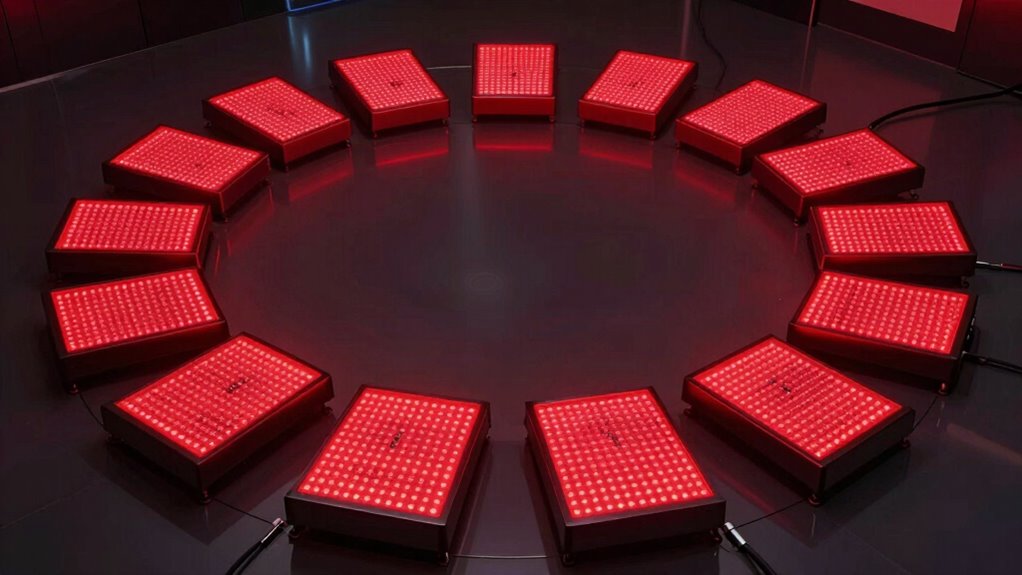

Red light therapy panels vary most in coverage, wavelength options, and how easily they fit into a home routine. I name the BestQool 4-Wavelength 470W Panel my best overall pick for its broader wavelength range, while the Hooga HG300 is a more approachable choice with a built-in timer and adjustable stand. For targeted face and neck sessions, the Mito Red Light MitoMIN 2.0 offers a more compact format. The tradeoff is between a larger panel’s coverage and versatility, a smaller unit’s easier placement, and the added setup or cost that can come with more features. Read on for the full breakdown of all 15 options and guidance on matching a panel to your space and intended use.

Get business pricing on monitors, keyboards and dev gear
- Business-only prices and quantity discounts
- Tax-exempt purchasing
- Multiple users, one account, clear invoices
Key Takeaways
- The lineup divides into three useful formats: larger panels such as the BestQool 470W, tabletop units such as the Hooga HG300, and compact targeted options such as the MitoMIN 2.0.
- Wavelength variety is not the same as better fit. BestQool’s four-wavelength models and Morfone’s tri-wavelength design offer more options, while the many 660nm and 850nm models may better suit buyers who want a simpler setup.
- Controls and positioning separate practical home choices. Built-in timers and adjustable stands on models such as the Hooga HG300 and HG200 can make repeat sessions easier to manage.
- Some products combine more than one format. The INIA panel-and-belt 2-in-1 is the clearest choice for buyers seeking both panel and wearable-style use, but that flexibility may be unnecessary for someone who only wants a stationary panel.
- The product list gives uneven technical detail. Several listings specify wavelengths or LED counts, while many do not provide comparable output or coverage figures, so shoppers should verify those specifications rather than rank on headline wattage alone.
| INIA Red Light Therapy Panel & Belt 2-in-1, 1064nm + 850nm Dual NIR |  | Best for Flexible, Targeted Sessions | Wavelengths: 1064nm and 850nm | LED count: 360 | Modes: Steady, Pulse 10Hz, Pulse 40Hz | VIEW ON AMAZON | See Our Full Breakdown |
| BestQool Red Light Therapy Panel, 660nm Red & 850nm Infrared Light, 105W |  | Best for Adjustable Home Setup | Wattage: 105W | Wavelengths: 660nm red and 850nm infrared | Irradiance: 95.6 mW/cm² at 3 inches | VIEW ON AMAZON | See Our Full Breakdown |
| Hooga HG300 Red Light Therapy Panel, 660nm Red & 850nm Near-Infrared Light, 60 LEDs, Built-in Timer, Adjustable Stand for Home Wellness |  | Best Compact Starter Panel | Wavelengths: 660nm red and 850nm near-infrared | LED count: 60 | Dimensions: 12.6 x 4.92 x 2.44 inches | VIEW ON AMAZON | See Our Full Breakdown |
| Hooga PRO300 Red Light Therapy Panel – 660nm Red & 850nm Near‑Infrared, 60 Dual‑Chip LEDs, Timer, Tabletop Stand |  | Best for Larger Panel Coverage | Wavelengths: 660nm red and 850nm near-infrared | LED configuration: 60 dual-chip LEDs | Wattage: 300 watts | VIEW ON AMAZON | See Our Full Breakdown |
| Red Light Therapy for Body and Face with Infrared LED Panel, 660nm & 850nm, at-Home Use |  | Best for Flexible Positioning | Wavelengths: 660nm and 850nm | LED count: 486 LEDs: 324 red and 162 near-infrared | Panel size: 8 x 14.5 inches | VIEW ON AMAZON | See Our Full Breakdown |
| INTEO Red Light Therapy for Face and Body, Infrared Red Light Therapy Lamp |  | Best for Adjustable Positioning | Wavelengths: 660nm red and 850nm infrared | Panel size: 13 × 7.5 inches | Maximum height: 46.5 inches | VIEW ON AMAZON | See Our Full Breakdown |
| Hooga Red Light Therapy Panel Device – 660nm Red & 850nm Near Infrared Light Therapy, LED Light Therapy Lamp for Face & Body, 40 LEDs, Timer, Adjustable Stand – HG200 |  | Best Compact Panel | Wavelengths: 660nm red and 850nm near-infrared | LED count: 40 | Dimensions: 9.8 × 6.3 × 1.2 inches | VIEW ON AMAZON | See Our Full Breakdown |
| Red Light Therapy for Body and Face with Adjustable Stand, 660nm & 850nm Infrared LEDs |  | Best for Broad Coverage | LED count: 180 | Panel size: 11 × 14.5 inches | Wavelengths: 660nm and 850nm | VIEW ON AMAZON | See Our Full Breakdown |
| Viconor Red Light Therapy for Face and Body, Infrared Light Therapy Lamp with Stand 660nm & 850nm |  | Best Curved Design | LED count: 120 | Red wavelength: 660nm | Infrared wavelength: 850nm | VIEW ON AMAZON | See Our Full Breakdown |
| Mito Red Light MitoMIN 2.0 Red Light Panel for Face and Neck |  | Best for Targeted Sessions | Wavelengths: 660nm red and 850nm near-infrared | Dimensions: 12 × 9 × 3 inches | LED diodes: 60 high-powered LEDs | VIEW ON AMAZON | See Our Full Breakdown |
| Red Light Therapy Panel, 660nm & 850nm, for Face & Body, Black |  | Best for Customizable Sessions | Wavelengths: 660nm and 850nm | Irradiance: 140 mW/cm² at 3 inches | Coverage: 15″ × 14″ at 3″; 20″ × 18″ at 6″; 26″ × 24″ at 12″; 31″ × 28″ at 18″ | VIEW ON AMAZON | See Our Full Breakdown |
| Red Light Therapy for Face and Body with Stand – 660nm Red & 850nm Infrared Light Therapy Lamp |  | Best for Adjustable Positioning | LED count: 120 LEDs | Red wavelength: 660nm | Infrared wavelength: 850nm | VIEW ON AMAZON | See Our Full Breakdown |
| BestQool Red Light Therapy Panel, 4 Wavelengths, 470W |  | Best for Expandable Coverage | Wavelengths: 630nm, 660nm, 850nm, and 940nm | Power: 470W | LED count: 300 | VIEW ON AMAZON | See Our Full Breakdown |
| Morfone Red Light Therapy Panel with Tri-Wavelength Technology |  | Best for Multiple Light Modes | Wavelengths: 660nm, 850nm, and 940nm | Panel size: 14.2 × 6.3 inches | Modes: 5, including full combination, red only, infrared only, and pulse | VIEW ON AMAZON | See Our Full Breakdown |
| BestQool Red Light Therapy Panel, 4 Wavelengths, 160W |  | Best Compact Four-Wavelength Panel | Wavelength count: 4 | Power: 160W | Dimensions: 19.7 × 8.4 × 2.6 inches | VIEW ON AMAZON | See Our Full Breakdown |
| red light therapy panel | Wavelengths | LED count |
|---|---|---|
| INIA Red Light Therapy Panel & | 1064nm and 850nm | 360 |
| BestQool Red Light Therapy Pan | 660nm red and 850nm infrared | — |
| Hooga HG300 Red Light Therapy | 660nm red and 850nm near-infrared | 60 |
| Hooga PRO300 Red Light Therapy | 660nm red and 850nm near-infrared | — |
| Red Light Therapy for Body and | 660nm and 850nm | 486 LEDs: 324 red and 162 near-infrared |
| INTEO Red Light Therapy for Fa | 660nm red and 850nm infrared | — |
| Hooga Red Light Therapy Panel | 660nm red and 850nm near-infrared | 40 |
| Red Light Therapy for Body and | 660nm and 850nm | 180 |
| Viconor Red Light Therapy for | — | 120 |
| Mito Red Light MitoMIN 2.0 Red | 660nm red and 850nm near-infrared | — |
| Red Light Therapy Panel | 660nm and 850nm | — |
| Red Light Therapy for Face and | — | 120 LEDs |
| BestQool Red Light Therapy Pan | 630nm, 660nm, 850nm, and 940nm | 300 |
| Morfone Red Light Therapy Pane | 660nm, 850nm, and 940nm | — |
| BestQool Red Light Therapy Pan | — | — |
More Details on Our Top Picks
INIA Red Light Therapy Panel & Belt 2-in-1, 1064nm + 850nm Dual NIR
The INIA stands apart from the more conventional 660nm red and 850nm panels in this lineup by pairing 1064nm and 850nm near-infrared with a wearable belt. That gives buyers two ways to position treatment: use the panel for broader exposure or the belt to keep light close to a particular area. Its steady, 10Hz, and 40Hz modes add control, though the supplied details do not explain how to choose between them. Unlike the tabletop Hooga HG300, this is a more adaptable setup for people who want wearable treatment as well as a panel. The tradeoff is that the extra format and modes may be unnecessary for a simple skin-focused routine, and the description gives no panel dimensions or irradiance figures for comparing coverage and output. Regular use is part of the commitment.
Pros:- Includes both a panel and wearable belt for different treatment positions.
- Offers 1064nm and 850nm near-infrared wavelengths.
- Provides steady, 10Hz, and 40Hz modes.
- 360 LEDs provide a large LED array.
Cons:- The description does not provide panel dimensions or irradiance figures.
- The added belt and modes may be unnecessary for buyers seeking a straightforward panel.
- Visible results require consistent use.
Best for: People who want both a stand-alone panel and a wearable option for targeting different body areas.
Not ideal for: Buyers who want a simple, clearly specified tabletop panel or need published dimensions and irradiance to compare coverage.
- Wavelengths:1064nm and 850nm
- LED count:360
- Modes:Steady, Pulse 10Hz, Pulse 40Hz
- Design:Panel and wearable belt
- Stated use cases:Muscle relaxation, skin brightening, circulation
- Treatment formats:Panel exposure and wearable targeted treatment
Our verdict“Choose the INIA if a wearable belt alongside a panel matters more than a simpler tabletop setup or detailed output specifications.”
BestQool Red Light Therapy Panel, 660nm Red & 850nm Infrared Light, 105W
The BestQool earns its place for buyers who want a panel they can position more than one way: its U-shaped stand and wall-mounting kit suit different home layouts, while touchscreen controls make switching among red, infrared, or combined light direct. The stated 95.6 mW/cm² at 3 inches gives a specific output reference that several products here, including the flexible Red Light Therapy panel with gooseneck, do not provide. That makes comparison easier, though the figure is tied to a close distance rather than every possible setup. At 105W, it is a more substantial choice than the compact Hooga HG300, but needs room for positioning and may be more equipment than a casual user wants. Its 660nm and 850nm combination also keeps it focused on two wavelengths rather than broader-spectrum options elsewhere in the roundup.
Pros:- Offers 660nm red and 850nm infrared light with separate and combined modes.
- Includes both a U-shaped stand and a wall-mounting kit.
- Touchscreen controls provide a direct way to change settings.
- Provides an irradiance figure measured at 3 inches.
Cons:- Requires space for positioning and mounting.
- The stated irradiance applies at 3 inches and does not describe output at other distances.
- A 105W panel with several setup options may be more involved than occasional users need.
Best for: Home users who want to switch between red and infrared modes and need stand or wall-mount positioning options.
Not ideal for: Casual users with little setup space, or buyers who want a compact panel that is easy to store between sessions.
- Wattage:105W
- Wavelengths:660nm red and 850nm infrared
- Irradiance:95.6 mW/cm² at 3 inches
- Modes:Red light, infrared, both
- Positioning:U-shaped stand and wall-mounting kit
- Controls:Touchscreen
- LED and cooling details:Flicker-free LEDs and advanced cooling system
Our verdict“Pick the BestQool if adjustable mounting and a stated close-range irradiance matter more than compact size or a simple setup.”
Hooga HG300 Red Light Therapy Panel, 660nm Red & 850nm Near-Infrared Light, 60 LEDs, Built-in Timer, Adjustable Stand for Home Wellness
The Hooga HG300 is the most compact choice in this group for a buyer who wants a tabletop panel for targeted sessions, rather than the larger coverage promised by the Hooga PRO300. Its 60 LEDs, adjustable stand, and built-in timer give a home routine a defined place and session control without the PRO300’s heavier, larger-format build. Independent red and near-infrared controls also let users select the light types separately. Protective eyewear is listed among the included conveniences. The tradeoff is coverage: a compact tabletop format is a poor match for anyone expecting broad, single-session body exposure. The supplied dimensions are 12.6 x 4.92 x 2.44 inches, but the listed item weight appears unusually low at 0.107 ounces, so I would not use that figure to judge portability. It is a focused entry point, not a substitute for a large panel.
Pros:- Compact tabletop format is suited to targeted sessions.
- Includes an adjustable stand and protective eyewear.
- Built-in timer supports a repeatable session routine.
- Independent red and near-infrared controls allow separate light selection.
Cons:- Small format is not suited to broad body coverage.
- Requires a tabletop placement for use.
- The supplied item-weight figure appears unusually low and is not a reliable basis for judging portability.
Best for: First-time buyers with a tabletop spot who want a compact panel for focused face or body-area sessions.
Not ideal for: People seeking broad body coverage in one session or a panel they can mount as a larger fixed setup.
- Wavelengths:660nm red and 850nm near-infrared
- LED count:60
- Dimensions:12.6 x 4.92 x 2.44 inches
- Controls:Independent red and near-infrared controls
- Timer:Built-in
- Mounting:Table mount with adjustable stand
- Beam angle:60 degrees
- Average life:50,000 hours
Our verdict“Choose the HG300 for a focused tabletop routine; choose the larger Hooga PRO300 if wider coverage is the priority.”
Hooga PRO300 Red Light Therapy Panel – 660nm Red & 850nm Near‑Infrared, 60 Dual‑Chip LEDs, Timer, Tabletop Stand
The Hooga PRO300 is the lineup’s larger-format Hooga option, contrasting with the compact HG300’s targeted tabletop approach. Its 61.2-inch length and 60 dual-chip LEDs are aimed at broader exposure, while independent wavelength controls and a digital timer give buyers control over red and near-infrared sessions. The panel can also connect with other PRO series units, a useful path for people planning a modular setup instead of replacing a small panel later. That scale comes with practical costs: at 4.3 kg, it is not an easy device to move around, and its footprint calls for generous tabletop or floor space. The stated 300-watt figure and internal cooling fans describe a high-output design, but the supplied details do not include an irradiance measurement. Buyers wanting a compact, easy-to-store starter panel should look to the HG300 instead.
Pros:- Long 61.2-inch panel is designed for broader coverage than the compact HG300.
- Dual-chip LEDs combine 660nm red and 850nm near-infrared.
- Independent wavelength controls and a built-in digital timer support session adjustments.
- Modular design can link with other PRO series panels.
Cons:- At 4.3 kg, it is less convenient to move frequently.
- Its long panel requires substantial placement space.
- The supplied specifications do not state an irradiance measurement.
Best for: Home users who want a long panel for broader treatment areas and may add compatible PRO-series panels later.
Not ideal for: People with limited floor or tabletop space, or anyone who needs a light panel that is easy to move and store.
- Wavelengths:660nm red and 850nm near-infrared
- LED configuration:60 dual-chip LEDs
- Wattage:300 watts
- Dimensions:61.2 x 15.7 x 3.1 inches
- Weight:4.3 kg
- Beam angle:60 degrees
- Controls and timer:Independent wavelength controls and digital timer
- Warranty:3-year manufacturer warranty
Our verdict“Choose the PRO300 for a larger, potentially expandable setup; choose the HG300 if compact size and easy placement matter more.”
Red Light Therapy for Body and Face with Infrared LED Panel, 660nm & 850nm, at-Home Use
This panel suits buyers who want to adjust both the light level and the direction of treatment. Its flexible gooseneck, adjustable hook, and sturdy stand offer more positioning choices than the fixed tabletop format of the Hooga HG300, while five brightness levels and remote control make adjustments possible without reaching for the panel. The 660nm and 850nm combination is familiar from the BestQool and both Hooga panels, but this model lists 486 LEDs and a smaller 8 x 14.5-inch panel rather than the PRO300’s long format. That makes it a different kind of home setup, not a clear replacement for a large coverage panel. The description gives no irradiance or wattage figure, so output comparisons are limited. Timer choices run from 20 to 60 minutes; buyers wanting short preset sessions should check whether those intervals suit their routine.
Pros:- Flexible gooseneck, stand, and hook provide several positioning options.
- Five brightness levels allow light adjustment.
- Remote control and timer settings offer convenient session control.
- Combines 660nm red and 850nm near-infrared LEDs.
Cons:- The supplied specifications do not state wattage or irradiance.
- The 8 x 14.5-inch panel is smaller than the long Hooga PRO300.
- Listed timer choices begin at 20 minutes, which may not suit every routine.
Best for: Home users who need adjustable positioning and want remote brightness and timer controls for face or body-area sessions.
Not ideal for: Buyers who need a stated irradiance or wattage for comparing output, or want a long panel for broad coverage.
- Wavelengths:660nm and 850nm
- LED count:486 LEDs: 324 red and 162 near-infrared
- Panel size:8 x 14.5 inches
- Brightness:5 adjustable levels
- Timer settings:20, 30, 40, 50, and 60 minutes
- Remote control range:65.6 ft
- Power cord length:7 feet
- Included accessories:Sturdy stand and adjustable hook
Our verdict“Choose this panel if flexible placement and remote controls matter more than published output figures or a larger treatment surface.”
INTEO Red Light Therapy for Face and Body, Infrared Red Light Therapy Lamp
The INTEO is a flexible choice for buyers who want to position a panel around different parts of the body rather than keep it fixed on a tabletop. Its 13 × 7.5-inch panel sits on a stand that reaches 46.5 inches, with a 360° rotatable head and 180° flip for changing the angle. That gives it more positioning range than the compact Hooga HG200, though the HG200 is easier to fit into a small room. INTEO also lists adjustable brightness, modes, and timers, which lets users tailor sessions, but its description does not give the available settings or irradiance. At seven pounds, it is portable for a stand-based device, yet its height and footprint still call for storage space. I’d choose it for adaptable home use, not for buyers who need verified output figures or a truly compact panel.
Pros:- Height-adjustable stand and rotating, flipping head offer flexible positioning.
- Brightness, modes, and timer options allow session adjustments.
- Seven-pound weight and detachable design support moving or storing the unit.
- Combines 660nm red and 850nm near-infrared light.
Cons:- The 46.5-inch maximum height and stand require more space than the Hooga HG200.
- No irradiance or detailed output measurements are provided in the supplied specifications.
- Consistent use over several weeks may be needed before users notice changes.
Best for: Home users who want a height-adjustable panel they can angle toward the face, torso, or limbs during different sessions.
Not ideal for: Apartment dwellers with little floor or storage space, and specification-focused buyers who need published irradiance or detailed timer settings.
- Wavelengths:660nm red and 850nm infrared
- Panel size:13 × 7.5 inches
- Maximum height:46.5 inches
- Weight:7 pounds
- Lamp head:360° rotation and 180° flip
- Controls:Adjustable brightness, modes, and timers
- Included component:Cover
Our verdict“Choose the INTEO if adjustable angles and stand height matter more than a small footprint or published output measurements.”
Hooga Red Light Therapy Panel Device – 660nm Red & 850nm Near Infrared Light Therapy, LED Light Therapy Lamp for Face & Body, 40 LEDs, Timer, Adjustable Stand – HG200
The Hooga HG200 is the easiest fit here for a desk, bedside table, or tight treatment area. At 9.8 × 6.3 inches, it is far smaller than the 11 × 14.5-inch panel in the Red Light Therapy for Body and Face model, so it suits focused face or limb sessions better than broad body coverage. Its 40 LEDs use the familiar 660nm red and 850nm near-infrared combination, while a built-in timer and adjustable stand simplify setup. The stated 48-watt draw and irradiance above 90mW/cm² provide more output detail than the INTEO listing, though that does not change the HG200’s limited treatment area. It is a corded, indoor-only device, and its small panel means users covering larger regions will need to reposition it. I’d pick it for a compact routine, not for wide-area sessions.
Pros:- Compact dimensions make it easier to place and store than larger stand-mounted panels.
- Built-in timer and adjustable stand simplify routine setup.
- Lists 660nm red and 850nm near-infrared wavelengths.
- Supplied product data states 48 watts and irradiance above 90mW/cm².
Cons:- Small treatment area requires repositioning for broader body coverage.
- Corded design is intended for indoor use and is not water resistant.
- The supplied information advises avoiding direct viewing of the LEDs.
Best for: People seeking a compact, corded panel for targeted face, neck, or limb sessions at home.
Not ideal for: Buyers who want broad coverage per session, outdoor use, or a panel intended for professional treatment settings.
- Wavelengths:660nm red and 850nm near-infrared
- LED count:40
- Dimensions:9.8 × 6.3 × 1.2 inches
- Wattage:48 watts
- Light source:LED
- Power:Corded electric
- Features:Built-in timer, cooling fan, and adjustable stand
- Stated irradiance:Above 90mW/cm²
Our verdict“Choose the HG200 for a space-saving targeted routine, but choose a larger panel if covering more of the body per session is the priority.”
Red Light Therapy for Body and Face with Adjustable Stand, 660nm & 850nm Infrared LEDs
For buyers who want to treat a wider area without stepping up to an unspecified professional setup, this model’s 11 × 14.5-inch panel and 180 LEDs give it the broadest documented coverage in this group. That makes it a more natural fit for torso or larger-area sessions than the Hooga HG200, whose compact panel is better suited to focused use. The stand adjusts from 45 to 60 inches, and its head rotates 360°, giving users several ways to position the light. Five brightness levels and timer choices from 20 to 60 minutes add control, while the remote and listed safety glasses can make sessions easier to manage. The tradeoff is size: this is less convenient to store or move than the Viconor’s portable curved design. I’d favor it for a dedicated home setup, not a cramped room or minimal-control routine.
Pros:- Large 11 × 14.5-inch panel and 180 LEDs cover a wider area than the Hooga HG200.
- Stand adjusts from 45 to 60 inches and lamp head rotates 360°.
- Five brightness levels and timer options from 20 to 60 minutes offer session flexibility.
- Remote control and safety glasses are listed among the included accessories.
Cons:- Larger panel and stand take more room to set up and store than compact options.
- Multiple controls may add complexity for buyers seeking a basic device.
- The supplied specifications do not state wattage or irradiance.
Best for: Households with enough floor space for a stand-mounted panel and buyers who want wider coverage for body sessions.
Not ideal for: People with limited storage, those who want a highly portable device, or buyers who prefer a simple interface with few settings.
- LED count:180
- Panel size:11 × 14.5 inches
- Wavelengths:660nm and 850nm
- Adjustable height:45–60 inches
- Brightness levels:5
- Timer options:20, 30, 40, 50, or 60 minutes
- Lamp head:360° rotation
- Listed accessories:Remote control and safety glasses
Our verdict“Choose this model for broad home coverage and adjustable positioning if you have room for a larger stand-mounted panel.”
Viconor Red Light Therapy for Face and Body, Infrared Light Therapy Lamp with Stand 660nm & 850nm
The Viconor takes a different approach from the flat-faced Hooga HG200: its curved design is intended to bring light around a broader body area, while the included stand and hook give users options for positioning it at home. It has 120 LEDs using 660nm red and 850nm infrared light, placing it between the Hooga’s compact 40-LED panel and the 180-LED large-panel model for stated LED count. Its 180° angle adjustment supports repositioning, but the listing does not provide panel dimensions, irradiance, or height range, so it is harder to judge coverage and fit before buying. The curved shape may also be less convenient when aiming light at a small, specific area. I’d consider it for flexible general use, but buyers who prioritize measurable output or precise targeting may prefer the better-documented Hooga or MitoMIN 2.0.
Pros:- Combines 660nm red and 850nm infrared LEDs.
- Curved design offers an alternative to flat panels such as the Hooga HG200.
- 180° angle adjustment supports changes in positioning.
- Includes a stand, hook, and 1.8-meter power cord.
Cons:- No panel dimensions, weight, or irradiance figures are supplied for judging fit and output.
- Curved shape may be less suited to precise treatment of a small target area.
- The supplied description calls for daily 15–30 minute sessions.
Best for: Home users who want a stand- or hook-positioned curved panel for varied face and body sessions.
Not ideal for: Buyers needing confirmed panel dimensions, irradiance figures, adjustable height, or a flat surface for precisely targeting small areas.
- LED count:120
- Red wavelength:660nm
- Infrared wavelength:850nm
- Adjustable angle:180°
- Power cord length:1.8 meters
- Design:Curved panel
- Included components:Stand, hook, and power cord
Our verdict“Choose the Viconor if its curved form and flexible mounting appeal, but opt for the Hooga or MitoMIN if documented dimensions or output details matter more.”
Mito Red Light MitoMIN 2.0 Red Light Panel for Face and Neck
The MitoMIN 2.0 is the more specification-focused small-panel option here. Its 60 high-powered LEDs fit in a 12 × 9-inch body, making it better suited to face, neck, and other targeted sessions than the broad-coverage 180-LED panel. Three modes—red only, near-infrared only, or both—give users more control over which light bands are active than the Hooga HG200 listing specifies. The supplied data also states 21,720 joules in 10 minutes and notes third-party testing, though buyers should not read those figures as a guarantee of personal results. Its main limitation is coverage: larger treatment areas will require repositioning, just as with other compact panels. Compared with the Viconor, the MitoMIN provides clearer dimensions and modes, but gives up the Viconor’s curved design and listed stand-and-hook flexibility.
Pros:- Three modes allow red-only, near-infrared-only, or combined use.
- 60 high-powered LEDs are housed in a compact 12 × 9-inch panel.
- Supplied data states 21,720 joules in 10 minutes.
- Product description notes third-party testing and FSA/HSA eligibility.
Cons:- Small coverage area means repositioning for larger body regions.
- The supplied description says consistent use is needed for noticeable results.
- The product description identifies it as potentially expensive relative to other home devices.
Best for: Buyers focused on face and neck sessions who want selectable red and near-infrared modes plus stated testing information.
Not ideal for: People prioritizing full-body coverage per session, or those seeking a larger panel with a stand included in the supplied product details.
- Wavelengths:660nm red and 850nm near-infrared
- Dimensions:12 × 9 × 3 inches
- LED diodes:60 high-powered LEDs
- Modes:Red Only, NIR Only, Both
- Stated session energy:21,720 joules in 10 minutes
- Testing:Description states third-party tested
- Eligibility:Description states FSA/HSA eligible
Our verdict“Choose the MitoMIN 2.0 for controlled face and neck sessions with clearly listed modes, not for wide-area treatment.”
Red Light Therapy Panel, 660nm & 850nm, for Face & Body, Black
This panel suits buyers who want more control over how a home session runs without stepping up to a larger modular system like the BestQool Pro300. Its 660nm red and 850nm infrared wavelengths cover the two bands shared by several panels in this roundup, while nine pulse frequencies add more session options than the simpler setups listed here. The remote and 1.77-inch touch display make adjustments easier when the panel is already positioned for use.
The listed irradiance is 140 mW/cm² at 3 inches, with coverage figures that expand as distance increases. That gives buyers useful placement information, but they will need to choose a consistent distance themselves: treatment-time guidance is not provided. Its compact steel body is easier to accommodate than the Pro300, though the smaller format is less suited to covering a broad area at once.
Pros:- 660nm and 850nm wavelengths provide red and near-infrared light in one panel.
- Nine pulse frequencies offer more adjustment than basic fixed-mode options.
- Touchscreen and remote allow controls to be changed from different positions.
- Steel construction and compact dimensions suit a home setup with limited space.
Cons:- Session duration and recommended treatment routines are not specified.
- Coverage changes with distance, so placement needs deliberate adjustment.
- The compact panel covers less area at once than larger options such as the BestQool Pro300.
Best for: Home users who want adjustable pulse settings, remote control, and a compact panel for targeted face or body sessions.
Not ideal for: Buyers who want clear session-duration guidance or broad, hands-free coverage from a larger panel.
- Wavelengths:660nm and 850nm
- Irradiance:140 mW/cm² at 3 inches
- Coverage:15″ × 14″ at 3″; 20″ × 18″ at 6″; 26″ × 24″ at 12″; 31″ × 28″ at 18″
- Controls:1.77-inch LCD touchscreen and remote control
- Pulse modes:9 adjustable pulse frequencies
- Material:SPCC steel
- Dimensions:13.98″ × 7.87″
- EMF level:Listed as close to 0
Our verdict“Choose this panel if you value pulse customization and convenient controls more than wide-area coverage or preset session guidance.”
Red Light Therapy for Face and Body with Stand – 660nm Red & 850nm Infrared Light Therapy Lamp
The included stand is the main reason to choose this lamp over the handheld-style or modular panels in this group. Its 180-degree angle and height adjustment make it easier to direct light toward the face or another body area without needing to hold the unit, and the curved design is intended to focus coverage around the treatment area. A 3-meter power cord also gives more freedom to place it around a room than a short-reach setup.
It pairs 660nm red light with 850nm infrared light, like the Morfone panel, but does not list multiple modes or a warranty. The 120 LEDs and included stand make this a straightforward home lamp rather than a system designed to expand into broad coverage like the BestQool Pro300. The stated routine of 15–30 minutes daily may also ask for more regular time than buyers want to set aside.
Pros:- Stand adjusts in height and angle to direct light at different areas.
- Curved design is intended to focus coverage around the face or body.
- Combines 660nm red and 850nm infrared LEDs.
- Three-meter power cord allows flexible placement at home.
Cons:- Daily sessions are listed as 15–30 minutes, which requires a regular time commitment.
- No irradiance figure or selectable treatment modes are provided.
- Stand setup and lamp size may be inconvenient in a small room.
Best for: People seeking a stand-mounted lamp they can reposition for face and body sessions without holding the device.
Not ideal for: Buyers who want a modular panel, documented irradiance, or multiple wavelength and pulse settings.
- LED count:120 LEDs
- Red wavelength:660nm
- Infrared wavelength:850nm
- Power cord:3 meters
- Adjustment:180-degree angle and height adjustment
- Included accessories:Stand and hook
Our verdict“Pick this lamp if an adjustable stand matters more to you than modular expansion or detailed performance specifications.”
BestQool Red Light Therapy Panel, 4 Wavelengths, 470W
The Pro300 is the strongest fit here for buyers planning a larger, expandable treatment setup. Its four wavelengths—630nm, 660nm, 850nm, and 940nm—give it a broader wavelength mix than the two- and three-wavelength Morfone and stand-mounted lamp options. The modular design is the more meaningful distinction: it allows buyers to build beyond a single panel, rather than relying on one compact unit for every area.
Listed irradiance exceeds 106 mW/cm² at 3 inches, and the 30-degree beam angle is narrower than the 60-degree beam on BestQool’s 160W panel. That can suit a more directed setup, while the 160W model’s wider beam may better match buyers seeking broader light spread from one unit. The Pro300’s 470W rating and 300 LEDs come with practical costs: it needs more room, and first-time users may find the modular setup less straightforward than a stand-mounted lamp.
Pros:- Four listed wavelengths include both 630nm and 940nm alongside 660nm and 850nm.
- Modular design supports expansion beyond a single panel.
- Irradiance exceeds 106 mW/cm² at 3 inches.
- Built-in cooling fan and durable construction support extended home use.
Cons:- Larger setup can require substantial room and planning.
- Modular assembly may be less simple than using a stand-mounted lamp.
- Its 30-degree beam is narrower than the 60-degree beam on the BestQool 160W panel.
Best for: Buyers with room for a larger panel who want four wavelengths and the option to expand their setup over time.
Not ideal for: First-time users seeking a small, ready-to-position lamp or anyone without space for a larger modular arrangement.
- Wavelengths:630nm, 660nm, 850nm, and 940nm
- Power:470W
- LED count:300
- Beam angle:30 degrees
- Irradiance:Exceeds 106 mW/cm² at 3 inches
- Design:Modular, expandable panel
- Cooling:Built-in cooling fan
Our verdict“Choose the Pro300 if expandability and four wavelengths outweigh the space and setup demands of a larger panel.”
Morfone Red Light Therapy Panel with Tri-Wavelength Technology
Morfone is a practical middle ground for buyers who want more wavelength and mode choice than the basic two-wavelength lamps, without taking on the Pro300’s modular setup. It combines 660nm, 850nm, and 940nm light with five modes, including red-only, infrared-only, full-combination, and pulse settings. That lets users select among more configurations than the simpler stand-mounted 660nm/850nm lamp, though it does not match the Pro300’s four listed wavelengths.
The panel measures 14.2 × 6.3 inches and offers 180-degree rotation and height adjustment, making it easier to redirect than a fixed panel. Protective sunglasses are included, and the one-year warranty adds a concrete ownership detail. The tradeoff is that no irradiance or LED count is listed, so it is harder to compare output directly with BestQool’s panels. The advertised 10–30-minute sessions and home-use format may also be less appealing to buyers seeking a quick or clinic-style setup.
Pros:- Three wavelengths include 940nm in addition to 660nm and 850nm.
- Five modes provide red-only, infrared-only, combined, and pulse options.
- Height and angle adjustment help direct the panel toward different areas.
- Protective sunglasses and a one-year warranty are included.
Cons:- Irradiance and LED count are not listed.
- The 14.2 × 6.3-inch panel may not cover a large area at once.
- Listed sessions last 10–30 minutes, and the product is intended for home use.
Best for: Home users who want selectable red, infrared, combined, and pulse modes in a panel that can be repositioned.
Not ideal for: Spec-focused shoppers who need listed irradiance or LED count to compare expected output across panels.
- Wavelengths:660nm, 850nm, and 940nm
- Panel size:14.2 × 6.3 inches
- Modes:5, including full combination, red only, infrared only, and pulse
- Adjustment:180-degree rotation and height adjustment
- Power support:110V outlets
- Included accessory:Protective sunglasses
- Warranty:1 year
Our verdict“Choose Morfone if adjustable positioning and several light modes matter more than having detailed output specifications or modular expansion.”
BestQool Red Light Therapy Panel, 4 Wavelengths, 160W
This BestQool panel makes more sense for buyers who want four wavelengths in a single home unit but do not need the Pro300’s larger 470W modular format. Its 160W rating and 6.61-pound weight make it the more manageable of the two BestQool options listed here, while the 60-degree beam angle spreads light more broadly than the Pro300’s 30-degree beam. That wider spread may suit targeted home sessions without building a multi-panel wall.
The panel lists four wavelengths but does not identify their individual values in the provided specifications, so buyers cannot compare its wavelength mix as precisely as the Pro300’s. Irradiance is listed as 109 mW/cm² at 3 inches, and the modular design allows multiple units to connect if one panel proves too limited. The compromise is less guidance about operation: adjustable intensity and timer details are not provided, and its 19.7-inch length still calls for dedicated storage space.
Pros:- Four wavelengths offer a broader stated range than the dual-wavelength options.
- 60-degree beam angle spreads light more broadly than the Pro300’s 30-degree beam.
- Modular design allows additional panels to be connected.
- Listed irradiance is 109 mW/cm² at 3 inches.
Cons:- The individual wavelength values are not specified in the provided product data.
- No details are given for adjustable intensity or timer functions.
- At 19.7 inches long, it still needs a dedicated home storage spot.
Best for: Home users who want a lighter, wider-beam panel with four wavelengths and the option to connect additional units.
Not ideal for: Buyers who need specified wavelength values, built-in timer details, or a small panel for travel.
- Wavelength count:4
- Power:160W
- Dimensions:19.7 × 8.4 × 2.6 inches
- Weight:6.61 pounds
- Irradiance:109 mW/cm² at 3 inches
- Beam angle:60 degrees
- Design:Modular; multiple panels can be connected
Our verdict“Pick this model if you want a more manageable four-wavelength panel with a wider beam, but not if exact wavelength or control details are priorities.”

How We Picked
I compared the 15 listed products on the factors that change the buying experience: stated wavelengths, panel or treatment format, coverage clues, controls, positioning, and suitability for face, neck, or broader body use. I gave more weight to useful, clearly described features than to headline wattage alone, since a wattage figure without comparable output and measurement details does not tell a shopper how much area a panel can serve.
The order reflects how well each product’s stated features serve a distinct buyer need, with versatility and clear usability helping a product lead. The BestQool 470W ranks first for its four-wavelength configuration; the Hooga HG300 earns a strong position for its timer and adjustable stand in a manageable tabletop format. Compact and focused devices follow for buyers with narrower treatment areas, while listings with less specific technical information rank lower because the available details make direct comparison harder. This is a feature-based editorial comparison, not a claim of clinical efficacy or firsthand testing.
Factors to Consider When Choosing Red Light Therapy Panels
Before choosing among red light therapy panels, decide what you need the device to do in your home—not just which listing has the largest number. These broader checks can help you compare models with different formats and incomplete specifications.
Match Panel Size to the Area You Plan to Treat
Start with the body area you expect to address in a typical session, then check the panel’s actual dimensions and recommended distance. A compact unit can be convenient for face or neck use, but treating a larger area may require repositioning and more time. A larger panel can cover more at once, though it needs more room to store and position. Don’t assume a product labeled for “face and body” covers the whole body without moving it. Look for measurements and coverage guidance from the manufacturer before buying. If the listing omits them, treat that as an information gap rather than guessing from the product name.
Compare Wavelengths Without Treating More as Automatically Better
Many panels in this roundup list 660nm red light and 850nm near-infrared light, while some offer additional wavelengths. More wavelengths may appeal if you want a broader configuration, but the count alone does not show how much light each wavelength delivers or whether the device suits your intended routine. Check whether the manufacturer clearly identifies each wavelength and explains the controls for using them. Avoid paying extra based only on a longer wavelength list if the output, operating instructions, or treatment area remain unclear. A simpler two-wavelength model may be easier to compare and operate. Choose based on the specifications and use guidance you can verify.
Look for Output and Coverage Details, Not Just Wattage
Wattage figures can be difficult to compare across listings because they may describe different electrical or device measurements. They do not, on their own, establish irradiance at a particular distance or the area receiving light. Search the manufacturer’s information for irradiance, measurement distance, panel dimensions, and any independent test details. Compare those figures only when the methods and distances match. If the information is absent, avoid assuming that a higher wattage means a stronger or more effective session. This matters especially when comparing the BestQool high-wattage models with smaller tabletop panels that may publish different kinds of specifications.
Plan for Positioning, Timer Controls, and Eye Comfort
A panel is only practical if you can position it comfortably and use it according to its instructions. Adjustable stands and built-in timers can reduce setup friction, particularly for tabletop sessions, while a larger device may call for a separate mounting plan. Check whether the stand is included, how stable it appears in the product information, and whether the unit can be placed at the distance its manufacturer recommends. Read the manual for eye-safety guidance; do not assume that red light or near-infrared light is comfortable to look at directly. Also check whether controls let you manage the light modes you actually intend to use. A few minutes spent checking setup details can prevent a mismatch with your room or routine.
Decide Whether You Need a Panel, a Wearable, or Both
Most choices here are stationary panels or lamps, but the INIA 2-in-1 listing pairs a panel with a belt format. That kind of combination may suit someone who values targeted placement and wants more than one way to use a device. It can be needless complexity if you only plan to position a panel in one spot. A compact panel is easier to move and store, while a larger model can make broader coverage more convenient but takes up more space. Consider who will use it, where sessions will happen, and whether you want to move the device between rooms. Let those practical constraints decide the format before you compare added features.
Check the Manual, Safety Guidance, and Support Before Buying
Product listings do not always provide enough detail to judge everyday use, so read the manual and manufacturer’s guidance before settling on a model. Look for clear directions on session duration, distance, cleaning, ventilation, and any precautions for your circumstances. Confirm what the warranty covers and how the seller handles replacement parts or support. Be wary of health claims that promise results beyond the information provided by the manufacturer or credible clinical evidence. A timer is a convenience, not a substitute for following usage directions. When the documentation is thin, prioritize a product whose operating and support information you can verify.
Frequently Asked Questions
Should I choose a four-wavelength panel over a 660nm and 850nm model?
Not automatically. The BestQool four-wavelength models offer more listed wavelength options than the many 660nm and 850nm panels in this roundup, but additional wavelengths do not tell you how much light reaches the treatment area. Check the manufacturer’s output information, operating modes, and guidance for your intended use. A simpler panel may be a better fit if you want straightforward controls and clear specifications. Choose the broader configuration when the extra wavelengths have a documented purpose for you, not just because the number is larger.
Is a compact panel enough if I want to use red light on more than my face?
It can be, but you may need to reposition it between areas, which adds time and makes consistent placement harder. Compact options such as the MitoMIN 2.0 are most naturally suited to focused use, while larger panels are generally more convenient when you want to illuminate a broader area at once. Check the panel dimensions and the manufacturer’s coverage guidance rather than relying on “face and body” in a listing title. If you expect frequent body-area sessions, compare the space a larger panel needs with the time you would spend moving a compact one.
Does a higher wattage number mean a panel is more powerful?
No; a wattage figure alone cannot establish how much light reaches your skin or how much area the panel covers. Listings may use wattage to describe different measurements, which makes direct comparisons unreliable without additional details. Look for irradiance figures, the distance at which they were measured, and panel size. Compare those values only when the measurement conditions match. If a listing gives a large wattage number but little supporting information, treat it as an incomplete specification rather than proof of superior performance.
Should I pay more for a panel with an adjustable stand and timer?
Those features can be worth prioritizing if they make sessions easier to position and repeat in your home. The Hooga HG300 and HG200 list timer and stand features, giving them a practical advantage over listings whose setup details are less explicit. A stand may still be too small or limited for your preferred placement, so check its dimensions and adjustability. A timer helps manage operation but does not replace the manufacturer’s session directions. If your setup is already stable and easy to control, the added features may not matter as much as coverage or clear output data.
What should I verify before using a panel near my face or eyes?
Read the product manual for its recommended distance, session length, operating modes, and eye-safety directions before use. Do not assume that near-infrared light is harmless to look at because it may be less visible than red light. Check whether the manufacturer recommends eye protection and follow that guidance. If you have a health condition, take medication that affects light sensitivity, or have a specific concern about exposure, ask a qualified health professional before starting. A product title alone is not a substitute for clear safety instructions.
Conclusion
For the broadest listed wavelength range, I’d start with the BestQool 4-Wavelength 470W as my best overall, while checking its output and coverage documentation before buying. The BestQool 4-Wavelength 160W is my best value-style choice for shoppers who want a four-wavelength format without choosing the larger listed model, provided its footprint and specifications fit their needs. For a more established tabletop feature set, the Hooga PRO300 is my premium-leaning pick; the Hooga HG300 is my best for beginners thanks to its built-in timer and adjustable stand. If your priority is focused face and neck use, consider the MitoMIN 2.0; if you want panel and belt formats in one listing, look at the INIA 2-in-1. My final choice would come down to intended coverage, usable documentation, and whether the device fits the space and routine you already have.
Halloween Picks
halloween
As an affiliate, we earn on qualifying purchases.