
🔍 Read the full analysis: How Stillness And Light Meet In “OORT — Comet Vigil For P/2043 K1 Vesper” on ThorstenMeyerAI.com

Get business pricing on monitors, keyboards and dev gear
- Business-only prices and quantity discounts
- Tax-exempt purchasing
- Multiple users, one account, clear invoices
TL;DR
OORT — Comet Vigil for P/2043 K1 Vesper is an AI-built web exhibition centered on a fictional comet and observatory. Its star trails accumulate as visitors remain on the page, while scrolling changes an illustrated orbit; the comet and observatory are inventions, not astronomical discoveries.
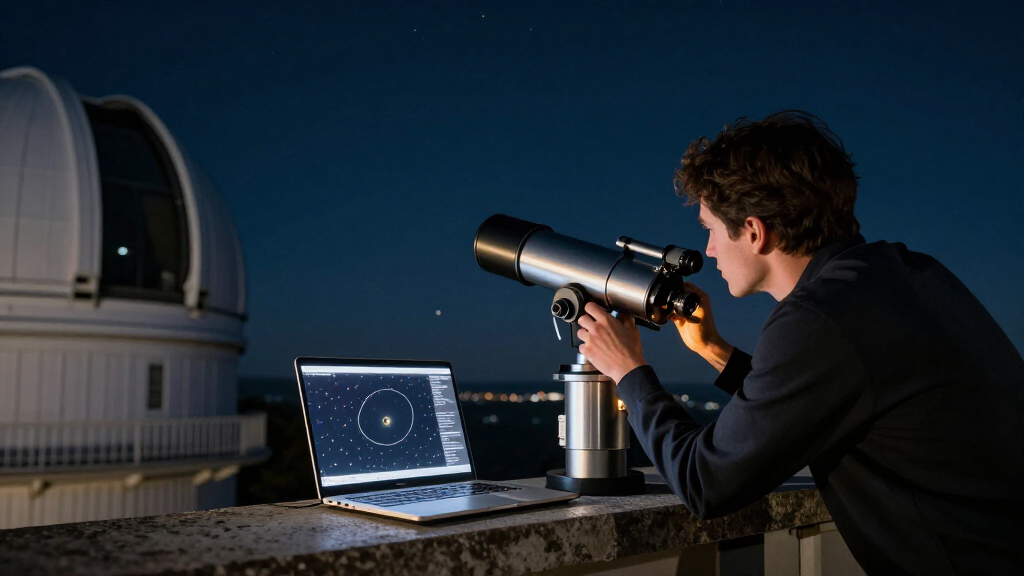
OORT — Comet Vigil for P/2043 K1 Vesper, an AI-built online exhibition room, turns a fictional observatory’s long wait for a fictional comet into an interactive web artwork, as described in the original analysis. The page accumulates star trails over time and lets visitors change an illustrated orbital sequence, making duration and attention the central experience rather than presenting a real astronomical observation.
The artwork is identified as room 170 of 175 in the FABLE/175 exhibition. Its subject, P/2043 K1 Vesper, is fictional, as is the community said to have kept watch for it over decades. The room’s premise is not a report about a comet in the sky: its observatory, readings and vigil belong to an invented setting.
Its main visual feature is a canvas of seeded stars whose curved trails grow as time passes. The same local sky can resume when a visitor returns on the same device, with elapsed time kept in local storage. A separate scrolling illustration moves the comet along an imagined orbit; its ion tail is drawn away from the sun, while its dust tail bends along the orbit. The drawing’s geometry, distance and year use the same progress value.
Other controls include a range input that adjusts a defocused view and associated brightness estimate, and a hold action that opens a simulated shutter. The page records a timestamp for that interaction, but the comet remains unseen in the artwork. The supplied description says animation stops when the page is hidden and that reduced-motion settings receive a still version. The design uses a dark observatory palette, with cyan for the ion tail and readings, red-orange for actions, and monospaced type for coordinates and notes.
FABLE/175 · Room 170 · Interactive web exhibition
How Stillness And Light Meet In OORT
Comet Vigil for P/2043 K1 Vesper turns a fictional observatory’s long wait into an interactive artwork. Star trails gather as visitors stay; scrolling moves an imagined comet along its orbit.
01 / The experience
How the page makes waiting visible
OORT makes duration part of the artwork. Instead of revealing a fabricated comet image, it lets a seeded star field change and records a moment of attention.
Star trails accrue
A canvas adds curved trails over time. The local sky can resume on the same device when a visitor returns.
Orbit shifts
Scrolling advances an illustrated orbital sequence. Position, distance, and year follow one shared progress value.
The shutter stays simulated
A hold action opens a simulated shutter and records a timestamp. The comet remains unseen in the artwork.
02 / Visitor journey
From attention to imagined evidence
The interface borrows observatory language—coordinates, readings, and a shutter—to frame a fictional premise, not to report a real observation.
Enter the room
Meet the fictional observatory and its long vigil.
Remain present
Watch seeded stars accumulate their trails.
Change perspective
Scroll to move Vesper through an imagined orbit.
Mark a moment
Hold the simulated shutter; the comet stays unseen.
03 / The visual language
A sky shaped by code
The design uses a dark observatory palette, cyan readings, red-orange actions, and monospaced notes to suggest instruments while keeping the scene unmistakably artistic.
Scientific-looking details, clearly fictional
The ion tail is drawn away from the sun; the dust tail bends along the orbit. A range input changes a defocused view and its associated brightness estimate.
04 / Fact check
What the fiction does—and does not—establish
References to an observatory, observing community, and decades-long vigil belong to the invented setting. They are not evidence about a real comet or historical observing campaign.
OORT is an AI-built web exhibition in FABLE/175, listed as room 170. P/2043 K1 Vesper and its observatory are fictional.
A real comet discovery, a verified 40-year wait, a last sighting in 1608, or independent testing and accessibility audit results.
Does staying reveal the comet?
No. The star trails grow with elapsed time; the artwork keeps Vesper unseen and in transit.
What happens when the page is hidden?
The project description says animation stops while the page is hidden and reduced-motion settings receive a still version. Independent test results are not provided.
Where can readers explore OORT?
The live room is listed at fable-25-830.netlify.app/sites/oort/ and belongs to the wider FABLE/175 collection.
How is the shutter timestamp stored?
The supplied material does not specify whether that timestamp remains only on the visitor’s device.
How the Page Makes Waiting Visible
OORT’s central choice is to treat time spent on the page as part of the artwork. Rather than supplying a fabricated image of the comet as a reward, the experience lets a visitor see the star field change and records a moment of attention. The result is a web interaction built around patience, not a claim that the visitor has witnessed an astronomical event.
That distinction matters because the room borrows the visual language of an observatory: coordinates, measurements, orbital paths and a shutter control. By labeling the comet and its community as fictional, the work frames those details as elements of an artistic premise. Readers can engage with its scientific-looking interface without mistaking it for an ephemeris or evidence about a real object.
The room also makes a technical point through its form. Persistent local state, a canvas animation and an SVG diagram are used not just to decorate a page, but to make duration and changing perspective perceptible. The provided description presents the page as both an exhibition and a study of how code can shape a visitor’s sense of waiting.
As an affiliate, we earn on qualifying purchases.
A Fictional Observatory in FABLE/175
The room belongs to FABLE/175, an online collection described in the source material as having 175 rooms. OORT is listed as room 170. Its live page is hosted at fable-25-830.netlify.app/sites/oort/, and the room’s footer includes a link to the art-direction prompt that informed the piece.
That prompt calls for a long-exposure aesthetic, an imagined comet named Vesper, invented observer logs and an ephemeris-style presentation. It also describes a three-pass production process: build the room, critique and revise it, then conduct an art-direction review. These are details of the project brief, not independent confirmation of how every requested review or test was carried out. The source points readers to a separate design guide for fuller build notes.
“The comet remains unseen and in transit.”
— OORT project description
interactive astronomy display models
As an affiliate, we earn on qualifying purchases.
As an affiliate, we earn on qualifying purchases.
What the Fiction Does Not Establish
Vesper is fictional, and the supplied material does not identify an actual comet, observatory or historical observing campaign behind the room. References in the prompt to a 40-year wait and a last sighting in 1608 are requested invented content, not verified historical records. They should not be read as facts about a real comet.
The source describes intended behaviors, including local persistence, pausing when a tab is hidden and a still presentation for reduced-motion settings. It does not provide independent testing results, performance measurements or accessibility audit findings. It is also unclear from the supplied material how the recorded shutter timestamp is stored or whether it remains only on the visitor’s device. The page’s brightness estimate is part of the fictional instrument interface; no real-world measurement or calibration is documented.
As an affiliate, we earn on qualifying purchases.
Visit the Room and Its Guide
The room is presented as available to visit now at the linked Netlify address. Visitors can watch the canvas change, scroll through the orbital illustration and use the controls, bearing in mind that the comet and its readings are fictional. The project description also directs readers to a design guide for notes on the canvas, SVG orbit and visual system.
The source gives no announcement of a future release, event or scientific update. The next step described is exploration of the room itself and the wider FABLE/175 collection. Any later changes to the page, exhibition or accompanying guide are not specified.
As an affiliate, we earn on qualifying purchases.
Key Questions
Is P/2043 K1 Vesper a real comet?
No. The project describes P/2043 K1 Vesper as fictional, along with its observatory and observing community. The room is an artwork, not a comet-discovery announcement.
What changes while a visitor stays on the page?
The canvas’s seeded star trails grow with elapsed time. According to the project description, the local sky and its elapsed time can resume on the same device when a visitor returns.
Does the shutter control show the comet?
No. Holding the control opens a simulated shutter and records a timestamp, but the artwork keeps the comet unseen and in transit.
Where can readers see OORT?
The live room is listed at fable-25-830.netlify.app/sites/oort/. The project description also points to the wider FABLE/175 collection and a design guide.
Source: ThorstenMeyerAI.com
Fall Picks
fall essentials
As an affiliate, we earn on qualifying purchases.