📊 Full opportunity report: IEP Negotiation Rehearsal Simulators: Bridging Gaps In Advocacy on IdeaNavigator AI — validation score, market gap, and execution plan.

Get business pricing on monitors, keyboards and dev gear
- Business-only prices and quantity discounts
- Tax-exempt purchasing
- Multiple users, one account, clear invoices
TL;DR
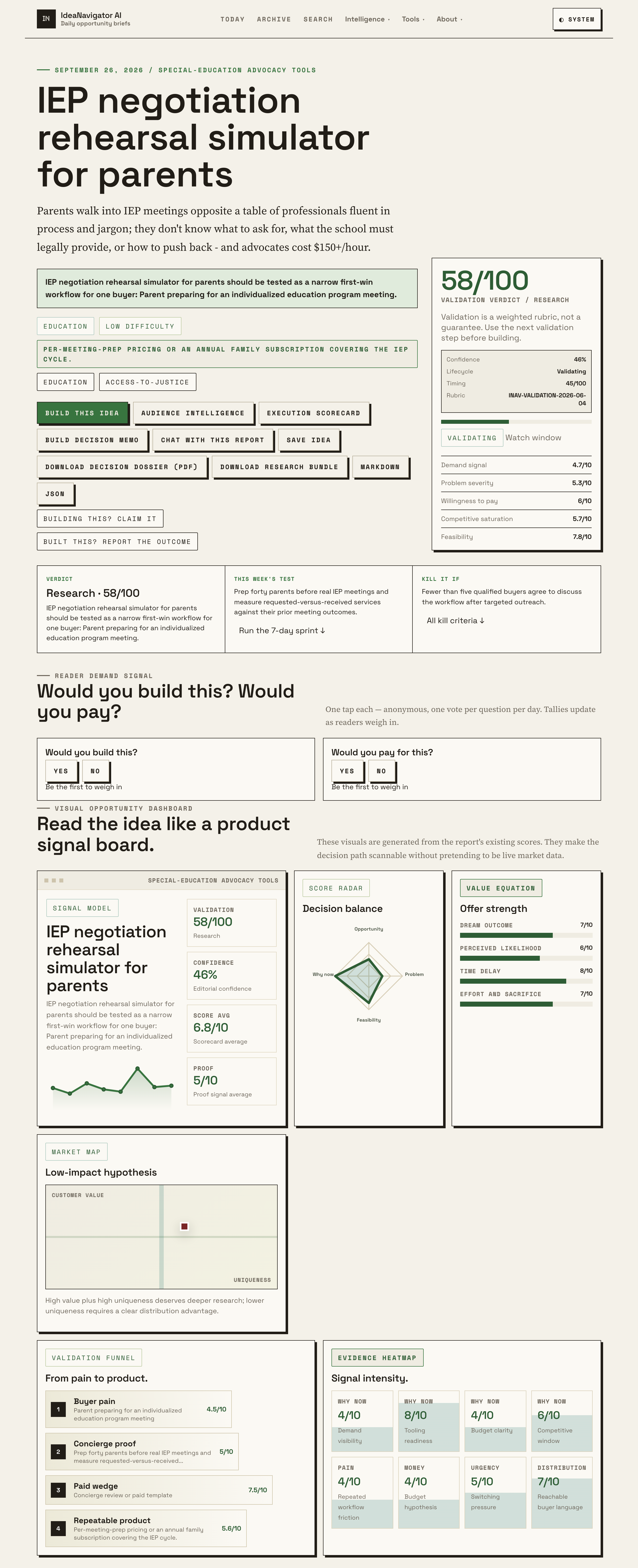
IdeaNavigator AI has outlined a proposed tool for parents preparing for individualized education program meetings. The concept would explain documents and entitlements, help prepare service requests, and let parents rehearse responses to school pushback. It remains a proposal; no launch, test results, or measured effect on meeting outcomes are reported.
IdeaNavigator AI has outlined a proposed IEP negotiation rehearsal simulator for parents preparing for individualized education program meetings. The concept would help families interpret education records, prepare requests, and practice responding to objections; there is no reported launch or evidence yet that the tool changes meeting outcomes.
The proposed workflow is designed for one user at a specific point: a parent preparing for an IEP meeting. A parent would upload the current IEP and evaluation reports. The tool would then explain the documents and relevant entitlements in plain language, generate a list of requests with legal grounding, and simulate a meeting in which a school representative might push back. The intended result is practice articulating and maintaining a position before the real meeting.
IdeaNavigator AI frames the problem as an imbalance in familiarity with the process. Parents may face a group of school professionals who know the procedures and terminology, while families may be unsure what to ask for, what the school is required to provide, or how to challenge a response. The proposal also cites advocacy services costing $150 or more per hour as a reason some families could seek a lower-cost preparation option. No pricing for the proposed simulator is specified.
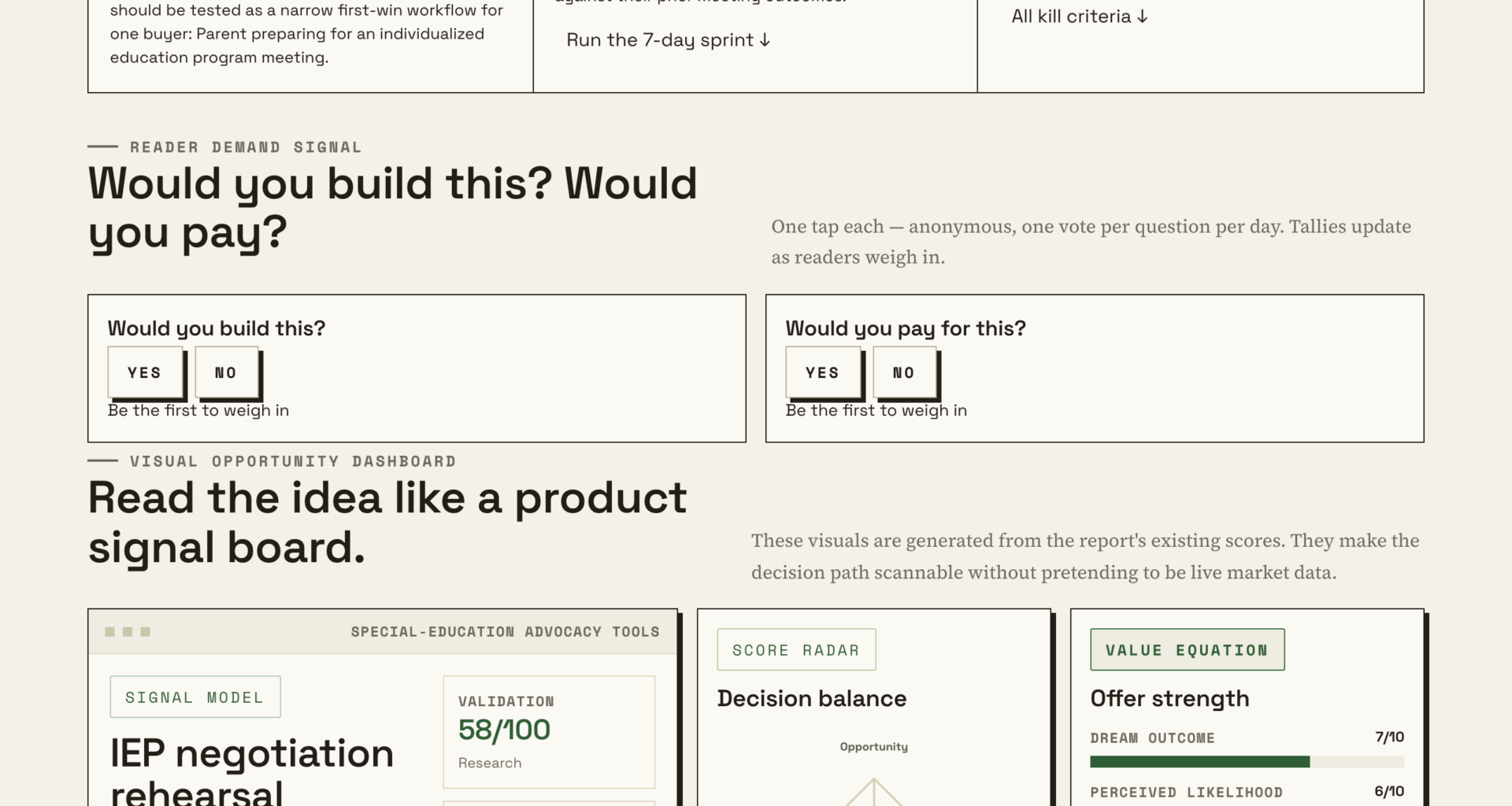
Two possible revenue approaches are identified: charging for preparation for an individual meeting or offering an annual family subscription covering the IEP cycle. To test demand and potential effectiveness, IdeaNavigator AI proposes preparing 40 parents before real meetings and comparing the services they request and receive with outcomes from their earlier meetings. That is a proposed validation plan, not a completed study; no participant results, comparison method, or study timeline are reported.
Preparing Parents Before IEP Meetings
The proposed simulator would let parents organize questions and practice explaining requests before discussing a child’s services with school staff. Its document review and role-play are designed to use a family’s records and upcoming meeting. The proposal does not specify a price or provide evidence about access for families who cannot afford individual advocacy support.
Requests made during an IEP process can relate to a student’s supports and services. The simulator’s effect on those discussions would depend on the quality of its guidance, the student’s circumstances, school decisions, and applicable requirements. No evidence currently shows that the proposed simulator improves services received. The proposed comparison with prior meetings would also need to account for differences between cases and meeting circumstances.
Top picks for "negotiation rehearsal simulator"
As an affiliate, we earn on qualifying purchases.
The Proposed Meeting Preparation Workflow
An individualized education program is a plan used in special education to document a student’s educational needs and supports. The concept focuses on preparation for a meeting about that plan, rather than on ongoing instruction or a general service for schools. Its proposed sequence starts with records already held by the family, moves to a plain-language explanation and a request list, and ends with a simulated conversation that includes realistic resistance.
IdeaNavigator AI says language-model role-play has reached a point where it can simulate a realistic meeting. It also cites rising special-education identification rates and tightening district resources as conditions that may make meetings more difficult. The proposal provides no underlying figures, dates, or independent evidence to assess those trends in this account. They are not measurements of meeting conflict or proof of demand for a simulator.
The concept’s proposed test is tied to actual meetings rather than user satisfaction alone: prepare 40 parents, then compare requested and received services with each family’s earlier outcomes. The description does not say whether the tool exists as a working prototype, whether schools or specialists have reviewed its guidance, or whether any families have tried it.
Evidence and Safeguards Still Missing
It is not clear whether a product has been built, when it might become available, who would review its explanations, or how the proposed prices would compare with advocacy services. No trial findings are reported. The suggested 40-parent exercise is a plan for validation, and its outcome measures and recruitment details are not provided.
The proposal also leaves open how the simulator would handle differences in student needs, location, and the documents families upload. It does not describe how legal information would be checked or updated, how the system would flag uncertainty, or what parents would be told when a question needs advice from a qualified professional. Because the concept involves sensitive education records, the description also does not specify data storage, access, retention, or deletion practices. These are unanswered product questions, not reported failures.
A Proposed Test With Families
The next stated step is to test the workflow with 40 parents preparing for real IEP meetings. IdeaNavigator AI proposes comparing each parent’s requested and received services with their outcomes from a prior meeting. No start date or results have been announced in the material describing the proposal.
For that test to clarify whether the idea helps, details would need to show how prior and current meetings are compared and what counts as a meaningful change. Information about participant recruitment, review of the simulator’s guidance, and privacy protections would also help families assess the project. Until such details or results are available, the simulator remains a product concept with a proposed validation plan, rather than a demonstrated service.
Source: IdeaNavigator AI
Key Questions
Is the IEP simulator available now?
The description outlines a proposed product, but does not report a launch, prototype, or availability date.
What would the proposed tool do?
Parents would upload an IEP and evaluation reports. The concept would explain them in plain language, suggest requests with legal grounding, and simulate meeting discussion and pushback.
Has it been shown to improve services?
No results are reported. IdeaNavigator AI proposes testing the concept with 40 parents and comparing requested and received services with their prior meeting outcomes.
How much would it cost?
No price is specified. The proposal suggests either per-meeting preparation charges or an annual family subscription.
Source: IdeaNavigator AI
Fall Picks
fall essentials
As an affiliate, we earn on qualifying purchases.