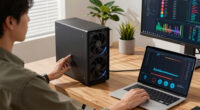
📊 Full opportunity report: Acoustic Dampening, Placement, and the “Rig in the Closet” Setup on ThorstenMeyerAI.com — validation score, market gap, and execution plan.
TL;DR
Placing AI workstations in separate rooms or closets significantly reduces noise. Proper ventilation is crucial for enclosed setups to prevent overheating. Acoustic foam alone is less effective than strategic placement.
Placing high-power AI workstations in separate rooms or enclosed cabinets can drastically reduce noise levels at the workstation, according to experts. This approach is increasingly adopted as a practical solution for noise-sensitive environments, especially when combined with proper ventilation.
Experts emphasize that the most effective way to reduce noise from a high-power AI rig is to move it away from the user, such as into another room or closet, rather than relying solely on acoustic foam or other sound absorption materials. This strategy leverages the principle that distance and physical separation are the most impactful noise mitigation methods.
The ‘rig in the closet’ setup is gaining popularity, where the machine is housed in a sealed or semi-sealed space. However, this approach requires careful ventilation to prevent heat buildup. Without proper airflow—such as passive vents or active exhaust fans—the temperature inside the enclosure can rise to levels that cause thermal throttling and increased fan noise, defeating the purpose of noise reduction.
Soundproof cabinets that integrate temperature-controlled airflow are effective but come at a higher cost. They combine acoustic lining with ducted ventilation to keep the rig cool and quiet, making them suitable for continuous operation in noise-sensitive environments.
Acoustic dampening
& the rig in the closet.
The most powerful noise fix isn’t a material — it’s a floor plan. A rig you can’t hear because it’s in another room beats any amount of foam. Tap the approaches in Part 1 to see what actually works.
(another room)
(levers 1–4)
(door / barrier)
(acoustic foam)
Contain the noise, not the heat
Why Placement and Ventilation Are Critical for Quiet AI Workstations
Effective noise management is essential for maintaining a comfortable and productive workspace, especially for those working with high-performance AI hardware that generates significant heat and noise. Proper placement and ventilation not only improve acoustic comfort but also ensure hardware longevity by preventing overheating.
Adopting these strategies allows users to operate powerful AI rigs without disturbing their environment, enabling quieter workspaces and reducing the need for costly soundproofing materials. This approach is particularly relevant for remote work, shared offices, or home labs where noise can be disruptive.
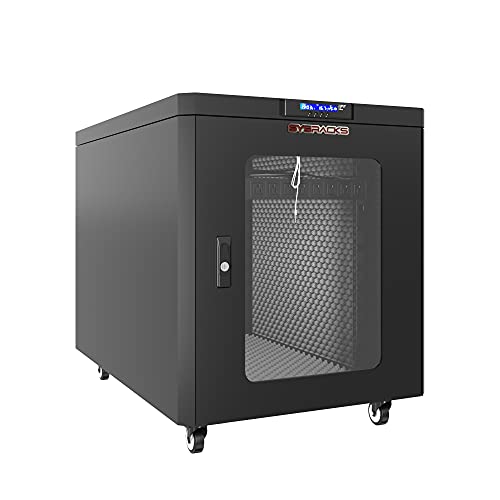
Sysracks Soundproof Server Rack Quiet - Acoustic Sound Proof Cabinet for Servers - Up to 36% Noise Reduction - Locking Server Enclosure - Silent Networking Cabinet - Noise Sound Dampening Box (15U)
- Size: 15U Soundproof Cabinet (26x35x36 inches)
- Air Control: LED screen with 2 fans for temperature and energy saving
- Adjustable Rails: U-Mark rails and shelf for versatile equipment installation
As an affiliate, we earn on qualifying purchases.
As an affiliate, we earn on qualifying purchases.
Current Best Practices for Noise Reduction in AI Workstations
Traditional noise mitigation relied heavily on acoustic foam and soundproofing materials, which only absorb airborne noise but do little to address structure-borne vibrations or heat. Recent insights highlight that distance and isolation are far more effective, especially when combined with proper ventilation.
The concept of placing rigs in separate rooms or closets aligns with the understanding that airborne and structure-borne noise require different fixes. While acoustic foam can soften reflections within a space, it cannot block sound transmission through walls or floors. Mechanical decoupling and strategic placement are now recognized as the most impactful measures.
In practice, many users have adopted network-based workflows, where the physical hardware is located remotely from the workspace, leveraging remote access tools like SSH or API calls. This reduces the need for quiet workspaces at the physical location of the hardware and emphasizes the importance of ventilation for enclosed setups.
"Moving the rig into another room or closet is the most effective way to eliminate noise at the source, especially when combined with proper ventilation."
— Thorsten Meyer, AI workspace expert

Focusound 52 Pack Acoustic Foam Panels 1" x 12" x 12" Sound Proof Foam Panles Soundproofing Noise Cancelling Wedge Panels for Home Office Recoding Studio with 300PCS Double-Side Adhesive
- Soundproofing Design: Triangular grooves for noise absorption
- Includes Adhesive Tape: 300pcs double-sided adhesive for easy installation
- Easy Shape Recovery: Soak in water to restore foam shape
As an affiliate, we earn on qualifying purchases.
As an affiliate, we earn on qualifying purchases.
Remaining Questions About Enclosed AI Rig Setups
While placement and ventilation are proven effective, the optimal design of soundproof cabinets that balance noise reduction and heat dissipation remains an area of ongoing development. Cost and complexity can be barriers for some users, and best practices for DIY enclosures are still evolving.
It is also unclear how different hardware configurations, ambient environments, and usage patterns influence the effectiveness of these strategies. More empirical data is needed to establish standardized guidelines for various setups.
As an affiliate, we earn on qualifying purchases.
Next Steps for Implementing Quiet AI Workstations
Users should evaluate their workspace to determine the feasibility of relocating their rigs or building enclosed setups with proper ventilation. Manufacturers of soundproof enclosures are likely to refine designs that better balance noise suppression and thermal management.
Further research and case studies are expected to provide clearer guidelines on best practices, including cost-effective DIY solutions and advanced cooling integrations for enclosed spaces.

Sysracks 18U Soundproof Server Cabinet – Quiet, Locking Network Rack for Home & Office, Noise-Reducing Enclosure with Ventilation & Cooling for Servers, Networking & IT Equipment
- Soundproofing Technology: Reduces noise by up to 36%
- Large External Dimensions: 35-inch depth, 18U capacity
- Durable Steel Construction: Heavy-duty cold-rolled steel
As an affiliate, we earn on qualifying purchases.
As an affiliate, we earn on qualifying purchases.
Key Questions
Is acoustic foam sufficient to reduce noise from a high-power AI rig?
Acoustic foam alone is generally ineffective at blocking noise transmission; it softens reflections within a room but does not prevent sound from escaping through walls or floors. Placement and barriers are more effective.
Can I put my AI workstation in a closet without overheating?
Yes, but only if the closet has proper ventilation, such as passive vents or active exhaust fans. Without airflow, heat will build up, causing thermal throttling and increased noise from fans.
What are the best ways to soundproof a closet for a GPU rig?
Using a combination of acoustic lining, sealed panels, and temperature-controlled exhaust fans offers the best balance of noise reduction and thermal management. Cost and complexity vary depending on the setup.
Does network-based operation eliminate the need for quiet hardware setups?
Partially. While remote operation reduces the need for a quiet physical workspace, hardware still needs proper ventilation to prevent overheating, especially in enclosed or remote setups.
Source: ThorstenMeyerAI.com