
🔍 Read the full analysis: 10 Best Home Theater Projectors To Make AI Part Of Your Viewing Setup on ThorstenMeyerAI.com

Get business pricing on monitors, keyboards and dev gear
- Business-only prices and quantity discounts
- Tax-exempt purchasing
- Multiple users, one account, clear invoices
TL;DR
A source roundup ranks 10 home theater projectors by image processing, light source, streaming and setup flexibility, with the Epson Home Cinema 2350 at the top. The supplied material does not identify specific AI features in any model, so the title’s AI framing is not substantiated by the product details.
A 10-projector buying guide names the Epson Home Cinema 2350 its leading pick, citing 4K PRO-UHD processing and smart streaming, while comparing it with nine alternatives for fixed rooms and portable viewing. Despite the title’s reference to AI, the supplied product information does not specify AI-powered functions for any model, leaving that part of the promise unverified.
The guide assesses projectors by resolution and processing, light source, streaming and connection options, and setup needs. It places the Epson Home Cinema 2350 first, the Epson Home Cinema 980 as a simpler 1080p alternative, and the ViewSonic LS740HD as the laser-light-source option. It also identifies six portable smart models: Aurzen, ONOAYO, X9 Pro, VIDAA, HAPPRUN and Wimius.
The supplied material does not give complete specifications for every product, nor does it provide prices, test results, model numbers for several portable picks, or a publication date. The rankings are presented as a feature-based comparison rather than a documented lab test. Buyers should check each model’s exact resolution, throw distance, screen-size range, brightness guidance, ports and streaming-app support before purchasing.
A key distinction is native imaging resolution versus input support. The guide cautions that some projectors can decode 4K content while using native 1080p imaging; accepting a 4K signal does not mean the projector displays the same detail as a higher-resolution imaging system. It also says portable smart projectors prioritize flexible setup and convenience over the needs of a fixed theater installation.
The 10 picks
- 1
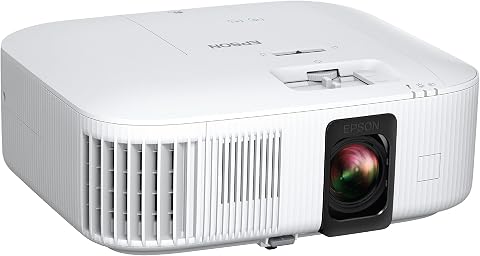 Epson Home Cinema 2350 4K PRO-UHD Smart Streaming ProjectorView on Amazon →
 - 2
 ViewSonic LS740HD 5500 Lumens 1080p Laser Projector with 1.3x Optical Zoom an…View on Amazon →
 - 3
 Epson Home Cinema 980 3LCD 1080p ProjectorView on Amazon →
 - 4
 X9 Pro Smart Projector with VIDAA OS, Native 1080p, 4K Decoding, HDR10, and A…View on Amazon →
 - 5
 Optoma HD146X 1080p Full HD Home Theater ProjectorView on Amazon →
 - 6
 VIDAA Smart Projector with Native 1080p, 4K Decoding, Wi-Fi 6, and BluetoothView on Amazon →
 - 7
 Smart Outdoor Projector with 4K Support, WiFi & Bluetooth, Dual Speakers, Aut…View on Amazon →
 - 8
 ONOAYO 4K Portable Outdoor Projector with WiFi and BluetoothView on Amazon →
 - 9
 Aurzen Roku TV Smart Projector with Wifi and Bluetooth, Roku Streaming Experi…View on Amazon →
 - 10
 HAPPRUN Native 1080P Bluetooth ProjectorView on Amazon →
Match Features to the Room
The list matters because projector specifications can be easy to misread when a product accepts a high-resolution input but displays at a lower native resolution. That distinction, along with room brightness and viewing distance, can affect the result more than a headline resolution label. A buyer choosing for a dark, fixed room may have different priorities from someone who wants occasional streaming in several locations.
Light source and software also shape ownership. The ViewSonic’s laser source may appeal to shoppers who want to avoid routine lamp replacement, while built-in streaming can reduce devices and cables. But those features do not establish image quality or long-term value by themselves. The source’s AI framing remains unsupported: it does not describe an AI feature, explain what it would do, or compare AI capabilities among the picks.
How the Ten Picks Differ
The guide’s selection approach separates products by intended use rather than treating every projector as interchangeable. It favors a broad feature mix in its top pick, a straightforward 1080p proposition in the Epson 980, and a laser source in the ViewSonic LS740HD. Portable models are grouped around built-in software and setup convenience, though the supplied text does not detail each model’s individual strengths or limitations.
For installation, the guide advises checking projector placement, throw distance, screen size and ambient light. For streaming, buyers can compare built-in software with an external device: integrated apps may simplify casual use, while external players can be replaced separately. It also cautions that product specifications alone cannot predict performance in every room. No independent test methodology, measurements or direct comparisons are included in the supplied source.
“The Epson Home Cinema 2350 leads the roundup by combining 4K PRO-UHD processing with smart streaming.”
— ThorstenMeyerAI.com buying guide
AI Claims Need More Detail
The source material does not say that any of the 10 projectors uses AI, identify an AI function, or explain how such a function would affect viewing. It is therefore unclear whether “AI” refers to a specific capability, a connected device or service, or simply the intended theme of the title. No model-by-model benchmark, measured brightness comparison, pricing or current software-support information is supplied either.
Several entries are named only by brand or abbreviated model label, including X9 Pro and VIDAA, so readers may need additional information to identify the exact products. The guide also does not establish that its ranking reflects hands-on testing. Those gaps limit how confidently shoppers can compare the full set.
Verify Models Before Buying
Before choosing, readers should confirm the exact model and current specifications from the manufacturer or retailer, especially native resolution, supported input formats, throw distance, brightness guidance, light-source life and streaming-app availability. They should also verify whether any advertised AI capability is present on the projector itself, what it does, and whether it requires an account, internet connection or separate device.
The supplied source gives no announced test, product update or follow-up milestone. The next useful step for shoppers is to compare each candidate against their room and viewing habits, then seek independent measurements and current pricing. Until AI features are documented, the roundup is best read as a projector-selection guide, not evidence that these models make AI part of a viewing setup.
Key Questions
Which projector does the guide rank first?
It ranks the Epson Home Cinema 2350 first, citing 4K PRO-UHD processing and smart streaming. The source does not provide independent test measurements to support the ranking.
Does the roundup confirm that the projectors have AI features?
No. The supplied product details do not identify or describe an AI-powered feature in any of the 10 models. The title’s AI framing is not substantiated by the information provided.
Does a projector that accepts 4K input display native 4K detail?
Not necessarily. The guide says some models accept or decode 4K content while using native 1080p imaging. Buyers should check the imaging resolution, not only the supported input format.
Which picks are described as portable smart projectors?
The source names Aurzen, ONOAYO, X9 Pro, VIDAA, HAPPRUN and Wimius as portable smart models. It does not provide enough individual specifications to compare their software or performance in detail.
What should buyers check before selecting a projector?
Check native resolution, throw distance, screen size, ambient-light needs, ports and app support. Also verify the exact model and any claimed AI functions with current manufacturer information.
Source: ThorstenMeyerAI.com
Fall Picks
fall essentials
As an affiliate, we earn on qualifying purchases.