
TL;DR
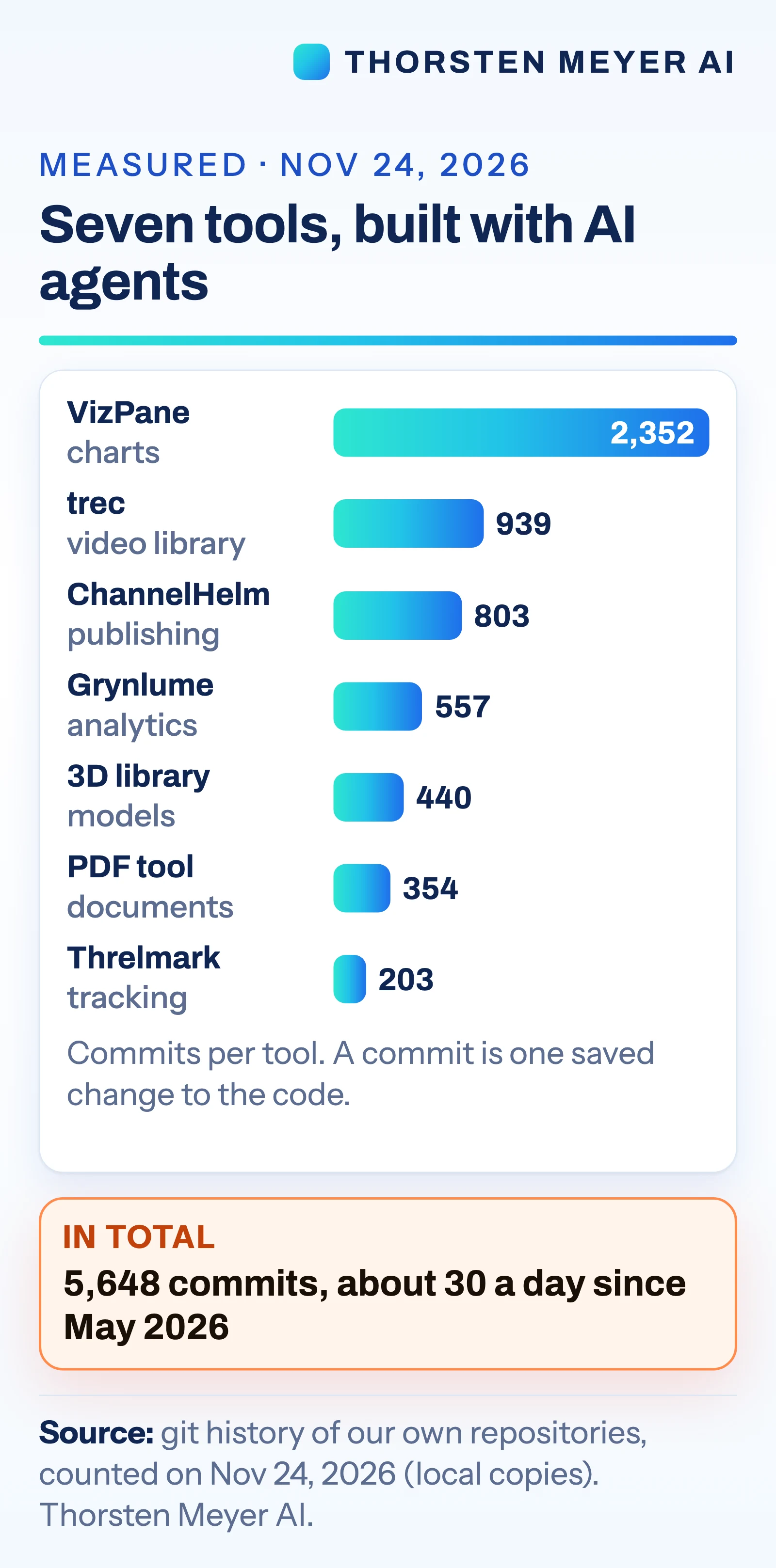
Thorsten Meyer says he has replaced several rented business software services with tools he built using Claude and Codex coding agents. He reports that seven tools in his own workflow had 5,648 commits and 2,128 test files as of Nov. 24, 2026, while acknowledging that upkeep, security and dependence on two AI providers remain costs.
Thorsten Meyer says he has replaced services for analytics, project tracking, PDF work and video recording with tools he built using Anthropic’s Claude and OpenAI’s Codex. In an article published Nov. 25, 2026, he describes connecting those tools so software agents can pass work between them. He says he is responsible for maintenance and security and relies on the two AI companies.

Get business pricing on monitors, keyboards and dev gear
- Business-only prices and quantity discounts
- Tax-exempt purchasing
- Multiple users, one account, clear invoices
Meyer says he pays for several Claude and Codex subscriptions; AI models used for voices, pictures and video clips are paid for separately, per use. He says coding agents work inside software projects: they read and write code, run tests and report results. He sets the goals and reviews what they produce. His account describes his own practice, not a controlled comparison of costs or productivity.
For the workflow accompanying the article and video, Meyer describes a job moving through seven of his tools, from a project tracker and tool-specific guides to transcript analysis, PDF research, 3D models, video publishing and read-only analytics. He says people set the goal and check the result, while agents carry out the handoffs. The figures he gives for seven tools—5,648 commits and 2,128 test files—are counts from his own repositories measured Nov. 24, 2026; they do not establish how reliable or secure the tools are.
Meyer says each tool has a guide that agents can read and a standard interface they can use. That design lets software discover how a tool works and interact with it without a person clicking through screens. He also says his projects include written rules, plans and work logs because coding agents do not automatically retain business knowledge between sessions.
The Costs Shift to Upkeep
Meyer describes using coding agents to build software tailored to a specific workflow. His account says the agents produce code for narrow applications, while he defines requirements and reviews the results. It does not establish whether this approach is suitable for other businesses or whether it reduces their software costs.
Meyer says he is responsible for maintenance, security and review of the tools. He also identifies dependence on Anthropic and OpenAI as a downside. The article does not provide a full cost comparison, including development time, model usage, hosting or future repairs, so it does not establish net savings.
Products Worth Considering

Logitech MX Master 4 for Mac

Sonos Era 100 SL Compact Microphone-Free Speaker, Black

Logitech MX Mechanical Wireless Illuminated Keyboard, Tactile Quiet, Graphite
As an affiliate, we earn on qualifying purchases.
From Rented Apps to Custom Tools
Meyer frames his approach against software as a service, or SaaS: applications hosted by a provider and accessed by users, typically through a browser. Citing the U.S. National Institute of Standards and Technology’s SP 800-145, page 2 (PDF page 6), he notes that SaaS users generally do not manage the underlying servers, storage or individual application capabilities beyond available settings. That arrangement offers ready-made services, but the customer works within the provider’s product.
His article argues that AI coding agents change the effort involved in making a custom alternative. Meyer uses Claude Code and Codex, but says the agents still need instructions and review. He describes their capabilities based on his experience and says they do not automatically learn a business over time; project notes provide the context they need. The article is a written companion to his video, “What If You Stopped Buying Software? My AI-Built Tool Fleet, Explained.”
““The scarce part is no longer the code. It is knowing exactly what you need, and checking that you got it.””
— Thorsten Meyer
Savings and Reliability Remain Unmeasured
The article does not quantify the total cost of Meyer’s setup or compare it with his previous software bills. It gives no figures for his time spent building and maintaining the tools, hosting, per-use model charges or security work. The reported commit and test-file counts describe repository activity, not independent measures of quality, safety or business value.
It is also unclear how the tools would perform for other organizations, how much human oversight the workflow requires in routine use, and what would happen if either AI provider changed its pricing or services. Meyer presents a personal account, and the article does not report an external audit of the tools or their security.
The Workflow’s Next Test
Meyer’s article and accompanying video document the workflow he uses now. Further evidence could include operating costs, maintenance demands and reliability over time, including how often people intervene when agents hand work between tools. The source material specifies no such evaluation or future milestone.
Key Questions
Which software does Meyer say he replaced?
He says his web analytics, project tracking, PDF work and video recording now run on tools he built. The article does not list every previous vendor or provide a before-and-after bill.
What do Claude and Codex do in his workflow?
Meyer says he uses the coding agents to read and write project code, run tests and report back. He sets each task’s goals and reviews the results.
What does “agentic” mean here?
In Meyer’s description, a tool is agentic when other software can read its guide and use a standard interface to interact with it, allowing work to move between tools without a person clicking through each step.
Do the repository figures show that the tools are secure or reliable?
No. The 5,648 commits and 2,128 test files are counts Meyer reports for seven repositories on Nov. 24, 2026. They do not independently establish security, reliability or performance.
Does building a tool fleet necessarily save money?
The source does not establish that. Meyer describes paying for AI subscriptions and per-use model services, and taking responsibility for maintenance and security, but gives no complete cost comparison.
Source: Thorsten Meyer AI