
📊 Full opportunity report: Why A Shared Task Workspace Fits Agency Social Media Work on IdeaNavigator AI — validation score, market gap, and execution plan.

Get business pricing on monitors, keyboards and dev gear
- Business-only prices and quantity discounts
- Tax-exempt purchasing
- Multiple users, one account, clear invoices
TL;DR
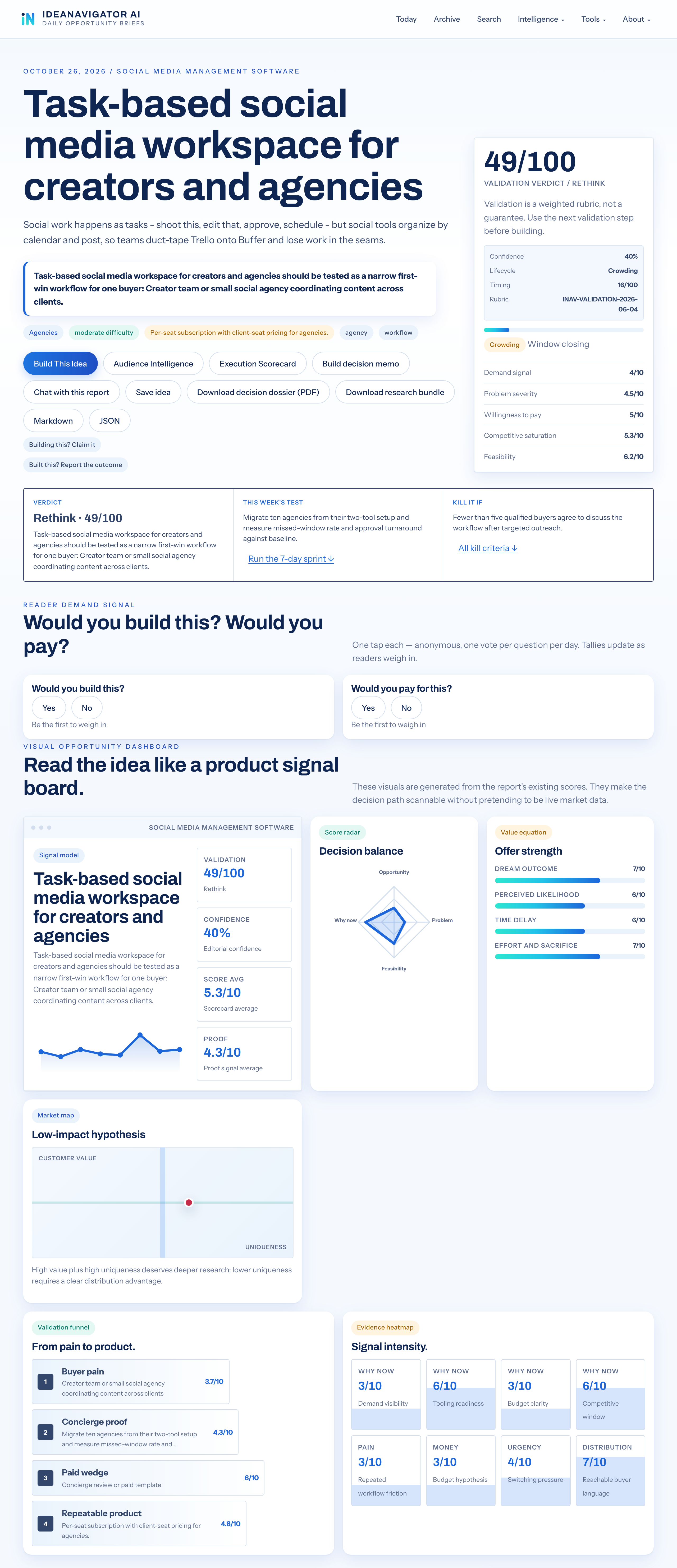
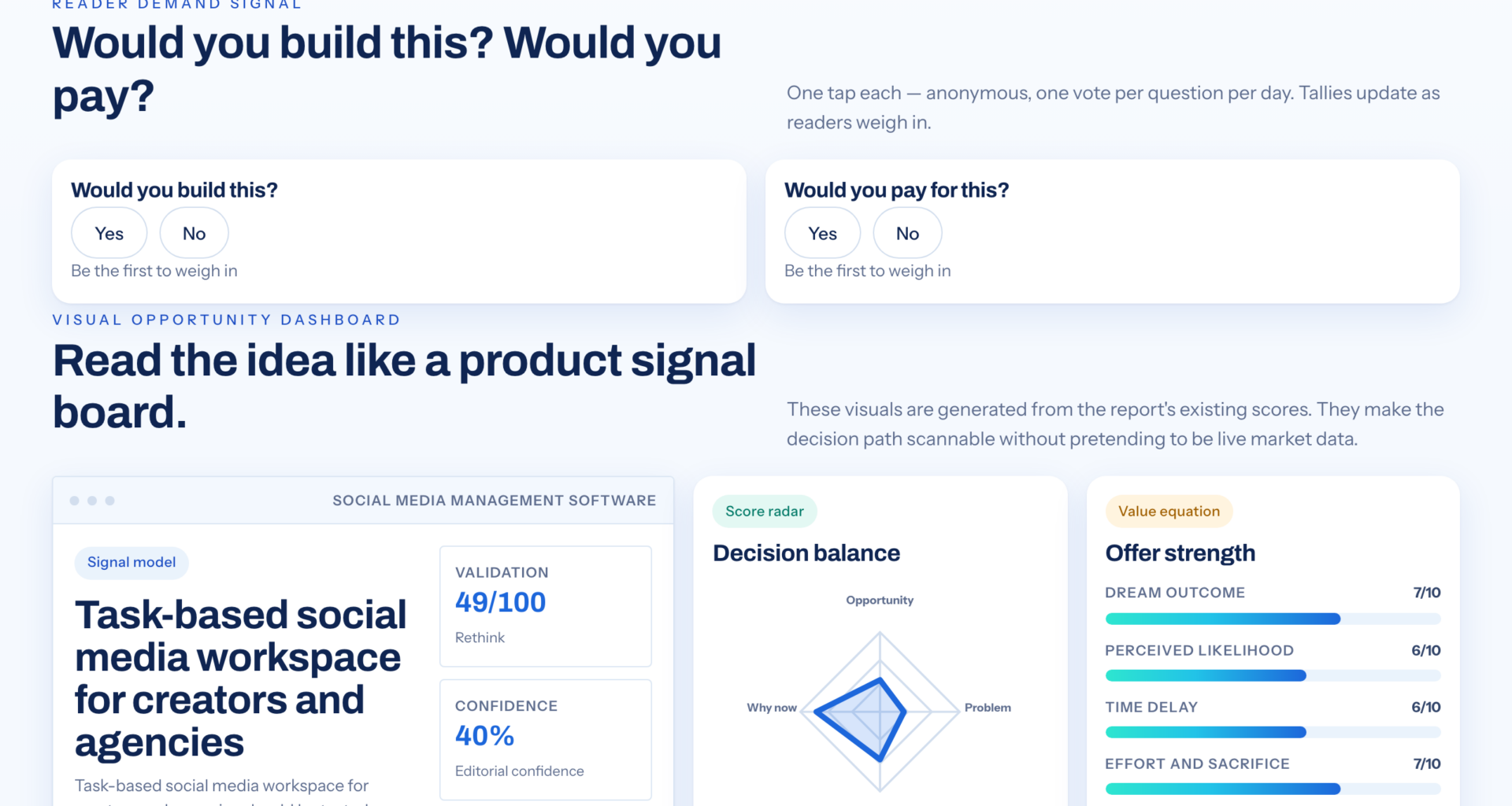
IdeaNavigator AI proposes testing a shared, task-based social media workspace with creator teams and small agencies managing content across clients. The concept would combine post production, client approvals, asset versions and scheduling, but it is a product proposal—not a launched service or a validated result.
IdeaNavigator AI has proposed a task-based social media workspace for creator teams and small agencies, combining post production, client approvals and scheduling in one pipeline. The concept addresses a workflow gap: teams often manage content in social scheduling tools while tracking briefs, edits and approvals in separate project software, but the proposal has not been reported as a launched or tested product.
The proposed workspace would treat each social post as a task moving through stages such as brief, asset creation, editing, approval and scheduling. It would include client-facing approval links, version tracking for creative assets, and scheduling that becomes available after approval. The goal is to connect the work required to produce a post with the act of publishing it, rather than asking teams to coordinate across separate systems.
The initial customer is deliberately narrow: a creator team or small social agency coordinating content across clients. The suggested business model is a per-seat subscription, with a separate pricing approach for client seats. These are product and commercial proposals; no prices, customer commitments or operating company details are provided.
IdeaNavigator AI suggests validating the concept by moving ten agencies from their existing two-tool setups and comparing missed publishing windows and approval turnaround with each agency’s baseline. No pilot results, baseline figures or measurement period are available. The ten-agency figure is a proposed test size, not evidence that a trial has happened.
Where Agency Work Gets Split
The idea focuses on the handoffs that sit between a content plan and a published post. A team may need to gather a brief, locate the right assets, edit a draft, obtain client sign-off and then schedule the approved version. When those steps are tracked separately from the publishing calendar, people may have to move information between tools and confirm which version is current. A shared task record could make status and ownership easier to follow, if it works reliably in day-to-day agency use.
For agencies managing several client accounts, the proposed approach could also give clients a defined place to review work without requiring them to use the internal project system. The potential benefit is less coordination friction, not a demonstrated reduction in missed posts or faster approvals. Those outcomes would need to be measured in the proposed pilot, alongside practical concerns such as how teams handle revisions, urgent posts and different client approval rules.
The concept also puts pressure on product boundaries. Scheduling tools already manage publishing, while general project tools handle tasks; the proposal’s value depends on whether joining those functions around each post is more useful than configuring the two existing products. Its case rests on workflow fit, not on evidence that agencies lack scheduling software or that a combined tool will outperform current arrangements.
Products Worth Considering

Amazon Kindle Paperwhite (12th Generation, 2024), 16 GB, 7-inch Display, Jade

LG UltraGear 32GX850A-B 32-Inch 4K UHD Glossy OLED Gaming Monitor

DJI Osmo Mobile 7P with Mic Mini TX (Infinity Black) Gimbal Stabilizer
As an affiliate, we earn on qualifying purchases.
From Calendars to Post Tasks
The proposal describes a mismatch between how social platforms organize work and how teams carry it out. Scheduling products commonly center on calendars and posts, while production includes work that happens before a post is ready to schedule. IdeaNavigator AI says teams can bridge that gap by pairing a social tool with a generic project-management tool, creating handoffs where tasks, assets and approvals may be tracked apart from the post itself.
Its timing rationale is that rising expectations for content volume have multiplied team workflows, while scheduling-tool providers have left much of the work-management layer to general-purpose software. These points are the proposal’s assessment of the market; no market-size figures, independent research or named incumbent products are included. The article therefore cannot establish how widespread the problem is or whether existing platforms have recently changed their features.
The recommended first step is not a broad platform for every social media user. It is a focused test with agencies already coordinating multiple clients and using two tools. This framing makes the proposal testable: teams can compare the current setup with a single post pipeline and record whether approval and publishing work improve.
Pilot Results Still Pending
No product launch, working prototype, agency trial or performance result is described. It remains unclear whether agencies would adopt a combined workspace, which existing tools they would replace, and whether clients would use approval links rather than email or other review channels. The proposal also does not specify integration requirements, supported social networks, access controls, or how changes made after approval would affect scheduling.
The proposed validation metrics—missed-window rate and approval turnaround—are not defined in detail. There is no stated baseline period, method for attributing changes to the workspace, or explanation of how differences among agencies would be handled. Without those details and pilot data, claims about time saved, fewer missed posts or improved client service would be premature.
Testing the Agency Workflow
The next step described in the proposal is a pilot with ten agencies migrating from a two-tool workflow. To assess the concept, a test would need to establish each agency’s existing missed-window rate and approval turnaround, then track the same measures after adopting the new process. It would also be useful to record whether teams and clients complete the stages inside the workspace or continue relying on external messages and documents.
No schedule for a pilot or product release has been announced, and no follow-up findings are available. Until those details emerge, the workspace should be understood as a product opportunity and test plan rather than an operational solution with proven results.
Source: IdeaNavigator AI
Key Questions
Is the task-based social media workspace available now?
No launch is reported. IdeaNavigator AI has outlined a product concept and an approach for testing it, but has not provided availability details.
Who is the proposed workspace for?
The initial audience is creator teams and small social agencies coordinating content across multiple clients.
What would the workspace include?
The proposed MVP would track each post through briefing, asset creation, editing, approval and scheduling. It would also include client-facing approval links and asset versioning.
How would the idea be tested?
The proposal recommends migrating ten agencies from their current two-tool setups and comparing missed publishing windows and approval turnaround with a baseline. No trial results have been reported.
What remains unproven?
It is not yet known whether agencies would adopt the workflow or whether it would reduce missed windows or shorten approvals. No pilot data, pricing or release timeline has been provided.
Source: IdeaNavigator AI