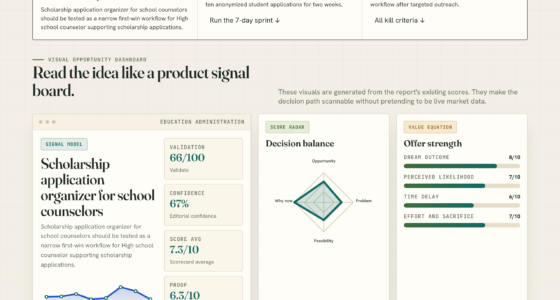
📊 Full opportunity report: Using Cumulative Attention Data To Reduce Screen Overload In K-12 Schools on IdeaNavigator AI — validation score, market gap, and execution plan.

Get business pricing on monitors, keyboards and dev gear
- Business-only prices and quantity discounts
- Tax-exempt purchasing
- Multiple users, one account, clear invoices
TL;DR

Researchers have developed a method to quantify the total attention load students face from multiple school apps. This could help districts reduce screen overload and improve student well-being. The approach involves scoring and reporting cumulative attention burdens across software portfolios.
A new method for measuring the cumulative attention burden of school software has been proposed, aiming to help district administrators better manage students’ screen time and attention load. This approach, developed by IdeaNavigator AI, involves scoring software portfolios based on how apps’ autoplay, notifications, streaks, and variable rewards stack across a typical school day. The goal is to provide a board-ready report that informs procurement decisions and reduces the risk of screen overload for students.
The proposed system ingests a district’s entire app portfolio, extracting per-app ratings related to attention-draining mechanics. It then applies a layered model that accounts for how these mechanics compound over a student’s day, producing a comprehensive attention score. This score aims to reflect the total attention load imposed by multiple apps working simultaneously or sequentially, which has previously gone unmeasured.
According to sources involved in the development, this measure offers a new way for district leaders to evaluate the overall impact of their digital tools beyond individual app ratings. It responds to recent concerns about the effects of screen time, especially with increasing phone bans and lawsuits targeting excessive device use in schools. The system is designed to be scalable, with an annual subscription fee based on district enrollment and additional charges for procurement reviews.
Initial validation plans include scoring three districts’ software portfolios, presenting findings to their school boards, and observing whether the reports influence procurement decisions within two quarters. The ultimate aim is to create a standardized, defensible measure that guides districts toward selecting less attention-intensive software, thereby improving student focus and well-being.
Implications for Student Attention Management
This development offers a practical tool for districts to address the growing concern over student screen overload. By quantifying the cumulative attention load, districts can make more informed procurement choices, potentially reducing the number of apps that contribute to constant distraction. The approach aligns with ongoing efforts to create healthier digital environments in schools and could influence future regulations or standards for educational technology.
Furthermore, this method provides a defensible, data-driven way to respond to legal and policy pressures around screen time, moving beyond subjective app ratings to a comprehensive portfolio assessment. If validated, it could lead to widespread adoption and set a new benchmark for responsible edtech procurement.
student attention management software
As an affiliate, we earn on qualifying purchases.
As an affiliate, we earn on qualifying purchases.
Background on Screen Overload and Edtech Evaluation
Concerns over excessive screen time in schools have intensified recently, driven by legal actions, phone bans, and research linking high device use to attention issues. Traditionally, districts have relied on individual app ratings or user reports to evaluate edtech tools, but these methods overlook the cumulative effect of multiple apps used throughout the day.
Recent policy discussions emphasize the importance of managing students’ attention load at a portfolio level, rather than evaluating apps in isolation. However, there has been no standardized, quantitative measure to assess the combined impact of apps’ attention-draining features, such as autoplay, streaks, notifications, and variable rewards. The proposed cumulative attention score aims to fill this gap, providing a comprehensive metric aligned with current concerns and legal pressures.
Early pilot programs are planned to test the scoring system’s effectiveness in real district settings, with validation focused on whether the report influences procurement decisions and reduces overall screen time concerns.
screen time management tools for schools
As an affiliate, we earn on qualifying purchases.
As an affiliate, we earn on qualifying purchases.
Uncertainties Around Implementation and Effectiveness
It is not yet clear how accurately the cumulative attention score will reflect real student attention or how well districts will adopt and integrate this measure into their procurement processes. The validation process is still in early stages, and results from pilot districts are pending. There may also be challenges in standardizing app ratings across diverse software portfolios and in convincing districts to rely on this new metric over traditional evaluation methods.
educational app attention load assessment
As an affiliate, we earn on qualifying purchases.
As an affiliate, we earn on qualifying purchases.
Next Steps for Validation and Adoption
The immediate next step is to conduct pilot tests in three districts, scoring their software portfolios and presenting the findings to their school boards. Researchers and developers will monitor whether the reports influence procurement decisions over the following two quarters. Success in these pilots could lead to broader adoption and potential integration into district-level software review processes. Further refinement of the model and scoring system is expected based on initial feedback and data.
As an affiliate, we earn on qualifying purchases.
Key Questions
How does the cumulative attention score differ from existing app ratings?
The cumulative attention score considers how multiple apps’ attention-draining features stack and compound over a school day, providing a portfolio-level measure rather than evaluating apps individually.
Will this system be applicable to all types of educational software?
The initial focus is on apps with features like autoplay, streaks, notifications, and variable rewards, which are known to impact attention. Its applicability to other software types will depend on further validation.
When can districts expect to start using this scoring system?
Pilot programs are ongoing, with validation results expected within the next two quarters. Broader availability will depend on pilot outcomes.
Could this measure influence future edtech regulations?
If validated, the cumulative attention score could serve as a standard metric for responsible edtech procurement and regulation, encouraging developers to design less attention-intensive apps.
What are the main challenges in implementing this system?
Challenges include standardizing app ratings, integrating scoring into existing procurement workflows, and ensuring districts trust and adopt the new metric.
Source: IdeaNavigator AI
Halloween Picks
halloween
As an affiliate, we earn on qualifying purchases.