
📊 Full opportunity report: Understanding The Backyard Home Market And Its Technology on IdeaNavigator AI — validation score, market gap, and execution plan.

Get business pricing on monitors, keyboards and dev gear
- Business-only prices and quantity discounts
- Tax-exempt purchasing
- Multiple users, one account, clear invoices
TL;DR
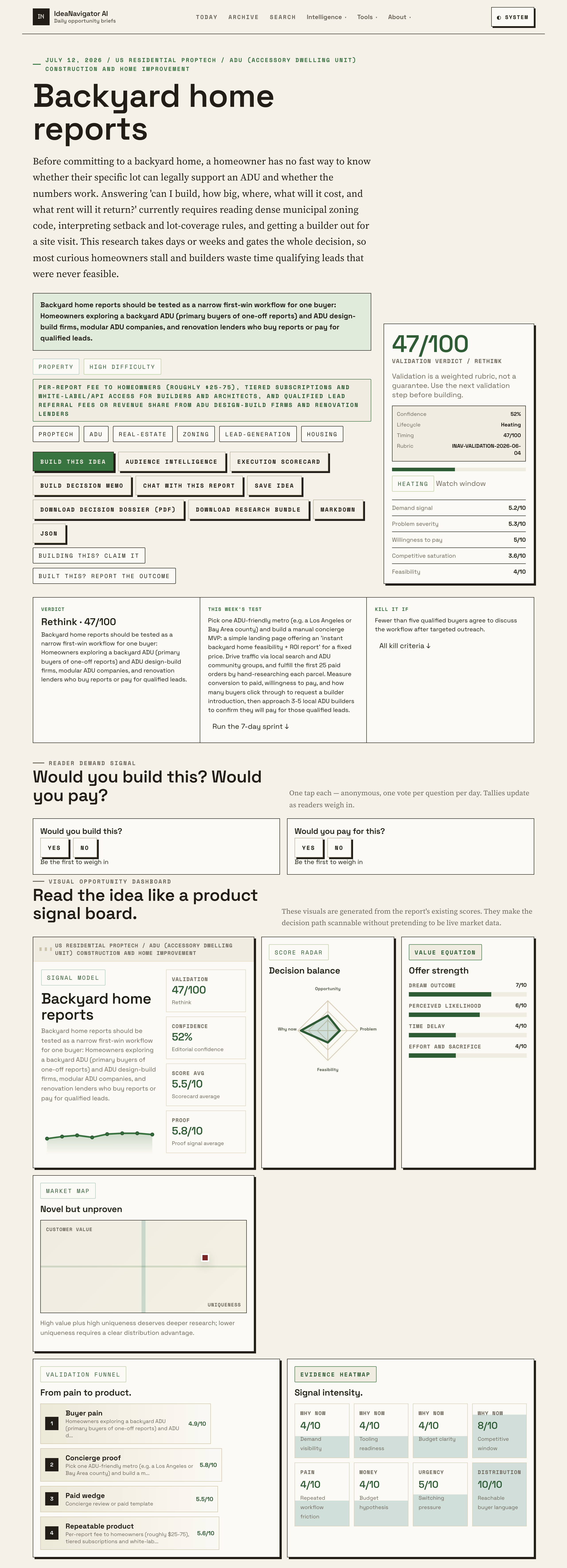
IdeaNavigator AI has published an analysis proposing per-address backyard home feasibility reports as a narrow, immediately testable proptech product. The pitch targets homeowners exploring accessory dwelling units (ADUs) and the builders and lenders serving them, citing surging ADU permitting in California and newly practical parcel-data and LLM tooling.
A new analysis from IdeaNavigator AI argues that one of the most practical entry points into residential proptech is a narrow one: paid, instant backyard home feasibility reports that tell a specific homeowner whether their lot can legally support an accessory dwelling unit (ADU) and what the economics would look like. The analysis frames the offering as a “first-win workflow” — a small, testable product aimed at homeowners stalled at the earliest, most frustrating stage of an ADU project, and at the builders and lenders who need qualified, feasible leads rather than curious browsers.
The core problem the analysis identifies is a research bottleneck. Before committing to a backyard home, a homeowner has no fast way to answer the questions that gate the entire decision: can I build, how big, where on the lot, what will it cost, and what rent will it return? According to the analysis, answering those questions today requires reading dense municipal zoning code, interpreting setback and lot-coverage rules, and scheduling a builder site visit — a process that takes days or weeks. The result, the analysis argues, is that most curious homeowners stall, while builders waste time qualifying leads that were never feasible.
The proposed product is a web app where a homeowner enters a property address and pays for a homeowner-ready PDF report. The system would ingest county parcel data — boundaries, lot size, existing footprint — and evaluate the lot against state ADU law plus a manually curated rule set for a single launch market, such as a few California counties. Each report would cover allowed ADU types, maximum size, setback and lot-coverage constraints, a buildable-area estimate, a realistic build-cost band, and projected rental income drawn from local rent comps. A “connect me with a vetted ADU builder” button would capture lead-generation revenue alongside report sales.
The revenue model is layered: a per-report fee to homeowners of roughly $25–75, tiered subscriptions and white-label or API access for builders and architects, and qualified lead referral fees or revenue share from ADU design-build firms and renovation lenders. Validation is deliberately manual: launch in one ADU-friendly metro such as a Los Angeles or Bay Area county, fulfill the first 25 paid reports by hand, and measure conversion and builder-intent clicks before approaching three to five local ADU builders to confirm they will pay for those leads.
Why Feasibility Reports Fill a Real Gap
The proposal matters because it targets the single decision point that determines whether an ADU project happens at all. Feasibility — not financing or design — is where most homeowners abandon the idea, according to the analysis, because the cost of finding out is measured in days of zoning research or an expensive site visit. A $25–75 report that answers feasibility questions in minutes would lower that barrier sharply.
The model also matters for the supply side. ADU design-build firms and renovation lenders spend heavily on customer acquisition, and the analysis argues that a report purchase is itself a strong qualification signal: someone who pays for a feasibility report on their own address is far closer to building than a casual website visitor. That dual-sided dynamic — homeowner payment plus builder lead fees — is what makes the narrow product potentially sustainable rather than a one-off utility.
The timing argument is structural rather than speculative. California legalized ADUs statewide in 2016 and has loosened rules nearly every year since, while other states and cities follow suit. Los Angeles County alone permitted over 45,000 ADUs in 2023, and ADUs now represent roughly one in five new housing units produced in California, according to figures cited in the analysis. A US housing shortage estimated in the millions of units provides continued policy pressure in favor of backyard construction.
Products Worth Considering

Samsung 37-inch Odyssey G7 Curved 4K UHD Gaming Monitor (G75F)

DJI Osmo Mobile 8 Phone Gimbal with Mic Mini Transmitter, Infinity Black

Logitech MX Keys S Combo Wireless Keyboard and Mouse, Graphite
As an affiliate, we earn on qualifying purchases.
The Legal and Data Shift Behind the Idea
Two developments make the product newly practical, according to the analysis. The first is legal: the 2016 California state law legalizing ADUs, followed by near-annual rule loosening, converted backyard units from a permit battle into a largely by-right entitlement in much of the state. Comparable reforms are spreading to other states and cities, expanding the addressable market over time.
The second is technological. County parcel and zoning data sets have matured to the point where lot boundaries, lot size, and existing structure footprints can be pulled programmatically. At the same time, LLM-based code parsing makes it feasible to convert dense municipal zoning text into structured rules — although the analysis recommends against relying on automation at launch, advising hand-curated rule sets for a single launch market to guarantee report accuracy. The overall market is US residential proptech and ADU construction, a segment whose permitting volume has grown sharply since the legal reforms began.
What the Analysis Hasn’t Proven
The analysis is a market opportunity assessment, not evidence of a working business. No pricing assumptions have been tested with real customers, and it remains unclear whether homeowners will pay $25–75 for a report they may believe they can get free from a city planning office or a builder’s free consultation. The analysis itself flags this by prescribing a manual validation phase rather than assuming demand.
Report accuracy is also unproven. Zoning rules vary by county and city, change frequently, and interact with state law in ways that are easy to mis-parse; a feasibility report that is wrong on setbacks or maximum size could expose a report seller to liability, a risk the analysis does not address. The lead-gen side is likewise unvalidated — whether ADU builders will actually pay for report purchasers as qualified leads is a hypothesis to be tested with three to five firms, not a confirmed revenue stream. Finally, the cited market figures, including the 45,000 Los Angeles County permits in 2023, are presented without an original data source and would need independent verification.
How the Market Test Would Run
The prescribed next step is a concierge MVP in a single ADU-friendly metro: a simple landing page offering an “instant backyard home feasibility + ROI report” at a fixed price, traffic driven through local search and ADU community groups, and the first 25 paid orders fulfilled by hand-researching each parcel. Founders following the playbook would measure conversion to payment, willingness to pay, and how many buyers click through to request a builder introduction.
Only after those numbers exist would the model approach ADU design-build firms to confirm willingness to pay for qualified leads. From there, the path outlined is geographic expansion county by county, automation of the curated rule sets using parcel data and code parsing, and layered B2B products — subscriptions, white-label access, and API integrations for builders, architects, and renovation lenders. Whether any of that proceeds depends entirely on the outcome of the initial manual test.
Source: IdeaNavigator AI
Key Questions
What is a backyard home feasibility report?
A paid per-address report that tells a homeowner whether their lot can legally support an ADU, including allowed unit types, maximum size, setback and lot-coverage constraints, a buildable-area estimate, a build-cost band, and projected rental income from local rent comps.
Who would buy these reports?
Per the analysis, the primary buyers are homeowners exploring a backyard ADU, who would pay a one-off fee of roughly $25–75. ADU design-build firms, modular ADU companies, and renovation lenders would buy reports, subscriptions, or qualified leads derived from report purchasers.
Why is this considered viable now?
California legalized ADUs statewide in 2016 and has loosened rules nearly every year since, with other jurisdictions following. Los Angeles County permitted over 45,000 ADUs in 2023, and mature parcel data plus LLM-based code parsing make instant per-address analysis newly practical, according to the analysis.
How would the idea be validated?
By launching in one ADU-friendly metro, fulfilling the first 25 paid reports manually, and measuring conversion, willingness to pay, and builder-intent clicks — then confirming that three to five local ADU builders will pay for the resulting qualified leads.
What are the main risks?
Unproven consumer willingness to pay, the difficulty of keeping zoning rule sets accurate across jurisdictions with changing regulations, potential liability for incorrect reports, and the untested assumption that builders will pay for report purchasers as leads.
Source: IdeaNavigator AI