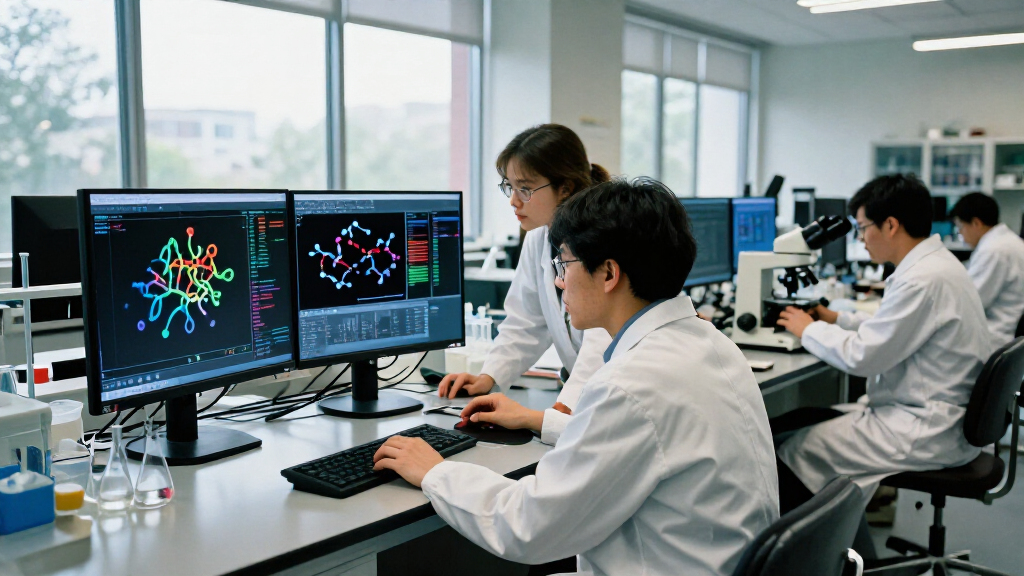

🔍 Read the full analysis: TikTok CEO’s Three-Year Outlook For AI In Scientific Research on ThorstenMeyerAI.com

Get business pricing on monitors, keyboards and dev gear
- Business-only prices and quantity discounts
- Tax-exempt purchasing
- Multiple users, one account, clear invoices
TL;DR
A CNBC headline says TikTok CEO Shou Zi Chew expects AI to contribute to major scientific breakthroughs within three years. The material available here does not include the article text, an exact quote, examples or evidence, so the forecast cannot be assessed in detail.
A CNBC headline attributes a near-term scientific forecast to TikTok CEO Shou Zi Chew: he expects artificial intelligence to contribute to major breakthroughs within three years. The available material does not include CNBC’s article text or a transcript, so it does not establish which fields Chew meant, what he counts as a breakthrough, or what supports the timeline.
The headline reports an expectation about AI’s future role, not a completed scientific discovery. It does not identify a research result, laboratory, AI system or project that is already on course to produce a breakthrough. The supplied material also contains no direct wording from Chew, so his forecast cannot be quoted or interpreted beyond the headline’s description.
That gap limits what can be concluded about the scope of the claim. It is not clear whether Chew was referring to AI tools that analyze large datasets, help generate or test hypotheses, support laboratory work, or a combination of research tasks. Nor does the material say whether he was expressing a personal view, describing a company position or offering a broader prediction about the technology sector.
The distinction between AI assisting research and producing a confirmed finding matters. A model-generated suggestion or an apparent pattern in data is not, by itself, a validated scientific result. Researchers need to evaluate evidence, test findings and assess whether results can be reproduced. No such evidence or validation is described in the available account.
Why the Three-Year Forecast Matters
The forecast draws attention to the possibility that AI could affect research on a short timeline, rather than only changing consumer-facing technology. If tools help scientists analyze data, examine possible explanations or speed up parts of experimental work, they could influence how quickly some research questions are explored. The headline, however, provides no examples that show this is already happening in a specific field or at a scale that would support Chew’s prediction.
For readers, the key distinction is between a broad outlook and evidence of a breakthrough. A prediction may be worth tracking, but the words “major scientific breakthroughs” are not defined in the material supplied. Without a field, measurable benchmark or named finding, it is not possible to judge what would count as the forecast coming true. Claims about any eventual discovery would also need to be assessed on the evidence for that finding, not simply on whether AI was involved.
The three-year window gives the statement a period that could be revisited, but there is no stated milestone or method for measuring progress. That leaves the forecast as a general expectation rather than a testable account of a specific research program.
As an affiliate, we earn on qualifying purchases.
From AI Assistance to Verified Findings
AI can be used in research in different ways, including processing large collections of data and helping researchers explore possible explanations. Those uses do not make a system an independent source of scientific proof. Scientists still need to examine whether an output is reliable, test relevant claims and communicate enough evidence for others to evaluate the work.
This distinction is especially relevant to a forecast framed around breakthroughs. A tool might help identify a promising direction or save time on part of an analysis without directly producing a discovery. The supplied headline does not clarify which kind of contribution Chew had in mind, and it offers no examples of previous or ongoing work to help readers place his prediction in a research timeline.
The available account is limited to the headline and a summary noting that the CNBC article body could not be extracted. It gives no interview date, exact quotation or supporting study. Those missing details prevent a fuller assessment of the remarks and their basis.
“Shou Zi Chew expects artificial intelligence to contribute to major scientific breakthroughs within three years.”
— CNBC headline, as described in the supplied material
As an affiliate, we earn on qualifying purchases.
What the Forecast Leaves Open
The available material does not identify which scientific fields Chew was discussing, how he defined a major breakthrough or what evidence supports the three-year estimate. It also provides no examples of research projects, AI systems or results connected to the prediction. Without the full report or a transcript, the circumstances and precise scope of his remarks remain unknown.
It is also unclear whether any particular discovery is underway or expected. The headline does not report a completed finding, and the supplied material does not name researchers, studies or independent assessments that would allow the forecast to be compared with current results. No basis is provided to say that a breakthrough is assured or that AI would be its sole cause.
As an affiliate, we earn on qualifying purchases.
Details Needed to Test the Prediction
The next step for assessing the claim is access to the full CNBC report or a transcript showing Chew’s exact remarks and any examples he gave. That could clarify whether the forecast concerns particular research areas, current projects or expected improvements in AI capabilities. Until then, the three-year timeframe is the only specific measure available, and it has no stated milestone in the material provided.
Over time, the prediction can be judged only against identifiable findings and the evidence supporting them. Any claimed breakthrough would need to be described specifically, with its research basis and validation made clear. The supplied material does not give a date for Chew’s remarks, so it also does not establish precisely when the three-year period begins or when it ends.
As an affiliate, we earn on qualifying purchases.
Key Questions
What did TikTok CEO Shou Zi Chew predict?
A CNBC headline, as described in the supplied material, says Chew expects AI to contribute to major scientific breakthroughs within three years. His exact wording is not available here.
Which areas of science did he mention?
The available information does not name any scientific field, project or discovery. The full report or a transcript would be needed to clarify the scope.
Does the headline report that AI has already produced a breakthrough?
No. It reports a forecast about the next three years, not a completed or validated scientific result.
What evidence supports the three-year estimate?
No supporting evidence is included in the supplied material. It contains no direct quote, study, example or explanation of how Chew reached the estimate.
When does the three-year period begin?
The interview date and publication details are not available in the supplied material, so the start and end dates of the forecast cannot be determined from it.
Primary source: ByteDance Seed · via ThorstenMeyerAI.com
Fall Picks
fall essentials
As an affiliate, we earn on qualifying purchases.