
Rangefinders use laser technology and geometric principles to measure distance accurately. They send a laser beam toward the target, then calculate how long it takes to reflect back, adjusting for angles and tilt with built-in sensors. Trigonometry helps convert these angle and distance measurements into true target distances, even on steep slopes or uneven terrain. Mastering these concepts makes targeting easier—keep exploring to learn how all these calculations work together seamlessly.

Get business pricing on monitors, keyboards and dev gear
- Business-only prices and quantity discounts
- Tax-exempt purchasing
- Multiple users, one account, clear invoices
Key Takeaways
- Rangefinders measure distance by calculating the time or signal reflection of laser beams directed at the target.
- They use trigonometry, combining angles and baseline distances to determine the true target distance.
- Tilt and elevation affect measurements; correction features adjust for these angles for accuracy.
- Narrow laser beam divergence improves precision by focusing the laser on the target.
- Proper calibration and stable device handling are essential for reliable, accurate distance and angle readings.
What Is a Rangefinder and How Does It Measure Distance?
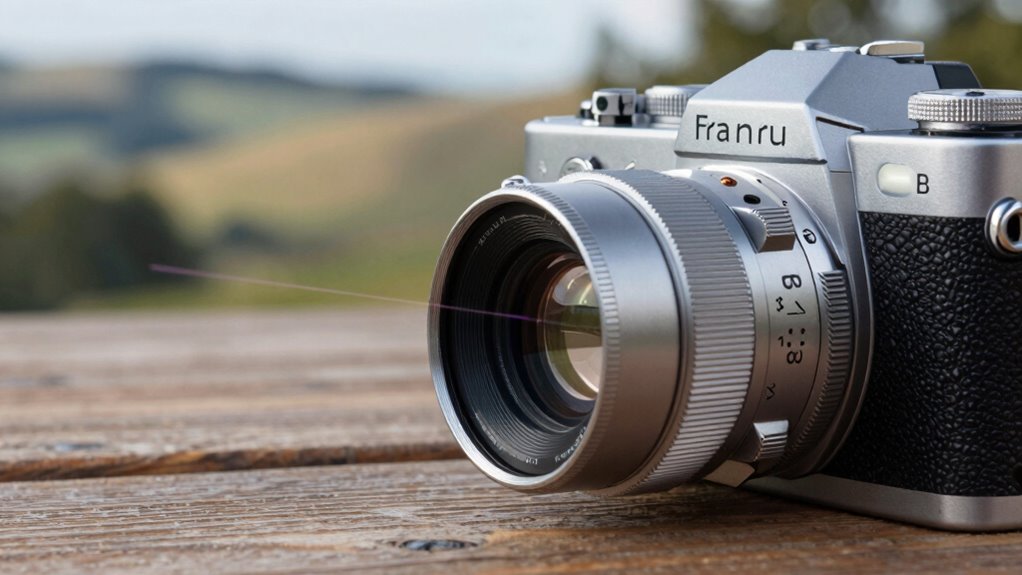
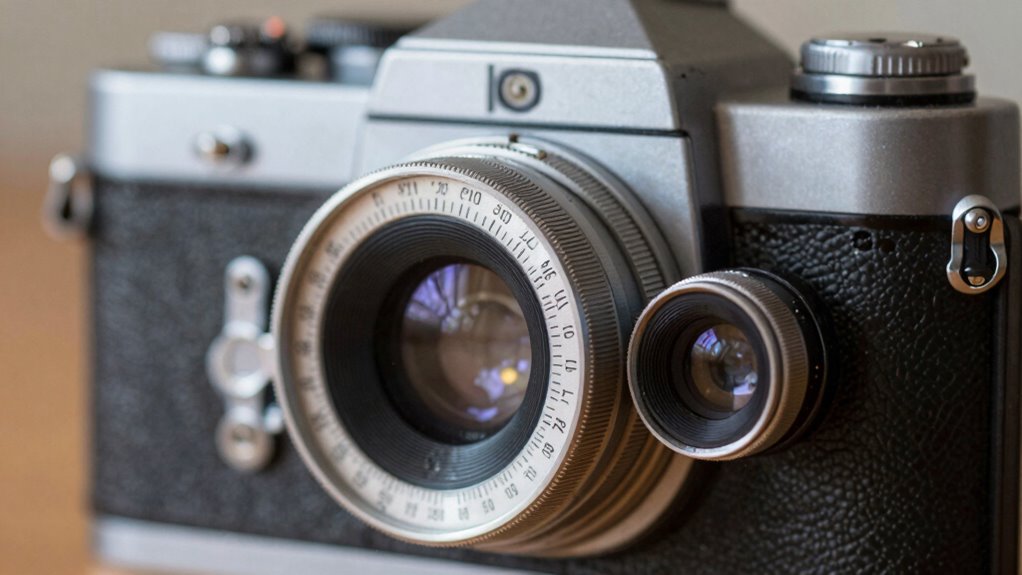
Have you ever wondered how golfers accurately judge the distance to their target or how surveyors measure land with precision? That’s where a rangefinder comes in. It uses laser technology to send a focused laser beam toward your target. The device then measures the time it takes for the laser to reflect back, calculating the distance based on this information. Inside, optical systems help direct and focus the laser beam, ensuring accurate readings. Rangefinders are designed for quick, precise measurements, whether you’re on a golf course or surveying land. They combine laser technology with sophisticated optical systems to give you reliable distance data instantly. laser technology enables these devices to provide fast and accurate results in diverse settings. Additionally, optical systems are crucial for focusing and directing the laser beam accurately, which enhances the device’s overall precision. Understanding the power requirements of these devices is essential to ensure proper operation and safety during use. Moreover, advancements in optical system design have further improved the accuracy and usability of modern rangefinders, making them more accessible for various applications. A good understanding of the underlying principles helps users operate these devices more effectively and interpret their measurements accurately.
How Do Angles and Measurements Affect Rangefinding?
Ever wonder how angles influence the accuracy of rangefinding? When measuring distance, the angle between your device and the target matters a lot. A slight tilt can throw off laser alignment, causing inaccurate readings. Rangefinders often use signal processing to interpret the laser’s reflections, correcting for angle differences through trigonometry. If you’re not aligned properly, the signal might scatter or weaken, leading to errors. By adjusting for angles, the device ensures the laser beam hits the target precisely, and the returned signal is clear. Proper calibration and understanding of angle measurement are key to maintaining accuracy across various terrains. Additionally, the key traits of skilled rangefinder users include patience and attention to detail, which are vital for ensuring correct measurements. Being aware of body jewelry measurements and materials can also help in understanding how equipment calibration might be affected in different environments. Recognizing how decoding fan culture influences user behavior can also provide insights into how technology is adopted and optimized in diverse settings.
The Geometry of Distance Calculation in Rangefinders
Understanding how rangefinders calculate distance starts with grasping triangulation principles, where angles and baseline lengths are key. You’ll explore various angle measurement techniques that improve accuracy, like laser or optical methods. A high refresh rate can further enhance the precision of these measurements by reducing motion blur and ensuring more stable readings. Additionally, advancements in sensor technology have contributed to more reliable and quicker distance computations in modern devices. Furthermore, calibration methods help maintain measurement accuracy over time by compensating for environmental factors and device wear. Finally, you’ll see how distance computation formulas combine these measurements to give precise results. Efficient passive voice detection can further enhance the clarity of technical explanations.
Triangulation Principles
How do rangefinders accurately determine distances using geometry? They rely on triangulation principles, which involve measuring angles and applying basic trigonometry. The device emits a laser beam that should be precisely calibrated through laser calibration to ensure accuracy. Beam divergence, or how much the laser spreads out, affects measurement precision; a narrower divergence means more accurate distance readings. The rangefinder calculates the distance by knowing the angle between the laser source and the target, then using the triangle formed between the device, the laser spot, and the target. This geometric approach allows for quick, reliable measurements without needing to physically reach the object. By carefully controlling laser calibration and minimizing beam divergence, the device ensures the triangulation calculations remain precise and trustworthy. laser calibration is crucial for maintaining measurement accuracy in these devices, and understanding the effects of Beam divergence can help optimize measurement results.
Angle Measurement Techniques
Rangefinders determine distances by measuring angles with high precision. They use laser alignment to guarantee accurate targeting and angle calibration to maintain measurement consistency. These devices often employ laser beams to detect the angle between your position and the target, translating it into distance. Proper angle calibration is essential for reliable results, especially when measuring over long distances. To illustrate, consider this table:
| Technique | Tool Used | Key Benefit |
|---|---|---|
| Laser Alignment | Laser emitter | Precise targeting |
| Angular Sensors | Gyroscopes | Accurate angle measurement |
| Signal Reflection | Light pulses | Improved calibration |
| Digital Processing | Microprocessors | Fast, reliable calculations |
Additionally, understanding dream symbolism related to time and measurement can provide insight into how we perceive life’s passage and uncertainties. The integration of laser-based tools further enhances measurement accuracy by reducing human error and providing real-time feedback. Incorporating advanced calibration methods ensures consistent accuracy across different measurement scenarios. Moreover, these calibration techniques often rely on precise angular sensors to maintain consistent accuracy over various conditions. Employing robust testing procedures is also crucial to verify that calibration remains effective in different environments.
Distance Computation Formulas
Distance calculation in rangefinders relies on applying geometric principles to the measured angles and known baseline distances. Once the device captures an angle, it uses laser calibration to guarantee accurate beam alignment, reducing measurement errors. Signal processing then refines the data by filtering out noise and enhancing the signal quality. These processed signals help determine the precise angle between the device and the target. Using basic trigonometry, the rangefinder applies formulas such as the Law of Cosines or simple tangent functions, depending on the measurement setup. By combining the baseline distance and the measured angles, the device calculates the distance to the target. This integration of laser calibration, signal processing, and geometric formulas ensures accurate, reliable distance measurements in various conditions.
How Tilt and Elevation Change Your Measurements
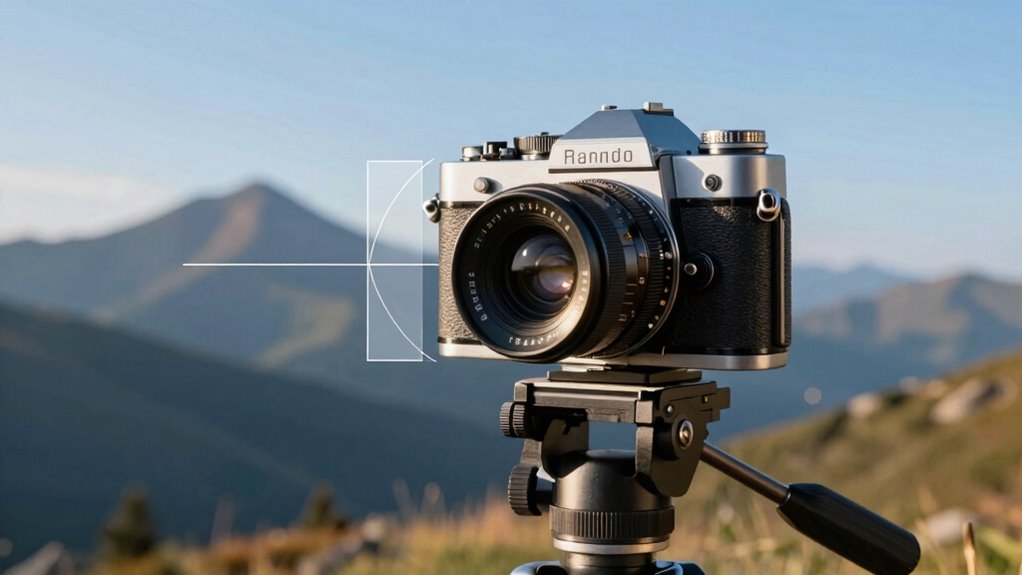
When you tilt a rangefinder or change the elevation angle, it can substantially affect your distance measurements. Tilt effects occur because the device measures along a line that isn’t perfectly horizontal, leading to overestimations or underestimations if uncorrected. Elevation impact refers to how uphill or downhill angles alter the perceived distance, making targets appear closer or farther than they truly are. When the device isn’t level, the measurement isn’t just a simple straight line; it includes the angle of tilt. Ignoring tilt effects can cause inaccuracies, especially over long distances or steep slopes. Additionally, understanding how angle measurement influences readings can help you interpret and adjust your results more accurately. For example, many rangefinders are equipped with angle correction features that automatically compensate for tilt, improving measurement precision. To improve accuracy, you need to account for these factors, ensuring your measurements reflect true horizontal or vertical distances, rather than the sloped line of sight.
Using Trigonometry to Get Accurate Distance and Angles
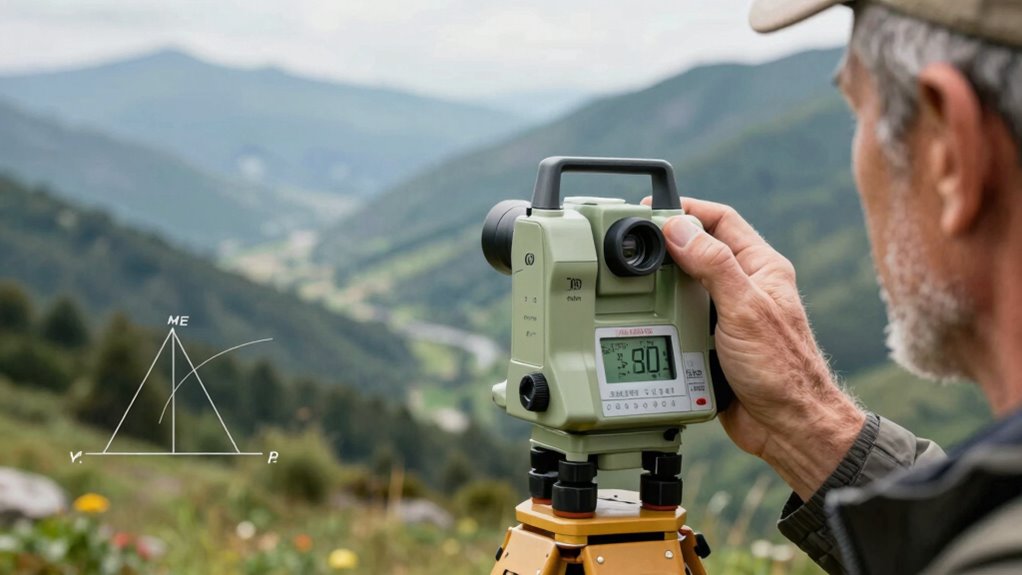
To obtain accurate measurements when using a rangefinder on inclined or declined surfaces, you need to apply trigonometry. Your rangefinder’s optical magnification helps you aim precisely, guaranteeing the laser hits the target accurately. Proper laser calibration is vital for trustworthy readings, especially at longer distances or challenging angles. Trigonometry allows you to convert the laser’s direct measurement into true distance by accounting for the angle of elevation or decline. When you measure an inclined surface, you’re fundamentally creating a right triangle, where the laser forms the hypotenuse. By using sine, cosine, or tangent functions, you can calculate the actual distance and angles more precisely. This process ensures your measurements are reliable, regardless of terrain or target position.
Tips to Improve Your Rangefinder Accuracy in the Field
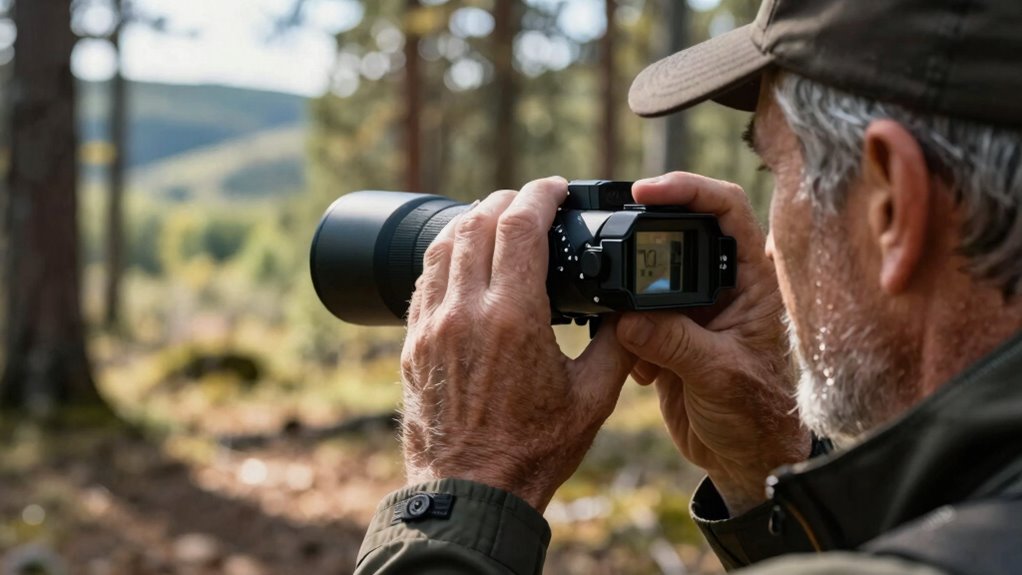
Ensuring accurate readings with your rangefinder in the field requires attention to several practical factors. First, regularly calibrate your laser to guarantee precision. Second, be mindful of weather effects like fog, rain, or heat waves, which can distort laser signals. Third, stabilize your stance and hold the device steady for consistent measurements. Fourth, double-check your device’s settings, especially if it offers different modes for distance or angle. Keep your lens clean and free of dirt or smudges to avoid measurement errors. Remember, environmental conditions and laser calibration directly impact accuracy. By staying vigilant about these factors, you’ll improve your rangefinder’s reliability and get more precise readings every time.
Frequently Asked Questions
What Types of Rangefinders Are Available for Different Activities?
You can find various rangefinders tailored for different activities, such as golf, hunting, or surveying. Laser types vary, with some offering simple point-and-shoot functions, while others include advanced features like angle measurements. User interfaces differ too, with some devices providing intuitive displays and easy controls. Choose a rangefinder that matches your activity’s needs, ensuring it offers the right laser type and user interface for accurate, hassle-free measurements.
How Does Weather Affect Rangefinder Accuracy?
Weather, especially atmospheric conditions like fog, rain, or haze, can diminish your rangefinder’s accuracy by scattering or absorbing the signals it uses. To maintain precision, you should perform calibration procedures regularly, especially before critical measurements. Keep in mind that extreme weather can challenge even well-calibrated devices, so always account for environmental factors and double-check readings in adverse conditions to ensure reliable results.
Can Rangefinders Measure Angles in Three Dimensions?
Imagine opening a new dimension of precision—yes, rangefinders can measure angles in three dimensions. They use advanced sensors to perform three dimensional calculations, capturing both horizontal and vertical angles. This capability allows you to determine distances and elevations accurately, transforming simple angle measurement into an all-encompassing spatial understanding. Whether you’re surveying or hunting, this three-dimensional functionality broadens your scope, giving you a complete picture with every measurement you take.
What Are Common Mistakes to Avoid When Using a Rangefinder?
You should avoid calibration errors and improper targeting when using a rangefinder. Always double-check the device’s calibration before use, as miscalibration leads to inaccurate readings. Make sure you aim precisely at your target, keeping the rangefinder steady and centered on the object, to prevent measurement errors. Additionally, avoid rushing your readings—taking your time guarantees more accurate measurements and reduces mistakes.
How Do Advanced Features Like Ballistic Compensation Impact Measurements?
You might think advanced features like ballistic compensation complicate measurements, but they actually improve accuracy. When you enable ballistic compensation, your rangefinder adjusts for bullet trajectory, accounting for factors like distance and angle. Proper rangefinder calibration guarantees these features work correctly, giving you precise readings. This way, you can confidently hit your target, even at long ranges or difficult angles, making your shots more accurate and reliable.
Conclusion
Now that you understand how rangefinders use geometry and trigonometry, you’ll see why they’re so precise. Did you know that even a small tilt can throw off measurements by over 10%? Mastering these concepts helps you get accurate distances and angles every time. With a little practice, you’ll confidently use your rangefinder to make better shots, measure longer distances, or plan your next adventure with ease. Keep honing those skills—you’ll be surprised at what you can accomplish!
Halloween Picks
halloween
As an affiliate, we earn on qualifying purchases.