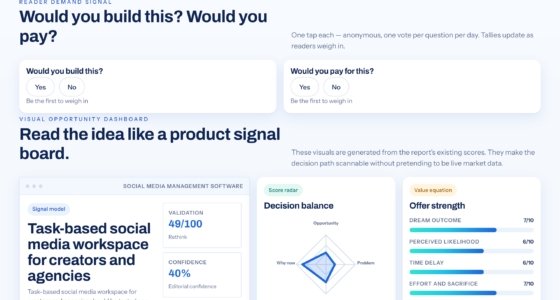
📊 Full opportunity report: Make Camera Practice Part Of Your Small Business Communication Routine on IdeaNavigator AI — validation score, market gap, and execution plan.

Get business pricing on monitors, keyboards and dev gear
- Business-only prices and quantity discounts
- Tax-exempt purchasing
- Multiple users, one account, clear invoices
TL;DR
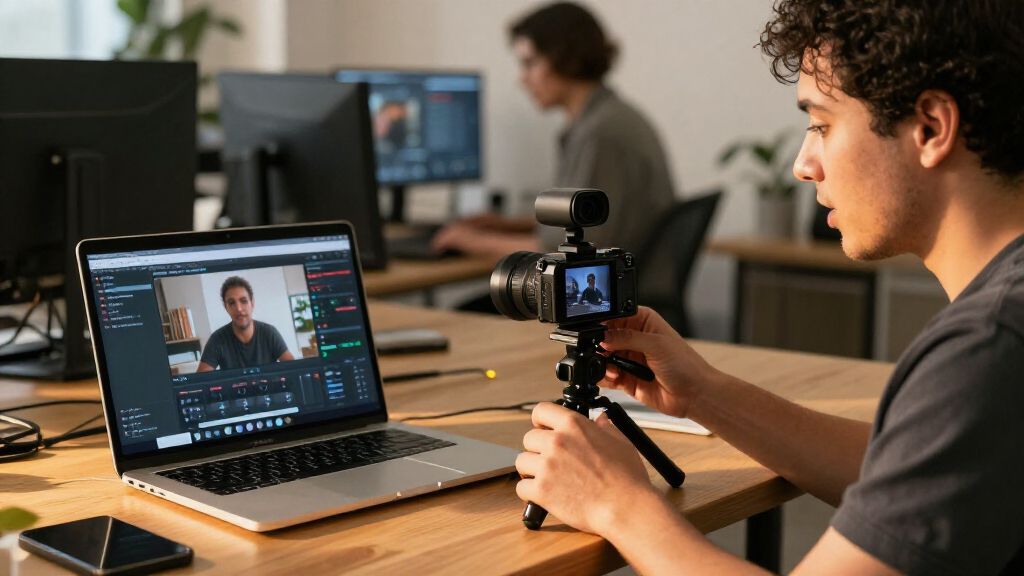
IdeaNavigator AI has outlined a proposed practice app for small-business owners who want to make video but struggle when recording themselves. The concept includes short daily exercises and private feedback, but it remains an idea: a 30-day cohort and a waitlist comparison are proposed, not reported results.
IdeaNavigator AI has outlined a proposed camera-practice app for small-business owners who know video could support their marketing but find recording themselves difficult. The concept pairs two-minute daily exercises with feedback on delivery, while a proposed 30-day cohort would test whether participants publish a real video; no product launch or test findings are reported.
In its IdeaNavigator AI concept outline, the problem identified is a gap between the pressure business owners feel to post video and their ability to get comfortable recording it. The proposal describes camera anxiety as stumbling, repeated takes and self-criticism that can keep owners from publishing at all. It argues that public-speaking courses may not address the specific experience of recording alone, reviewing a take and deciding whether to share it.
The suggested minimum viable product would start with daily, two-minute prompts, moving users from reading prepared material to speaking more freely. The IdeaNavigator AI outline says the app would offer private feedback on pace, filler words, eye line and energy, and show changes over time. It would also use confidence streaks and a gradual path toward recording actual business content. These are proposed features, not confirmed capabilities of an available app.
For validation, IdeaNavigator AI proposes recruiting 100 business owners for a 30-day cohort and comparing their results with a waitlist control. The outline names how many participants publish their first real video by day 45 as the measure. It also suggests a consumer subscription and a team tier for agencies that coach clients, but provides no pricing, revenue estimates or evidence of demand.
Make Camera Practice Part Of Your Small Business Communication Routine
IdeaNavigator AI has outlined a proposed practice app for business owners who want to use video but find recording themselves difficult. The concept combines brief daily exercises with private feedback. A 30-day cohort is proposed to test whether practice leads to publishing; no launch or test results are reported.
Concept stage · Features and validation plan are proposals, not confirmed product capabilities.
Suggested short practice sessions
Proposed cohort practice period
Business owners in the proposed cohort
First real video publication measure
Practice for the moment the camera turns on
The concept targets owners who already see a role for video in marketing but feel uncomfortable recording alone. Repeated takes, stumbling, and self-criticism can make it harder to publish. The proposal argues that solo recording may call for a different kind of practice than broad public-speaking training.
Recording feels difficult
The intended user believes video matters, yet may freeze when it is time to speak to a camera.
Low-stakes repetition
Brief prompts would help users move from prepared reading toward speaking more freely.
Publish real content
A gradual path would lead toward recording actual business videos, if the routine proves useful.
From a private prompt to a published video
IdeaNavigator AI’s outline describes a possible minimum viable product with private delivery feedback and progress tracking. These features have not been confirmed in an available app.
Read
Start with prepared material in a short daily prompt.
Speak
Gradually move toward less scripted responses.
Review
Private feedback would cover pace, filler words, eye line, and energy.
Record
Build toward creating and publishing real business content.
Open questions: The outline does not identify a specific AI model or explain how feedback would be calculated, checked for accuracy, or adapted to different speaking styles and recording conditions.
Measure publishing behavior, then ask what it means
The proposed trial would compare a 30-day practice cohort with a waitlist control. Its named early outcome is the number of participants who publish a first real video by day 45.
100 owners · 30 days
Recruit business owners for daily practice and compare their publishing behavior with a waitlist group. Recruitment details, group handling, and the definition of a published video are not provided.
First video by day 45
This could show whether participants take a first publishing step. It would not establish lasting confidence, marketing quality, customer growth, or revenue impact on its own.
Bars indicate the evidence status in the supplied outline, not measured performance or a forecast.
A specific use case, with important gaps to resolve
No availability details
No app name, developer, release date, price, or working prototype is reported.
Feedback is unverified
No accuracy tests or details explain how automated feedback would account for individual styles.
Demand is unknown
Subscription and agency team tiers are suggested, but there are no pricing, revenue, or demand findings.
The concept’s significance rests on the test it proposes. Practice engagement and a first published video are useful early signals, but they are different from evidence that customers or sales improve.
What readers should know
Is the camera-practice app available now?
No launch or available product is reported. The outline describes a proposed app concept and possible features.
Who is it intended for?
Business owners who believe video matters for their work but feel uncomfortable or freeze when recording themselves.
What exercises are proposed?
Two-minute daily prompts, progressing from reading to freer speaking, with private feedback on pace, filler words, eye line, and energy.
How would the concept be tested?
A proposed 30-day cohort of 100 owners would be compared with a waitlist control on first-video publishing by day 45. No results are available.
Would that show improved sales?
No. Counting published videos could test whether participants take that step, but the outline does not set out sales or revenue measures.
Could agencies use it?
A team tier for agencies coaching clients is suggested. Whether agencies would pay, or automated feedback would add value to human coaching, remains open.
Testing Whether Practice Leads to Publishing
The IdeaNavigator AI proposal focuses on a practical obstacle: some owners may understand the value of video yet avoid recording because the process feels uncomfortable. If a private practice routine helps them move from rehearsing to publishing, it could address a different need from broad communication training: repeated, low-stakes practice for solo recording.
That potential remains unproven. Feedback about pace or filler words is not the same as evidence that a user becomes more comfortable, produces useful marketing or gains customers. The proposal’s day-45 publication measure offers a concrete early behavioral outcome, but it would not by itself establish commercial impact. For small firms deciding where to spend limited time and money, the distinction between practice engagement and business results matters.
The proposal also points to a possible agency use case, where coaches might support multiple clients through a team tier. Whether agencies would pay for such a tool, and whether automated feedback would add value to human coaching, are open questions. The concept’s importance therefore lies in the test it proposes, rather than in any demonstrated market traction.
Products Worth Considering

DJI Mic 3 Wireless Microphone System (2 Transmitters, 1 Receiver, Charging Case)

Logitech MX Keys S Wireless Keyboard, Graphite

Logitech MX Mechanical Wireless Illuminated Keyboard, Tactile Quiet, Graphite
As an affiliate, we earn on qualifying purchases.
A Specific Gap in Video Coaching
As presented in IdeaNavigator AI’s outline, the proposal sits within the communication skills training market and responds to the spread of video-first marketing expectations across businesses of different sizes. The outline does not provide market-size figures or evidence that every small-business owner faces the same level of pressure. Its intended user is narrower: an owner who already believes video matters but freezes when it is time to record.
IdeaNavigator AI frames multimodal AI as a reason the concept may be timely, because software could assess elements such as speaking pace, filler words, eye contact and energy. However, the outline does not name a specific model, explain how those measures would be calculated, or report tests of accuracy. It also does not say how feedback would account for different communication styles or recording conditions. The technology is presented as a proposed means of delivering feedback, not as a verified solution.
No App or Outcomes Confirmed
The IdeaNavigator AI outline describes a product opportunity and validation plan, not a launched service or completed study. No app name, developer, release date, price or working prototype is provided. It is also unclear whether any business owners have tested the exercises or whether the suggested feedback measures have been evaluated for reliability.
The proposed cohort design leaves important details unspecified, including how participants would be recruited, what counts as a published video, how the waitlist group would be handled and whether other support would be offered. The outline gives no expected conversion rate, retention figure or customer-acquisition evidence. Until those details and results exist, claims that the app can reduce anxiety, increase publishing or improve business performance remain unverified.
A Cohort Would Test the Core Claim
IdeaNavigator AI’s outline proposes a 30-day trial with 100 owners, followed by measurement of first-video publication by day 45 against a waitlist control. No start date, recruitment announcement or trial results are provided in the outline. If the test proceeds, its findings could indicate whether the practice routine changes publishing behavior, though further evidence would be needed to assess longer-term use and business outcomes.
For now, the proposal remains at the idea and validation-planning stage. Any later product announcement would need to clarify the app’s availability, pricing, privacy practices for video analysis and the evidence behind its feedback. The end-of-article attribution identifies IdeaNavigator AI as the origin of the concept; it does not establish that the product has been built or independently tested.
Source: IdeaNavigator AI
Key Questions
Is the camera-practice app available now?
No launch or available product is reported. The IdeaNavigator AI outline describes a proposed app concept and possible minimum viable product features.
Who is the app intended for?
It is aimed at business owners who believe video matters for their work but feel uncomfortable or freeze when recording themselves.
What would the app’s exercises include?
The proposed routine uses two-minute daily prompts, progressing from reading to speaking more freely, with private feedback on pace, filler words, eye line and energy.
How would the concept be tested?
IdeaNavigator AI proposes a 30-day cohort of 100 owners, with the number who publish a first real video by day 45 compared with a waitlist control. No trial results are available.
Would the app show that video marketing improves sales?
Not from the proposed measure alone. Counting published videos could test whether participants take that step, but the outline does not set out a sales or revenue measure.
Source: IdeaNavigator AI