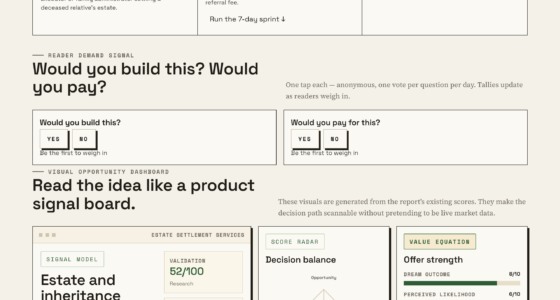

📊 Full opportunity report: Forge or Self-Host? The Real Cost of Sovereign AI on ThorstenMeyerAI.com — validation score, market gap, and execution plan.
Open a free Amazon Business account
Business pricing, bulk buying and tax-exempt orders.
Create a free accountAs an affiliate, we earn on qualifying purchases.
TL;DR
Recent analysis shows that the cost gap between self-hosted and managed sovereign AI models is larger than expected, challenging assumptions about control and expense. The capability gap with proprietary models has narrowed, but costs and operational complexity remain significant.
New research indicates that the economic advantage of self-hosting sovereign AI models is diminishing, with costs often exceeding those of managed solutions. This shift challenges the long-held belief that control over data and models justifies higher expenses, impacting organizations considering their AI infrastructure options.
Since the launch of Mistral Forge in March 2026, organizations such as the European Space Agency and ASML have adopted a managed sovereignty approach, hosting models on proprietary infrastructure or Mistral’s European cloud. The core argument for self-hosting has been control over data and compliance, but recent cost analysis shows that GPU expenses, idle hardware costs, and human labor significantly inflate total costs.
Self-hosted GPU costs for serious models typically range from $2,000 to $20,000 per month, depending on hardware and utilization rates. In contrast, API-based on-demand pricing has increased, with GPU-hour costs rising about 14% year-over-year, making on-demand inference more expensive than many assume. Additionally, low utilization rates (5-10%) cause hardware costs to skyrocket per token, often exceeding the costs of managed inference by 2-5 times.
Operational costs, including staffing for model maintenance and monitoring, further diminish the economic appeal of self-hosting. In Germany, a DevOps engineer costs roughly €62,000–89,000 annually, which translates into an additional €1,500–4,000 monthly expense for most organizations—expenses not reflected in API invoices.
Meanwhile, recent advances in open models, such as Z.ai’s GLM-5.2, a 753-billion-parameter model released under a permissive license, have narrowed the performance gap with proprietary models for many enterprise tasks like summarization, extraction, and code assistance. However, for high-horizon, autonomous workloads, proprietary models still outperform open alternatives.
Forge or Self-Host?
The Real Cost of Sovereign AI
Sovereignty is the reason. Cost usually isn’t. — Forge Trilogy, Part 3
Two ways to buy control
Managed sovereignty (Forge-style)
- Full lifecycle: pre-training, post-training, RL on your data, in your jurisdiction
- Vendor’s training recipes + orchestration — no ML-infra team required
- Platform dependency: Mistral architectures only, for now
- Open question: do most enterprises need custom-trained models at all?
DIY self-hosting (open weights)
- Maximum control: air-gap capable, no vendor can switch you off
- GPU floor $2–20k/mo; H100 rates rose ~14% y/y
- Idle penalty ~10× below ~30% utilization — the silent budget killer
- The human: DevOps/MLOps runs €62–89k gross in Germany, seniors €100k+
The capability excuse evaporated — GLM-5.2 (open, MIT) vs Claude Opus 4.8
The answer that works: route, don’t choose (Bifröst pattern)
The verdict: self-hosting usually isn’t cheaper — but the capability tax on sovereignty has collapsed to a few points. You no longer sacrifice quality for control; you only pay for it. Price it honestly, then decide whether you’re buying insurance or ideology.
Implications for Organizations Considering Sovereign AI
This analysis questions the financial rationale behind self-hosting sovereign AI, especially for organizations with moderate utilization. While control and compliance remain critical, the actual costs—hardware, human resources, and operational complexity—often make managed solutions more practical and cost-effective. The narrowing capability gap also means organizations can now access high-quality open models without sacrificing performance, further reducing the need for costly self-hosted setups.
For decision-makers, understanding these dynamics is vital to avoiding overspending on infrastructure that may not deliver proportional benefits. The perception that self-hosting is inherently cheaper or more controllable no longer holds true in many realistic scenarios, potentially reshaping enterprise AI strategies.
As an affiliate, we earn on qualifying purchases.
Evolving Economics and Capabilities of Sovereign AI in 2026
Over the past two years, the narrative around sovereign AI has shifted from control to cost-effectiveness. Initially, organizations believed that self-hosting provided a competitive edge by ensuring data sovereignty, despite higher expenses. However, recent developments show that the cost of GPU hardware, especially during supply shortages, and operational overheads have increased, while the capability gap between open and proprietary models has narrowed significantly.
Advances like Z.ai’s GLM-5.2 demonstrate that open models are now competitive for many enterprise tasks, reducing the perceived need for expensive proprietary solutions. Meanwhile, API providers have raised prices, and hardware costs continue to grow, making self-hosting less financially attractive than before.
Industry experts emphasize that the original motivation for sovereignty—control over data—remains valid, but the economic trade-offs are more complex than simple cost comparisons suggest.
“Forge offers managed sovereignty solutions that balance control with operational efficiency, but organizations must carefully evaluate costs.”
— Mistral spokesperson
As an affiliate, we earn on qualifying purchases.
Uncertainties in Cost Estimates and Performance Benchmarks
While current cost analyses are comprehensive, precise expenses vary widely based on hardware prices, utilization rates, and staffing models. The long-term performance of open models like GLM-5.2 compared to proprietary models in high-stakes applications remains under ongoing evaluation, and future hardware supply constraints could further influence costs. Additionally, the full operational costs of maintaining sovereignty, including compliance and security, are still being assessed.
enterprise AI infrastructure hardware
As an affiliate, we earn on qualifying purchases.
As an affiliate, we earn on qualifying purchases.
Future Trends in Sovereign AI Infrastructure and Cost Optimization
Organizations will likely continue to evaluate open models’ capabilities against proprietary solutions, especially as open architectures improve. Hardware prices and supply chain stability will significantly impact the economics of self-hosting. Meanwhile, cloud providers may introduce new billing models to better accommodate low-utilization workloads, potentially shifting the cost balance further. Regulatory developments around data sovereignty could reinforce the importance of managed solutions despite higher costs.
As an affiliate, we earn on qualifying purchases.
Key Questions
Is self-hosting still a cost-effective option for sovereign AI?
Based on current data, self-hosting is generally more expensive than using managed solutions for most organizations, especially at typical utilization levels. The hardware, staffing, and operational costs often outweigh the benefits of control.
How do recent open models compare to proprietary models in performance?
Open models like Z.ai’s GLM-5.2 now perform competitively on many enterprise tasks, narrowing the gap with proprietary models. However, for high-horizon, autonomous applications, proprietary models still hold an advantage.
What are the main hidden costs of self-hosting sovereign AI?
Operational expenses such as staffing, hardware underutilization, and maintenance often exceed initial hardware costs. Low utilization rates significantly increase per-token costs, making self-hosting less economical.
Will hardware prices or supply chain issues affect the economics of self-hosting?
Yes, supply chain constraints and rising hardware costs can further increase the expenses associated with self-hosting, potentially making managed services more attractive.
What should organizations consider when choosing between self-hosting and managed sovereignty?
Organizations need to evaluate total cost of ownership, including hardware, staffing, operational complexity, and performance requirements, rather than relying solely on perceived control advantages.
Source: ThorstenMeyerAI.com
Fall Picks
fall essentials
As an affiliate, we earn on qualifying purchases.