
📊 Full opportunity report: Find GLP-1 Stock And Cash-Pay Pricing Across US Channels on IdeaNavigator AI — validation score, market gap, and execution plan.

Get business pricing on monitors, keyboards and dev gear
- Business-only prices and quantity discounts
- Tax-exempt purchasing
- Multiple users, one account, clear invoices
TL;DR
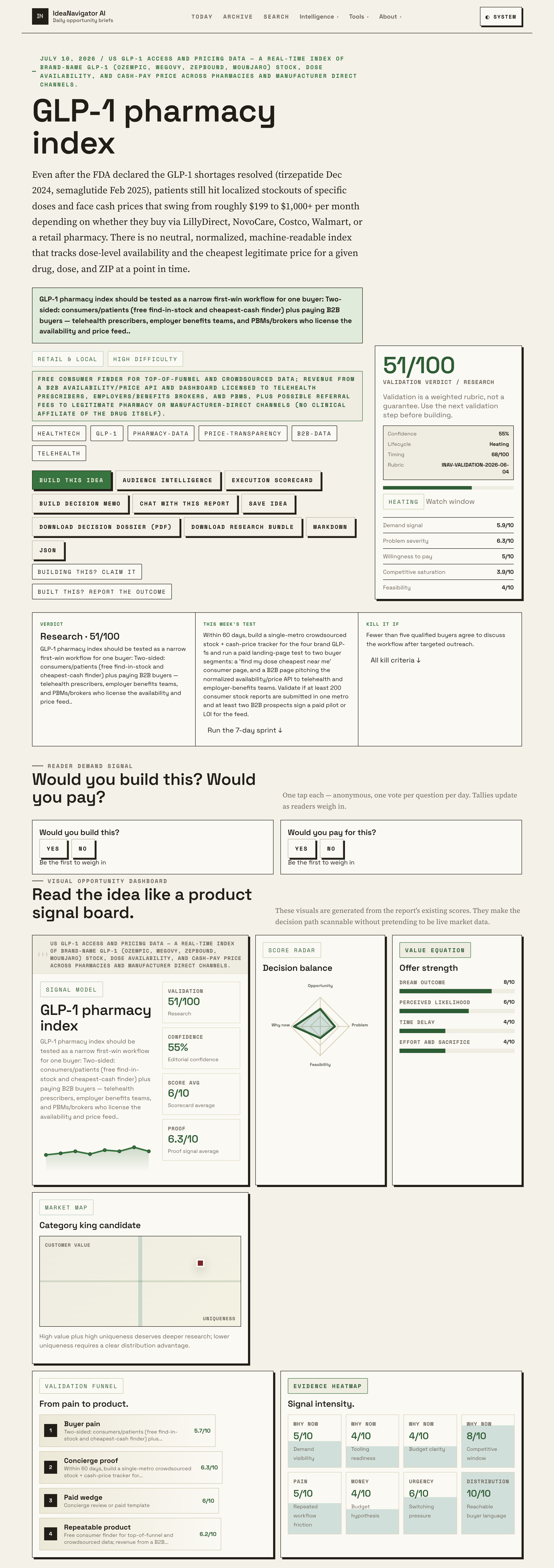
A proposal calls for a free tool to help U.S. patients find brand-name GLP-1 doses in stock and compare cash prices by ZIP code, with a paid data feed for health care buyers. The idea responds to fragmented pricing and localized stock gaps, but it is a proposed business concept, not a launched service or verified national price index.
IdeaNavigator AI has proposed a U.S. index that would help patients search for brand-name GLP-1 medicines by dose and ZIP code, while selling normalized availability and cash-price data to health care buyers. The proposal addresses a market where prices vary across direct and retail channels and patients may still encounter local gaps in specific doses, but no operating index or national stock dataset is described.
The proposed free consumer tool would cover Ozempic, Wegovy, Zepbound and Mounjaro. A user would select a drug, dose and ZIP code to see reported availability and compare legitimate cash-pay options. The suggested price sources include manufacturer direct programs LillyDirect and NovoCare, Costco and Walmart cash programs, and a discount-price layer modeled on services such as GoodRx. The proposal also calls for alerts when a particular dose becomes available.
IdeaNavigator AI says cash prices can range from about $199 to more than $1,000 per month, depending on medicine and purchase channel. It does not specify a date, dose, eligibility rules, formulation or other conditions for that range, so it should not be read as a like-for-like price comparison. The plan would combine public price information with crowdsourced reports of local stock, then standardize those observations into a data feed.
The proposed business model pairs free patient searches with paid access for telehealth prescribers, employer benefits teams, pharmacy benefit managers and brokers. A small pilot would test one metro area, collect stock reports and pitch the feed to buyers. The suggested success measures are at least 200 consumer reports and two paid pilots or letters of intent within 60 days; these are targets, not achieved results.
Why Dose-Level Data Could Matter
A searchable view of dose availability and cash prices could make it easier for patients to compare options when their prescribed dose is difficult to find or the price differs by channel. It could also give prescribers and benefits teams a clearer view of access conditions, if the data are current and sufficiently reliable. The proposal says employers report GLP-1 medicines account for roughly 20% of pharmacy spending, but it provides no survey, population, period or spending definition for that figure.
For buyers, the central potential value is a normalized dataset that can be used across several pharmacy and manufacturer-direct channels. For patients, it is a single search interface instead of checking each channel separately. Those benefits remain conditional: stock reports can become stale quickly, and a listed cash price may depend on eligibility or purchasing terms that differ among channels.
From Shortage Lists to Scattered Channels
The proposal frames the current challenge as a shift from national shortage concerns to fragmented local supply and pricing. It says the FDA declared shortages resolved for tirzepatide in December 2024 and semaglutide in February 2025. The proposal also points to the end of compounding grace periods and the arrival of competing cash-pay routes as factors reshaping access. These dates and policy developments are presented as context for the business idea; the proposal does not provide underlying FDA notices or details about how individual products and doses were affected.
It identifies manufacturer-direct services, retail pharmacies and discount programs as separate places where patients may encounter different prices. It also notes a TrumpRx portal launch in February 2026. Together, these changes are said to have created a need for an independent comparison layer. The concept would rely on public pricing and user-submitted availability reports rather than claiming that any one listed retailer represents the full market.
Data Quality and Pricing Questions
The proposal does not identify a launch team, operating service, pharmacy data agreements or a method for confirming whether crowdsourced stock reports are accurate. It is also unclear how frequently prices and availability would be refreshed, how the tool would distinguish a temporary stockout from a broader supply issue, or how it would handle differences in cash-price eligibility and purchase conditions.
No evidence is provided that patients would submit reports at the scale needed, or that employers, telehealth providers or benefits intermediaries would pay for the feed. The suggested price range and employer-spending figure lack enough detail to compare products, periods or populations. The proposal also does not establish that the named channels have comparable offers for every medicine and dose.
A Proposed 60-Day Pilot
The next step outlined is a single-metro test of a consumer search page and a business-facing pitch for a data API. The project would seek stock submissions for four brand-name medicines and test interest among telehealth and employer-benefits buyers. Its stated validation goals are 200 consumer reports and two paid pilots or letters of intent within 60 days. No metro, start date or participating buyers are named, so whether the test will proceed remains unknown.
Source: IdeaNavigator AI
Key Questions
Has the GLP-1 pharmacy index launched?
No launch is reported. IdeaNavigator AI describes a proposed service and a possible pilot, with no operating website or data feed identified.
Which medicines would the tool cover?
The proposed first version would track Ozempic, Wegovy, Zepbound and Mounjaro by drug, dose and ZIP code.
How would the index gather information?
The plan combines crowdsourced local stock reports with normalized public cash-price data from manufacturer-direct and retail channels, plus a discount-price layer. The proposal does not describe a verification or update process.
Who would pay for the data?
The proposed paying customers are telehealth prescribers, employer benefits teams, pharmacy benefit managers and brokers. The suggested pilot would test whether at least two prospects sign a paid pilot or letter of intent.
Source: IdeaNavigator AI
Halloween Picks
halloween
As an affiliate, we earn on qualifying purchases.