🔍 Read the full analysis: Can A Sim2Real Workflow Improve Microduck’s Obstacle Navigation? on ThorstenMeyerAI.com

Get business pricing on monitors, keyboards and dev gear
- Business-only prices and quantity discounts
- Tax-exempt purchasing
- Multiple users, one account, clear invoices
TL;DR
A Hugging Face tutorial describes a simulation-to-robot workflow for training a separate obstacle-navigation controller for Microduck in NVIDIA Isaac Lab, using Newton for simulated physics and time-of-flight sensing. The existing walking policy remains fixed, and the supplied material reports no measured performance or physical-robot trial results.
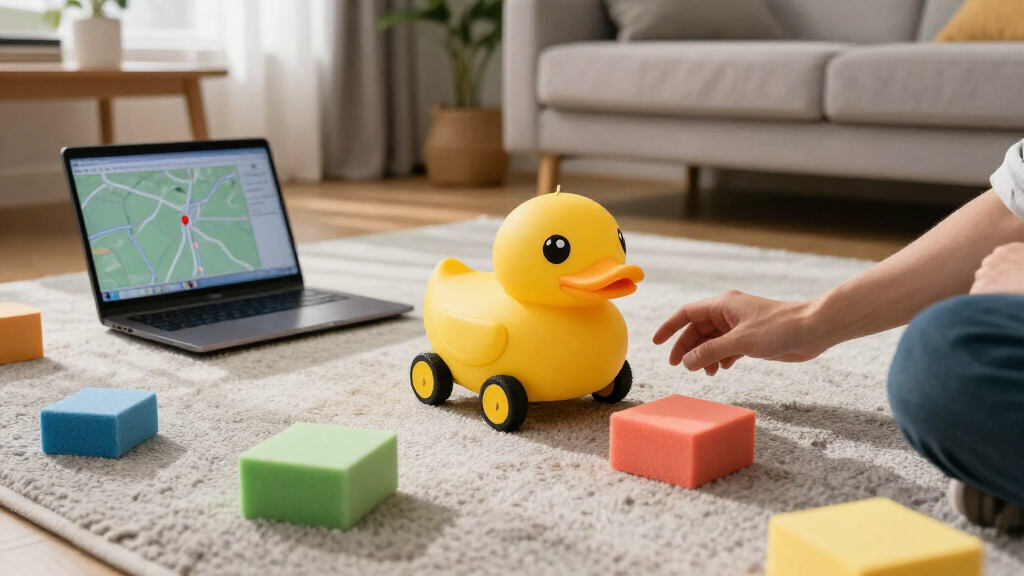
A Hugging Face tutorial, based on the original Microduck obstacle-avoidance analysis, describes how to train a separate controller to steer the Microduck robot around obstacles in NVIDIA Isaac Lab, while keeping its existing walking policy fixed. The workflow uses Newton simulation for physics and time-of-flight sensor readings, but the supplied material does not report measured results or confirm that the controller has been tested on a physical robot.
The controller is designed to sit between a person’s gamepad direction commands and Microduck’s existing locomotion system. It adjusts forward, lateral and turning velocity commands; the fixed walking policy then turns those commands into joint actions. In this setup, navigation training does not change the weights of the policy responsible for walking.
For its input, the navigation controller uses a history of time-of-flight (ToF) measurements alongside body and controller state described as available on the robot. The tutorial models a VL53L5CX sensor with a Newton raycaster camera, describing an 8-by-8 distance grid that updates at 15 hertz, has a 45-degree field of view and covers a stated range of 0.12 to 4 meters. The source says sensor placement and floor readings were informed by real recordings.
During training, a critic receives additional simulation state to guide learning; the tutorial says that extra input is not required when deploying the controller. Its reward design favors progress toward a goal and safe arrival, while penalizing collisions, falls, rapid approaches and abrupt command changes. Obstacle positions and orientations vary when training episodes reset. The scene includes basic geometry and OpenUSD SimReady assets, such as a cardboard box, an office bin and a bedside cabinet.
Microduck obstacle avoidance From simulation to robot testing
A Hugging Face tutorial trains a steering controller in Isaac Lab while keeping Microduck’s walking policy fixed. Newton simulates physics and time-of-flight sensing.
Steering stays separate
A new controller adjusts gamepad velocity commands; the existing walking policy continues to produce joint actions.
- Uses ToF history and available body and controller state
- Adjusts forward, lateral and turning commands
- Previously trained and kept fixed
- Converts velocity commands into joint actions
Training in simulation
The workflow varies obstacles and sensor readings to prepare the navigation controller for less ideal measurements.
Newton raycasting models VL53L5CX time-of-flight distance readings.
Training adds noise, delays and missing readings, and varies obstacle positions and orientations.
Rewards encourage goal progress and safe arrival while penalizing collisions, falls and abrupt changes.
Evaluation evidence
The tutorial describes evaluation, policy export and preparation for hardware testing.
Workflow details
Simulation setup, sensor modeling and steps toward robot testing are described.
Measured outcomes
The supplied material gives no training metrics, collision rates or physical trial results.
Separating Steering From Walking
The design addresses a distinct robotics problem: a policy that keeps a robot walking does not necessarily know how to steer around something in its path. By training a separate navigation layer, the workflow offers a way to add obstacle steering without retraining the gait and balance system. That modular structure could also help developers isolate whether a failure originates in locomotion or steering, although the supplied tutorial material does not report such a test.
The simulation includes noise, delays and missing ToF readings to expose the controller to less reliable data than ideal sensor output. This is relevant because simulated success alone cannot show whether a policy will work with physical sensors and hardware. The described techniques are intended to address that gap, but their effectiveness after transfer has not been established in the supplied material.
Products Worth Considering

Samsung Odyssey OLED G8 34-Inch Curved Ultra WQHD Gaming Monitor

Jackery Explorer 1000 v2 Portable Power Station, 1024Wh LiFePO4 Battery

LG UltraGear 27G640A-B 27-Inch QHD IPS Gaming Monitor, 300Hz, 1ms, G-SYNC Compatible, FreeSync Premium, DisplayHDR 400, HDMI 2.1, USB-C, Adj
As an affiliate, we earn on qualifying purchases.
The tutorial builds on an earlier Microduck walkthrough, which supplies a previously trained walking-policy checkpoint. The obstacle-avoidance task is identified as IsaacContrib-ObstacleAvoidance-Flat-MicroDuck, with environment configuration, sensor implementation and task components organized in the Isaac Lab repository, according to the source.
The described workflow covers simulation, training and evaluation, followed by policy export and preparation for robot testing. The hardware setup listed includes a configured Microduck, the walking-policy export, a supported ToF sensor, a paired gamepad and a level test area with obstacles. These details describe the planned test setup, not evidence that testing has been completed.
“A walking policy can keep Microduck balanced, but it does not tell the robot how to steer around an obstacle in its path.”
— Hugging Face tutorial
Hardware Performance Is Unreported
The supplied excerpt gives no training metrics, collision rates, goal-completion results or comparison with another controller. It describes evaluation and preparation for hardware testing but does not provide outcomes from those stages or confirm that a physical-robot trial took place. The publication date and timing of any planned trial are also unspecified.
It is also unclear how well the controller performs across different obstacle layouts and sensor conditions, how much tuning transfer to a configured Microduck requires, and whether the sensor randomization improves real-world reliability. The stated sensor specifications and training methods do not answer those performance questions. Evidence from repeatable physical trials would be needed to establish how often the robot reaches goals without collisions or falls, including when readings are delayed or missing.
Simulation Evaluation Before Robot Trials
The workflow described proceeds from training to policy evaluation and export, then to hardware testing with the listed Microduck setup. The source does not provide a schedule for those tests or state that they have occurred. The next evidence to look for is reported simulation performance followed by physical trials across varied obstacle arrangements.
Useful results would include goal completion, collision and fall rates, and comparisons across sensor conditions, especially with delayed or missing ToF readings. Until those results are reported, the tutorial should be read as a concrete training and transfer workflow—not as evidence that Microduck’s obstacle avoidance has been validated on hardware.
Key Questions
Does the workflow retrain Microduck’s walking policy?
No. The tutorial says the existing walking policy stays fixed. A separate controller adjusts velocity commands before they reach that policy.
What role does Newton play?
According to the tutorial, Newton simulates physics and ToF measurements in the Isaac Lab training environment.
Has the controller been shown to work on a physical Microduck?
The supplied material does not report a physical-robot trial or its results. It describes preparation for hardware testing, but does not establish real-world performance.
What sensor setup does the tutorial describe?
It models a VL53L5CX time-of-flight sensor as an 8-by-8 distance grid updating at 15 hertz, with a 45-degree field of view and a stated range of 0.12 to 4 meters.
Primary source: Hugging Face · via ThorstenMeyerAI.com