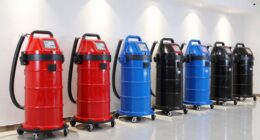
For most home garages, I’d start with the VEVOR 13-Gallon: its 4.6 SCFM at 90 PSI and quieter 66 dB operation offer a useful balance for tool work without moving up to a large stationary unit. The Metabo HPT 6-Gallon Pancake stands out for higher 200 PSI tank pressure in a portable format, while the Campbell Hausfeld 60-Gallon Two-Stage suits a fixed shop with demanding, sustained air needs. The main tradeoff is between portability and work capacity, with noise, available electrical service, and floor space shaping the choice too. Smaller units can handle tires and intermittent tasks but may pause often during air-hungry work. Read on for how all 15 options compare and which garage jobs each one fits best.

Get business pricing on monitors, keyboards and dev gear
- Business-only prices and quantity discounts
- Tax-exempt purchasing
- Multiple users, one account, clear invoices
Key Takeaways
- The VEVOR 13-Gallon leads for a mixed-use garage because its stated 4.6 SCFM at 90 PSI and 66 dB operation pair useful airflow with a quieter-than-many-workshop setup.
- The Metabo HPT pancake model has the highest listed maximum pressure among the portable units here at 200 PSI, but tank pressure alone does not establish how long it can run a tool.
- The 60-gallon Campbell Hausfeld and Ingersoll Rand models are fixed-shop choices, not simple upgrades for every garage; their 230V or 3 HP specifications call for attention to electrical service and installation.
- Wall-mount models from Craftsman, ECOMAX, and Craftsman Tire Inflator prioritize hose access and saved floor space, while their small tanks point toward inflation and brief air tasks rather than sustained tool use.
- Tank size does not tell the whole story: the listed airflow at 90 PSI varies from 2.8 CFM on the quiet 5-gallon model to 5.1 CFM on the Klutch 29-gallon, a more useful comparison for many air tools.


| air compressors for garage | Maximum pressure | Noise level | Weight | Tank capacity |
|---|---|---|---|---|
| VEVOR 6.3 Gallon 2 HP Oil-Free | 116 PSI | — | 43 pounds | — |
| Craftsman 2-Gallon Portable Ai | 125 PSI | 78 dB | 11.11 kg (about 24.5 pounds) | 2 gallons |
| Quiet Oil-Free Air Compressor | 120 PSI | 68 dB | — | — |
| Craftsman Tire Inflator All-in | 125 PSI | 73 dB | 21 pounds | 0.5 gallons |
| Campbell Hausfeld 60-Gallon 2- | 175 PSI | 65 dB | 255 pounds | 60 gallons |
| Metabo HPT Portable Pancake Ai | 200 PSI | 73 dB | 41 pounds | 6 gallons |
| ECOMAX Wall Mount Air Compress | 125 PSI | 70 dB | 20.9 pounds | 0.5 gallons |
| VEVOR 13-Gallon Air Compressor | 125 PSI | 66 dB | 71 pounds | 13 gallons |
| ECOMAX 6 Gallon 150 PSI Pancak | 150 PSI | 75 dB | 34.17 pounds | 6 gallons |
| Craftsman 6 Gallon 150 PSI Oil | 150 PSI | 82 dB | 30.8 pounds | 6 gallons |
| Ingersoll Rand SS3L3 Single St | 135 PSI | 78 dB | — | 60 gallons |
| Klutch 20-Gallon Air Compresso | 175 PSI | 80 dB | 90 pounds | 20 gallons |
| CRAFTSMAN Wall Mount Air Compr | 125 PSI | 65 dB | 11.14 kg | 0.5 gallons |
| Klutch 29-Gallon Air Compresso | 175 PSI | 81 dB | 127 pounds | 29 gallons |
| 15-Gallon Air Compressor | 125 PSI | 66 dB | 68.3 pounds | 15 gallons |
More Details on Our Top Picks
VEVOR 6.3 Gallon 2 HP Oil-Free Air Compressor, Max 116 PSI
The VEVOR 6.3-gallon strikes a useful middle ground for a garage that needs more than an inflator but does not have room or wiring for a stationary compressor. Its 3.35 CFM at 90 PSI and 2 HP motor suit intermittent pneumatic-tool use, tire work, and smaller spray or woodworking jobs. Compared with the Craftsman 2-gallon model, it offers a larger reserve for longer bursts; unlike the Campbell Hausfeld 60-gallon unit, it runs on standard 120V power and is easier to fit into a home workspace. The tradeoff is its 116 PSI ceiling, which limits pressure headroom for some demanding tools, and its 43-pound weight makes it less convenient to move than a small inflator. The oil-free pump and listed safety protections keep routine upkeep simple.
Pros:- 6.3-gallon tank provides more air reserve than the Craftsman 2-gallon portable model.
- 3.35 CFM at 90 PSI supports intermittent pneumatic-tool use.
- Oil-free design reduces routine pump maintenance.
- Overheating protection and pressure relief add useful operating safeguards.
Cons:- 116 PSI maximum pressure may not meet the needs of higher-pressure applications.
- At 43 pounds, it is less convenient to carry than a compact inflator.
- Its 2 HP output is not intended for sustained, demanding shop workloads.
Best for: Home garage owners who want a mid-size tank for tire inflation and intermittent air-tool or woodworking tasks on standard 120V power.
Not ideal for: Mechanics running air-hungry tools for extended periods, or buyers who need more than 116 PSI or a lightweight unit to carry around.
- Tank volume:6.3 gallons
- Maximum pressure:116 PSI
- Power:2 HP
- Voltage:120 volts
- Airflow:3.35 CFM at 90 PSI
- Weight:43 pounds
- Dimensions:25.2 x 13 x 28.7 inches
Our verdict“Choose the VEVOR for a standard-outlet garage needing a practical mid-size tank, but look to a larger stationary compressor for sustained heavy tool use.”
Craftsman 2-Gallon Portable Air Compressor, 1/3 HP, 125 PSI, Oil-Free, Lightweight with 10-Piece Accessory Kit
The Craftsman 2-gallon is the portable, light-duty choice in this group: its 125 PSI rating and included 10-piece accessory kit make tire inflation and small air jobs straightforward without assembling a separate set of fittings. It makes more sense for quick tasks than the VEVOR 6.3-gallon, which has a larger tank and higher stated motor power but takes up more space. This Craftsman’s compact capacity also sets a clear limit: the tank will run down faster during repeated tool use, and the listed 1/3 HP motor is not aimed at demanding garage work. At about 24.5 pounds, it is still a corded machine rather than a grab-and-go battery inflator, despite its handle. I’d choose it for occasional use and included accessories, not as a shop’s main air supply.
Pros:- 10-piece accessory kit covers common inflation tasks out of the box.
- 125 PSI maximum pressure is higher than the VEVOR 6.3-gallon model’s 116 PSI.
- Oil-free pump avoids oil-change maintenance.
- Rubber-reinforced handle supports moving it around a garage or job site.
Cons:- Two-gallon tank limits how long it can supply air before cycling.
- The 1/3 HP motor is suited to light tasks rather than demanding pneumatic tools.
- At about 24.5 pounds and corded, it is not as effortless to carry or use away from an outlet as its compact size may suggest.
Best for: Drivers and home garage owners who mainly inflate tires or handle short, light-duty air tasks and want an accessory kit included.
Not ideal for: DIYers using pneumatic tools for extended stretches, or anyone seeking a larger air reserve and stronger motor for regular workshop work.
- Tank capacity:2 gallons
- Maximum pressure:125 PSI
- Motor power:0.33 HP
- Voltage:120 V
- Noise level:78 dB
- Weight:11.11 kg (about 24.5 pounds)
- Included accessories:10-piece accessory kit
Our verdict“Pick this Craftsman for tire inflation and occasional light jobs with a ready-to-use kit, not for sustained air-tool work.”
Quiet Oil-Free Air Compressor, 68 dB, 2.8 CFM @ 90 PSI, 5 Gallon Air Tank
At a stated 68 dB, this 5-gallon compressor is the noise-conscious pick for a garage attached to a home or shared with other work areas. Its 2.8 CFM at 90 PSI and rapid stated recovery make it better suited to stop-and-start nailing, cleaning, inflation, and woodworking than the Craftsman 2-gallon unit, while its tank remains smaller than the VEVOR 6.3-gallon. Wheels, a 25-foot hose, and an accessory kit help it move between tasks without requiring as much setup. The balance has limits: 120 PSI maximum pressure and 1.2 HP do not put it in the same class as the Campbell Hausfeld 60-gallon compressor for sustained shop work. It is also corded, so its quiet operation does not make it a cordless option.
Pros:- 68 dB operating noise is a useful fit for indoor or attached garages.
- 2.8 CFM at 90 PSI and a 5-gallon tank support intermittent tool use better than the Craftsman 2-gallon model.
- Wheels and a 25-foot hose make it easier to move around a work area.
- Oil-free pump and included accessory kit reduce maintenance and setup needs.
Cons:- 120 PSI maximum pressure is below the 175 PSI offered by the Campbell Hausfeld 60-gallon compressor.
- Its 1.2 HP motor and 5-gallon tank are not intended for prolonged, air-hungry tasks.
- Corded operation requires access to an outlet.
Best for: Home workshop users who need a wheeled, quieter compressor for indoor nailing, cleaning, inflation, and intermittent woodworking.
Not ideal for: Garage owners running high-demand tools continuously or needing a stationary, high-capacity air supply with substantial pressure headroom.
- Tank volume:5 gallons
- Airflow:2.8 CFM at 90 PSI
- Maximum pressure:120 PSI
- Motor power:1.2 HP
- Noise level:68 dB
- Hose length:25 feet
- Voltage:110 V
- Dimensions:22.05 x 11.03 x 19.08 inches
Our verdict“Choose this model when indoor noise and easy movement matter more than the high pressure and long-run capacity of a stationary compressor.”
Craftsman Tire Inflator All-in-One Wall-Mount Air Compressor Oil-Free with Retractable 30ft Hose and Pressure Regulator 1.5HP 125PSI
This Craftsman is designed around garage convenience, not tank capacity. Its wall-mount format and retractable 30-foot hose keep the compressor and hose off the floor, making it a neat option for tire inflation, brad nailing, stapling, and finishing work close to its mounting spot. The 1.5 HP motor and 125 PSI ceiling exceed the Craftsman 2-gallon model’s pressure rating, while the 0.5-gallon tank is far smaller than either that portable unit or the VEVOR 6.3-gallon. That difference matters: the wall unit is a tidy source for brief tasks, but it will cycle more often when a tool draws air continuously. At 21 pounds, it can be mounted without the footprint of a floor-standing compressor, though the fixed hose length and corded power constrain placement.
Pros:- Wall-mount design frees floor space in a crowded garage.
- Retractable 30-foot hose offers a broad working reach without a loose hose on the floor.
- 125 PSI maximum pressure and 1.5 HP motor suit short inflation and finishing tasks.
- Oil-free operation reduces routine maintenance.
Cons:- The 0.5-gallon tank provides little reserve for sustained tool use.
- Corded power and fixed mounting limit where the compressor can be used.
- The 30-foot hose sets a firm limit on reach from the mounted unit.
Best for: Garage owners with limited floor space who want a permanently mounted source for tire inflation and short finishing or brad-nailing jobs.
Not ideal for: Users who need a portable compressor, long runs of pneumatic-tool use, or air access beyond the included 30-foot hose.
- Tank capacity:0.5 gallons
- Maximum pressure:125 PSI
- Motor power:1.5 HP
- Airflow:2.3 CFM
- Hose length:30 feet
- Noise level:73 dB
- Weight:21 pounds
- Dimensions:22.2 x 16.1 x 7.1 inches
Our verdict“Choose this Craftsman when saving floor space and keeping a hose ready matter more than tank capacity or portability.”
Campbell Hausfeld 60-Gallon 2-Stage Air Compressor, 175 PSI, 230V
The Campbell Hausfeld 60-gallon is the clear step up for a garage built around regular pneumatic work rather than occasional inflation. Its two-stage cast-iron pump, 7.6 CFM airflow, and 175 PSI ceiling provide far more capacity and pressure headroom than the portable VEVOR 6.3-gallon or the quiet 5-gallon compressor. The vertical tank also uses less floor width than a horizontal layout, though its 77-inch height still calls for careful placement. This is a stationary shop installation, not a compressor to roll between jobs: it weighs 255 pounds and requires a 230V connection. Its stated 65 dB noise level is comparatively low for this class, but it remains a large motorized machine in a quiet garage. I’d favor it only when the electrical setup, space, and workload justify its scale.
Pros:- 60-gallon tank and 7.6 CFM airflow support more sustained work than the portable compressors in this group.
- 175 PSI maximum pressure provides more headroom than the VEVOR 6.3-gallon’s 116 PSI.
- Two-stage cast-iron pump is built for demanding workshop use.
- Vertical tank design reduces floor width compared with a horizontal tank of similar capacity.
Cons:- Requires a 230V electrical connection rather than a standard 120V outlet.
- At 255 pounds, it needs planning and help for installation or relocation.
- Its 77-inch height can be difficult to accommodate in a low-ceiling or crowded garage.
Best for: Garage mechanics and serious DIYers with a 230V circuit, room for a tall stationary tank, and recurring demand for painting, grinding, bolting, or other air-tool work.
Not ideal for: Small or shared garages without 230V power, and users who need a portable unit mainly for tire inflation or brief tasks.
- Tank capacity:60 gallons
- Pump:Two-stage cast iron
- Maximum pressure:175 PSI
- Airflow:7.6 CFM
- Motor power:3.7 HP
- Voltage:230 V
- Noise level:65 dB
- Weight:255 pounds
- Dimensions:33 x 29 x 77 inches
Our verdict“Choose this stationary Campbell Hausfeld when your garage has 230V power and frequent tool use calls for a large, high-pressure air reserve.”
Metabo HPT Portable Pancake Air Compressor, 6 Gallon 200 PSI, EC914S
The Metabo HPT EC914S earns its place for garage owners who use framing or finish nailers and need more airflow than a typical pancake compressor supplies. Its 4 CFM at 90 PSI and 200 PSI maximum give it an advantage over the Craftsman 6-gallon model, listed at 2.6 CFM, when tools demand air at a steady pace. The six-gallon tank and roughly 41-pound weight keep it movable, though it is not as easy to lift as a compact inflator. That airflow still does not make it a substitute for a large-tank compressor during sustained, air-hungry work. At 73 dB, it can also be intrusive in a small enclosed garage. I’d choose it for intermittent nailing and general tool use, not prolonged grinding or other continuous-duty jobs.
Pros:- 4 CFM at 90 PSI supports more demanding pneumatic tasks than lower-airflow six-gallon options.
- 200 PSI maximum provides pressure headroom for compatible tools.
- Six-gallon tank balances useful capacity with a portable pancake format.
- About 41 pounds makes it easier to move than larger garage compressors.
Cons:- 73 dB can be disruptive in an enclosed or attached garage.
- A six-gallon tank is still limiting for prolonged continuous tool use.
- At about 41 pounds, it may be cumbersome for users who frequently carry equipment up stairs.
Best for: Garage woodworkers and DIY renovators who run nailers and want more airflow than a standard six-gallon pancake compressor.
Not ideal for: Users who need quiet operation, frequent lifting, or sustained airflow for continuous-duty tools.
- Tank capacity:6 gallons
- Maximum pressure:200 PSI
- Airflow:4 CFM at 90 PSI
- Power:1.3 hp
- Voltage:120 volts
- Noise level:73 dB
- Weight:41 pounds
- Dimensions:16 x 16 x 18.5 inches
Our verdict“Choose the Metabo HPT if your garage work centers on nailers and you want substantially more airflow than the Craftsman six-gallon option.”
ECOMAX Wall Mount Air Compressor – Oil-Free Portable Tire Inflator with Retractable 30ft Hose, Mini 0.5-gal Tank, 125 PSI Max Pressure, 1.5 HP for Garage and Home
The ECOMAX wall-mount compressor is aimed at a different garage problem than the Metabo HPT or other six-gallon pancake models: keeping a hose ready without storing a tank on the floor. Its 30-foot retractable hose, gauge, and regulator make topping up tires or handling short bursts with light-duty tools straightforward, while the oil-free pump cuts routine maintenance. The compact 0.5-gallon tank is the tradeoff. It cannot provide the stored air of the ECOMAX 6-gallon pancake or the VEVOR 13-gallon model, so the pump will cycle more often during repeated tasks. Its 2.3 CFM rating also points to light garage work rather than demanding tools. At 20.9 pounds, it is relatively manageable, but the cord still ties it to an outlet.
Pros:- Retractable 30-foot hose reaches around a typical garage without a loose hose to store.
- Wall-mount format frees floor space.
- Oil-free pump reduces maintenance needs.
- Gauge, regulator, and quick coupler are built in for convenient inflation and light tasks.
Cons:- The 0.5-gallon tank offers little reserve for repeated tool use.
- At 2.3 CFM, airflow is better suited to light-duty work than demanding pneumatic tools.
- Corded operation requires an available outlet near the mounting location.
Best for: Drivers who want a permanently mounted garage tire station with a long retractable hose and occasional light-tool capability.
Not ideal for: DIYers who run nailers, sanders, or other tools for extended periods and need a larger reserve of compressed air.
- Tank capacity:0.5 gallons
- Maximum pressure:125 PSI
- Airflow:2.3 CFM
- Motor:1.5 hp
- Hose length:30 feet
- Noise level:70 dB
- Weight:20.9 pounds
- Dimensions:22 x 15.5 x 7 inches
Our verdict“Pick this ECOMAX for a tidy, wall-mounted tire and light-duty station, not as your garage’s main compressor for extended tool use.”
VEVOR 13-Gallon Air Compressor, 2HP, 4.6 SCFM @ 90 PSI, Oil-Free, 66 dB Quiet Operation
For a garage where tank capacity and noise matter more than easy lifting, the VEVOR 13-gallon compressor is the strongest fit in this group. Its 4.6 CFM at 90 PSI and larger tank give it more breathing room for woodworking, auto repairs, and intermittent painting than the six-gallon Metabo HPT or Craftsman models. At a listed 66 dB, it is also the quieter choice compared with the 75 dB ECOMAX pancake and 82 dB Craftsman. The advantage comes with bulk: this unit weighs 71 pounds, and its wheels help roll it around but do not make it easy to lift or store. Its 125 PSI ceiling may also rule it out for tools that require higher pressure. I’d favor it for a fixed garage workspace with occasional mobility needs.
Pros:- 13-gallon tank supplies more stored air than the six-gallon pancake options.
- 4.6 CFM at 90 PSI suits a broader range of intermittent garage tasks.
- 66 dB rating is quieter than the other listed compressors in this batch.
- Reinforced wheels make it easier to roll across a garage floor.
Cons:- At 71 pounds, it is difficult to lift despite its wheels.
- The 125 PSI maximum may not meet the requirements of some pneumatic tools.
- Its larger footprint takes more storage space than a pancake compressor or wall-mounted unit.
Best for: Home mechanics and woodworkers who want a larger air reserve, useful airflow, and quieter operation for varied garage tasks.
Not ideal for: People who need a compressor they can carry frequently, have limited storage space, or use tools requiring more than 125 PSI.
- Tank capacity:13 gallons
- Airflow:4.6 CFM at 90 PSI
- Maximum pressure:125 PSI
- Motor:2 hp
- Noise level:66 dB
- Power source:120-volt corded electric
- Weight:71 pounds
- Dimensions:17.5 x 16.5 x 33.3 inches
Our verdict“Choose the VEVOR 13-gallon model if you want more capacity and quieter operation than a pancake compressor and can accommodate its size and weight.”
ECOMAX 6 Gallon 150 PSI Pancake Air Compressor Portable Oil-Free Tank with Accessories Kit
The ECOMAX 6-gallon pancake compressor makes sense for garage owners who want a portable starter setup and value the included accessories. Its oil-free pump and reported 34.17-pound weight make it easier to move than the VEVOR 13-gallon, while the six-gallon tank gives it more reserve than the wall-mounted ECOMAX’s half-gallon tank. Dual quick couplers are useful when two compatible tools need to stay connected, but they do not increase the compressor’s total airflow. The supplied airflow figure is listed as “3 cubic inches per minute,” which is not a useful CFM rating for comparison, so I would not select it for airflow-intensive work based on that number. The 75 dB noise rating is another compromise, and its 150 PSI limit is below the Metabo HPT’s 200 PSI.
Pros:- Six-gallon tank suits common inflation and intermittent garage tasks.
- Oil-free design avoids routine pump oil changes.
- Dual quick couplers allow two compatible tools to be connected.
- Included accessories offer a convenient starting setup.
Cons:- The supplied airflow figure is stated in cubic inches per minute, so it cannot be reliably compared with standard CFM ratings.
- 75 dB operation may be loud in an attached or enclosed garage.
- 150 PSI maximum is lower than the Metabo HPT’s 200 PSI rating.
Best for: DIY garage owners who want a portable six-gallon compressor with an accessory kit for inflation and occasional light pneumatic work.
Not ideal for: Buyers choosing by verified airflow for demanding tools, or anyone needing quiet operation and sustained heavy-duty performance.
- Tank capacity:6 gallons
- Maximum pressure:150 PSI
- Airflow:Listed as 3 cubic inches per minute
- Power:1.5 hp
- Voltage:120 volts
- Hose length:25 feet
- Noise level:75 dB
- Weight:34.17 pounds
Our verdict“Consider this ECOMAX for a portable, accessory-inclusive DIY setup, but choose a compressor with a clear CFM rating for airflow-dependent tools.”
Craftsman 6 Gallon 150 PSI Oil-Free Pancake Air Compressor
The Craftsman 6-gallon pancake compressor is the easiest of these full-size tank options to carry, at 30.8 pounds, making it a practical pick for someone who moves between a garage, driveway, and storage shelf. Its 2.6 CFM at 90 PSI gives a clearer performance picture than the ECOMAX pancake’s ambiguously stated airflow, but it trails the Metabo HPT’s 4 CFM when tools need more sustained air. Dual quick couplers let two tools connect, although the compressor’s output remains the limiting factor. The 150 PSI maximum covers common inflation and light workshop use, not every tool requirement. Its biggest drawback is noise: the listed 82 dB is the loudest among these five options. I’d choose it for portability and occasional tasks, not a noise-sensitive garage.
Pros:- 30.8-pound weight makes it easier to carry than the other six-gallon models listed here.
- 2.6 CFM at 90 PSI provides a stated airflow figure for comparing compatible tools.
- Oil-free pump reduces routine maintenance.
- Dual quick couplers allow two compatible tools to remain connected.
Cons:- 82 dB noise level can be disruptive in an attached or enclosed garage.
- Lower airflow than the Metabo HPT makes it less suited to tools with higher air demands.
- Six-gallon capacity limits sustained operation.
Best for: Homeowners who need a light, easy-to-store compressor for tire inflation, brad nailers, and occasional workshop tasks.
Not ideal for: Garage users who need quiet operation, high airflow for extended tool use, or a compressor for continuous-duty applications.
- Tank capacity:6 gallons
- Maximum pressure:150 PSI
- Airflow:2.6 CFM at 90 PSI
- Power:1 hp
- Voltage:120 volts
- Noise level:82 dB
- Weight:30.8 pounds
- Dimensions:15.8 x 16.4 x 17 inches
Our verdict“Pick the Craftsman for easy carrying and basic garage jobs, but choose the Metabo HPT for higher airflow or the VEVOR for quieter, longer sessions.”
Ingersoll Rand SS3L3 Single Stage Air Compressor, 3 HP, 60 Gal Vertical
For a garage with a dedicated 230V circuit and room for a stationary tank, the Ingersoll Rand SS3L3 is the strongest fit in this group for sustained, demanding work. Its 60-gallon tank, 3 HP motor, and 135 PSI maximum pressure suit bolting and other jobs that benefit from a larger reserve of air. The cast-iron pump is rated for more than 5,000 hours of service, a durability advantage over the oil-free portable Klutch models, though this compressor is far less convenient to move. It also needs a bigger footprint and runs at a listed 78 dB, so it is not a quiet or casual-use choice. I would favor it over the Klutch 29-gallon when tank capacity and pump longevity matter more than portability. The listed item weight of 0.27 g appears erroneous, so I would verify actual handling and installation needs before purchase.
Pros:- 60-gallon tank provides a large reserve for extended garage tasks
- Cast-iron pump is rated for over 5,000 hours of service
- 135 PSI maximum pressure and 3 HP motor suit demanding applications
- Auto start/stop control and thermal overload protection support straightforward operation
Cons:- Requires 230V power, limiting where it can be installed
- Large vertical footprint and stationary format make relocation impractical
- Listed noise level is 78 dB, and the listed 0.27 g weight appears to be a data error
Best for: Garage owners with a 230V circuit, permanent floor space, and regular bolting or other demanding air-tool work.
Not ideal for: Renters, small garages, or buyers who need a compressor they can move between jobs; its 60-gallon vertical tank is a substantial fixed installation.
- Motor power:3 HP
- Voltage:230V
- Tank capacity:60 gallons
- Maximum pressure:135 PSI
- Airflow capacity:11.3 m3/min (as listed)
- Maximum current:14.7 A
- Noise level:78 dB
- Dimensions:25 x 25 x 67 inches
Our verdict“Choose the SS3L3 for a permanent, 230V garage setup where tank capacity and pump durability matter more than portability or quiet operation.”
Klutch 20-Gallon Air Compressor, 2 HP, 120V
The Klutch 20-gallon is a practical middle ground for garage owners who want more stored air than a small portable compressor without committing to a 230V installation. Its 120V, 2 HP setup fits a standard-voltage workspace, while the oil-free pump reduces routine maintenance. At 4.2 SCFM at 90 PSI, it is better suited to intermittent pneumatic-tool use than long, air-hungry sessions; the larger Klutch 29-gallon provides more tank capacity and slightly higher stated airflow, but weighs 127 pounds versus this model’s 90. The wheels and handle help with repositioning, though 90 pounds is still a load to lift into a vehicle or carry up steps. Its 80 dB noise level also makes it a poor choice for noise-sensitive indoor work.
Pros:- 120V power avoids the need for a 230V garage circuit
- 20-gallon tank offers more stored air than compact portable models
- Oil-free pump reduces maintenance demands
- Wheels and handle allow repositioning around the garage
Cons:- 90-pound weight makes lifting and frequent transport difficult
- 80 dB operating noise may be disruptive indoors
- 4.2 SCFM at 90 PSI is a constraint for sustained high-demand tools
Best for: Home mechanics and DIYers who need a wheeled, standard-voltage compressor for tire work and intermittent garage tools.
Not ideal for: Buyers running air-hungry tools for long stretches, or anyone who needs a quiet compressor for an attached or shared living space.
- Motor power:2 HP
- Voltage:120V
- Tank capacity:20 gallons
- Airflow:4.2 SCFM at 90 PSI
- Maximum pressure:175 PSI
- Maximum current:14 A
- Weight:90 pounds
- Noise level:80 dB
Our verdict“Pick this Klutch for a mobile, standard-voltage garage setup where moderate tank capacity and lower pump maintenance outweigh noise and limited sustained airflow.”
CRAFTSMAN Wall Mount Air Compressor with 8-Piece Accessory Kit, Portable & Quiet, 125 PSI, 1.5 HP
When a garage compressor mainly handles tires, quick inflation, and occasional light-duty tasks, the CRAFTSMAN wall-mount keeps the setup compact and the hose close at hand. Its 30-foot retractable hose reaches around a typical garage without moving a tank, and 65 dB operation is quieter than the 80–81 dB Klutch models in this lineup. The tradeoff is the tiny 0.5-gallon tank: it cannot match the working reserve of the Klutch 20-gallon, so sustained tool use means frequent cycling and it is a poor match for extended painting or other continuous jobs. The included accessory kit adds convenience for basic tasks, but its 125 PSI maximum also makes it less suited to applications demanding higher pressure. I see it as a space-saving convenience station, not a workshop workhorse.
Pros:- Wall-mount format frees floor space in a crowded garage
- 30-foot retractable hose reaches across work areas
- 65 dB noise level is lower than the Klutch tank compressors listed here
- Includes an 8-piece accessory kit for common inflation tasks
Cons:- 0.5-gallon tank requires frequent cycling during sustained use
- Not suited to large-scale or continuous pneumatic work
- 125 PSI maximum may not meet the needs of higher-pressure applications
Best for: Car owners and home DIYers who want a wall-mounted station for tire inflation and short, occasional air tasks.
Not ideal for: Garage users running pneumatic tools or painting for extended periods; the 0.5-gallon tank has little reserve and the 125 PSI ceiling limits some applications.
- Motor power:1.5 HP
- Tank capacity:0.5 gallons
- Maximum pressure:125 PSI
- Hose length:30 feet
- Noise level:65 dB
- Weight:11.14 kg
- Model:CMXECXA0250541A
- Included components:Air hose and accessories kit
Our verdict“Choose this CRAFTSMAN for quiet, space-saving inflation and brief jobs, not as a substitute for a larger tank compressor.”
Klutch 29-Gallon Air Compressor, 2.5 HP, 120V, 175 PSI, 5.1 CFM at 90 PSI
The Klutch 29-gallon gives a garage more stored air and stated delivery than the 20-gallon Klutch, while keeping the convenience of 120V power. Its 5.1 CFM at 90 PSI and 29-gallon tank make it the better of those two for longer bursts with pneumatic tools, nailing, or intermittent painting. The larger tank does come with a real mobility penalty: at 127 pounds, it is substantially heavier than the 20-gallon model, even with large wheels. Its 81 dB noise level is also the loudest listed among these five, so it may be awkward in a garage connected to living space. Oil-free operation cuts routine pump maintenance, and the vertical design saves some floor area, but I would still choose the smaller Klutch when easy repositioning matters more than extra reserve.
Pros:- 29-gallon tank holds more air for longer work intervals than the 20-gallon Klutch
- 5.1 CFM at 90 PSI supports a wider range of intermittent garage-tool use
- Oil-free pump reduces routine maintenance
- Large wheels and vertical layout aid movement and help limit floor footprint
Cons:- 127-pound weight makes moving it over obstacles or loading it difficult
- 81 dB noise level can be disruptive in an attached garage
- 120V power and stated airflow still limit it for some sustained heavy-duty work
Best for: DIY mechanics and garage hobbyists who want greater tank reserve and airflow than a 20-gallon compressor while staying on 120V power.
Not ideal for: Buyers who need a light, quiet compressor or who plan to run demanding tools continuously beyond its stated airflow capacity.
- Motor power:2.5 HP
- Voltage:120V
- Tank capacity:29 gallons
- Airflow:5.1 CFM at 90 PSI
- Maximum pressure:175 PSI
- Weight:127 pounds
- Noise level:81 dB
- Dimensions:23.2 x 21.1 x 45.3 inches
Our verdict“Choose the 29-gallon Klutch over the 20-gallon model when extra reserve and airflow matter more than easier handling and quieter operation.”
15-Gallon Air Compressor, 2HP, Quiet 66dB, 4.5CFM@90PSI
This 15-gallon compressor is the quiet-workspace pick: its 66 dB noise level is well below the 80–81 dB figures listed for the Klutch tank models, making it more appealing in an attached garage or during indoor projects. It also offers a useful middle ground between the tiny CRAFTSMAN wall-mount tank and the bulkier 20- and 29-gallon Klutch units. With 4.5 CFM at 90 PSI, it can support intermittent nailing, spraying, drilling, and inflation, but its 125 PSI maximum and smaller tank make it a less appropriate choice for demanding, sustained work than the Klutch 29-gallon. The 68.3-pound weight and wheels allow repositioning, though frequent lifting remains a chore. The listed 110V supply may also limit compatibility depending on the garage’s available outlet.
Pros:- 66 dB operation is quieter than the Klutch 20- and 29-gallon models
- 15-gallon tank provides more reserve than a wall-mounted 0.5-gallon compressor
- 4.5 CFM at 90 PSI supports a range of intermittent garage tasks
- Wheels and handle support repositioning around the workspace
Cons:- 125 PSI maximum is lower than the 175 PSI Klutch compressors
- 68.3-pound weight can make frequent lifting or transport awkward
- 110V supply may not suit every garage outlet or electrical setup
Best for: Garage hobbyists who need a quieter tank compressor for intermittent spraying, nailing, drilling, or tire inflation.
Not ideal for: Users who need high-pressure or sustained heavy-duty air-tool operation, or buyers who cannot confirm compatibility with a 110V supply.
- Motor power:2 HP
- Voltage:110V
- Tank capacity:15 gallons
- Airflow:4.5 CFM at 90 PSI
- Maximum pressure:125 PSI
- Noise level:66 dB
- Weight:68.3 pounds
- Material:Alloy steel
Our verdict“Choose this model for quieter, intermittent garage work, but choose the Klutch 29-gallon if greater pressure headroom and tank reserve matter more.”
How We Picked
I ranked these air compressors for garage use by how well their stated specifications suit common garage jobs: tire inflation, cleaning, brad or finish nailing, and longer sessions with air tools. I gave particular weight to airflow at 90 PSI when listed, tank capacity, pressure, noise, mobility, and the practical demands of power supply and placement. A large tank can reduce how often a motor cycles, but it cannot make up for insufficient delivered airflow during sustained tool use.
The order reflects useful capability balanced against garage fit, not a claim that one size suits every buyer. Quiet, portable units rank well for shared or space-limited garages; larger tanks and higher airflow rise for heavier work, while stationary 60-gallon compressors are placed for buyers with dedicated space and compatible electrical service. Where a listing does not provide a comparable airflow figure, I avoid treating its pressure or horsepower alone as proof of stronger tool performance.
Factors to Consider When Choosing Air Compressors For Garage
Before choosing, match the compressor to the work you actually repeat—not the biggest tool you might use once. These factors help separate a convenient tire-and-nailer unit from a setup that can support longer sessions in a home shop.
Match Airflow to the Tool, Not Just the Tank
For tools that run continuously or in long bursts, compare their required SCFM at the stated pressure with the compressor’s delivered airflow at that same pressure. A rating at 90 PSI is more useful for many garage tools than an impressive maximum PSI number on its own. If a tool’s demand is near the compressor’s output, the motor may run often and the tool may lose performance during extended work. Intermittent nailers can tolerate a smaller compressor because each shot uses air briefly. Check the requirements for the specific tool model before buying, and leave headroom rather than planning around a perfect match. When airflow is not listed, avoid assuming horsepower or tank volume fills in the missing information.
Treat Tank Size as a Buffer, Not More Airflow
A larger tank stores more compressed air and can help cover short bursts while reducing how frequently the pump starts. It does not raise the compressor’s sustained output, so a small pump paired with a large tank can still struggle during continuous sanding, grinding, or spraying. Buyers often overvalue gallons because tank size is easy to compare; for repeated tool use, airflow and duty pattern matter just as much. Smaller tanks can be a sensible choice for inflating tires, using a brad nailer, or keeping a portable unit easy to store. Think about how long each task runs and how much downtime between tasks is acceptable. That usage pattern is a better guide than choosing the largest tank that fits.
Check Garage Power Before Choosing a Large Unit
Portable and small-tank compressors are often easier to fit into an existing garage setup, but larger stationary models can call for a dedicated circuit or 230V service. Confirm voltage, amperage, plug requirements, and starting demands against the product documentation and your garage wiring before purchase. A compressor that cannot start reliably on the available circuit is not a practical upgrade, even if its capacity suits your tools. Do not use an extension cord unless the manufacturer permits it and specifies a suitable gauge and length. For a major electrical change, ask a qualified electrician to review the circuit. Including electrical work in the plan can change whether a stationary model makes sense.
Decide Where Noise and Air Access Matter Most
Noise affects more than comfort: it can limit when you work, disturb adjoining rooms, or make a shared garage unpleasant. Compare stated decibel figures only as a starting point, since placement, surfaces, and distance affect what you hear. An oil-free compressor may reduce routine lubrication work, but it does not mean maintenance-free operation; follow the manual for draining condensate and checking filters and fittings. Wall-mounted units can free floor space and keep a hose close at hand, though their small tanks suit brief jobs better than sustained air-tool sessions. Stationary models may offer more capacity but need space for access, ventilation, and service. Plan hose routing and storage before settling on a location.
Pay More Only for Capacity You Will Use
A step up in tank size or motor rating is worthwhile when it supports a real change in workload, such as running a higher-demand tool more often or keeping several tasks moving. For occasional tire checks and household inflation, a large fixed compressor can add installation needs and occupy valuable space without improving the jobs you do. On the other hand, choosing a small unit for regular tool use can mean frequent cycling, interruptions, and frustration. Consider how often you will use air tools, whether tasks overlap, and whether portability matters more than recovery time. Also account for accessories: a hose, regulator, and fittings must suit the pressure and airflow of the job. The right spend follows your workload, not the highest specification on the page.
Frequently Asked Questions
Is a 6-gallon pancake compressor enough for a home garage?
It can be a good fit for tire inflation, occasional blow-off work, and intermittent nailer use, especially when portability matters. The 6-gallon Craftsman and ECOMAX pancake models are more convenient to move than the larger tank units here. They are less suited to tools that draw air continuously, since a modest tank does not guarantee enough sustained airflow. Check the tool’s SCFM requirement against the compressor’s output at the same PSI before deciding. If the listing does not state comparable airflow, treat that as an information gap rather than assuming the tank size settles it.
Should I choose the quiet 66 dB VEVOR 13-gallon or a larger 60-gallon compressor?
Choose based on workload and installation, not noise alone. The VEVOR 13-gallon is the more practical direction for a garage where moderate tool use, quieter operation, and a smaller footprint matter. A 60-gallon two-stage model is aimed at a dedicated shop with heavier or longer-running demands, and it brings substantial space and power-service requirements. If you mainly inflate tires or run tools in short bursts, the larger unit may be more compressor than you need. For repeated high-demand work, compare the specific tool’s airflow needs with the stationary compressor’s documented output.
Can a 120V compressor run impact wrenches or spray guns?
Voltage by itself does not tell you whether a compressor can keep a tool working. Check the compressor’s delivered SCFM at the tool’s operating pressure, then compare it with the wrench or spray gun’s demand and expected duty cycle. A tool may operate briefly from stored air yet slow down during repeated use if the pump cannot recover quickly enough. Spray work is especially sensitive to inconsistent airflow, so follow the spray-gun maker’s requirements carefully. The Klutch 20-gallon and 29-gallon listings provide different capacity and airflow information, but the right match still depends on the exact tool and circuit.
Are wall-mounted compressors a good choice for more than inflating tires?
They can handle some brief tasks beyond tires if the tool’s air demand is modest and the compressor specifications support it. Their main advantage is convenient hose access without a tank taking up floor space. The Craftsman and ECOMAX wall-mount options listed here have small tanks, so they are not the natural choice for long sessions with air-hungry tools. Check airflow and duty information in the product documentation before using one for a job such as extended blowing or spraying. If your work regularly needs sustained output, a larger tank compressor with a documented SCFM figure is a safer direction.
What should I verify before installing a 60-gallon garage compressor?
Start with the model’s voltage, amperage, wiring, and starting requirements, then confirm your garage can support them. The Campbell Hausfeld model is listed at 230V, while the Ingersoll Rand is a 3 HP, 60-gallon unit; consult each manual for its exact installation requirements. Measure the space for the compressor and leave room for airflow, maintenance access, and safe hose routing. Consider how the unit will be anchored and how condensate will be drained. If electrical service or installation details are unclear, get a qualified electrician or installer involved before purchase.
Conclusion
For a best overall pick, I’d choose the VEVOR 13-Gallon for its stated 4.6 SCFM at 90 PSI and 66 dB operation, a strong combination for a mixed-use home garage. The best value in practical capability is the Klutch 29-Gallon if its 5.1 CFM at 90 PSI and 120V setup match your tools and available circuit. For a best premium, fixed-shop choice, consider the Campbell Hausfeld 60-Gallon Two-Stage when you have the space, electrical service, and sustained workload to justify it. Beginners focused on tires, light inflation, or occasional nailer work can start with a portable pancake model such as the Craftsman 6-Gallon rather than buying excess capacity. For tight spaces and quick inflation, the wall-mounted Craftsman or ECOMAX keeps the floor clearer; for a quieter portable setup, look at the VEVOR 13-Gallon or the quiet 15-Gallon model. Match airflow to the tools you own, then let noise, space, and power requirements settle the final choice.
Halloween Picks
halloween
As an affiliate, we earn on qualifying purchases.