If you’re exploring watch movements, understanding the basics helps you choose what’s right for you. Automatic watches wind themselves as you wear them, using a rotor that converts wrist motion into energy, while quartz watches rely on a battery and a tiny crystal to keep time accurately. Automatics are prized for their craftsmanship, but quartz offers precision and low maintenance. Keep going to discover more details about these movements and which suits your style.
Key Takeaways
- Automatic movements use a rotor to wind the mainspring through wrist motion, while quartz movements rely on a battery-powered crystal oscillator.
- Quartz watches are more accurate and require less maintenance compared to automatic watches, which need regular servicing.
- Automatic watches showcase traditional craftsmanship and are often more collectible, whereas quartz watches prioritize convenience and affordability.
- The power source for automatics is generated by movement, eliminating batteries, while quartz watches depend on battery replacement.
- Both types have distinct components: automatics feature gears and a balance wheel, whereas quartz watches use a quartz crystal and stepper motor.
Why Watch Movements Matter: An Overview
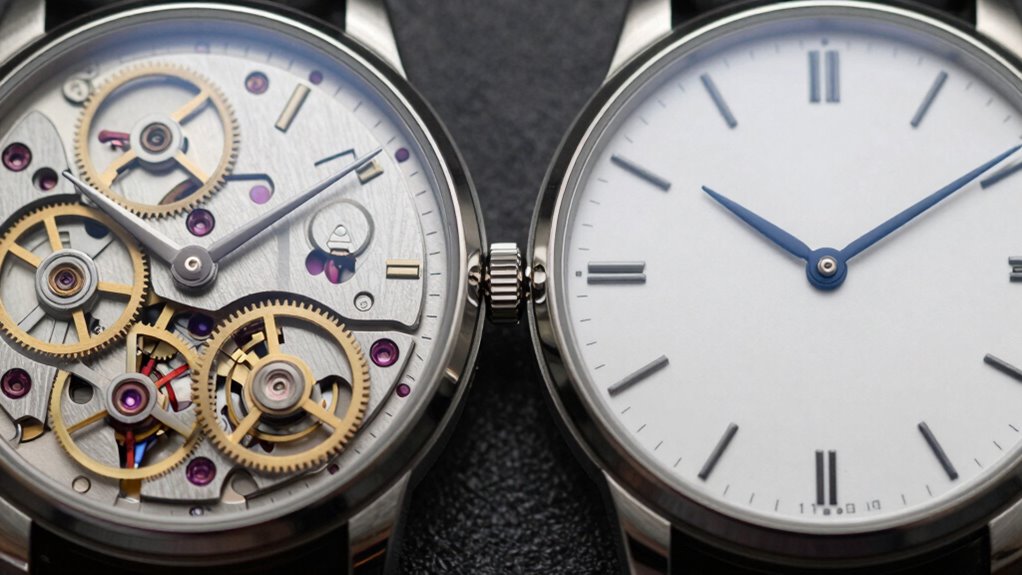
Understanding watch movements is essential because they determine how your watch keeps time and functions. The movement influences the overall performance, durability, and accuracy of your timepiece. The engineering behind watch movements showcases the intricate craftsmanship and technological innovation involved in high-end watches, elevating the watch’s prestige. High-end brands often emphasize their movement engineering as a symbol of quality and exclusivity. Whether it’s a meticulously crafted mechanical movement or a precise quartz system, the movement impacts your experience and how you value the watch. Precision engineering plays a vital role in ensuring that these innovations improve both reliability and user experience. Advances in movement technology continue to push the boundaries of accuracy and functionality, making movements a crucial aspect of modern watchmaking. Regular maintenance and servicing of the movement components are essential to preserve performance over time. For enthusiasts and collectors, understanding the contrast ratio in projectors can also influence their appreciation of visual performance in home cinemas, highlighting the importance of detailed engineering across different fields. By understanding these differences, you can better appreciate a watch’s design, engineering, and the innovation behind its performance.
How Do Automatic Watch Movements Work?

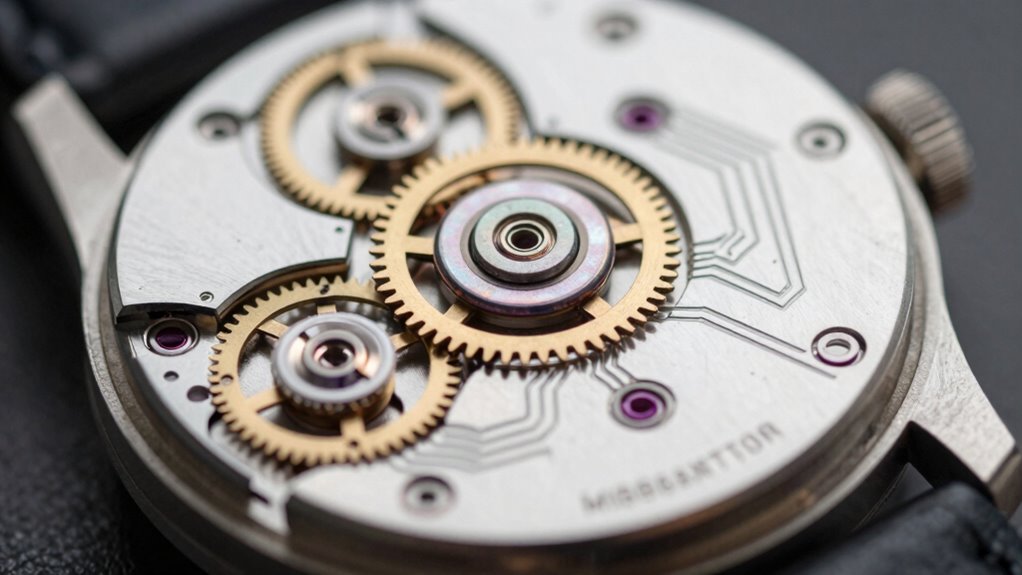
Automatic watch movements rely on a mainspring that stores energy as you wear the watch. This energy transfers through a gear train, regulating the release of power to keep the watch running smoothly. The oscillator, usually a balance wheel, controls the timing, ensuring accurate movement. Proper water damage prevention is essential to maintain their precision and longevity over time. Additionally, regular maintenance can help ensure the gear train operates efficiently and extends the lifespan of the watch. Paying attention to temperature fluctuations also helps preserve the accuracy of automatic movements and prevents internal components from expanding or contracting. Understanding the importance of lubrication can further improve performance and reduce wear on internal components.
Mainspring Power Source
The mainspring serves as the heartbeat of an automatic watch, storing energy that powers the entire movement. Its design is vital, as it determines how much energy it can hold and release steadily. A well-crafted mainspring ensures consistent torque, leading to accurate timekeeping. When you wear the watch, your wrist movements wind the mainspring, winding it tighter and storing more energy. The mainspring’s power reserve indicates how long the watch runs after fully wound—some can last 40 hours, others up to a week. The mainspring’s ability to hold and release energy smoothly is essential for reliable operation. Free Floating design elements in mainsprings contribute to better energy distribution and longevity. Additionally, the material composition of the mainspring affects its resistance to fatigue and corrosion, impacting the watch’s durability over time. Its design impacts not just power reserve but also the watch’s overall performance and durability over time.
Gear Train Functionality
The mainspring’s stored energy flows through a series of gears that regulate the watch’s timing. This gear train transmits power from the mainspring to the escapement, which controls the release of energy. Each gear reduces the speed of the energy transfer, ensuring consistent movement of the hands. The gear train’s precise arrangement allows the watch to keep accurate time by translating the mainspring’s energy into controlled, incremental movements. The escapement works closely with the gear train to release energy at regular intervals, maintaining steady motion. Without this interconnected system, your watch wouldn’t measure time reliably. Together, the gear train and escapement form the core of automatic movement, turning stored energy into the smooth, accurate ticking you observe on your watch face.
Oscillator’s Role
To keep time accurately, the oscillator acts as the watch’s heartbeat, regulating the release of energy from the gear train. Its role is crucial in maintaining precise timekeeping. The oscillator’s role involves vibrating at a consistent frequency, which ensures steady movement of the gear train and accurate seconds, minutes, and hours display. Frequency stability is key here; a stable oscillator prevents time drift caused by variations in temperature, position, or age. In automatic watches, the balance wheel and hairspring form the oscillator, oscillating back and forth at a fixed rate. The more stable the oscillator, the better your watch keeps time. This consistent vibration ensures that energy is released smoothly, making the watch reliable and precise over extended periods. Oscillator’s stability is vital for maintaining long-term accuracy in watch movements.
What Are Quartz Watch Movements and How Do They Function?
Quartz watch movements rely on a tiny quartz crystal that vibrates when electricity passes through it, creating a precise oscillation. A battery supplies power, which drives the crystal and sends signals to a stepper motor. This motor then moves the watch hands accurately, ensuring reliable timekeeping. Choosing the right measurement tools is essential for maintaining the accuracy of such precise mechanisms.
Quartz Crystal Oscillation
When a quartz crystal is subjected to an electric voltage, it begins to vibrate at a precise frequency, creating a stable and reliable timekeeping signal. This crystal oscillation is what keeps quartz watches highly accurate. During operation, the crystal’s consistent vibrations generate electrical pulses that drive the watch’s circuitry. To understand its importance: conversion between units The crystal’s frequency determines the watch’s accuracy. Stable oscillation minimizes time deviations. Efficient crystal oscillation extends battery longevity because less power is needed to maintain vibrations. Additionally, temperature stability is crucial for maintaining the crystal’s consistent oscillation under varying environmental conditions. Temperature effects can influence the crystal’s vibrational frequency if not properly managed. Environmental factors such as temperature fluctuations can impact the crystal’s performance, highlighting the need for robust design features. Furthermore, oscillation stability ensures the watch maintains its precision over time. These factors make quartz movements dependable, with the crystal’s consistent oscillation ensuring precise timekeeping while also conserving battery life. This combination of accuracy and efficiency is what makes quartz watches a practical choice for everyday use.
Battery Power Source
A quartz watch relies on a small battery to power its movement, providing the energy needed for accurate timekeeping. The battery’s lifespan varies depending on usage and features, typically lasting between one to five years. Because quartz watches are highly power-efficient, they consume minimal energy, which extends battery life compared to other types of watches. When the battery runs low, you’ll need to replace it to keep your watch running precisely. The efficiency of quartz movements means you won’t need frequent winding or adjustments, making them convenient and reliable. Battery longevity is an important factor for long-term maintenance and ensuring your watch remains accurate. Additionally, power efficiency in quartz movements contributes to their widespread popularity for everyday wear. Overall, the battery power source in a quartz watch ensures consistent operation with minimal maintenance, highlighting its advantage in long-term accuracy and ease of use.
Stepper Motor Action
The stepper motor is the key component that translates electrical signals into the precise movement of the watch hands. In quartz watches, it receives signals from the battery-powered circuit, which keeps the motor moving accurately. Unlike automatic watches, quartz movements don’t rely on hand winding or a rotor mechanism; instead, they use a tiny stepper motor to produce consistent steps.
To understand its function better:
- The motor receives pulses that correspond to one-second intervals.
- These pulses cause the motor to rotate in small, controlled steps.
- This movement turns gears that move the watch hands smoothly and precisely.
This combination ensures high accuracy, making quartz watches reliable without the need for manual winding or rotor mechanisms.
Comparing Accuracy: Are Quartz Watches More Precise Than Automatics?

Have you ever wondered why quartz watches are often considered more accurate than automatics? Quartz movements use a tiny crystal oscillator that vibrates consistently, usually losing only a few seconds per month. In contrast, automatics rely on mechanical parts that can be affected by temperature, position, and wear, leading to greater time deviations. If you’re into chronograph functions, quartz watches often maintain precise timing during complex measurements. Additionally, quartz watches typically have better water resistance since they don’t contain delicate mechanical components that need protection. While automatics showcase craftsmanship, quartz watches excel in accuracy and reliability. The simplicity of quartz technology often results in fewer points of failure, making them more dependable for everyday use. Moreover, the mechanical precision of quartz movements contributes significantly to their superior accuracy. The impact of external factors can influence automatic watches more noticeably than quartz ones. Ultimately, if precise timekeeping is your priority, quartz watches are the clear choice, even if automatics offer a more traditional appeal.
Maintenance and Longevity: Caring for Automatic and Quartz Watches
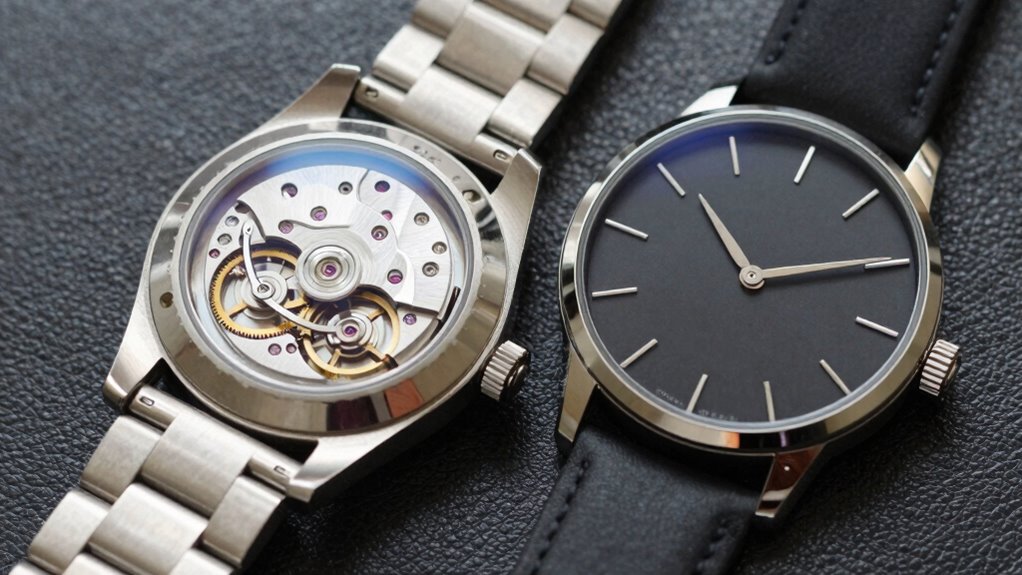
Caring for your automatic and quartz watches requires understanding their distinct needs to guarantee they remain accurate and durable over time. For quartz watches, monitoring battery life is essential; replace the battery before it dies to prevent leakage or damage. Regular servicing intervals, typically every 3-5 years, keep the movement functioning smoothly. Automatics rely on consistent wear and proper maintenance to stay accurate. To extend their longevity, follow these steps:
- Wear your automatic regularly or wind it if unused.
- Keep your quartz watch’s battery fresh to avoid corrosion.
- Schedule professional servicing periodically to ensure all components stay in prime condition.
How Are Automatic Watches Powered? Understanding Self-Winding Mechanisms

Automatic watches are powered by a self-winding mechanism that converts the natural motion of your wrist into energy. This process relies on a rotor mechanism—a small semi-circular weight that spins with your movements. As you wear the watch, the rotor swings back and forth, transferring energy to a mainspring. This mainspring stores the energy generated by your wrist’s motion, which then powers the watch’s gear train and escapement. Unlike manual watches, you don’t need to wind it regularly; your daily activities keep it running. The self winding system ensures continuous operation as long as you wear it regularly. This elegant mechanism makes automatic watches a reliable, low-maintenance choice for those who appreciate craftsmanship and convenience without the need for batteries.
Pros and Cons of Quartz Movements
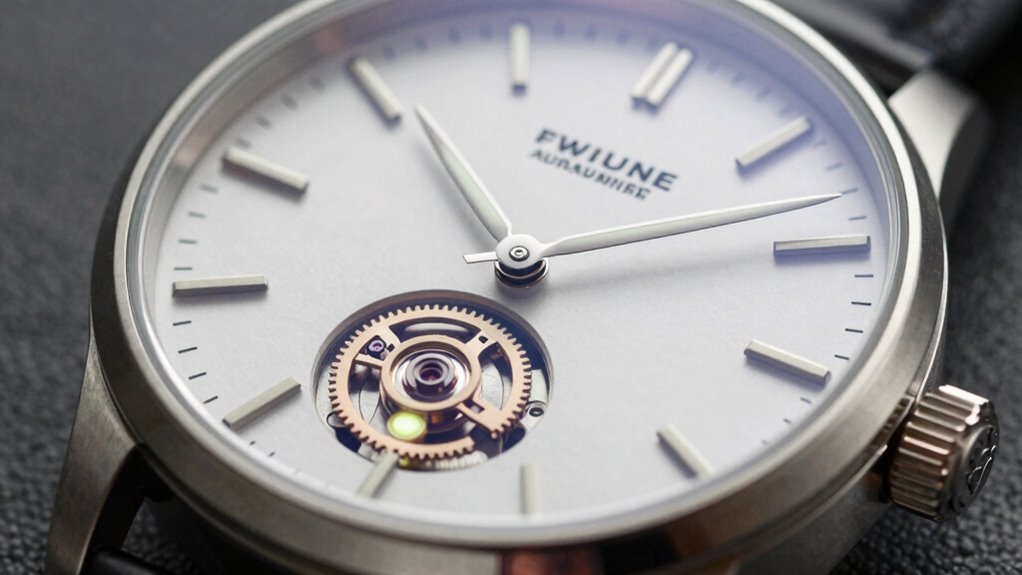
Are quartz movements the most practical choice for everyday watches? They offer simplicity and reliability, making them popular. But consider these pros and cons.
- Battery lifespan: Quartz watches typically last 1-2 years before needing a new battery, reducing maintenance.
- Movement complexity: They feature fewer moving parts, meaning less chance of mechanical failure and easier repairs.
- Cost-effectiveness: Quartz watches are usually more affordable upfront and over time, thanks to their durability and low upkeep.
However, some see them as less appealing due to their lack of traditional craftsmanship and the environmental impact of batteries. Still, for daily wear, their accuracy and low-maintenance nature often outweigh these drawbacks.
Which Watch Movement Fits Your Lifestyle and Budget?

Choosing the right watch movement depends on your daily routines and budget. If you prefer a low-maintenance option with precise timekeeping, quartz watches are affordable and reliable, often featuring simple watch faces and versatile strap materials like rubber or stainless steel. They’re perfect if you want a sleek look without extra upkeep. On the other hand, automatic watches suit those who appreciate craftsmanship and don’t mind regular winding or wearing the watch daily. These watches often have more intricate watch faces and leather straps, offering a more luxurious feel. Your lifestyle dictates whether you prioritize convenience or craftsmanship. Budget-wise, quartz watches are generally less expensive upfront, while automatics may require a higher investment but offer long-term value and a timeless aesthetic.
How Easy Is It to Repair or Upgrade Automatic and Quartz Movements?
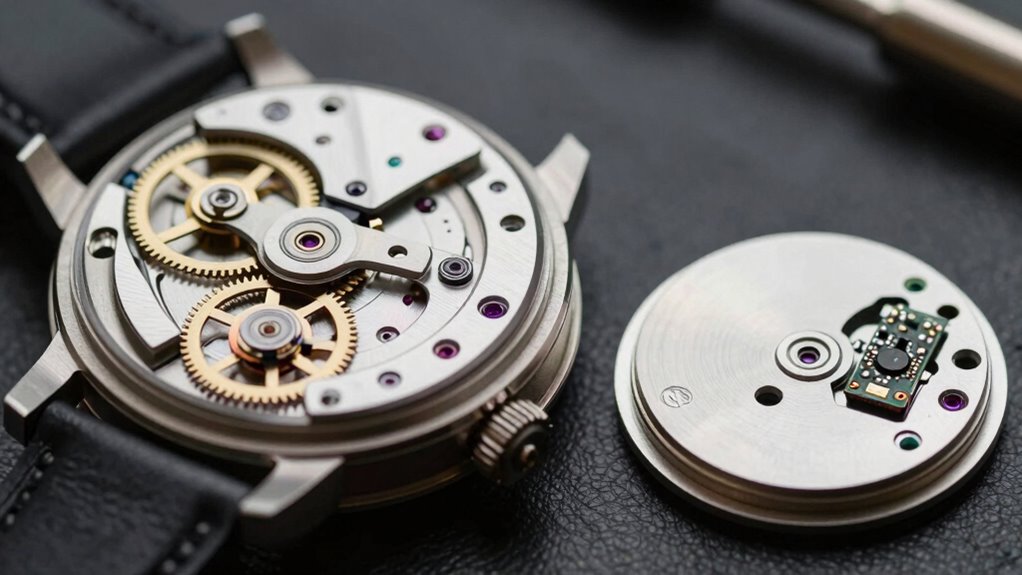
When it comes to repairing or upgrading watch movements, the process varies considerably between automatic and quartz models. Automatic watches, with their intricate mechanical parts, require more specialized watch repair skills and often involve delicate disassembly. Upgrading an automatic movement can be complex, needing precise adjustments or replacements of components. Quartz watches, on the other hand, are generally easier and faster to repair because of their simpler electronic components. For a movement upgrade, quartz models typically involve swapping out the entire module rather than intricate parts. Here’s what to contemplate:
Automatic movements require delicate repairs and complex upgrades, while quartz models are easier and faster to service and upgrade.
- Automatic watch repair demands expertise in delicate mechanical systems.
- Quartz watch repairs tend to be more straightforward and cost-effective.
- Upgrading an automatic movement is more complex than replacing a quartz module.
Is an Automatic or Quartz Watch Better for Collectors and Enthusiasts?

For collectors and enthusiasts, deciding between an automatic and a quartz watch often depends on what you value most in a timepiece. If you cherish craftsmanship and heritage, automatic watches from luxury brands and vintage models appeal more, offering intricate movements and a sense of tradition. Quartz watches, however, deliver precision and convenience, often at a lower price point. Consider this comparison:
| Feature | Automatic | Quartz |
|---|---|---|
| Maintenance | Regular servicing | Minimal, battery replacement |
| Accuracy | Slightly less precise | Highly accurate |
| Heritage & Value | High, especially vintage models | Generally lower resale value |
| Power Source | Wrist movement or manual winding | Battery-powered |
| Collectibility | Highly collectible, iconic brands | Less collectible, practical |
Your choice hinges on whether you prioritize heritage or precision.
Frequently Asked Questions
What Are the Environmental Impacts of Automatic Vs Quartz Watches?
You might find automatic watches more eco-friendly since they don’t need batteries, reducing waste from battery recycling. However, they often contain eco-friendly materials in their manufacturing. Quartz watches use batteries, which can harm the environment if not properly recycled. By choosing models with sustainable materials and supporting battery recycling initiatives, you can minimize your watch’s environmental impact, no matter which movement you prefer.
How Do Temperature Changes Affect the Accuracy of Each Movement Type?
You might think automatic and quartz watches are equally affected by temperature changes, but that’s not true. Thermal expansion impacts quartz movements more, causing small inaccuracies, while automatic watches often have temperature compensation mechanisms. As temperatures fluctuate, quartz watches can lose or gain seconds quickly, whereas automatic watches generally maintain better accuracy due to their design. So, temperature changes directly influence each type’s precision, with quartz being more sensitive.
Are There Hybrid Watches That Combine Automatic and Quartz Features?
Yes, there are hybrid watches that combine automatic and quartz features. These hybrid watches, often called automatic quartz combinations, seamlessly blend the accuracy of quartz with the traditional appeal of automatic movements. You benefit from precise timekeeping while enjoying the mechanical charm. This combination offers the best of both worlds, making it a popular choice for those who want reliability and style in one sleek package.
How Does Water Resistance Vary Between Automatic and Quartz Watches?
Like the fortress of a castle, water resistance depends on sealing technologies, not just the movement type. Both automatic and quartz watches can achieve similar waterproof ratings if properly sealed. The level of water resistance varies based on design, with some rated for depths like 100 meters. Always check the waterproof rating, and trust sealed cases to keep moisture out, regardless of whether the watch is automatic or quartz.
What Are the Typical Costs for Repairing Automatic Versus Quartz Movements?
You’ll find that repair costs for automatic watches generally fall between $200 and $600, mainly due to their complex mechanisms, while quartz watch repairs are usually cheaper, averaging $50 to $150. The pricing comparison shows automatic movements demand higher maintenance costs because of their intricate parts and skilled labor. Quartz watches are simpler, so they’re cheaper to repair, making them a more budget-friendly option for everyday wear.
Conclusion
Ultimately, choosing between automatic and quartz watches depends on what matters most to you—precision, craftsmanship, or convenience. But what if the real question is something deeper? Could one movement hold the key to revealing a new appreciation for timepieces? The answer isn’t just about features; it’s about what resonates with your passion and lifestyle. The choice is yours—are you ready to explore the hidden depths of watch movements?