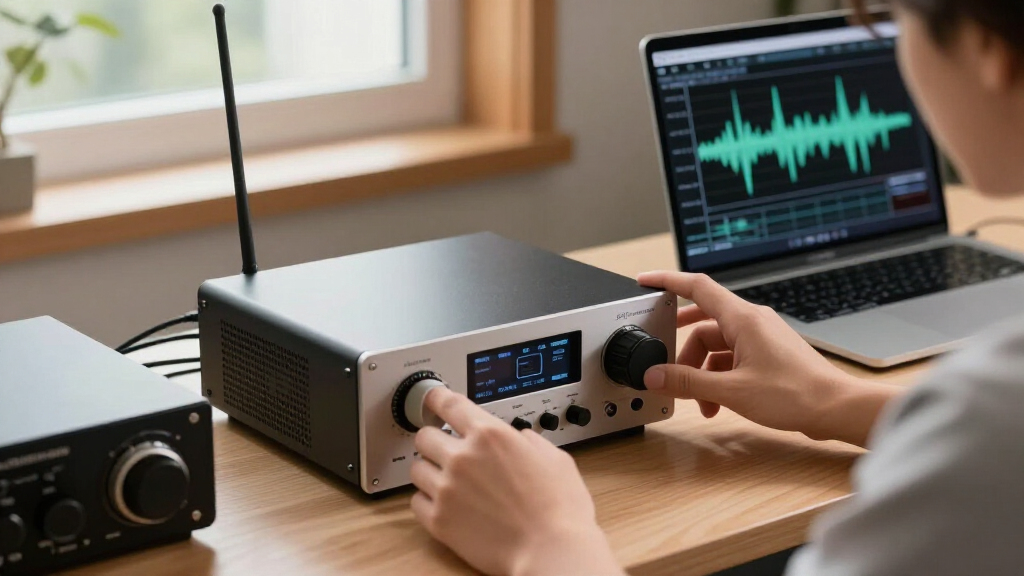

📊 Full opportunity report: AI’s Role In Revolutionizing Shortwave Number Listening: The Station 36 Case on ThorstenMeyerAI.com — validation score, market gap, and execution plan.

Get business pricing on monitors, keyboards and dev gear
- Business-only prices and quantity discounts
- Tax-exempt purchasing
- Multiple users, one account, clear invoices
TL;DR
AI has been used to create an immersive web platform that simulates vintage shortwave radio listening. This innovation allows users to interactively tune into secret signals, marking a significant development in digital radio recreation.
Artificial intelligence has enabled the creation of Station 36, an interactive web experience that simulates vintage shortwave radio listening, as detailed in the original analysis. Developed entirely through AI-driven design and programming, it allows users to manually tune into simulated secret signals, reviving the tactile joy of vintage radio signal hunting within a browser environment. This development marks a significant step in digital recreations of historical radio practices, offering both educational and recreational value.
Station 36 is a web-based project designed to emulate a Cold War-era shortwave listening post. Its interface features a vintage bakelite-inspired design, with a simulated tuning dial, spectral waterfall, and audio synthesis that mimics static, heterodyne whistles, Morse code, and voice signals. The entire experience is built with inline SVG, JavaScript, and Web Audio API, ensuring a fully self-hosted, dependency-free environment that responds to user interactions in real-time.
Developed by an AI system following a detailed art-direction brief, the platform offers tactile control over frequency tuning, with visual and audio feedback synchronized to create an authentic experience. Users can discover hidden signals and even find a secret message embedded in the spectral display, adding an element of discovery reminiscent of classic radio hobbyist activities.
According to the creators, this project demonstrates AI’s ability to craft immersive, historically inspired digital environments that blend visual design, sound synthesis, and interactive controls without external assets or frameworks. It is part of a larger series of AI-designed web projects, each aiming to evoke specific historical or cultural themes through innovative web craftsmanship.
Innovative Use of AI in Vintage Radio Simulation
This development showcases AI’s potential to recreate complex, tactile experiences that were once physical, now entirely within a browser. It offers a new way for radio enthusiasts, educators, and historians to explore shortwave signals interactively, broadening access to vintage radio culture. Additionally, it demonstrates how AI can assist in preserving and reimagining historical practices through modern technology, potentially influencing future digital recreations of other analog systems.Products Worth Considering

Logitech MX Master 4 for Mac, Ergonomic Bluetooth Mouse with Haptic Feedback, Ultra-Fast Scrolling, USB-C Charging, for MacOS, iPadOS, Windo

Samsung 32-Inch Odyssey OLED G8 (G80SH) 4K Gaming Monitor

LG 34GX90SA-W 34-inch Ultragear WQHD OLED Curved Gaming Monitor
As an affiliate, we earn on qualifying purchases.
Historical and Technological Background of Shortwave Listening
Shortwave radio listening has long been a hobby for enthusiasts seeking to intercept secret or international signals, especially during the Cold War era. Traditional listening involved physical hardware, manual tuning, and decoding Morse or voice signals, often in secretive environments. In recent years, digital recreations and simulations have emerged, but most lacked the tactile and auditory authenticity of real hardware. The advent of AI-driven design and programming now enables the creation of highly realistic, interactive digital environments that emulate these vintage experiences with unprecedented fidelity.“AI has allowed us to craft a fully interactive, authentic simulation of vintage shortwave listening, accessible directly through a browser without external dependencies.”
— an anonymous researcher
Unanswered Questions About AI’s Role in Signal Authenticity
It is still unclear how accurately the platform replicates the full complexity of real shortwave signals, including the fidelity of audio synthesis and spectral accuracy. The extent to which users can reliably discover signals or decode messages compared to real hardware remains to be tested in broader user studies. Additionally, the long-term preservation of such AI-generated environments and their potential for educational use are still under exploration.Next Steps for Development and Broader Adoption
Developers plan to expand the platform’s capabilities, including more sophisticated signal simulations and user customization options. They aim to gather feedback from radio hobbyists and educators to refine the experience. There is also interest in integrating this approach into broader digital preservation efforts for vintage radio practices, as well as exploring its potential as an educational tool in technical and history curricula.
Key Questions
How realistic is the Station 36 simulation compared to real shortwave listening?
The platform uses advanced audio synthesis and spectral visualization to emulate vintage signals, but its accuracy compared to real hardware has not been formally validated. It provides a convincing experience, though some nuances of real signals may be simplified.
Can users decode actual Morse code or messages using this platform?
The platform simulates Morse signals and allows users to discover hidden messages, but it is primarily a visual and auditory recreation. It is not designed for real decoding of live signals but offers an educational approximation.
Is this project intended for educational use or hobbyists?
Both. It serves as an educational tool to demonstrate vintage radio principles and as a hobbyist platform for signal discovery and exploration within a digital environment.
Will the platform be available for public use long-term?
While currently accessible, the long-term availability depends on ongoing development and hosting decisions. The creators aim to keep it accessible as part of a broader series of AI-crafted web experiences.
Are there plans to expand this concept to other vintage technologies?
Yes, the developers are exploring similar AI-driven recreations of other analog systems, aiming to preserve and modernize historical technical experiences.
Source: ThorstenMeyerAI.com