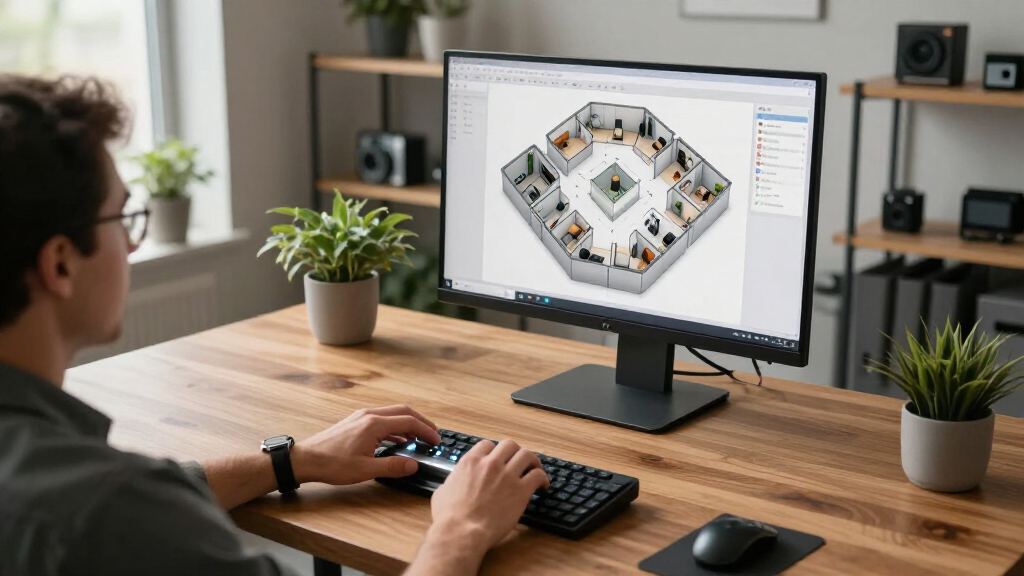

🔍 Read the full analysis: AI III Highlight: Twelve Rooms In The Tower Designed For Safe AI Work on ThorstenMeyerAI.com

Get business pricing on monitors, keyboards and dev gear
- Business-only prices and quantity discounts
- Tax-exempt purchasing
- Multiple users, one account, clear invoices
TL;DR
The AI III project unveils twelve specialized rooms within the AI Tower, each tailored for safe AI research and application. This initiative aims to enhance security and control in AI development, with details confirmed by Thorsten Meyer AI. The project is part of ongoing efforts to ensure responsible AI use.
Thorsten Meyer AI has introduced a new feature called the AI Tower, comprising twelve specialized rooms designed explicitly for safe and controlled AI research and deployment. This development aims to address growing concerns about AI safety and responsible experimentation, providing a secure environment for developers and researchers.
The AI Tower is a modular structure accessible via web browsers, allowing users to explore different aspects of AI safety and functionality without sign-up, cookies, or tracking. Each of the twelve rooms focuses on a specific aspect of AI work, such as retrieval-augmented generation, prompt engineering, autonomous agents, and automation workflows, offering hands-on experiments and testing environments.
According to Thorsten Meyer AI, the initiative is part of the Inside AI series, which aims to demystify AI technology and promote responsible use. The rooms are designed to be user-friendly, enabling users to test and understand AI capabilities and limitations through practical exercises. The project emphasizes transparency, with features like source verification and testing prompts to prevent misuse or misinterpretation.
While the rooms are accessible on various devices, the platform emphasizes privacy and security, avoiding data collection or tracking. The launch aligns with broader industry efforts to develop safer AI practices, especially as AI systems become more integrated into critical sectors like healthcare, finance, and governance.
Inside AI · Safe experimentation · March 2026
Twelve Rooms in the Tower Designed for Safe AI Work
The AI Tower brings focused, browser accessible spaces together for exploring AI capabilities, testing ideas, and learning responsible practices in a controlled setting.
01 / The environment
One tower, focused spaces
Each room centers on a specific area of AI work. Together, they offer practical ways for developers, researchers, and curious users to examine how systems behave and where their limits lie.
Knowledge grounding
Retrieval-augmented generation
Explore how retrieved sources can inform an AI response and why source verification matters.
Human direction
Prompt engineering
Test how instructions shape outputs, then examine ambiguity, reliability, and potential misuse.
Autonomy
Autonomous agents
Study agent behavior and the value of boundaries, oversight, and controlled testing.
Orchestration
Automation workflows
See how connected AI tasks can be designed and evaluated with safety checks in view.
Shared purpose
Eight further rooms
The project describes twelve rooms; the four named examples are part of a broader set of focused environments.
Learning by doing
Practical experiments
Hands-on exercises aim to make AI functions, risks, and limitations easier to understand.
02 / How the approach works
Explore, test, understand, improve
The Tower is presented as an accessible learning environment: users can move from a focused experiment toward a clearer view of system behavior and responsible use.
Choose a room
Start with a specific AI topic or task.
Run an experiment
Try prompts and workflows in a dedicated setting.
Check the result
Use source checks and testing prompts to examine outputs.
Apply with care
Carry lessons about limits and oversight into real work.
03 / Why it matters
Safety through structured exploration
Controlled spaces can help people examine AI behavior before applying it in higher impact settings. The initiative aligns with wider efforts to improve transparency and responsible development.
What the Tower offers
- Browser based access across devices
- No sign-up, cookies, or tracking, according to the project
- Topic focused experiments for learning and testing
- Emphasis on transparency and source verification
What remains to be learned
- How widely the rooms will be adopted
- Whether they will connect with external tools or standards
- How well they reduce misuse or errors over time
- What user feedback and independent review will show
04 / Context & next steps
Part of a wider learning series
The Inside AI series has also featured the Museum and Engine Room modules, explaining AI concepts and engineering principles. The Tower extends that educational focus into safe, practical exploration.
Who can use it?
It is described as publicly accessible through a web browser, with no account required.
Is it an industry standard?
That is not yet established. The project may offer an example for accessible safety testing.
What is the key limitation?
Long-term effectiveness and broader adoption have not yet been independently validated.
Why now?
AI is reaching critical fields such as healthcare, finance, and governance, increasing the need for responsible practices.
Implications for Responsible AI Development
The launch of these twelve dedicated rooms marks a significant step toward enhancing AI safety and transparency. By providing controlled environments for testing and understanding AI behavior, the initiative aims to reduce risks associated with unchecked AI deployment. It offers a practical tool for developers, researchers, and organizations seeking to ensure their AI systems operate within ethical and safety boundaries.
This approach could influence industry standards by demonstrating how structured, accessible environments can promote responsible innovation. As AI becomes more embedded in daily life, such tools are vital for preventing misuse, reducing errors, and building trust among users and regulators alike.
AI development safety testing tools
As an affiliate, we earn on qualifying purchases.
As an affiliate, we earn on qualifying purchases.
Background on AI Safety and the Inside AI Series
The Inside AI series, from Thorsten Meyer AI, has previously explored core aspects of AI technology, including the Museum and Engine Room modules, which focus on understanding AI’s inner workings and engineering principles. The series aims to make complex AI concepts accessible and promote responsible development practices.
Recent industry developments have highlighted concerns over AI safety, bias, and misuse. Initiatives like OpenAI’s safety protocols and regulatory discussions underscore the importance of controlled experimentation environments. The AI Tower builds on this momentum, offering a dedicated space for safe AI exploration.
Prior to this, efforts to create secure AI testing environments have been fragmented, often limited to internal research labs or proprietary platforms. The AI Tower represents a move toward democratizing access while maintaining safety standards, aligning with broader trends in AI governance and ethical AI deployment.
“The twelve rooms in the AI Tower are designed to give users a safe, transparent space to explore AI’s capabilities and limitations without risking misuse or unintended consequences.”
— Thorsten Meyer, Lead Developer at Thorsten Meyer AI
As an affiliate, we earn on qualifying purchases.
Unanswered Questions About Implementation and Adoption
It is not yet clear how widely the AI Tower will be adopted outside Thorsten Meyer AI, or how the platform will evolve over time. Details about potential integration with other tools or industry standards remain undisclosed. Additionally, the long-term effectiveness of the rooms in preventing misuse or errors has not been independently validated, and ongoing feedback from users will be crucial to assess impact.
secure AI experimentation software
As an affiliate, we earn on qualifying purchases.
As an affiliate, we earn on qualifying purchases.
Next Steps for the AI Tower Initiative
Thorsten Meyer AI plans to monitor user engagement and gather feedback on the twelve rooms over the coming months. They may introduce new features or expand the platform based on user needs and safety assessments. Industry experts will likely scrutinize the platform’s effectiveness and consider its role in shaping future AI safety protocols. Meanwhile, other organizations may develop similar environments, potentially leading to broader adoption of structured AI testing spaces.
As an affiliate, we earn on qualifying purchases.
Key Questions
What are the twelve rooms in the AI Tower designed for?
The rooms are tailored for specific aspects of AI research and safe deployment, including retrieval-augmented generation, prompt engineering, autonomous agents, and automation workflows.
Is the AI Tower accessible to the public?
Yes, the platform is accessible via web browsers on various devices, with an emphasis on privacy and no data tracking. It is designed for users to freely explore AI capabilities and safety features.
Will the AI Tower become a standard for industry safety practices?
It is too early to tell, but the initiative could influence industry standards by demonstrating effective, accessible safety environments for AI development.
What are the limitations of the AI Tower?
While it offers practical testing environments, the platform’s long-term effectiveness in preventing misuse remains to be validated, and broader adoption is still uncertain.
How does this development relate to broader AI safety efforts?
The AI Tower aligns with ongoing industry and regulatory initiatives aiming to promote responsible, transparent AI development and deployment.
Source: ThorstenMeyerAI.com
Fall Picks
fall essentials
As an affiliate, we earn on qualifying purchases.