TL;DR
A November 23, 2026 explainer from Thorsten Meyer AI describes how image diffusion models learn to predict noise added to training images, then generate pictures by gradually removing noise. It also covers text guidance, compressed image representations, common weaknesses and unresolved copyright questions.
Thorsten Meyer AI published an explainer on November 23, 2026, tracing how image diffusion models turn random noise into pictures and why their design can produce errors such as garbled text or misplaced objects. The article describes established methods from research papers and software documentation; it is an educational guide, not a report of a new model or research result.

Get business pricing on monitors, keyboards and dev gear
- Business-only prices and quantity discounts
- Tax-exempt purchasing
- Multiple users, one account, clear invoices
The explainer says diffusion models are trained by adding noise to real images in small increments. A neural network then learns to estimate the noise in each altered image. During generation, the model starts with random noise and repeatedly estimates and removes noise, producing an image over a sequence of steps. The guide cites the 2020 paper “Denoising Diffusion Probabilistic Models” by Jonathan Ho, Ajay Jain and Pieter Abbeel, which used 1,000 steps in its experiments.
Many image systems use latent diffusion: they first encode an image into a smaller representation, perform the denoising there and decode the result back into an image. The source gives Stable Diffusion v1 as an example, saying a 512 × 512 image is represented using 48 times fewer numbers. That compression reduces the work required, though the guide does not claim that every diffusion model uses this method.
Text prompts guide the process through a text encoder and a technique called classifier-free guidance. The source says stronger guidance can make a result follow the prompt more closely, with a possible cost to image quality. It also identifies recurring limitations: models may struggle with lettering, counting and spatial relationships. The supplied material says researchers have extracted near-copies of training images from models, and cites a 2025 UK court ruling that Stable Diffusion itself was not an “infringing copy.”
Why Noise Shapes the Results
Understanding the process helps explain why an image model can make a convincing scene while getting a small but meaningful detail wrong. The model repeatedly estimates how to remove noise, guided by patterns learned during training and signals from the prompt. The source connects that design to problems with lettering, object counts and spatial placement, including a cube appearing beside a sphere rather than on top of it.
The method also frames concerns about resemblance to training images. The explainer reports that researchers have extracted near-copies from models, but that observation does not establish how often such outputs occur or settle the legal status of model training. The cited UK ruling addresses one question about Stable Diffusion; the source says other questions remain open. For readers using or evaluating image generators, the practical point is that fluent-looking output is not proof that every detail is correct or that a result is wholly unlike training material.
Products Worth Considering

Samsung Galaxy Tab S10 Lite, 10.9-Inch LCD Tablet, 6GB RAM, 128GB Storage, Expandable up to 2TB, Gray

LG UltraGear 27-inch 4K UHD IPS Gaming Monitor, Dual Mode 180Hz/360Hz, 1ms, G-SYNC Compatible

Sonos Era 300 Wireless Smart Speaker with Dolby Atmos, Black
As an affiliate, we earn on qualifying purchases.
From Early Theory to Latent Diffusion
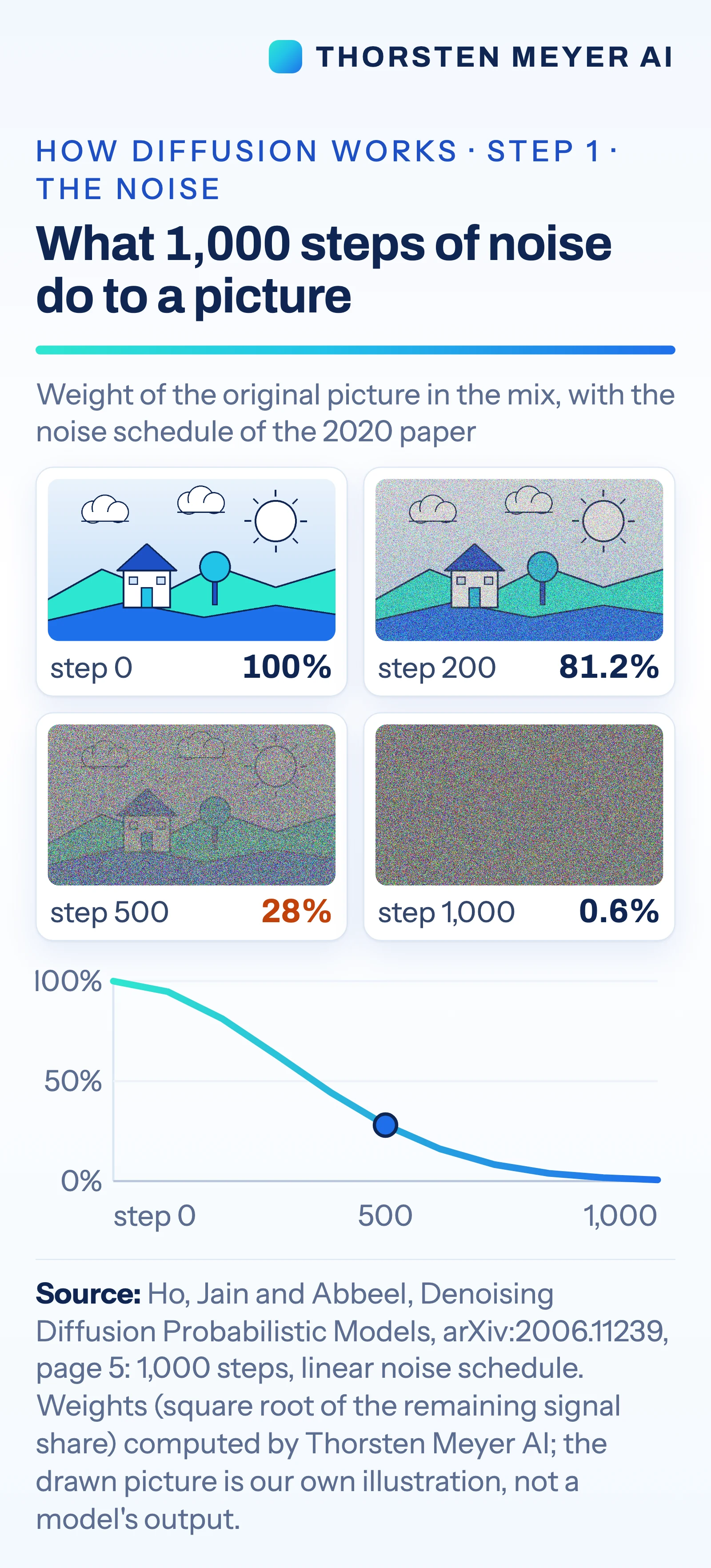
The underlying idea predates current image generators. The source points to a 2015 paper by Jascha Sohl-Dickstein and colleagues, which proposed gradually destroying structure in data and learning a reverse process that restores it. In 2020, Ho, Jain and Abbeel published “Denoising Diffusion Probabilistic Models,” a later method that helped make the approach practical. Their paper describes a forward chain that adds noise until the original signal is destroyed.
The guide uses the 2020 paper’s 1,000-step schedule to illustrate the change: it reports that the original image has 81.2% of its weight after 200 steps, 28% after 500 and 0.6% after 1,000. These figures describe that paper’s schedule, not a universal rule for every model. For generation, the explainer says a commonly used open-source pipeline has a 50-step default. That setting is an example from the cited Hugging Face diffusers documentation, rather than a claim that all systems use the same number of steps.
““More guidance means closer to the text, at some cost in image quality.””
— Thorsten Meyer AI explainer
Open Questions on Copies and Courts
The supplied material does not quantify how often generated images reproduce training examples, identify the conditions that make near-copies more likely or specify how broadly the cited extraction findings apply. It also gives no full case name or detailed account of the 2025 UK ruling, so the ruling should not be read as resolving every copyright issue involving training data or generated images. The source explicitly says other legal questions remain open.
The explainer’s figures and examples also have defined limits: the 1,000-step schedule belongs to the cited 2020 experiments, while 50 steps is a stated default for a commonly used pipeline. The material does not establish that every current model uses those settings. It offers no comparative measurements for how prompt guidance affects image quality, either.
What Readers Can Check Next
The article points readers to the research paper by Ho, Jain and Abbeel and to Hugging Face diffusers documentation for the technical details behind its account. Those references can help readers distinguish the paper’s specific training schedule from settings used by a particular software pipeline. The source does not announce a forthcoming model, study or court decision.
For now, the explainer’s practical message is to treat generated details as outputs that may need checking. Whether a particular image resembles training material, how well a prompt has been followed and how copyright rules apply can depend on evidence beyond the general process described here.
Key Questions
What does a diffusion model start with when generating an image?
It starts with random noise and repeatedly estimates and removes noise until an image takes shape.
How is a diffusion model trained?
Noise is added to training images in steps. A neural network learns to predict the added noise, a task that supports the reverse denoising process used to generate images.
Why can image models get text or object placement wrong?
The source identifies lettering, counting and spatial relationships as common weak points. It gives garbled lettering and objects placed in the wrong relation as examples.
Does the cited UK ruling settle AI image copyright questions?
No. The source says a UK court ruled in 2025 that Stable Diffusion itself was not an “infringing copy,” while other questions remain open. It does not provide enough case detail to draw broader legal conclusions.
Source: Thorsten Meyer AI