🔍 Read the full analysis: 10 Best Projectors For A Cinema-Quality Movie Room In 2027 on ThorstenMeyerAI.com

Get business pricing on monitors, keyboards and dev gear
- Business-only prices and quantity discounts
- Tax-exempt purchasing
- Multiple users, one account, clear invoices
TL;DR
ThorstenMeyerAI.com’s 2027 guide names 10 projectors for different home viewing needs, from the Epson Home Cinema LS11000 for dedicated media rooms to smart, lower-cost models for living rooms. The source provides some specifications and recommendations but does not include prices, independent test results or complete details for every pick, so its rankings should be treated as editorial guidance rather than verified performance comparisons.
ThorstenMeyerAI.com has published a 2027 guide to 10 home theater projectors, led by the Epson Home Cinema LS11000 as its best overall option for dedicated media rooms. The recommendations span laser, LED and lamp models, with the guide emphasizing that buyers should match brightness, resolution and smart features to their room rather than choosing on a headline specification alone.
The guide identifies the Epson Home Cinema LS11000 as the pick for a dedicated media room, citing its laser light source and 4K PRO-UHD image. It also recommends the NexAurea Smart Projector for buyers seeking built-in smart features and lower-cost convenience; the source lists native 1080p resolution and Wi-Fi 6. It does not provide a price or independent test measurements for either model.
Other models named in the source include the Optoma UHZ36, described as a bright choice for rooms with daylight; the Epson Home Cinema 980, a lamp-based option; and projectors from HAPPRUN, Aurzen and X9 Pro. The source refers to a HAPPRUN model rated at 1,500 ANSI lumens and says the HAPPRUN and Aurzen picks offer integrated access to streaming apps. It associates Wi-Fi 6 and Bluetooth 5.4 with the NexAurea and X9 Pro.
The guide says its selections were assessed across image quality, usability and value, including resolution, light source, HDR, contrast, setup features and connectivity. However, the supplied material does not name all 10 picks or give a complete specification sheet for each. A full model-by-model comparison cannot be independently reconstructed from the information available here.
The 10 picks
- 1
 Epson Home Cinema LS11000 4K PRO-UHD Laser ProjectorView on Amazon →
- 2
 Optoma UHZ36 4K UHD Laser HDR Home Theater Projector – BlackView on Amazon →
- 3
 Epson Home Cinema 980 3-Chip 3LCD 1080p Movie ProjectorView on Amazon →
- 4
 X9 Pro Smart Projector with VIDAA OS, 1080p Native Resolution, 4K Decoding, H…View on Amazon →
- 5
 HAPPRUN 1500 ANSI Lumens 4K Decoding Projector with Official Google TVView on Amazon →
- 6
 HAPPRUN Native 1080P Bluetooth Projector with Official Licensed Google TVView on Amazon →
- 7
 NexAurea Smart Projector with Native 1080p, 4K Decoding, Wi-Fi 6, Bluetooth 5…View on Amazon →
- 8
 Smart Outdoor Projector with 4K Support, WiFi & Bluetooth, Dual Speakers, Aut…View on Amazon →
- 9
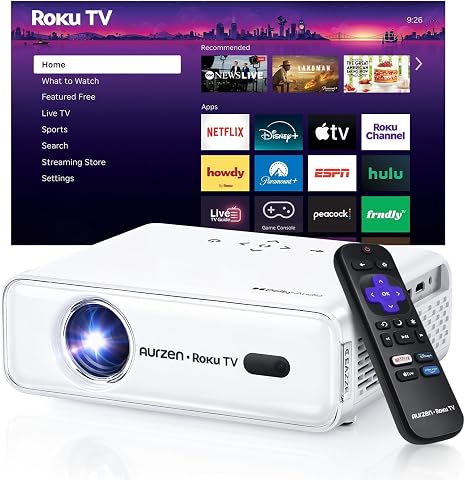 Aurzen Roku TV Smart Projector with Wifi and Bluetooth, Roku Streaming Experi…View on Amazon →
- 10
 HAPPRUN Native 1080P Bluetooth ProjectorView on Amazon →
Matching Projectors to Real Rooms
The guide’s central practical point is that a projector’s room fit can matter as much as its resolution. A lower-brightness LED unit may suit a dark dedicated theater, while a room used during daylight calls for more light output and may still benefit from controlling incoming light. Buyers who overlook this can end up with a large image that appears washed out, even if the projector accepts high-resolution video.
Its distinction between native resolution and 4K decoding also addresses a common source of confusion. A projector can accept a 4K signal and display it at a lower native resolution; that is not the same as displaying a native 4K image. The distinction matters most for people sitting close to a large screen or prioritizing fine detail, while other buyers may place greater value on cost, streaming convenience or flexibility.
Light-source choice affects ownership as well as image quality. The guide says laser models can reduce lamp-replacement needs and retain brightness over long use, while traditional lamps cost less upfront but may need replacement. Those are general tradeoffs, not a quantified cost comparison among the listed models.
Products Worth Considering

LG UltraGear 32-inch QHD Curved Gaming Monitor, 180Hz, 1ms, AMD FreeSync

Bose Smart Dolby Atmos Soundbar with Alexa, Voice Control, and Bluetooth

DJI Mic 3 Wireless Microphone Kit (2 Transmitters, 1 Receiver, Charging Case)
As an affiliate, we earn on qualifying purchases.
Resolution, Light and Setup Tradeoffs
The source frames projector buying around three connected decisions: how dark the room is, how detailed the image needs to be, and how much setup the owner wants to manage. It describes native 1080p as a practical baseline for many living rooms, while pointing to native 4K as an upgrade for viewers seeking greater detail. Its descriptions do not establish that every named projector has native 4K; the guide specifically warns that “4K support” can refer to signal decoding rather than panel resolution.
It also contrasts laser, LED and lamp illumination. The source says premium lasers can be rated for more than 20,000 hours and maintain brightness more consistently, whereas LED units generally suit darker rooms because of lower peak brightness. Lamp models can have a lower initial cost but add replacement expenses. These are source-provided generalizations; individual performance depends on model, settings and use.
For ease of use, the guide favors features such as automatic focus, keystone correction and integrated streaming, while noting that manual adjustments may help enthusiasts seeking a sharper setup. Wireless standards are another consideration, but the source gives no measured streaming or latency tests to compare the named products.
“The main tradeoff you will face is between raw brightness and color accuracy.”
— ThorstenMeyerAI.com buyer’s guide
Missing Tests and Model Details
The available source material does not list all 10 projectors by name, provide prices or show the measurements behind its rankings. It also does not include independent lab testing, side-by-side image comparisons, screen sizes, throw distances or full brightness and contrast figures for every model. As a result, the picks and descriptions should be read as the guide’s recommendations, not independently verified rankings.
It is also unclear when the guide was published beyond its 2027 framing, whether every model is available in the relevant market, and whether specifications or software support may change. Claims about longevity, wireless performance and streaming convenience are not accompanied by test methodology in the supplied text.
Check Availability Before Buying
Readers considering a purchase should compare the complete model list and current manufacturer specifications, then verify native resolution, measured brightness, throw distance and available inputs for the exact version being sold. Price and warranty information are also needed to judge total ownership cost, particularly when comparing lamp models with laser or LED alternatives.
Any later update to the guide could clarify the missing picks, add prices and document how image quality and usability were tested. Until then, its most actionable advice is to begin with the room’s lighting and layout, then weigh image fidelity against convenience and budget.
Key Questions
Which projector does the guide recommend overall?
It names the Epson Home Cinema LS11000 as its best overall pick for dedicated media rooms, citing laser illumination and 4K PRO-UHD. The source does not provide independent test results or a price comparison.
Does a projector that supports 4K display native 4K?
Not necessarily. The guide says some models can accept or decode a 4K signal but display it at a lower native resolution. Check the panel’s native resolution rather than relying on “4K support” wording.
What brightness is suitable for a room with daylight?
The source says higher brightness can help in rooms with ambient light and points to the Optoma UHZ36 for that use. It cites a HAPPRUN model at 1,500 ANSI lumens for moderate ambient light, but does not provide comparable measurements for every pick.
What details are missing from the 2027 list?
The provided material does not identify all 10 models or include a full price and specification table, independent testing, or availability information. Buyers should verify those details before deciding.
Source: ThorstenMeyerAI.com