
📊 Full opportunity report: What Small Offices Need From A Document Digitization Workflow on IdeaNavigator AI — validation score, market gap, and execution plan.
TL;DR
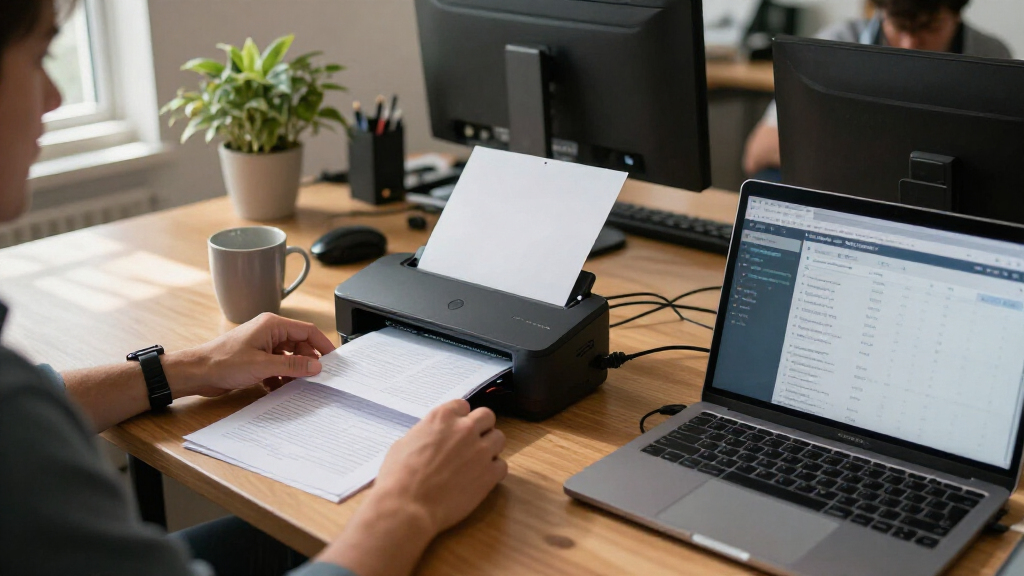
IdeaNavigator AI proposes a phone-based document scanning workflow for paper-heavy small offices, with automated text recognition, document classification and searchable PDFs. The proposal, described on IdeaNavigator AI’s website, is an early-stage product idea, not a launched service or a proven business; its suggested five-office pilot would test classification accuracy and willingness to pay.
IdeaNavigator AI has proposed a phone-based document digitization workflow for paper-heavy small offices, combining text recognition, suggested file names and searchable PDFs. As described in the company’s online proposal, the idea is still at the validation stage: no product launch, measured accuracy results or customer demand figures are provided, and a proposed pilot would test the workflow in five offices.
According to IdeaNavigator AI’s proposal, the product would target office managers at small nonprofits, clinics and law offices, where intake forms, invoices and records can build up in physical filing cabinets. The proposal identifies a specific limitation in many basic scanning workflows: scanned pages may become image files without useful names, categories or searchable text, leaving staff to sort and retrieve them manually.
The suggested minimum product, as outlined by IdeaNavigator AI, would let a user photograph a stack of documents with a phone. Optical character recognition (OCR) would read the text, while the software would suggest a document category and filename—for example, an invoice labeled with its date and vendor—and save the pages as searchable PDFs in a shared folder.
IdeaNavigator AI suggests a monthly per-seat subscription, with a page limit and additional charges for usage above that cap. Its proposed test is a one-week pilot with five small offices, each scanning a real backlog of 200 documents. The proposal says the evaluation would track correct auto-classification and whether the offices would pay for the service. No pilot has been reported as completed.
Reducing Manual Filing Work
For a small office without dedicated IT staff, the value of scanning depends on more than converting paper into digital images. Searchable text, consistent names and useful categories could make records easier to find and reduce the manual work that follows scanning. A shared folder could also give staff a common place to access digitized files, though IdeaNavigator AI’s proposal does not specify its access controls or storage design.
The practical test is whether automated suggestions are accurate enough to save time without creating a new review burden. If staff must repeatedly correct document types, dates or vendor names, the workflow may offer less benefit than expected. IdeaNavigator AI’s proposed pilot measures—classification accuracy and willingness to pay—address part of that question, but do not yet establish time savings, reliability across document types or long-term customer demand.
The suggested pricing model also makes usage a business concern. Page caps and overage fees could make costs more predictable for some offices, but IdeaNavigator AI provides no price, cap level or evidence that prospective customers would accept those terms.
document scanner app for small office
As an affiliate, we earn on qualifying purchases.
As an affiliate, we earn on qualifying purchases.
From Paper Stacks to Searchable PDFs
IdeaNavigator AI’s proposal responds to a familiar operational problem: small organizations may keep substantial paper records while lacking staff or systems for a dedicated digitization project. Basic phone scanning can create digital copies, but a folder full of unlabelled images may still be difficult to search and organize.
IdeaNavigator AI says on-device and API-based OCR, along with layout-aware models, are now inexpensive and accurate enough to support automatic naming, classification and field extraction without a dedicated IT team. That is the proposal’s rationale, not a performance result for a particular product. The proposal names no technology provider, benchmark, cost estimate or comparison of on-device and API processing.
The proposed workflow is deliberately narrow: capture documents, suggest a type and filename, then store searchable PDFs in a shared folder. IdeaNavigator AI does not describe a full records-management system, integrations with office databases, or policies for retaining and disposing of originals.
As an affiliate, we earn on qualifying purchases.
Accuracy, Privacy and Demand
IdeaNavigator AI reports no product or trial results. Its proposal does not say how well classification or field extraction performs on handwritten forms, poor-quality scans, unusual layouts or documents from different organizations. It also does not define how accuracy would be calculated or what threshold would count as useful.
Privacy and security details are also absent from the proposal. Small nonprofits, clinics and law offices may handle sensitive personal, medical or legal records, but IdeaNavigator AI does not specify where files or OCR data would be processed, who could access them, how long data would be kept, or what safeguards would apply. The proposal does not set out whether processing for a working product would happen on-device or through an API.
Commercial viability remains untested as well. Pricing, page limits and willingness to pay are not established, and the proposed one-week pilot with five offices would provide an initial signal rather than proof of broader demand. IdeaNavigator AI does not state whether any offices have agreed to participate.
As an affiliate, we earn on qualifying purchases.
A Five-Office Pilot Test
IdeaNavigator AI proposes a one-week pilot in five small offices, using a backlog of 200 documents per office. The proposal says the test would record how often the system classifies documents correctly and ask participants whether they would pay per seat. No start date, participating offices or results have been announced.
A useful evaluation would need to distinguish automated suggestions from final, staff-approved records and report how errors are handled. It could also clarify whether users must review every filename and extracted field, how quickly they can correct mistakes, and whether processing sensitive documents meets each office’s requirements. IdeaNavigator AI’s current proposal does not include those details.
Until a pilot produces results, the concept remains a product hypothesis rather than a demonstrated solution. Accuracy, usability, security arrangements and customer willingness to pay are the main open tests before the workflow could be judged ready for small-office use.
Source: IdeaNavigator AI
office document classification software
As an affiliate, we earn on qualifying purchases.
As an affiliate, we earn on qualifying purchases.
Key Questions
Is the document-scanning app already available?
No launch is reported. IdeaNavigator AI describes a proposed minimum product and a pilot plan, not an available service.
What would the proposed workflow do?
A user would photograph documents with a phone. OCR would read the pages, suggest a category and filename, and save them as searchable PDFs in a shared folder, according to IdeaNavigator AI’s proposal.
How would the idea be tested?
IdeaNavigator AI proposes a one-week pilot with five small offices, each scanning a backlog of 200 documents. It would measure classification accuracy and willingness to pay; no results are available yet.
How would the service charge customers?
IdeaNavigator AI suggests a monthly subscription per seat, with a page-volume cap and overage pricing. No prices or page limits have been specified.
Are privacy and security protections known?
No. IdeaNavigator AI’s proposal does not describe data processing locations, access controls, retention rules or safeguards for sensitive records. Those details would need to be established before offices could assess the workflow for confidential files.
Source: IdeaNavigator AI