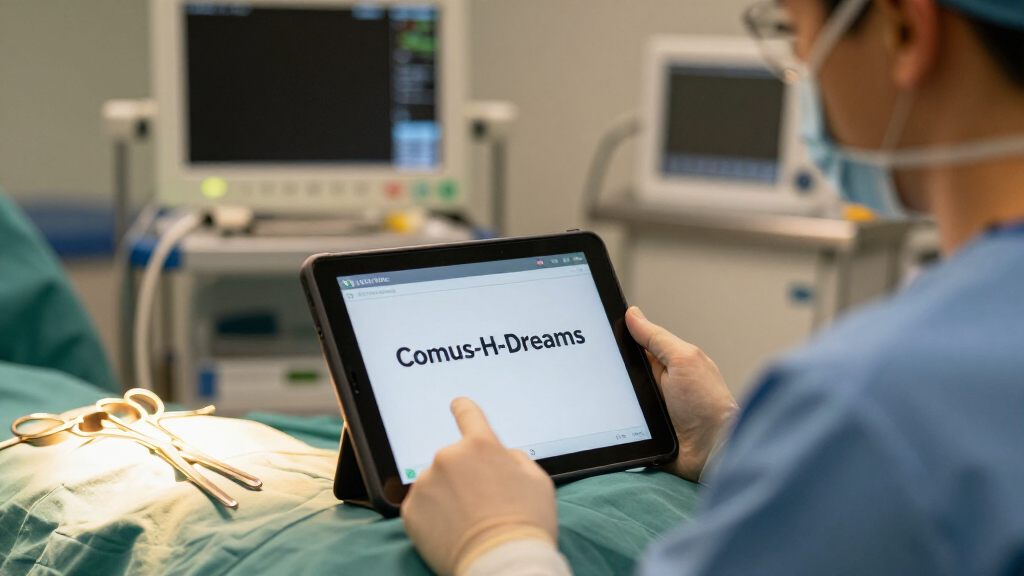

📊 Full opportunity report: Can AI With NVIDIA Cosmos-H-Dreams Improve Surgical Precision? Find Out on ThorstenMeyerAI.com — validation score, market gap, and execution plan.

Get business pricing on monitors, keyboards and dev gear
- Business-only prices and quantity discounts
- Tax-exempt purchasing
- Multiple users, one account, clear invoices
TL;DR
NVIDIA has launched Cosmos-H-Dreams, a real-time generative simulator for surgical environments, capable of producing video from robot commands on a single RTX PRO 6000 GPU. Its potential to improve surgical precision and testing is promising, but validation for clinical use remains unconfirmed.
NVIDIA has unveiled Cosmos-H-Dreams, a real-time, action-conditioned generative simulator designed for surgical robotics. The system can produce surgical videos from live robot commands on a single RTX PRO 6000 GPU, potentially enabling faster testing and development of robotic surgical procedures. While promising, independent validation and clinical testing are still pending, and the system is currently positioned as a research tool.
The Cosmos-H-Dreams model is a distilled version of NVIDIA’s earlier Cosmos-H-Surgical-Simulator, built on Cosmos-Predict2.5-2B, and capable of generating next-frame videos based on ongoing robot actions. It was specifically trained for tabletop suturing using data that includes successful and failed procedures, aiming to represent a broad spectrum of surgical scenarios. NVIDIA claims the system can operate in real time, supporting closed-loop control and rapid policy testing, which could significantly reduce costs and risks associated with physical experiments.
Although NVIDIA demonstrated integration with the Versius surgical platform, there is no evidence that Cosmos-H-Dreams is used in actual clinical settings or autonomous surgeries. The announcement highlights potential benefits for developing control policies and testing surgical tools but does not provide performance metrics such as frame rate, latency, or image quality. Validation studies, peer review, and assessments of physical accuracy are still needed before clinical deployment can be considered.
Potential Impact on Surgical Robotics Development
If validated, Cosmos-H-Dreams could accelerate the development and testing of surgical robots by providing a fast, visual simulation environment. This could reduce reliance on costly physical experiments, improve safety, and enhance training. However, without clinical validation, its immediate application in patient care remains uncertain, and the system’s ability to accurately predict real tissue behavior is unconfirmed.
surgical robotic simulation software
As an affiliate, we earn on qualifying purchases.
As an affiliate, we earn on qualifying purchases.
NVIDIA’s Advances in Surgical Simulation Technology
NVIDIA has been developing AI-based simulators for surgical applications, with earlier versions supporting offline policy evaluation and synthetic data generation. The new Cosmos-H-Dreams builds on this foundation, shifting to real-time streaming and integration with surgical hardware. The system was trained on diverse procedural data, including failures, to improve robustness. While prior efforts demonstrated potential for virtual testing, real-world validation has yet to be achieved, and the technology remains in the research phase.
“Cosmos-H-Dreams offers real-time, action-conditioned video generation for surgical robotics, enabling faster development cycles and safer testing environments.”
— NVIDIA spokesperson
real-time surgical training simulator
As an affiliate, we earn on qualifying purchases.
As an affiliate, we earn on qualifying purchases.
Unverified Performance and Clinical Readiness
Details on the system’s latency, image quality, and accuracy in reproducing physical tissue behavior are not publicly available. There are no peer-reviewed studies or independent tests confirming its reliability or safety for clinical use. Its current status is primarily as a research prototype, with validation and regulatory approval still required.
As an affiliate, we earn on qualifying purchases.
Next Steps Toward Clinical Validation and Deployment
Future efforts will focus on testing Cosmos-H-Dreams in closed-loop control scenarios on physical surgical robots, assessing its accuracy and stability. Independent validation studies are expected to evaluate its transferability from simulation to real hardware. NVIDIA may also expand hardware support and clarify access terms, but clinical adoption remains a future goal pending regulatory approval and validation.
As an affiliate, we earn on qualifying purchases.
Key Questions
What is NVIDIA Cosmos-H-Dreams?
It is a real-time, generative simulation system that produces surgical videos from robot commands, aiming to support development and testing of surgical robotics.
Can Cosmos-H-Dreams control real surgical robots autonomously?
No. The system generates visual simulations based on robot commands but is not designed for autonomous clinical operation at this stage.
What hardware is required to run Cosmos-H-Dreams?
NVIDIA states it runs in real time on a single RTX PRO 6000 GPU, but performance on other hardware is not specified.
Is Cosmos-H-Dreams validated for medical use?
No. The system is currently a research tool, with no peer-reviewed validation or clinical testing reported.
When might this technology be used in actual surgeries?
It is currently in the research phase, with clinical deployment dependent on validation, regulatory approval, and further testing.
Source: ThorstenMeyerAI.com
Evergreen bestsellers Picks
bestsellers
As an affiliate, we earn on qualifying purchases.