
📊 Full opportunity report: The Innovation Behind 'SINGULARITY': Particle Geometry Mapping In AI on ThorstenMeyerAI.com — validation score, market gap, and execution plan.

Get business pricing on monitors, keyboards and dev gear
- Business-only prices and quantity discounts
- Tax-exempt purchasing
- Multiple users, one account, clear invoices
TL;DR
Researchers have developed a novel AI technique called Particle Geometry Mapping, enabling the creation of highly immersive, data-driven environments. This breakthrough enhances AI’s ability to interpret and visualize complex forms, with potential applications in design and data analysis.
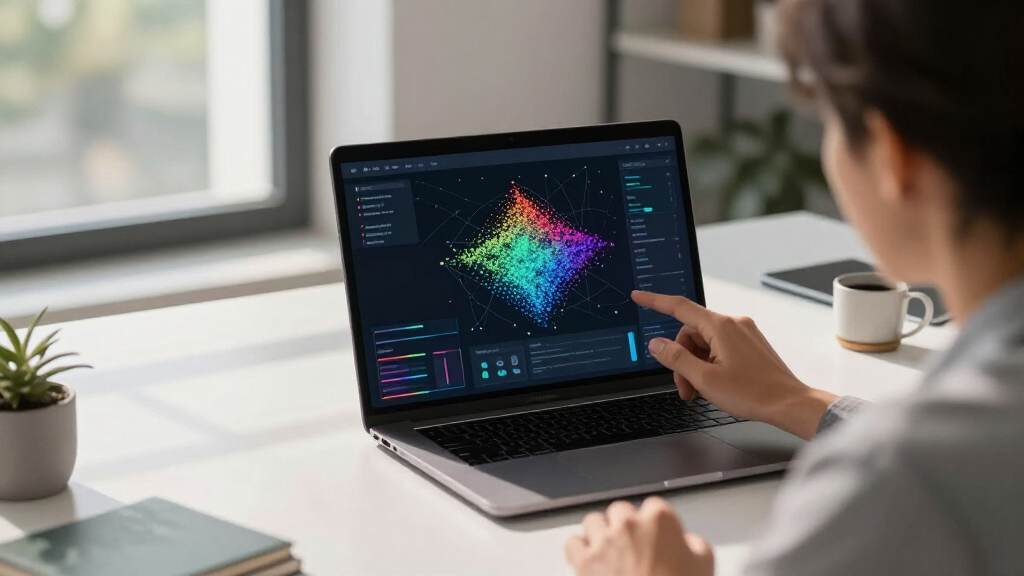
Researchers have introduced ‘Particle Geometry Mapping,’ a new AI-driven technique that translates data into complex geometric forms, showcased in the ‘SINGULARITY’ environment. This innovation enhances how AI interprets and visualizes data, offering new possibilities for immersive environments and design. The breakthrough was demonstrated through a detailed design project that transforms abstract data into dynamic, spatial forms, highlighting its potential for future applications in AI-driven environments and data visualization.
The ‘SINGULARITY’ project, as presented by Thorsten Meyer, features a space where AI leverages Particle Geometry Mapping to generate intricate geometric structures from data inputs. This method involves mapping data points to geometric particles, which then assemble into complex forms that challenge traditional visualization paradigms. The project aims to push the boundaries of AI’s creative and interpretative capabilities, blending art and technology seamlessly.
According to Meyer, this technique allows AI to create environments that are not only visually compelling but also serve functional purposes, such as data analysis and interface design. The process involves complex algorithms that translate data into spatial geometries, which are then rendered in immersive spaces. The project underscores the potential of such methods to redefine how humans interact with data and AI-generated environments.
The Innovation Behind “SINGULARITY”
Particle Geometry Mapping translates raw data into dynamic constellations of geometric particles—turning abstract information into immersive environments that can be explored, interpreted and designed.
A new spatial language for data
Showcased through the “SINGULARITY” environment, Particle Geometry Mapping assigns information to geometric particles and lets algorithmic rules assemble those particles into complex forms. The result challenges the flat, static conventions of data visualization.
Map meaning to particles
Values, categories and relationships can influence particle position, density, scale or behavior—giving data a spatial identity.
Assemble complex forms
Algorithms organize mapped particles into intricate structures that can evolve as their underlying inputs change.
Enter the visualization
Instead of viewing information from a distance, people may navigate an environment where structure, context and insight coexist.
From raw signal to immersive geometry
The exact implementation remains under development, but the demonstrated concept follows a clear interpretative pipeline: data is encoded, mapped, assembled and rendered as a navigable spatial system.
Ingest
Collect numerical, categorical or relational data.
Encode
Translate attributes into particle parameters.
Map
Position particles through geometric rules.
Assemble
Generate structures, clusters and relationships.
Render
Present the result as an immersive environment.
“Particle Geometry Mapping transforms raw data into immersive, spatial forms that challenge traditional visualization methods.”
Anonymous researcher
Beyond conventional visualization
Particle Geometry Mapping builds on 2D charts, static 3D models and generative design. Its distinguishing ambition is to make complex information spatial, responsive and experientially meaningful.
| Capability | 2D charts | Static 3D | Particle geometry |
|---|---|---|---|
| Fast summary reading | ✓Strong | ~Variable | ~Context dependent |
| Immersive exploration | ✗Limited | ~Possible | ✓Core strength |
| Dynamic response to data | ~Dashboard-led | ~Implementation-led | ✓Native ambition |
| Creative expression | ~Constrained | ✓Strong | ✓Generative |
| Technical maturity | ✓Established | ✓Established | ~Experimental |
✓ Strong fit ~ Conditional or developing ✗ Limited fit
Where spatial AI could matter
The technique suggests new possibilities wherever complex information must become understandable, interactive or emotionally engaging. These opportunity levels are editorial assessments—not measured performance results.
The path from concept to adoption
The breakthrough is compelling as a design demonstration. Wider adoption depends on technical refinement, real-time performance, pilot programs and evidence that spatial geometry improves decisions—not only aesthetics.
Data inputs
Define the information, attributes and relationships to encode.
Particle rules
Refine mapping algorithms and geometric behaviors.
Real-time tests
Measure clarity, responsiveness and scalability.
Industry use cases
Apply the technique to design, research and analysis.
Human–AI tools
Turn spatial generation into repeatable workflows.
The larger idea: AI as a spatial creative partner
“SINGULARITY” points toward systems that do more than calculate or illustrate. By converting information into responsive environments, Particle Geometry Mapping could help AI interpret complexity in forms humans can explore—merging analytical function with generative design.
Implications for AI-Driven Design and Data Visualization
The development of Particle Geometry Mapping signifies a major step forward in AI’s ability to interpret and visualize complex data through spatial forms. This could lead to more intuitive data analysis tools, immersive AI environments, and new forms of digital art. For industries relying on data-driven insights, such as architecture, gaming, and scientific research, this breakthrough offers new avenues for innovation and engagement.
Moreover, this technique exemplifies how AI can transcend traditional boundaries of computation, merging technical precision with creative expression. As a result, it could influence future AI development strategies, emphasizing interpretative and generative capabilities that enhance human-AI collaboration.
As an affiliate, we earn on qualifying purchases.
Evolution of Data Visualization and AI Creativity
Particle Geometry Mapping builds upon prior advances in AI data visualization, where traditional methods often relied on 2D graphs or static 3D models. Recent projects have explored immersive environments, but the ‘SINGULARITY’ project pushes this further by integrating complex geometric forms that respond dynamically to data inputs. The concept aligns with ongoing research into AI as a creative partner, capable of generating art and design based on abstract data.
This technique was likely inspired by developments in generative design and spatial data interpretation, which have gained traction over the past few years. The project also reflects a broader trend toward using AI to create environments that are both functional and aesthetically compelling, blurring the line between technical visualization and artistic expression.
“Particle Geometry Mapping transforms raw data into immersive, spatial forms that challenge traditional visualization methods.”
— an anonymous researcher
immersive environment design tools
As an affiliate, we earn on qualifying purchases.
As an affiliate, we earn on qualifying purchases.
Unanswered Questions About Practical Applications
It remains unclear how widely applicable Particle Geometry Mapping will be beyond experimental environments like ‘SINGULARITY.’ Specific technical limitations, scalability, and integration with existing AI systems are still under discussion. Additionally, the long-term impact on industries such as architecture or gaming has yet to be demonstrated in real-world settings.
geometric modeling software for AI
As an affiliate, we earn on qualifying purchases.
As an affiliate, we earn on qualifying purchases.
Next Steps for Research and Industry Adoption
Further research is expected to focus on refining the algorithms for real-time application and testing scalability across larger datasets. Industry partners may begin pilot projects to incorporate Particle Geometry Mapping into design, visualization, and data analysis tools. The ongoing development of immersive AI environments will likely showcase broader use cases in the coming months.
As an affiliate, we earn on qualifying purchases.
Key Questions
What is Particle Geometry Mapping?
It is an AI technique that translates data into complex geometric particles, creating immersive environments and visualizations.
How does ‘SINGULARITY’ demonstrate this technology?
The project uses Particle Geometry Mapping to transform data into spatial forms within an immersive space, showcasing its potential for design and data visualization.
What are potential applications of this technique?
Possible uses include immersive data analysis, digital art, architectural visualization, and AI-driven environment design.
Are there limitations to this technology?
Its scalability, integration with existing systems, and practical deployment in real-world scenarios are still under development and testing.
When might this technology become widely available?
Further research and pilot projects are expected over the next year, but broad industry adoption may take longer depending on scalability and practical viability.
Source: ThorstenMeyerAI.com
Fall Picks
fall essentials
As an affiliate, we earn on qualifying purchases.



![Isar Aerospace Launch Into Orbit [Video]](https://featurebuddies.com/wp-content/uploads/2026/09/isar-aerospace-launch-into-orbit-video-featured-560x300.jpg)