
📊 Full opportunity report: Appointment no-show recovery planner for therapy practices on IdeaNavigator AI — validation score, market gap, and execution plan.

Get business pricing on monitors, keyboards and dev gear
- Business-only prices and quantity discounts
- Tax-exempt purchasing
- Multiple users, one account, clear invoices
TL;DR
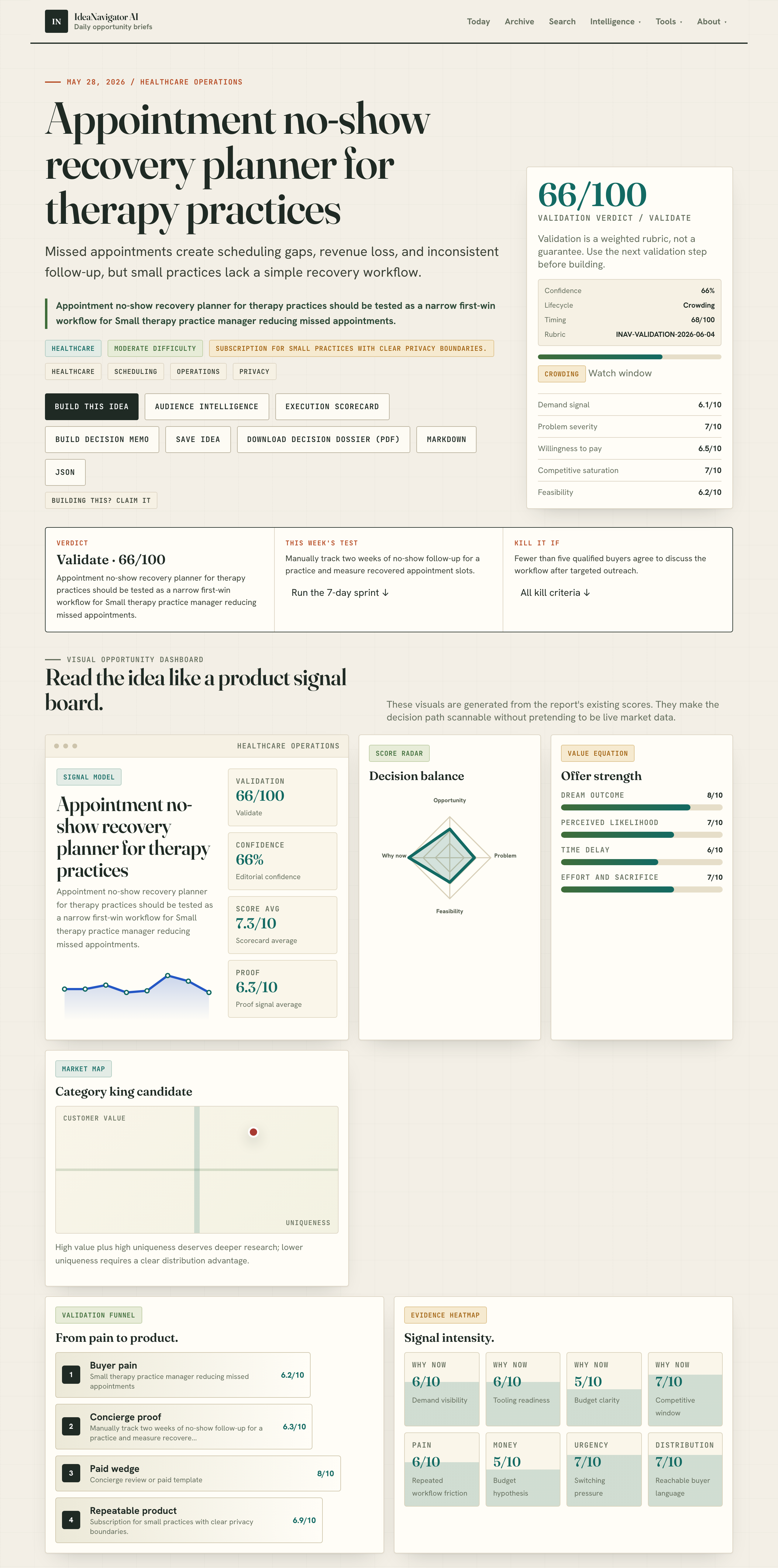
A new workflow tool for small therapy practices to track and recover missed appointments is entering testing. It aims to reduce revenue loss and improve follow-up without making clinical claims. The project is in early validation stages.
A new appointment no-show recovery planner for small therapy practices is being tested as a workflow tool to help reduce missed appointments and recover lost revenue. The initiative, developed by IdeaNavigator AI, aims to provide practices with a simple, non-clinical way to log missed visits, send reminders, and track outreach efforts, without making clinical claims.
The proposed tool is designed specifically for small therapy practices that face scheduling gaps and revenue loss due to missed appointments. It will function as a non-clinical tracker that logs missed visits, attempts at reminders, rescheduling status, and outreach templates. The initial testing involves manually tracking two weeks of no-show follow-up efforts to measure the number of recovered appointment slots.
According to IdeaNavigator AI, this approach is intended to be a first-step, low-barrier workflow that can be implemented quickly in small practices. The revenue model involves a subscription service that maintains clear privacy boundaries, focusing solely on operational improvements rather than clinical interventions. The project is currently in the validation phase, with early results expected to inform further development.
Operational Efficiency and Revenue Impact for Small Practices
This development matters because missed appointments are a significant source of revenue loss and scheduling inefficiency for small therapy practices. By providing a straightforward, non-clinical tool to manage no-shows, practices can potentially improve follow-up and fill scheduling gaps more effectively. The approach avoids complex clinical claims, making it easier to adopt and comply with privacy standards, which is crucial for small practices with limited administrative resources.
appointment no-show recovery planner for therapy practices
As an affiliate, we earn on qualifying purchases.
As an affiliate, we earn on qualifying purchases.
Growing Need for Practical No-Show Management Tools
Many small therapy practices lack dedicated operational workflows to handle missed appointments efficiently. While larger practices or healthcare organizations may have sophisticated no-show management systems, small practices often rely on manual follow-up, which is time-consuming and inconsistent. The recent push for operational tools that improve appointment adherence without clinical claims reflects a broader trend toward operational efficiency in healthcare. The concept of a simple, trackable no-show recovery workflow aligns with the increasing demand for practical, scalable solutions tailored to small practices.
“This no-show recovery planner aims to provide small practices with a low-cost, easy-to-implement workflow that can help recover missed appointment slots without adding clinical complexity.”
— an anonymous researcher
therapy practice appointment reminder tools
As an affiliate, we earn on qualifying purchases.
As an affiliate, we earn on qualifying purchases.
Early Results and Effectiveness of the Workflow
It is not yet clear how effective the no-show recovery planner will be in practice. The validation process involves manual tracking over two weeks, and results are still emerging. It remains uncertain whether practices will see a significant recovery of missed appointment slots or if the workflow will be adopted widely beyond initial testing.
small practice scheduling management software
As an affiliate, we earn on qualifying purchases.
As an affiliate, we earn on qualifying purchases.
Next Steps in Validation and Potential Expansion
Following initial testing, IdeaNavigator AI plans to analyze the data collected to assess the tool’s effectiveness. If results are positive, they will consider broader deployment and potential integration with existing scheduling systems. Further iterations may include automation features or expanded outreach templates, depending on user feedback and performance metrics. The goal is to establish a scalable, easy-to-use solution for small practices seeking operational improvements.
non-clinical appointment tracking system
As an affiliate, we earn on qualifying purchases.
As an affiliate, we earn on qualifying purchases.
Key Questions
How does the no-show recovery planner work?
The planner logs missed visits, sends reminders, tracks rescheduling, and uses outreach templates to follow up with patients, aiming to recover missed appointments.
Is this tool intended to replace clinical assessments?
No, the tool is designed solely for operational follow-up and does not make clinical claims or involve clinical decision-making.
Will this be available to all small practices?
Initially, the tool is in testing with a limited number of practices. If successful, it may be offered as a subscription service to a broader audience of small therapy practices.
What are the privacy considerations?
The service emphasizes clear privacy boundaries, focusing on operational data rather than clinical information, to comply with healthcare privacy standards.
When will the full version be available?
There is no confirmed release date yet; the next steps depend on the validation results from the ongoing testing phase.
Source: IdeaNavigator AI
Halloween Picks
halloween
As an affiliate, we earn on qualifying purchases.