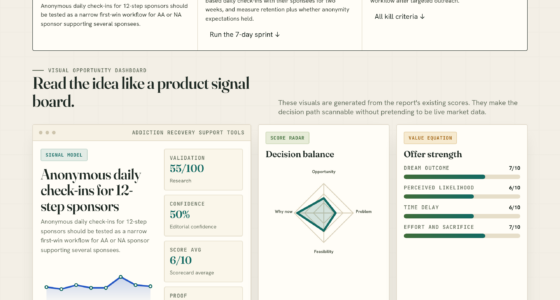
📊 Full opportunity report: The Critical Role Of Benefit Check Bots In Safety-Net Program Success on IdeaNavigator AI — validation score, market gap, and execution plan.

Get monitors, keyboards and dev gear delivered free — and shop member deals
- Fast, free delivery on millions of items
- Access to Prime Big Deal Days deals on October 6–7
- Prime Video, Amazon Music and more included
TL;DR
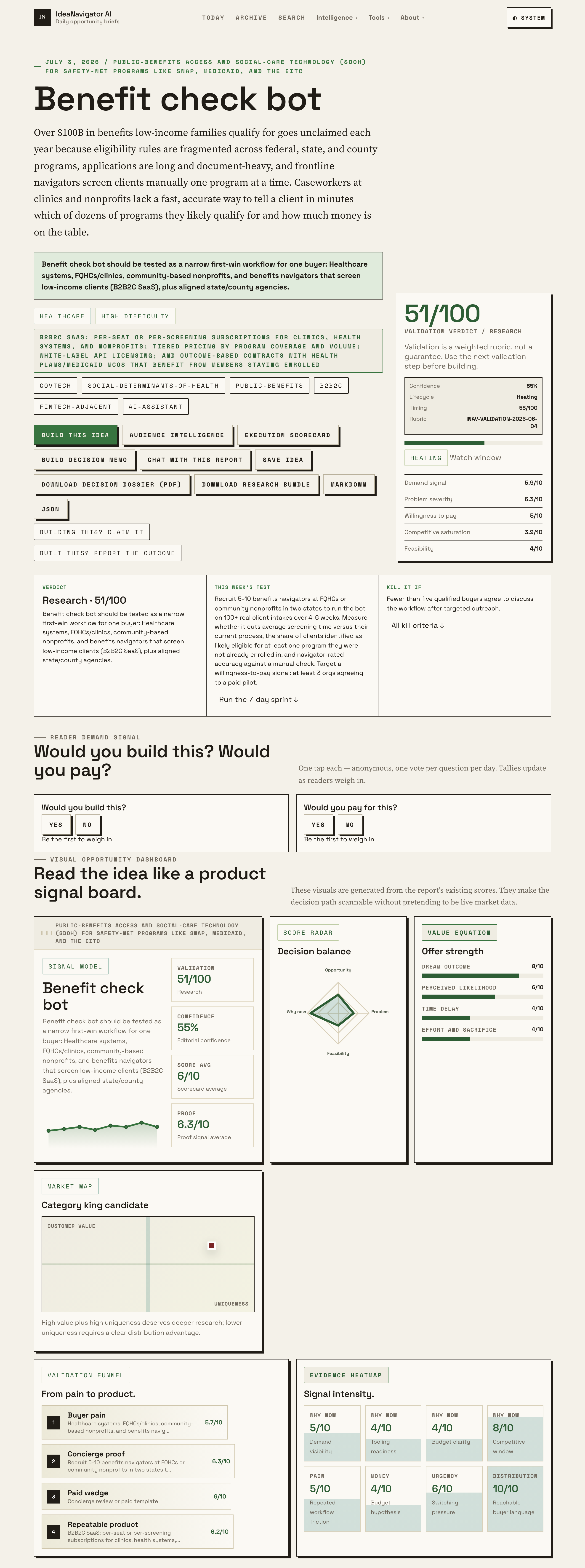
Benefit check bots are emerging as a promising tool to streamline eligibility screening for safety-net programs. They aim to reduce manual work, increase accuracy, and help low-income families claim more benefits. Early pilots are underway to validate their effectiveness.
Benefit check bots are being tested as a new digital tool to help healthcare systems, clinics, and nonprofits identify benefits for low-income clients more efficiently. These conversational AI-driven tools aim to address the long-standing challenge of fragmented eligibility rules and manual screening processes, which currently leave over $100 billion in benefits unclaimed annually, according to recent estimates. The initiative comes after the closure of Benefits Data Trust, a major nonprofit that previously handled benefits enrollment across seven states, creating a gap in outsourced benefits access capacity.
These benefit check bots are designed as white-label, conversational screening tools embedded on websites or delivered via SMS, enabling frontline staff or navigators to quickly determine a client’s likely eligibility for programs such as SNAP, Medicaid, the Earned Income Tax Credit (EITC), Child Tax Credit (CTC), WIC, and LIHEAP. The process involves a short series of yes/no and multiple-choice questions, after which the bot provides an estimated benefit amount and next-step application links. This approach aims to reduce screening time from hours to minutes and improve accuracy by leveraging multilingual AI capabilities.
Early pilots are being conducted with 5-10 benefits navigators at federally qualified health centers (FQHCs) and community nonprofits across two states. These pilots will assess whether the bots decrease screening time, increase the identification of eligible clients who are not yet enrolled, and deliver accurate, actionable information. The goal is to gather data on usability, effectiveness, and willingness to pay among participating organizations. The bots are expected to be scalable and customizable, with plans to expand to additional states and programs once validated.
Why Benefit Check Bots Are a Game-Changer for Safety-Net Programs
The introduction of benefit check bots could significantly improve access to vital safety-net programs for millions of low-income families. By automating eligibility screening, these tools can reduce the workload for overstretched caseworkers and navigators, allowing them to focus on personalized assistance and complex cases. Additionally, the increased accuracy and speed of screening may lead to higher enrollment rates, unlocking over $100 billion in unclaimed benefits annually. This could result in better health, economic stability, and overall well-being for vulnerable populations, while also easing administrative burdens on public agencies and service providers.
benefit eligibility screening software
As an affiliate, we earn on qualifying purchases.
As an affiliate, we earn on qualifying purchases.
Context of Benefits Access Challenges and Technological Innovation
For years, low-income families have struggled to access benefits due to fragmented eligibility rules across federal, state, and local programs, coupled with lengthy, paper-heavy application processes. Manual screening by frontline staff is time-consuming and prone to errors, often resulting in eligible individuals being overlooked or delayed in receiving aid. The closure of Benefits Data Trust in 2024, which handled benefits enrollment across multiple states, has exacerbated these issues, leaving a gap in capacity for outsourced benefits navigation. Meanwhile, advances in conversational AI and the urgent need to manage increased redeterminations following the COVID-19 pandemic have created an environment ripe for technological solutions. Pilot programs now aim to test whether benefit check bots can address these persistent barriers effectively.
As an affiliate, we earn on qualifying purchases.
What Aspects of Benefit Check Bots Are Still Being Tested
While pilot programs are promising, it is still unclear how well these bots will perform at scale across diverse populations and multiple programs. Questions remain about their long-term accuracy, user acceptance, and integration with existing systems. Additionally, the extent to which they can reliably identify all eligible clients and reduce administrative burdens without unintended errors is still being evaluated. Results from ongoing pilots will help clarify these uncertainties in the coming months.
healthcare benefits eligibility tool
As an affiliate, we earn on qualifying purchases.
As an affiliate, we earn on qualifying purchases.
Next Steps for Validation and Deployment of Benefit Check Bots
Participating organizations will continue pilot testing through the rest of 2024, collecting data on screening efficiency, accuracy, and client outcomes. If pilot results demonstrate significant improvements, plans are underway to expand deployment to additional states and programs, with a focus on integrating these tools into existing benefits navigation workflows. Stakeholders will also explore scaling options, including tiered pricing models and API licensing, to facilitate widespread adoption. Policymakers and agencies may consider supporting broader implementation based on pilot success, aiming to improve benefits access nationwide.
multilingual benefits screening chatbot
As an affiliate, we earn on qualifying purchases.
As an affiliate, we earn on qualifying purchases.
Key Questions
How do benefit check bots improve eligibility screening?
Benefit check bots automate the screening process by asking clients a series of questions and providing instant estimates of potential benefits, reducing manual work and increasing accuracy.
Are benefit check bots reliable across different programs and populations?
While early pilots show promise, full reliability across diverse populations and all programs remains under evaluation. Results from ongoing pilots will clarify their effectiveness.
Who can use benefit check bots?
Healthcare providers, clinics, community nonprofits, and government agencies involved in benefits navigation can embed or deploy these bots to assist clients.
What are the main challenges in deploying benefit check bots?
Key challenges include ensuring accuracy across varied eligibility rules, integrating with existing systems, and gaining user acceptance among clients and staff.
When will benefit check bots be widely available?
Widespread adoption depends on pilot outcomes, but if results are positive, broader deployment could begin as early as late 2024 or in 2025.
Source: IdeaNavigator AI
Halloween Picks
halloween
As an affiliate, we earn on qualifying purchases.