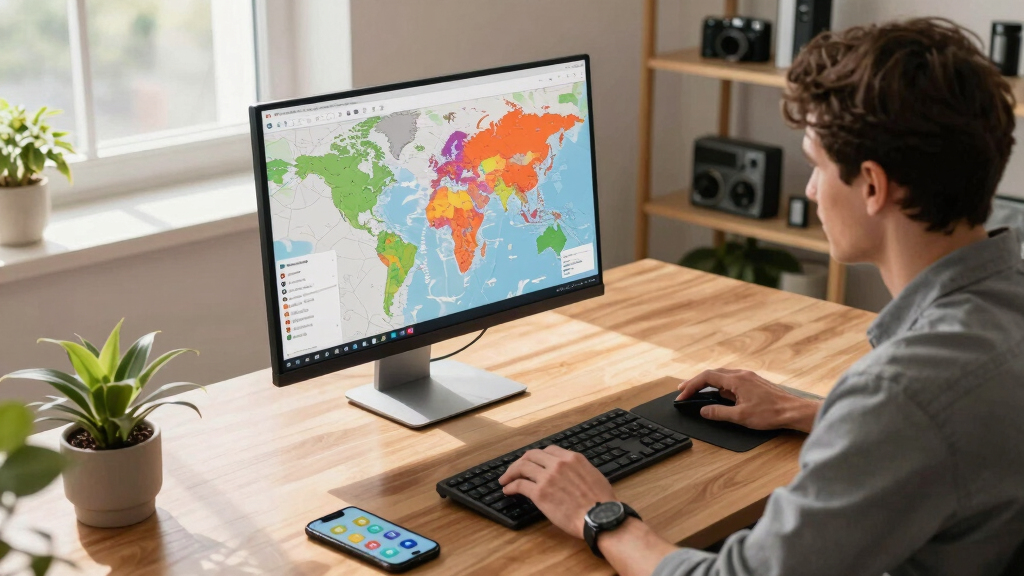

📊 Full opportunity report: Stenvrik: News as Geography on ThorstenMeyerAI.com — validation score, market gap, and execution plan.
TL;DR
Stenvrik launches a prototype news platform that visualizes live stories on a rotating 3D globe, organized by geography. It combines cost-effective technology with trend detection, offering a unique way to understand global news flow.
Stenvrik has introduced a novel news platform that visualizes live stories on a rotating 3D globe, pinning approximately 1,700 stories to 49 city hubs. This approach emphasizes geographic context over traditional list-based feeds, aiming to reshape how users perceive and interact with news.
The platform, currently in closed beta, organizes news stories by location, allowing users to spin the globe and see where breaking and developing stories are concentrated. It employs an autonomous trend engine that continuously detects and clusters stories by city, providing real-time insights into regional news clusters and emerging topics. Unlike typical news feeds, which are often list-based and time-ordered, Stenvrik’s interface offers a geographic perspective designed to better reflect the interconnected nature of global events. The system’s architecture minimizes operational costs by rendering the globe client-side and running its trend detection engine on owned infrastructure, resulting in an almost zero monthly running cost. This cost efficiency enables rapid iteration and deployment, with the platform originally developed as a low-cost prototype that evolved into a production product. The trend engine not only powers the user interface but also feeds signals back into the broader content network, offering strategic insights for content planning and market intelligence. Currently, the platform’s scope is limited to 49 city hubs, but its underlying technology has potential for broader application across news and trend detection networks.Stenvrik — news as geography
Not what is the news — where is it happening. ~1,700 live stories pinned to 49 city hubs on a rotating globe, with an autonomous trend engine that also feeds the network.
Spin the world; the news sorts itself.
A 60fps 3D globe where every story is pinned to the city it belongs to. Clusters, gaps, regions heating up — context a vertical feed throws away.
Independent commentary, produced with AI assistance under human editorial oversight. The views are the author’s own and may change. Stenvrik is in closed beta; features, availability, and behavior may change and it is provided without guarantee of uptime or fitness for a particular purpose. The autonomous trend engine clusters and places stories programmatically and may contain errors, mis-placements, or omissions — verify independently before relying on any of it. Product and company names are trademarks of their respective owners; mention does not imply endorsement.
Geography-Driven News Visualization Changes User Engagement
By organizing news around geographic locations, Stenvrik offers a fundamentally different approach to news consumption, emphasizing spatial context over chronological lists. This method can help users better understand regional developments and global interconnectedness, potentially influencing how news organizations prioritize coverage and how audiences perceive the importance of stories based on location. Additionally, the low-cost, scalable architecture demonstrates a sustainable model for innovative news platforms, especially in an industry where infrastructure costs often hinder experimentation. The integration of trend detection with geographic visualization also provides valuable market intelligence, enabling news outlets and related industries to act on emerging regional trends before they become widespread. Overall, this approach could reshape user habits and industry strategies, making geographic context a central element in news dissemination.As an affiliate, we earn on qualifying purchases.
Origins as a Cost-Effective Prototype Drive Innovation
Stenvrik originated from a low-cost demo created by Claude Design, initially designed as a simple visualization tool for news stories. Its development was driven by the desire to challenge the standard list-based news feeds, which often lack contextual and geographic depth. The prototype demonstrated that a globe-based interface could be built with minimal infrastructure costs, primarily because rendering occurs client-side and the trend engine runs on owned hardware. This cost-effective approach allowed rapid iteration and eventual transition from prototype to a full-fledged product without significant financial investment. The system’s architecture leverages autonomous trend detection to provide real-time insights, which are then used both for user display and internal market intelligence. The platform is currently in a limited beta, with plans to expand its geographic scope and functionality, potentially influencing broader trends in news visualization and analysis.“The core idea is to organize news by geography, not just chronology. It’s about understanding where stories are happening and how they connect across regions.”
— Thorsten Meyer, creator of Stenvrik

BEST LEARNING i-Poster My World – Interactive Talking World Map for Kids
- Interactive Touch Learning: Press countries to hear facts
- Extensive Fact Database: Over 1,000 spoken facts
- Educational Quiz Modes: 10 engaging quiz-and-learn modes
As an affiliate, we earn on qualifying purchases.
As an affiliate, we earn on qualifying purchases.
Unclear Scope and Future Expansion Plans
It is not yet clear how widely Stenvrik will expand beyond the current 49 city hubs or how the platform’s geographic and trend detection features will evolve. Details about user adoption, integration with existing news networks, and potential monetization strategies remain under development.geographic news visualization device
As an affiliate, we earn on qualifying purchases.
As an affiliate, we earn on qualifying purchases.
Expected Broader Deployment and Feature Enhancements
Stenvrik plans to expand its geographic coverage beyond the initial 49 hubs and refine its trend detection algorithms. As the platform moves out of closed beta, broader user testing and potential integration with other news services are anticipated. Additionally, future updates may include more interactive features and deeper analytics for content providers, aiming to make geographic news visualization a standard tool in newsrooms and for consumers alike.
SJSMARTGLOBE with Interactive APP & LED Illuminated Constellations at Night, US-Patented STEM education 10" World Globe with Detailed map
- Interactive Globe Size: 10-inch diameter
- Educational App Compatibility: Works with iPad, iPhone, Android
- LED Constellation Display: Shows 88 constellations and Milky Way
As an affiliate, we earn on qualifying purchases.
As an affiliate, we earn on qualifying purchases.
Key Questions
How does Stenvrik differ from traditional news feeds?
Stenvrik organizes news stories by geographic location on a 3D globe, providing spatial context rather than a chronological list, which helps users see where events are happening and their regional significance.
Is Stenvrik available to the public now?
The platform is currently in closed beta with limited access. It is not yet publicly available for general use.
How does the trend engine work without high operational costs?
The trend engine runs on owned infrastructure and the globe rendering is client-side, minimizing server costs and enabling a nearly zero-cost operation.
What are the potential benefits for news organizations?
The geographic visualization combined with trend detection offers insights into regional news dynamics, helping organizations prioritize coverage and identify emerging stories early.
Will the platform expand to more locations?
Expansion plans are underway to include more city hubs, but specific timelines and scope are still being developed.
Source: ThorstenMeyerAI.com