
TL;DR

Get business pricing on monitors, keyboards and dev gear
- Business-only prices and quantity discounts
- Tax-exempt purchasing
- Multiple users, one account, clear invoices
IdeaClyst is a local-first platform that combines an AI council, discovery engine, and founder workspace to help you validate and develop ideas efficiently. It reduces research time, surfaces overlooked opportunities, and keeps your data private, making it a game-changer for founders and teams.
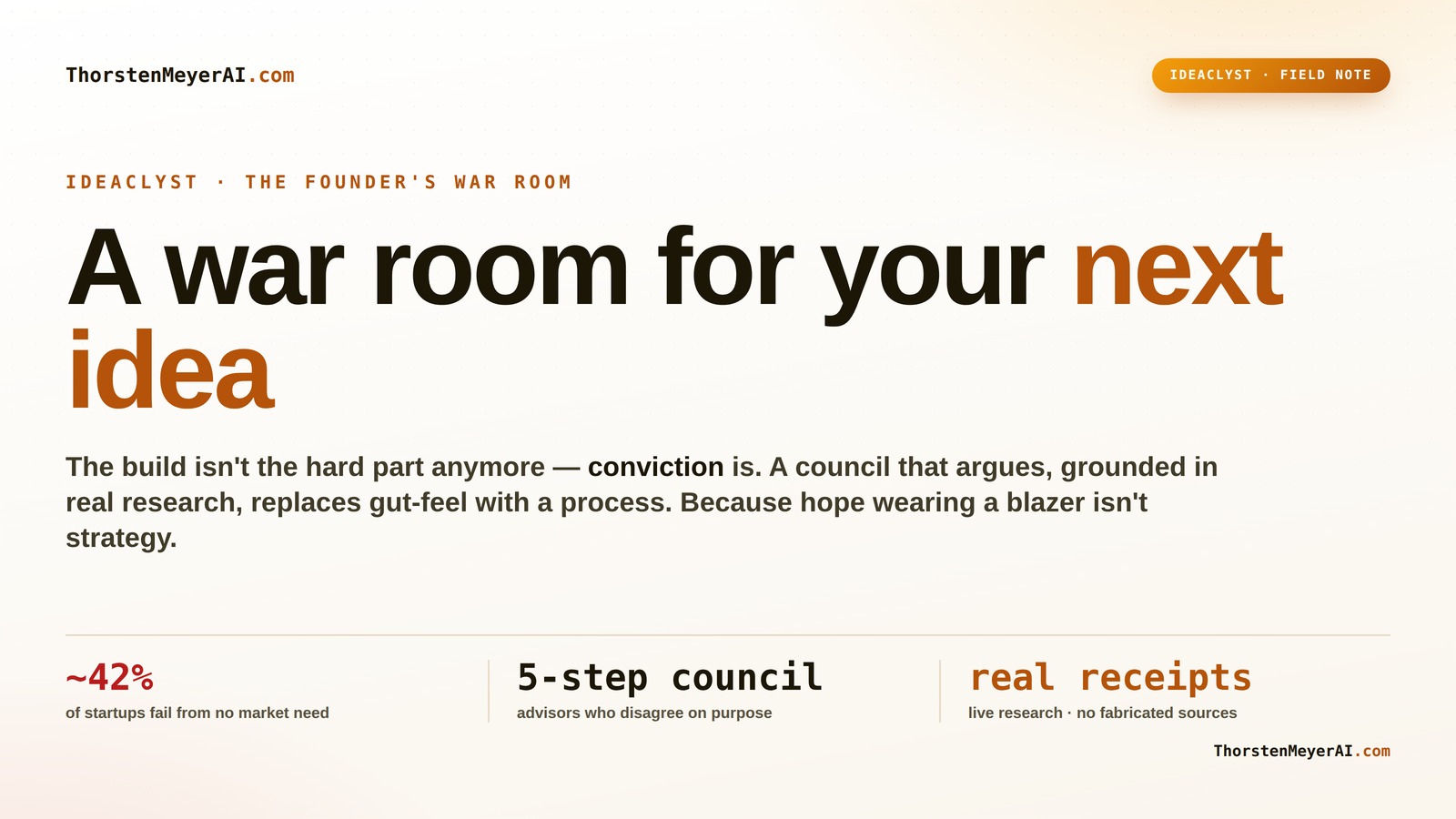
A war room for your next idea
The build isn’t the hard part anymore — conviction is. Knowing which idea deserves the next six months, and being able to defend it. Most founders answer with gut feel and optimistic math. That’s hope wearing a blazer. IdeaClyst replaces it with a process.
The most expensive decision is what to build
The single most valuable thing a tool can do is talk you out of the wrong six months. The numbers make the case better than any pitch.
Three tools in one — on your own machine
Strip away the framing and IdeaClyst is three things at once, all running locally with nothing leaving your laptop.
An AI council
Pressure-tests an idea you bring it — advisors who argue on purpose.
A discovery engine
Finds ideas you didn’t know to look for by hunting real demand signals.
A founder’s workspace
Carries winners from “interesting” all the way to “ready to build.”
Advisors who disagree on purpose
Not one confident, agreeable answer — a structured five-step deliberation where models play different roles and turn on their own work. The disagreement is the feature.
The five-step deliberation
A council that leads with the bad news surfaces the objections you’d otherwise find the expensive way, on month five.
Product strategy
Who’s it for, what’s the wedge, why now, what’s the business model.
Technical architecture
What would it actually take to build — and where’s the risk.
Critique pass
The council turns on its own work. Where’s the hand-waving? What kills this?
Second, independent critique
A different voice, a different angle — so blind spots don’t survive.
Final synthesis
Everything into one coherent founder packet: strategy, architecture, validation, plan.
When IdeaClyst cites a source, it actually fetched it
The hard departure from “ask an AI what it thinks of my startup.” It runs in a strict, real-data-only mode — if it can’t gather genuine evidence, it says so plainly rather than inventing a plausible paragraph.
Confidence with receipts
No fabricated statistics, no imaginary competitors, no made-up citations. The packet survives a skeptical co-founder or a sharp investor because the reasoning has receipts.
Market research first
Scouts the landscape before the council reasons about anything.
Competitor read
Real positioning, pricing signals, feature claims — differentiation vs. reality.
Validation with links
Not “talk to customers” — concrete signals & sources you can click.
From the blank page to build-ready
Evaluation is half the problem; the blank page is the other half. And a plan is worthless if it dies in a tab you never reopen.
Bring a space, not an idea
“AI for accountants,” “tools for indie game studios” — plus your goal and real capacity. It hunts demand signals across HN, Reddit, Product Hunt, GitHub, pricing pages.
- An honest market read — leads with the bad news when a space is hard
- An opportunity map — high pain, thin competition
- Ranked candidates — wedge, who pays, effort, risk, confidence
- each with KILL CRITERIA — when to walk away
A home and a forward path
Every promising idea gets carried forward, with every artifact in plain files on your disk.
- Validation tooling — sprint board, interview list, evidence browser
- Founder profile — a personal-fit lens; same discovery, different advice
- Build workspaces — funnel, personas, landing draft, version history
- “Build this idea” → a PRD + task queue, ready for a coding agent
Key Takeaways
- IdeaClyst’s structured AI council exposes blind spots by debating from multiple perspectives, leading to stronger, more balanced decisions.
- The local-first design keeps your ideas private, giving you control over sensitive information and reducing dependency on cloud services.
- The discovery engine surfaces market signals and opportunities you might overlook, speeding up the research phase.
- A step-by-step process helps you translate raw ideas into vetted, actionable plans efficiently.
- Compared to traditional brainstorming, IdeaClyst offers faster, more private, and more rigorous idea development.
As an affiliate, we earn on qualifying purchases.
Why IdeaClyst’s War Room Changes the Game for Founders
Traditional brainstorming sessions often turn into wish lists. IdeaClyst transforms that chaos into clarity with a dedicated, focused space. Think of it as your command center—where ideas are debated, critiqued, and refined. It’s like having a team of advisors arguing over every angle, but all on your laptop.
Imagine you’re pitching a new SaaS product. You toss in your initial idea, and IdeaClyst’s AI council starts dissecting it. One model argues your target market is too niche, while another highlights untapped segments you missed. The platform turns conflicting opinions into a clear, actionable plan. That’s the power of a war room—fast, ruthless, honest, and private.
As an affiliate, we earn on qualifying purchases.
How the AI Council Sparks Better Ideas — With Real Disagreements
IdeaClyst’s secret sauce is its AI council—five structured steps where models play different roles, argue, and critique each other. It’s like hosting a debate between five experts with conflicting views, all on your own machine. The first step: defining your idea. Then, the models debate strategy, tech risks, and market fit. Finally, they synthesize the discussion into a final plan.
Why does this matter? Because in real-world decision-making, conflicting opinions aren’t just noise—they’re signals. When models challenge each other, they reveal assumptions and biases that might otherwise go unnoticed. This process exposes blind spots, forcing you to consider alternative angles and tradeoffs. The result is a more nuanced, robust plan that accounts for potential pitfalls and opportunities. While it might seem complex, this structured debate helps you weigh different perspectives systematically, leading to more informed and confident decisions. It’s a way to simulate a diverse team of advisors on your machine, without the overhead of coordinating multiple people, and to do so rapidly. The tradeoff? It requires some initial setup and understanding of the debate process, but the payoff is a much clearer picture of your idea’s strengths and vulnerabilities.
As an affiliate, we earn on qualifying purchases.
The Discovery Engine: Finding Ideas You Never Knew Existed
IdeaClyst isn’t just about testing your ideas; it helps you find new ideas. Its discovery engine scans the web and pulls in relevant research, trends, and signals that you might overlook. Imagine browsing through a mountain of data, but instead of sifting manually, the platform highlights the most promising angles.
Why does this matter? Because innovation often hinges on spotting subtle signals—emerging trends, regulatory shifts, or overlooked niches—that can be game-changers. The discovery engine automates this process, saving you hours or even weeks of manual research. It surfaces ideas and signals aligned with your domain or interests, providing a broader context for your decision-making. This way, you’re not just validating your current idea but actively exploring adjacent opportunities that could pivot your strategy or open new markets. The implication? You’re better equipped to seize emerging opportunities early, reducing the risk of falling behind competitors. The tradeoff is that the engine’s suggestions are only as good as the data it pulls, so it’s essential to interpret signals critically and consider them as part of a broader strategic view.
As an affiliate, we earn on qualifying purchases.
Your Ideas Stay Private — Why Local-First Matters
Unlike cloud-based tools, IdeaClyst runs entirely on your machine. All files—plans, critique reports, research—are saved locally as plain text files. That means your fragile, raw ideas stay private. No cloud, no data leaks, no third-party access.
Why does this matter? Because in today’s digital landscape, data breaches and privacy concerns are more prevalent than ever. By keeping everything local, you retain full control over your sensitive information, reducing exposure to potential leaks or hacking. Additionally, local-first architecture means faster iteration—no waiting for uploads or syncs—allowing you to test and refine ideas rapidly. This immediacy can be crucial when time-sensitive opportunities arise. Moreover, it fosters trust: you’re not relying on third-party servers to safeguard your intellectual property. The tradeoff? You need to be disciplined about backups and version control, but for many founders, the privacy and speed benefits outweigh these considerations. Overall, local-first design aligns with a mindset of security, autonomy, and efficiency, empowering you to innovate without compromise.
Step-by-Step: Turning Your Idea Into a Built Plan
- Write a clear, concise description of your idea.
- Feed it into IdeaClyst’s AI council for a structured debate.
- Review the critique and risk assessments.
- Let the discovery engine surface related signals and opportunities.
- Refine your plan based on feedback and new insights.
- Save the final strategy and architecture as a Markdown file.
This process isn’t just a checklist; it’s a strategic loop. Each step encourages deliberate reflection, allowing you to identify gaps, validate assumptions, and discover new angles. Over time, this disciplined approach reduces impulsive decision-making and promotes a deeper understanding of your idea’s potential and pitfalls. The iterative nature means you can revisit and refine multiple times, gradually building a comprehensive, vetted plan that’s ready for execution. The tradeoff? It requires commitment and discipline, but the payoff is a well-founded strategy that minimizes risks and maximizes chances of success.
Comparison: Traditional Brainstorming vs. IdeaClyst War Room
| Feature | Traditional Brainstorm | IdeaClyst War Room |
|---|---|---|
| Speed | Days to weeks | Hours to a few days |
| Disagreement | Limited or superficial | Structured, multi-perspective debate |
| Data Privacy | Variable; often cloud-based | Always local, private files |
| Surface Opportunities | Manual research, scattered | Automated discovery engine |
| Decision Confidence | Relies on gut or limited data | Structured critique + data-backed insights |
What Founders Say About Using IdeaClyst
Early adopters report that the platform slashes their decision-making time by half. One startup founder shared how it helped them pivot from a failing feature idea in just two weeks—saving months of wasted effort. Another praised its ability to surface market signals they missed, giving them confidence to move forward.
While not every story is perfect, the consensus is clear: IdeaClyst makes the messy process of innovation more manageable, less risky, and faster.
Frequently Asked Questions
How does IdeaClyst compare to project management tools?
Unlike general project management tools, IdeaClyst focuses specifically on idea validation and strategic debate. Its structured council and discovery engine are tailored to help founders and teams vet ideas thoroughly before building.Can I customize the workflows in IdeaClyst?
Yes, many aspects like templates, critique steps, and discovery signals are customizable, allowing your team to adapt the platform to your specific innovation process.Is IdeaClyst suitable for small startups?
Absolutely. Its lightweight, local-first design makes it ideal for startups seeking fast, private decision-making without complexity or cloud reliance.What’s the main advantage of local-first architecture?
It ensures your ideas stay private, prevents data leaks, and allows faster feedback loops without waiting for cloud syncs or risking third-party breaches.How hard is it to get started with IdeaClyst?
It’s straightforward. Download the open-source software, install it on your machine, and start inputting ideas. The structured process guides you every step of the way.Conclusion
Imagine having a personal war room—an environment where your ideas are challenged, opportunities are uncovered, and decisions are made with confidence. That’s the promise of IdeaClyst: turning chaos into clarity, privately and fast. When you treat your ideas like an army preparing for battle, you’ll always be ready to win the next one.Halloween Picks
halloween
As an affiliate, we earn on qualifying purchases.