🔍 Read the full analysis: When Customers Scan And Pay: The Self-Checkout Shift on ThorstenMeyerAI.com

Get business pricing on monitors, keyboards and dev gear
- Business-only prices and quantity discounts
- Tax-exempt purchasing
- Multiple users, one account, clear invoices
TL;DR
U.S. cashier employment stood at about 3.1 million in 2025, down from roughly 3.6 million in 2019, according to Bureau of Labor Statistics figures cited in the source. The BLS projects a further 6% decline through 2035, while retailers in some markets have also scaled back self-checkout over service, speed and loss concerns. The figures show a changing role for cashiers, not the disappearance of the occupation.
U.S. cashier employment fell to about 3.1 million in 2025, from about 3.6 million in 2019, while the Bureau of Labor Statistics projects a further 6% decline by 2035. The figures, cited in a November 26, 2026 report by ThorstenMeyerAI.com, show how self-checkout and online shopping are reshaping retail work even as millions of people remain employed as cashiers.
The BLS counted 3,089,410 cashiers in May 2025 in its Occupational Employment and Wage Statistics survey, compared with 3,596,630 in May 2019. The source calculates that as a decline of about 14%. It also cites a separate figure of 3,106,300 cashier jobs in 2025 from the BLS Occupational Outlook Handbook; the two measures come from different BLS products and should not be treated as interchangeable.
The BLS projects cashier employment to decrease 6% between 2025 and 2035, or about 200,600 fewer jobs. Its stated reasons include self-service checkout stands and growing online sales. In a January 2026 review of its earlier projections, the agency said self-checkout shifts scanning and bagging tasks from store employees to customers. Those projections describe an expected trend, not a guarantee of how many jobs will be lost.
Retailers have not followed one uniform path. The source reports that Booths in England, Dollar General and Target in the United States pulled back some self-checkout operations between 2023 and 2024, citing issues including service, losses and speed. It also describes wider adoption in Germany and Japan, although the figures it provides are not accompanied by detailed survey methods.
Infographic 01 · A short history of self-service
From the clerk to the customer, 1916 to today
Each step moved a piece of the work across the counter: first fetching the goods, then reading the price, then scanning and ordering.
How the customer took over the clerk's work
- Before 1916: a clerk fetched, weighed and wrapped every item at the counter.
- 1916, Piggly Wiggly (Memphis): shoppers take the goods off the shelves themselves and pass a checking station to pay. Clarence Saunders files his patent on 21 October 1916.
- 26 June 1974, Troy, Ohio: a ten-pack of Juicy Fruit gum is the first product scanned with a barcode. A machine now reads the price.
- 9 July 1984: David R. Humble and two colleagues file the CheckRobot patent: the shopper scans, a scale checks the weight, a tunnel stops unscanned items. Payment still goes to a cashier.
- From 1986: CheckRobot machines in several Kroger supermarkets, as reported by CNN (2022).
- 2018: McDonald’s has kiosks in nearly 17,000 restaurants; in France, Italy and Spain well over half of in-restaurant orders go through them (company filing).
Sources differ on the exact opening day of the first Piggly Wiggly (6 or 11 September 1916). The Kroger installation is reported second-hand; we did not retrieve the 1987 newspaper original.
Sources: C. Saunders, US Patent 1,242,872 (1916/17); Tennessee Encyclopedia; GS1 Belgium & Luxembourg; Humble et al., US Patent 4,676,343 (1984/87); CNN (2022); McDonald's Form 10-K 2018.
Powered by Thorsten Meyer AI
How Checkout Changes Retail Work
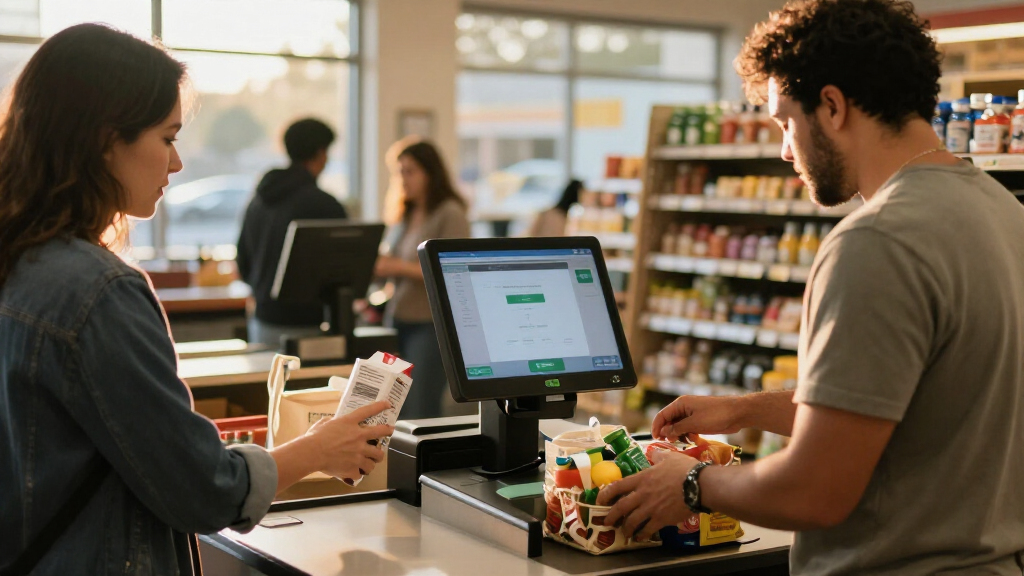
Self-checkout changes more than the equipment at the front of a store: it moves part of the checkout task to shoppers. Customers scan and bag items that a cashier might otherwise handle, while employees may oversee several stations, help with errors or carry out other store duties. For retailers, the arrangement can reduce labor needs at checkout, but it also depends on customers completing the work and on staff being available when machines or transactions require help.
The employment figures matter because cashiering remains a large occupation. A projected decline of about 200,600 jobs over a decade would affect workers and communities that rely on retail employment, even though it would not eliminate the role. The report does not establish that self-checkout alone caused the decline: the BLS also cites online sales, and the source notes the period included the pandemic and growth in online shopping.
Retailers’ decisions to reduce some self-checkout systems also show that labor savings are not the only consideration. Service, checkout speed and losses can influence whether stores keep, expand or limit the technology. The balance may differ by company, store format and country.
Products Worth Considering

Jackery HomePower 2000 Plus v2 Portable Power Station, 2048Wh

Bose QuietComfort Wireless Noise Cancelling Headphones, Sandstone

LG UltraGear 27G640A-B 27-Inch QHD IPS Gaming Monitor, 300Hz, 1ms, G-SYNC Compatible, FreeSync Premium, DisplayHDR 400, HDMI 2.1, USB-C, Adj
As an affiliate, we earn on qualifying purchases.
From Store Aisles to Barcode Scanners
The shift toward customer participation in shopping predates computers. In 1916, Clarence Saunders opened Piggly Wiggly in Memphis, where customers selected goods from shelves rather than asking clerks to fetch each item. Saunders’ patent for a “Self-serving store,” filed that year and granted in 1917, described a path through the store ending at a checking and payment station. The Tennessee Encyclopedia says Saunders did not invent self-service, but helped popularize it.
Automation at the register depended on barcode scanning. GS1 says a ten-pack of Wrigley’s Juicy Fruit gum was the first product scanned using a barcode, at a Marsh supermarket in Troy, Ohio, on June 26, 1974. In 1984, David R. Humble and colleagues filed a patent for a self-service distribution system in which shoppers scanned items and a scale checked their weight. The source says the system was installed at several Kroger supermarkets and that self-checkout machines were introduced in 1986.
Early self-checkout did not remove every cashier task: the patent’s process still had shoppers take a printed list to a cashier to pay. Today’s systems place more of the scanning and bagging process with customers. That history helps explain why the technology represents a shift in how retail tasks are divided, rather than a single moment when cashier work ended.
“Self-checkout reduces the need for labor because the main task of scanning and bagging items is transferred to the customer.”
— U.S. Bureau of Labor Statistics, in its January 2026 review of earlier employment projections
What the Employment Figures Cannot Show
The BLS figures and projections do not isolate how much of the cashier employment decline is caused by self-checkout, online sales, economic conditions or other changes in retail. The source notes that the period between 2019 and 2025 included the pandemic and an online-shopping boom, but it does not quantify their separate effects.
The source gives two 2025 cashier totals—3,089,410 workers in the May employment survey and 3,106,300 jobs in the Occupational Outlook Handbook—without fully explaining the methodological difference. They should be reported with their respective source and measure, rather than combined or treated as contradictory. The supplied account also does not provide detailed methods for its adoption estimates for Germany and Japan or a complete accounting of which retailer locations reduced self-checkout.
It remains uncertain how quickly stores will add or remove self-checkout stations, whether new systems will change the number or type of employees needed, and how the BLS projection will compare with actual employment through 2035.
BLS Outlook Runs Through 2035
The main forward-looking benchmark is the BLS projection for 2025 to 2035. The agency’s future employment estimates and subsequent annual cashier counts will show whether the anticipated 6% decline is on track, and whether the gap between projected and actual employment changes.
Retailers’ operating decisions will offer another indicator. The source describes some chains pulling back while other markets expand self-checkout, so the next developments to watch are company-specific changes to store layouts and checkout staffing—not a single industry-wide direction. Further detail on retailer policies, local job effects and the reasons customers encounter longer or shorter waits would help clarify how the shift is unfolding.
Key Questions
How many cashiers were employed in the United States in 2025?
The BLS Occupational Employment and Wage Statistics survey counted 3,089,410 cashiers in May 2025. A separate BLS Occupational Outlook Handbook figure cited in the source lists 3,106,300 cashier jobs for 2025; the measures should be kept distinct.
How much does the BLS expect cashier employment to change?
The BLS projects cashier employment will fall 6% from 2025 to 2035, or by about 200,600 jobs. This is a projection, not a confirmed future outcome.
Does the data show that self-checkout caused the decline?
No. The BLS names self-service checkout and increasing online sales as reasons for the projected decline, but the supplied figures do not separate their effects or establish that self-checkout alone caused the employment change.
Are retailers still expanding self-checkout?
The source describes different approaches. Some retailers, including Booths, Dollar General and Target, pulled back some self-checkout operations between 2023 and 2024, while the report says adoption is increasing in Germany and Japan. It does not provide a complete, comparable measure of current adoption across markets.
Source: ThorstenMeyerAI.com