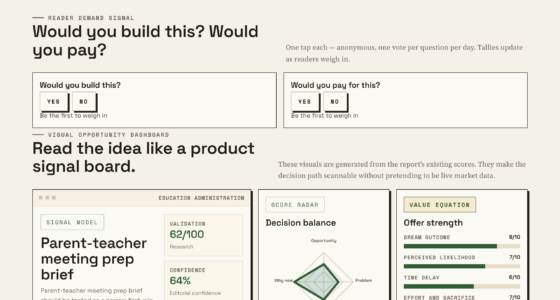

📊 Full opportunity report: Singapore: Engineer the Transition on ThorstenMeyerAI.com — validation score, market gap, and execution plan.

Get business pricing on monitors, keyboards and dev gear
- Business-only prices and quantity discounts
- Tax-exempt purchasing
- Multiple users, one account, clear invoices
TL;DR
Singapore is implementing a multi-faceted, state-led strategy to manage workforce transitions amid automation and AI growth. This includes ongoing reskilling, targeted income support, and AI development, all driven by a highly capable government.
Singapore is executing a comprehensive, state-driven strategy to manage workforce transition amid rapid technological change, emphasizing continuous reskilling and AI development. This approach highlights the country’s unique capacity to design and implement precise policies that aim to pre-empt displacement rather than respond after it occurs. The initiative involves multiple programs overseen by a highly capable government, including SkillsFuture, the National AI Strategy, and sector-specific wage models.
Singapore’s approach is characterized by a multi-instrumental, calibrated framework that targets various aspects of workforce transition. The government funds and manages programs like SkillsFuture for lifelong learning, which provides citizens with credits for subsidized training, and the Level-Up Programme, which offers additional financial support for mid-career retraining. The country also employs sector-specific wage models to boost productivity and wages, and mandates individual savings through the Central Provident Fund (CPF). Concurrently, Singapore is investing over a billion dollars into AI research and infrastructure, with a focus on open-source models and regional AI leadership, despite land and energy constraints. The entire system is designed to keep workers moving up the skill ladder, with active government coordination and targeted support for those displaced involuntarily.Engineer the Transition
Where others pick one lever, Singapore engineers all of them — a calibrated, well-funded instrument for each — and bets hardest that a high-capacity state can keep workers perpetually ahead of the machine.
Independent commentary, produced with AI assistance under human editorial oversight. The views are the author’s own and may change. This is analysis, not policy, economic, investment, or legal advice. Descriptions of SkillsFuture, Workfare, the CPF, the Progressive Wage Model, Singapore’s National AI Strategy and AI Council, and Temasek/GIC reflect publicly reported information as of mid-2026 and may change; figures are indicative. This phase maps differing approaches and endorses none; characterizations of contested arrangements present competing views, not a verdict. Country, program, and company names are referenced for analysis and imply no affiliation.
Why Singapore’s Multi-Program Approach Matters
Singapore’s strategy demonstrates a shift from reliance on universal safety nets to targeted, skill-based interventions. Its emphasis on continuous reskilling aims to pre-empt unemployment caused by automation, potentially serving as a model for other small, resource-constrained economies. The country’s capacity to precisely design and fund multiple programs reflects a high level of government competence, which is critical in managing the complex, interconnected challenges of technological transition. This approach prioritizes active labor market policies and state capacity over simple income support, which could influence global policy discussions on managing automation-driven displacement.
online reskilling courses for working adults
As an affiliate, we earn on qualifying purchases.
As an affiliate, we earn on qualifying purchases.
Singapore’s Unique Policy Ecosystem and Technological Push
Singapore’s model is rooted in its exceptional government capacity and meritocratic governance, enabling it to implement a broad array of targeted policies simultaneously. The nation’s focus on continuous reskilling has been central since the early 2000s, with SkillsFuture launched in 2015 as a flagship initiative. Its AI strategy, refreshed in 2026, combines public funding, open-source development, and regional leadership ambitions. Unlike many economies that rely heavily on social safety nets after displacement, Singapore aims to prevent displacement altogether through proactive skill development and technological integration. Its constraints—limited land, energy, and a small population—have driven it to engineer solutions that maximize efficiency and innovation.
“Our strategy is to keep every worker moving up the skill ladder, ensuring they stay ahead of automation rather than falling behind.”
— Singapore government spokesperson
AI and machine learning training programs
As an affiliate, we earn on qualifying purchases.
As an affiliate, we earn on qualifying purchases.
Remaining Questions About Implementation and Outcomes
While Singapore’s policies are well-funded and coordinated, it is still unclear how effectively these programs will prevent displacement at scale, especially amid rapid AI advancements. The long-term impact of these targeted interventions on employment, productivity, and economic growth remains to be seen. Additionally, the ability of the government to sustain such high levels of investment and coordination over decades is uncertain, particularly if global economic conditions shift or political priorities change.
lifelong learning subscription services
As an affiliate, we earn on qualifying purchases.
As an affiliate, we earn on qualifying purchases.
Next Steps in Monitoring and Scaling Singapore’s Transition Efforts
Singapore will likely continue refining its reskilling programs, expanding AI research, and monitoring employment outcomes. Key milestones include evaluating the effectiveness of the Mid-Career Training Allowance, scaling AI deployment across sectors, and possibly adjusting policies based on labor market feedback. International observers will watch how Singapore’s model influences other small economies facing similar technological transitions.
As an affiliate, we earn on qualifying purchases.
Key Questions
How does Singapore fund its reskilling programs?
The government allocates funding through national budgets, with programs like SkillsFuture and the Mid-Career Training Allowance heavily subsidized and targeted at specific worker groups.
What is the role of AI in Singapore’s economic strategy?
AI is central to Singapore’s future economy, with over a billion dollars invested in research, open-source models, and regional AI leadership, aiming to integrate AI into various sectors while reskilling workers displaced by automation.
Can Singapore’s approach be replicated in larger economies?
Singapore’s high government capacity and resourcefulness are unique, but its emphasis on targeted, calibrated policies offers lessons for other nations, especially small or resource-constrained ones.
Source: ThorstenMeyerAI.com
Columbus Day / Indigenous Peoples' Day Picks
long weekend sales
As an affiliate, we earn on qualifying purchases.