

📊 Full opportunity report: Real-Time Business Closure Notifications: Maximize Asset Opportunities on IdeaNavigator AI — validation score, market gap, and execution plan.

Get monitors, keyboards and dev gear delivered free — and shop member deals
- Fast, free delivery on millions of items
- Access to Prime Big Deal Days deals on October 6–7
- Prime Video, Amazon Music and more included
TL;DR
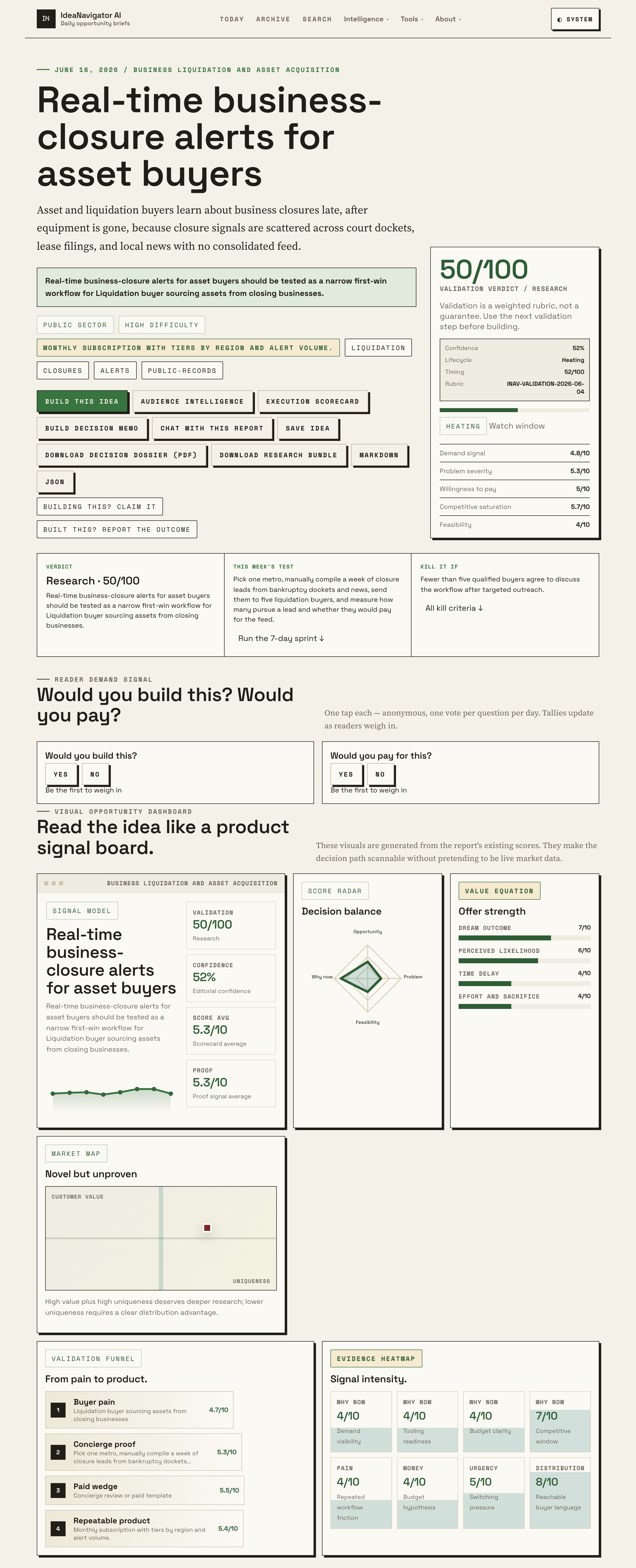
Liquidation asset buyers will soon test real-time alerts for business closures, enabling quicker access to assets and potentially increasing liquidation efficiency. The pilot aims to address delayed closure notifications.
Liquidation buyers will soon have access to real-time alerts for business closures, enabling them to identify assets immediately as companies shut down. The initiative, announced by IdeaNavigator AI, aims to address the longstanding issue of delayed information, which hampers asset recovery efforts and market efficiency.
The program involves a manually curated daily alert system where buyers specify a region and asset category. Human analysts then scan bankruptcy dockets and local news sources to identify recent closures that match the criteria, providing details such as business type, estimated asset value, and closure timeline. This approach is designed to offer a narrow, focused workflow for liquidation buyers, improving the speed of asset acquisition.
Fundamentally, the system aims to consolidate scattered signals—such as court filings, lease terminations, and news reports—into a single, timely feed. The concept is rooted in the observation that, post-pandemic, small-business closures and bankruptcies remain elevated, and the records are now electronically accessible, making real-time aggregation feasible for the first time. The pilot will test the effectiveness of this manual approach, with plans to evaluate whether buyers pursue leads and are willing to pay for such alerts.
Impact of Real-Time Closure Alerts on Asset Markets
This initiative could significantly enhance the efficiency of asset liquidation markets by reducing the time lag between business closure and asset acquisition. Faster notifications mean buyers can secure assets before they are removed or sold elsewhere, potentially increasing recovery rates and market liquidity. If successful, this model could set a new standard for liquidation workflows, especially in a market where small-business closures are frequent and records are increasingly digital.
business liquidation asset recovery tools
As an affiliate, we earn on qualifying purchases.
As an affiliate, we earn on qualifying purchases.
Digital Access to Business Closure Data Enables New Opportunities
Traditionally, asset buyers learned of business closures through scattered, delayed sources such as court dockets, lease filings, and local news. These signals often arrived too late, after assets had already been removed or sold. The pandemic accelerated business closures and bankruptcies, creating a surge in available assets but also exposing the inefficiencies in information flow. The shift to electronic filings now makes it possible to automate and aggregate closure signals in near real-time, opening new avenues for liquidation strategies.
“The ability to access and process closure signals electronically now makes real-time alerts feasible, which could transform how liquidation buyers operate.”
— an anonymous researcher
real-time business closure alerts software
As an affiliate, we earn on qualifying purchases.
As an affiliate, we earn on qualifying purchases.
Uncertainties About System Effectiveness and Adoption
It remains unclear how many liquidation buyers will adopt the manual alert system or how effective the alerts will be in prompting asset pursuit. The pilot’s success depends on buyer engagement, accuracy of signals, and whether the alerts translate into actual asset acquisitions. Further testing is needed to determine scalability and cost-effectiveness.
As an affiliate, we earn on qualifying purchases.
Next Steps for Pilot Testing and Market Validation
The initial phase involves selecting one metro area, compiling a week’s worth of closure leads, and distributing them to five liquidation buyers. The goal is to measure how many leads are pursued and whether buyers are willing to pay for ongoing alerts. Based on results, the system may be refined and expanded to additional regions or asset categories.
business bankruptcy notification system
As an affiliate, we earn on qualifying purchases.
As an affiliate, we earn on qualifying purchases.
Key Questions
How will the real-time alerts be generated?
Alerts will be manually curated daily by analysts who scan bankruptcy dockets and local news for relevant business closures matching buyer criteria.
Will this system replace existing methods of tracking closures?
No, it is designed to supplement current sources by providing more timely, consolidated information, especially for small-business bankruptcies and closures.
What types of assets will be covered?
The initial focus is on equipment and business assets from small to medium-sized businesses in selected regions.
How much will the service cost?
The model proposes a subscription fee tiered by region and alert volume, but pricing details are still under development.
When will wider rollout occur?
If pilot results are positive, a broader rollout to additional regions and asset categories could occur within the next year.
Source: IdeaNavigator AI
Halloween Picks
halloween
As an affiliate, we earn on qualifying purchases.