TL;DR
Qblox announced an integration connecting NVIDIA DGX Spark to its quantum system controller through NVIDIA NVQLink. The company reported round-trip latency below 7.2 microseconds on DGX Spark and below 4.0 microseconds on an NVIDIA RTX PRO 6000 Blackwell; the figures are company-reported, and no independent verification or detailed test conditions were provided in the source.
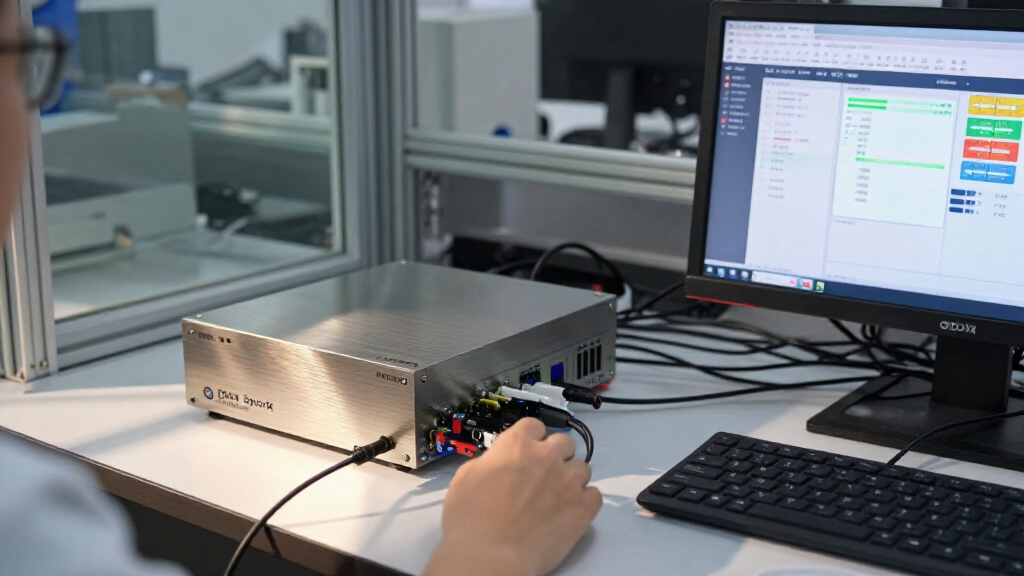
Qblox said it has connected NVIDIA’s DGX Spark computer to its quantum system controller using NVIDIA NVQLink, reporting round-trip latency below 7.2 microseconds on DGX Spark. The integration is intended to link GPU computing with quantum hardware for real-time hybrid workloads, including calibration and error correction; the performance figures are company-reported.

Get business pricing on monitors, keyboards and dev gear
- Business-only prices and quantity discounts
- Tax-exempt purchasing
- Multiple users, one account, clear invoices
Qblox also reported latency below 4.0 microseconds using an NVIDIA RTX PRO 6000 Blackwell. The company described these as measured round-trip results, but the announcement did not specify the test setup, workload, measurement method or whether an independent party verified the figures. The two results refer to different hardware and should not be treated as a controlled comparison without those details.
The system combines Qblox’s Q1 sequence processors and LINQ connectivity with NVIDIA GPU computing. Qblox says this arrangement can bring GPU processing into the quantum system’s real-time control loop. Its proposed uses include GPU-accelerated calibration, in which qubit parameters could be updated while experiments are running, and quantum error correction, where syndrome data would be sent to GPU-based decoders.
The companies also describe NVIDIA CUDA-Q as a development path for workloads that can run on desktop hardware and later move to GPU servers. Qblox says the same code is designed to carry over as systems scale. The announcement presents this as a route for researchers to develop and test hybrid applications locally before using larger computing infrastructure; it does not establish that every workload will transfer without changes or meet the same performance across systems.
Linking GPUs to Quantum Control
Quantum processors require classical systems to send control signals, process measurement results and coordinate experiments. Bringing a GPU into that loop could give researchers access to more computing capacity during operations, rather than limiting GPU use to work performed before or after a quantum run. That is the basis for Qblox’s claims about faster calibration and real-time error-correction workflows.
The announcement matters as a hardware integration and latency report, not as evidence that the system has already improved the performance of a particular quantum application. The figures indicate that Qblox says the connection can operate on microsecond timescales, but practical value depends on the complete system: the quantum processor, control hardware, network links, software and the task being run. The source does not report results for a specific qubit count, error-correction code or application.
For researchers, the desktop-to-server development model could lower the barrier to experimenting with hybrid workloads, if code and tools work as described. For the wider field, the announcement highlights an engineering challenge: as quantum systems grow, classical computation and control must keep pace. The integration is one proposed approach to that challenge, rather than proof that scaling requirements have been solved.
Products Worth Considering
Apple Watch Series 11 GPS + Cellular, 46mm Jet Black Aluminum Case with Black Sport Band (M/L)

Jackery Solar Generator 1000 v2 with Two 100W Solar Panels, 1024Wh LiFePO4 Battery

Amazon Kindle Paperwhite (12th Generation, 2024), 16GB, 7-Inch Display, Raspberry
As an affiliate, we earn on qualifying purchases.
From NVQLink Plans to Measurements
Qblox and NVIDIA have announced work on connecting quantum control with GPU computing in stages. According to Qblox’s announcement, this integration follows its October 2025 announcement involving NVQLink and its support for the NVIDIA CUDA-Q real-time API, announced in March 2026. Qblox characterizes the latest milestone as moving from an architecture-level plan to measured hardware performance.
The companies position NVQLink as the connection between GPU resources and quantum-control systems, while CUDA-Q provides a software framework for developing quantum and hybrid applications. DGX Spark is presented as a desktop platform for development, alongside the RTX PRO 6000 Blackwell result. The supplied announcement does not describe the underlying test configuration in enough detail to assess how the reported figures compare with other quantum-control integrations.
“Quantum computers will scale only as fast as the classical control systems around them.”
— Niels Bultink, CEO and co-founder of Qblox
Test Conditions Still Unreported
The announcement gives two latency thresholds but does not publish test conditions, workload details or measurement methodology. It is unclear how the results were measured, whether latency includes all parts of the quantum-control and GPU pipeline, or whether the tests involved a live quantum processor. The supplied material also does not identify independent validation.
Qblox describes calibration and error correction as supported use cases, but the announcement does not report demonstrated performance gains, error-correction outcomes or results from a specific quantum experiment. It is also unclear which parts of the CUDA-Q code transfer unchanged between DGX Spark and larger GPU servers, and what hardware or software requirements apply. The reported numbers should be read as company claims about the integration, not as a general performance guarantee.
Evidence From Application Tests
The next useful evidence would be technical documentation detailing the latency test setup, measurement boundaries and workloads, along with results from calibration or error-correction experiments on quantum hardware. Such information would help researchers judge whether the reported figures apply to their systems and applications.
Qblox and NVIDIA have not, in the supplied announcement, given a schedule for broader availability, a product release date or a roadmap for additional hardware configurations. Researchers will need further demonstrations to assess how the desktop development workflow performs and whether code transfers effectively to data-center GPUs as quantum systems grow.
Key Questions
What did Qblox announce?
Qblox said it integrated NVIDIA DGX Spark with its quantum system controller using NVQLink, connecting GPU computing with quantum-control hardware for hybrid workloads.
What latency did Qblox report?
Qblox reported round-trip latency below 7.2 microseconds on DGX Spark and below 4.0 microseconds on an NVIDIA RTX PRO 6000 Blackwell. The supplied announcement does not detail the test methodology or independent verification.
What workloads is the integration intended to support?
Qblox and NVIDIA cite GPU-accelerated calibration and quantum error correction, as well as simulation and other hybrid quantum-classical workloads. The announcement describes intended uses but does not publish application-level results.
Can researchers move code from DGX Spark to larger GPU systems?
The companies say NVIDIA CUDA-Q supports development on desktop hardware and that the same code is designed to carry over to GPU servers. The announcement does not provide independent portability tests or say that all workloads will transfer unchanged.
Source: rss