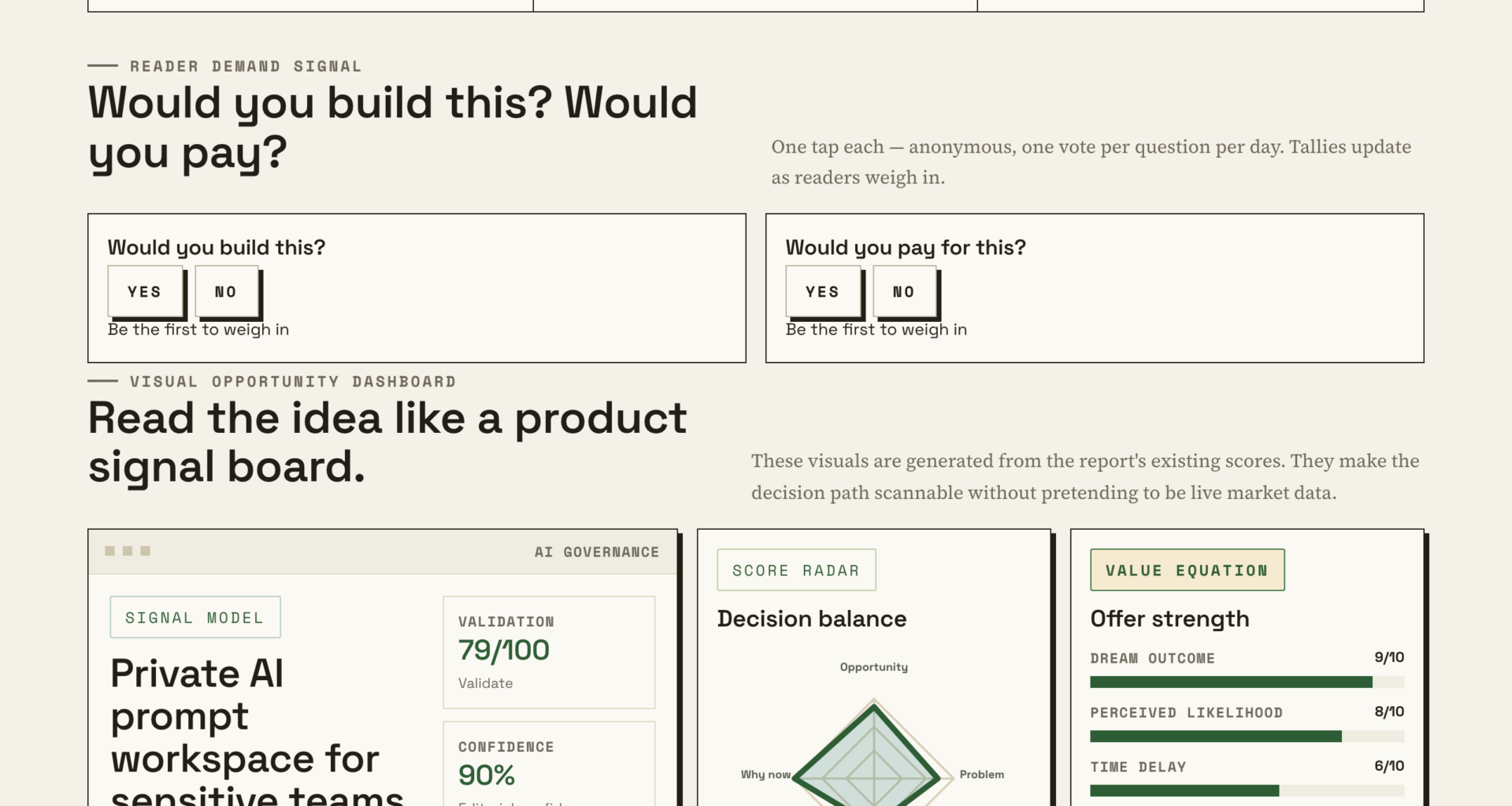

📊 Full opportunity report: Private AI Prompt Workspace For Sensitive Teams on IdeaNavigator AI — validation score, market gap, and execution plan.

Get monitors, keyboards and dev gear delivered free — and shop member deals
- Fast, free delivery on millions of items
- Access to Prime Big Deal Days deals on October 6–7
- Prime Video, Amazon Music and more included
TL;DR

IdeaNavigator AI is testing a new private prompt workspace tailored for small teams with sensitive workflows. The tool aims to improve data control and auditability in AI use. Its success could influence AI governance practices for regulated industries.
IdeaNavigator AI has announced the start of testing for a private AI prompt workspace designed specifically for small regulated teams working with sensitive data. The new tool aims to address concerns over data control, privacy, and auditability in AI workflows, marking a targeted step toward enhanced AI governance for sensitive industries.
The proposed local-first prompt workspace includes features such as redaction checklists, source notes, review status indicators, and exportable audit logs. It is intended for teams that need to keep sensitive drafts, prompts, and work artifacts tightly controlled, especially in regulated sectors like legal, healthcare, or finance.
According to IdeaNavigator AI, the initial focus is on testing this workflow with small teams that have historically avoided pasting sensitive content into AI tools, opting instead for manual redaction and review processes. The company plans to validate the approach through interviews with five operators who are currently managing sensitive AI workflows manually.
Why Private AI Workspaces Are a Critical Need for Regulated Teams
This development matters because it addresses a key challenge in AI governance: ensuring data privacy, control, and auditability for sensitive workflows. As more organizations incorporate AI into regulated processes, the need for secure, compliant tools grows. Successful testing could lead to wider adoption of private AI environments, reducing risks of data leaks and non-compliance, and setting new standards for responsible AI use in sensitive sectors.secure AI prompt management software
As an affiliate, we earn on qualifying purchases.
As an affiliate, we earn on qualifying purchases.
Growing Demand for Secure AI Tools in Regulated Industries
Over recent years, industries such as healthcare, finance, and legal services have increasingly integrated AI into their workflows. However, concerns about data privacy, security, and compliance have limited the adoption of cloud-based AI solutions for sensitive tasks. Existing tools often lack the granular control and audit features necessary for regulated environments, prompting a search for more secure alternatives.
IdeaNavigator AI’s new workspace aims to fill this gap by providing a local-first, privacy-focused environment that enables teams to manage prompts, drafts, and artifacts with tighter control, while maintaining compliance with regulatory standards.
“Teams handling sensitive data need more control over AI prompts and artifacts, especially when compliance and audit trails are required.”
— an anonymous researcher
As an affiliate, we earn on qualifying purchases.
Unanswered Questions About Adoption and Functionality
It is not yet clear how widely this private workspace will be adopted or how it will integrate with existing AI tools used by regulated teams. Details about its scalability, user interface, and specific security measures remain to be disclosed. Additionally, the effectiveness of the redaction and review features in real-world scenarios is still under evaluation.
audit trail software for sensitive data
As an affiliate, we earn on qualifying purchases.
As an affiliate, we earn on qualifying purchases.
Next Steps for Testing and Potential Deployment
IdeaNavigator AI plans to conduct pilot tests with five small teams, gathering feedback on usability and security. If successful, the company may roll out the workspace more broadly, potentially offering it as a subscription or annual license tailored for small regulated organizations. Further updates on results and feature enhancements are expected in the coming months.
As an affiliate, we earn on qualifying purchases.
Key Questions
How does the private AI prompt workspace improve data control?
The workspace offers features like redaction checklists, review status, and exportable audit logs, enabling teams to manage sensitive prompts and artifacts locally and with detailed oversight.
Will this tool integrate with existing AI platforms?
Details about integration are not yet confirmed. The initial focus is on a local-first environment, which may operate alongside or independently from cloud-based AI services.
Who is the target user for this workspace?
The primary users are small, regulated teams in industries such as legal, healthcare, and finance, where data privacy and compliance are critical.
When will the workspace be available for wider use?
There is no confirmed release date yet. The current phase involves pilot testing, with broader availability likely contingent on pilot outcomes.
What are the main security features of this workspace?
It includes local data storage, redaction checklists, review status management, and exportable audit logs designed to meet compliance standards.
Source: IdeaNavigator AI
Halloween Picks
halloween
As an affiliate, we earn on qualifying purchases.