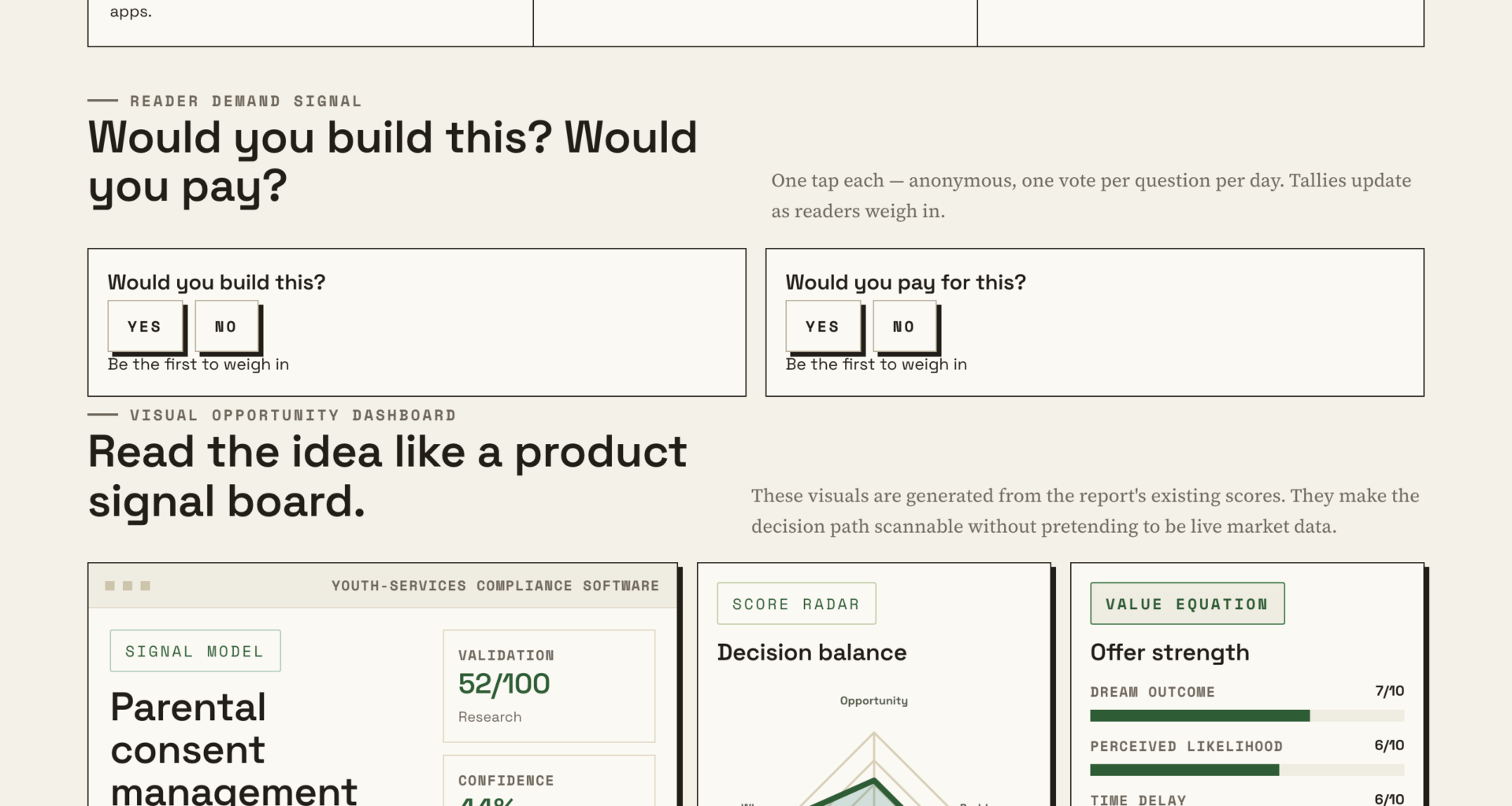

📊 Full opportunity report: Parent Permissions And Privacy Compliance For Youth Services on IdeaNavigator AI — validation score, market gap, and execution plan.

Get business pricing on monitors, keyboards and dev gear
- Business-only prices and quantity discounts
- Tax-exempt purchasing
- Multiple users, one account, clear invoices
TL;DR
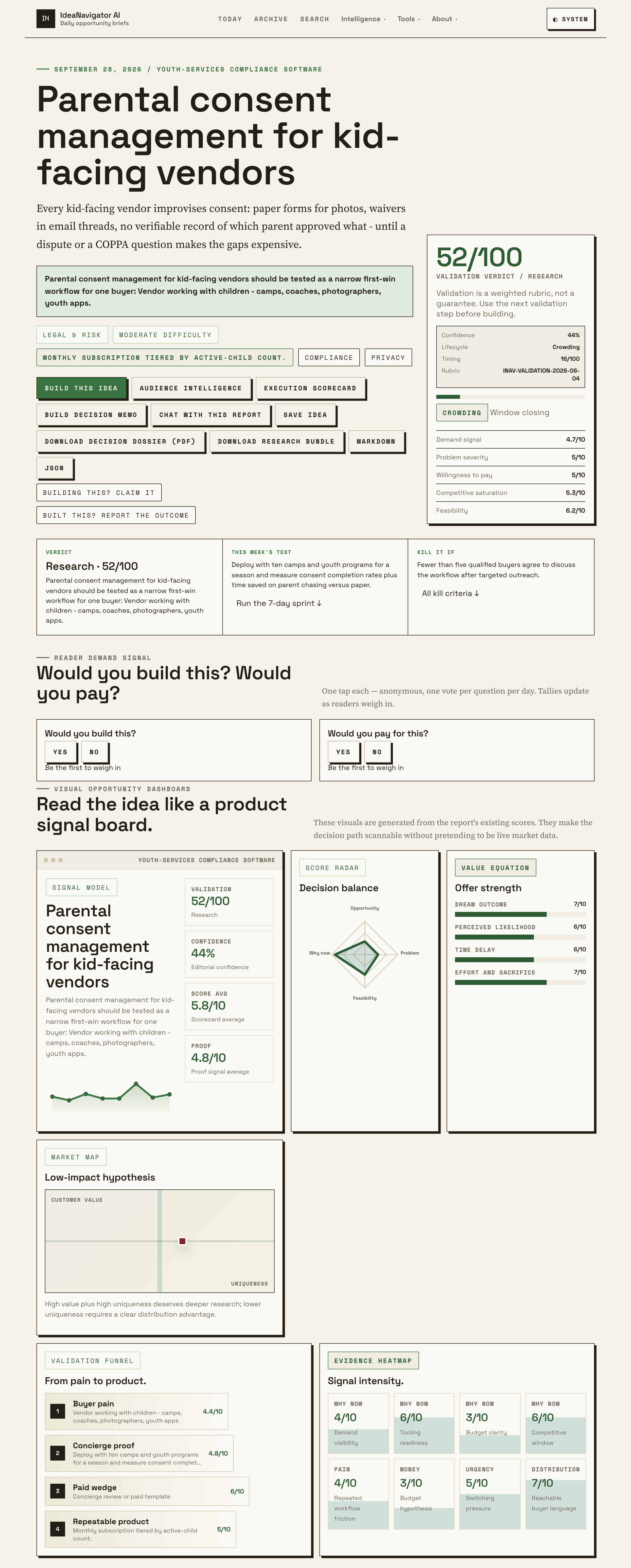
A proposal outlines a consent-management service for camps, coaches, photographers and youth apps, with phone-based forms, child-level records and expiry tracking. Its suggested next step is a season-long pilot with ten youth programs; no pilot results or product launch are reported.
IdeaNavigator AI has proposed a parental-consent management service for vendors working with children, including camps, coaches, photographers and youth apps. The proposal recommends testing the service with ten camps and youth programs for one season, measuring consent completion and time spent following up with parents; it does not report that a pilot has begun or that a product is available.
The proposed service would let parents complete vendor-branded consent forms on a phone. Suggested form categories include photo use, data collection, medical information and liability waivers. The concept responds to a problem described in the proposal: youth-service vendors may rely on paper forms and email threads without a clear record of which parent approved which use.
The proposed minimum product would keep a consent ledger for each child, track when permissions expire and provide an audit export. Identity checks would vary with the perceived risk of each consent request. The proposal does not specify verification methods, how vendors would set risk levels or what information an export would contain.
The suggested business model is a monthly subscription tiered by active-child count. The proposed validation plan is to work with ten camps and youth programs over a season, then compare completion rates and staff time spent pursuing consent against paper-based processes. No pricing, participating programs, measured outcomes or development schedule are provided.
A Clearer Record of Parent Approval
For organizations that work with children, a searchable record could help staff establish who gave permission, for which purpose and for what period. That may be useful when a parent questions a photograph, data use or other activity, or when a vendor needs to check whether an authorization is still current. The proposal frames this as an operational and compliance need; it does not establish that a digital record alone would meet any particular legal requirement.
The proposed pilot would test whether a dedicated workflow changes day-to-day administration. Completion rates and time spent chasing parents are concrete measures for camps and programs deciding whether a subscription is worthwhile. Results would also indicate whether families can complete the forms easily and whether vendors can maintain records without adding burdensome steps.
Paper Forms and Privacy Rules
The proposal says youth-service vendors often improvise consent through paper forms and email exchanges, which can make approvals difficult to verify later. It points to changing children’s privacy requirements, including updates to the Children’s Online Privacy Protection Act and state laws, as part of the reason vendors may seek stronger records. It does not cite particular provisions, enforcement actions or state requirements.
It also describes parents as increasingly challenging how photos and data about children are used. That is presented as part of the business case for the idea, rather than as a quantified trend. The proposed market includes a range of organizations, from camps and coaches to photographers and youth apps, whose consent needs may differ considerably.
Pilot Results and Legal Fit
No product launch, pilot participants or results are reported. The proposal does not name a developer, provide a release date or state whether any youth program has agreed to test the service. It also gives no evidence yet on parent completion rates, staff time saved, subscription demand or the cost of operating the system.
Important design and compliance questions remain open. The proposal does not explain how parental identity or authority would be verified, how sensitive medical details would be protected, how long records would be retained or how consent could be withdrawn. It also does not establish whether the proposed records and workflows would satisfy requirements applicable to each vendor, service or jurisdiction.
A Ten-Program Season Test
The next step described is a season-long trial with ten camps and youth programs. The proposal calls for measuring how often parents complete consent forms and how much staff time is spent following up compared with paper processes. Those measures could show whether the workflow is usable and whether it reduces administrative work, though the proposal gives no target thresholds or evaluation method.
Before a trial can produce results, organizers would need to recruit participating programs and define how the service handles different consent categories, identity checks, expiry dates and audit exports. No schedule or recruitment status is stated. Until those details and pilot findings are available, the service remains a proposed concept rather than a demonstrated solution.
Source: IdeaNavigator AI
Key Questions
Has a parental-consent platform launched?
No launch is reported. The proposal describes a possible service and a suggested pilot, but gives no product availability or release date.
Who is the proposed service for?
It is aimed at vendors working with children, including camps, coaches, photographers and youth apps.
What would the service include?
The proposed features include phone-based consent forms, child-level records, expiry tracking, identity checks matched to risk and an audit export.
How would the idea be tested?
The suggested test is a one-season pilot with ten camps and youth programs, measuring consent completion and staff time spent following up with parents.
Would the records guarantee legal compliance?
The proposal makes no such guarantee. It does not specify legal requirements, verification procedures or whether the planned records would satisfy rules that apply to particular services or locations.
Source: IdeaNavigator AI
Fall Picks
fall essentials
As an affiliate, we earn on qualifying purchases.