TL;DR
CISA urged organizations on November 17, 2026, to patch Java4Shell, a memory-corruption flaw in Java’s Base64 decoder. The documented exposure depends on the Java runtime, an x86-64 processor with AVX-512 VBMI, and whether outside input reaches the decoder; CISA’s record listed no exploitation at that time.
U.S. cybersecurity agency CISA urged organizations on November 17, 2026, to patch CVE-2026-114938, a memory-corruption flaw in the Java virtual machine’s Base64 decoder. Called Java4Shell by its finders, the vulnerability can put some Java services at risk when they run on a compatible processor and process outside input, though CISA’s record listed no exploitation at the time.

Get business pricing on monitors, keyboards and dev gear
- Business-only prices and quantity discounts
- Tax-exempt purchasing
- Multiple users, one account, clear invoices
CISA said specially crafted Base64 input could crash the Java virtual machine and allow unauthenticated remote code execution. The agency’s alert described the issue as affecting the x86-64 HotSpot JVM, the engine used to run Java programs in OpenJDK. Oracle and the OpenJDK project published November security advisories with fixes.
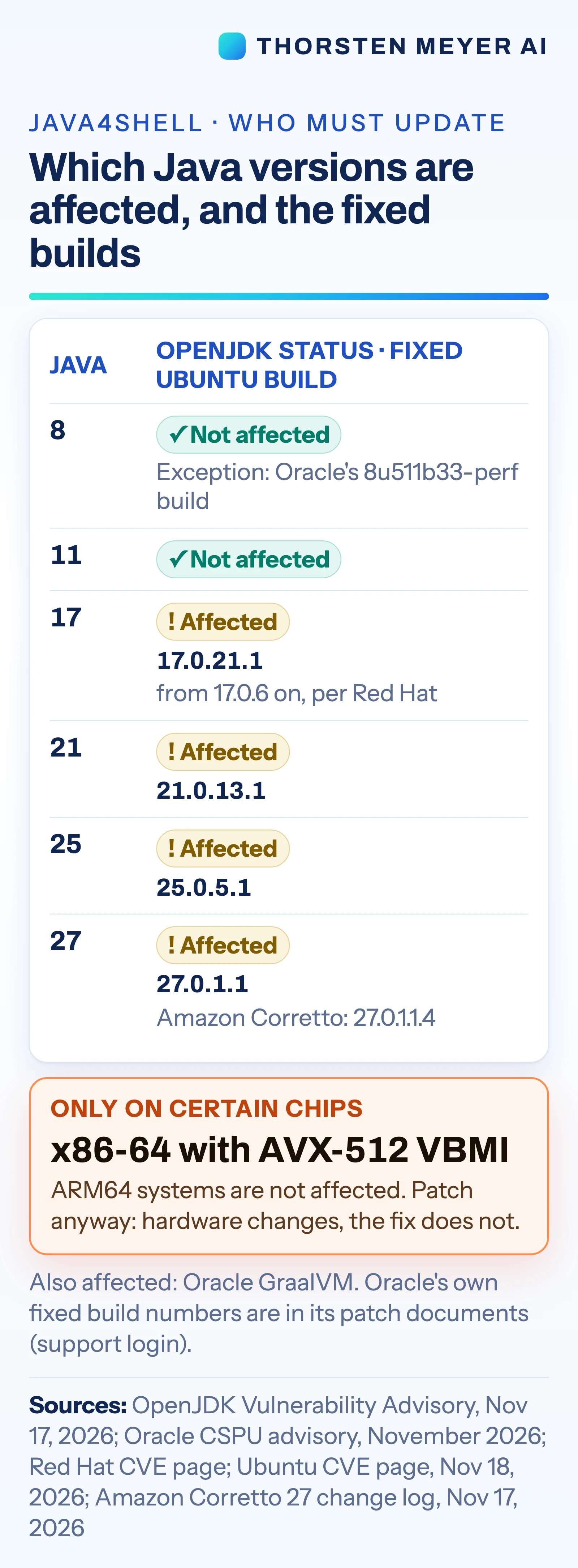
The affected runtime families identified in the source material include Java 17, 21, 25 and 27, Oracle GraalVM, and a specific Oracle Java 8 build. Red Hat said the vulnerable code entered OpenJDK in version 17.0.6; it said OpenJDK 8 and 11 are not affected. Red Hat also said systems need an x86-64 processor supporting AVX-512 VBMI for the flaw to apply; ARM64 systems and x86-64 processors without that feature are not affected.
The exposure also depends on whether a program passes untrusted data to the decoder. Oracle said exploitation requires data to reach APIs in the affected component, such as through a web service, and does not involve untrusted Java Web Start applications or applets. CISA advised organizations to apply the vendor update and check for Java runtimes bundled with other products and container images.
Why Java Services Need Review
The issue could affect internet-facing Java services that accept data from users or other systems, making it relevant to organizations running compatible Java builds on processors with the required instruction set. A Java installation alone does not establish exposure: administrators need to check the runtime version, processor architecture and features, and how the application handles external input.
The different severity scores also warrant care in describing the risk. Oracle rated the flaw 8.1 out of 10 and called it difficult to exploit; Red Hat assigned a critical 9.8, while the finders scored it 9.2 under CVSS 4.0. The U.S. National Vulnerability Database had not yet published a score, according to the source material. These assessments differ, but all point to applying the vendor fix where applicable.
Products Worth Considering

Samsung 27-Inch Odyssey G5 QHD Gaming Monitor (G50F)

Apple MacBook Air 13-inch with M5 Chip, 16GB Memory, 512GB SSD, Liquid Retina Display, and 12MP Center Stage Camera – Midnight

Kindle Paperwhite Signature Edition 32GB (2024 Model) – Metallic Black
As an affiliate, we earn on qualifying purchases.
The November Java Advisories
The Java4Shell name echoes Log4Shell, a widely known vulnerability in a Java logging library. The similar naming does not mean the two flaws share the same affected component or exposure conditions: Java4Shell concerns an optimized Base64 decoding routine in the JVM.
Oracle’s November 2026 Critical Patch Update covered 655 new security patches across its products, including 11 for Java SE, according to the source material. The OpenJDK project published a separate advisory on November 17. CISA’s alert was prepared with input from the Canadian Centre for Cyber Security; Siemens published a related advisory the following day.
““strongly urges organizations to immediately patch””
— CISA
Exploit Activity and Exposure
CISA’s CVE record listed “Exploitation: none” on November 17, and the flaw was absent from the agency’s known exploited vulnerabilities catalogue as of November 18, according to the source material. That is a time-stamped status, not proof that exploitation could not occur later or that every affected system has been identified.
The finders said they were withholding product-specific attack chains while organizations had time to upgrade. The source material does not establish how many systems are exposed, whether attackers have since developed or used exploit methods, or how many applications pass outside data to the vulnerable decoder.
Apply Vendor Updates
Administrators should identify Java runtimes in the affected range and apply the relevant vendor’s November 2026 update. They should prioritize internet-facing services, then check Java included with third-party products and container images. Organizations can use Oracle, OpenJDK and distributor advisories to confirm which builds contain the fix.
Teams should also review processor support and application data flows to determine whether the stated exposure conditions apply. CISA and vendors may update their advisories as technical details and exploitation status change; the source material does not give a later update schedule.
Key Questions
What is Java4Shell?
It is the name used by the flaw’s finders for CVE-2026-114938, a memory-corruption vulnerability in an optimized Base64 decoder in the Java virtual machine.
Which Java versions are listed as affected?
The advisories cited in the source material list Java 17, 21, 25 and 27, Oracle GraalVM, and a specific Oracle Java 8 build. Red Hat said OpenJDK 8 and 11 are not affected; check your distributor’s advisory for exact builds.
Does every Java server face the same risk?
No. The described exposure requires an affected runtime, an x86-64 processor with AVX-512 VBMI, and outside data reaching the vulnerable decoder. ARM64 systems and x86-64 processors without that feature were described as unaffected.
Has Java4Shell been exploited?
CISA’s record listed no exploitation on November 17, 2026, and the flaw was not in its known exploited vulnerabilities catalogue as of November 18, according to the source material. Those entries do not establish the status after those dates.
What should organizations do?
Apply the vendor’s November 2026 Java update where applicable. Check internet-facing services as well as runtimes bundled inside software products and container images.
Source: Thorsten Meyer AI