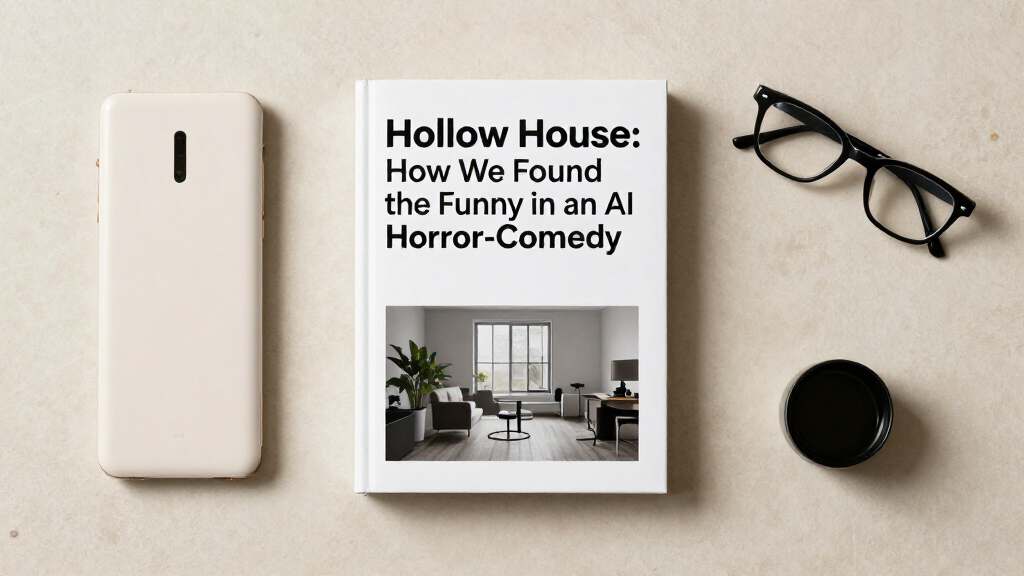

🔍 Read the full analysis: Hollow House: How We Found The Funny In An AI Horror-Comedy on ThorstenMeyerAI.com

Get business pricing on monitors, keyboards and dev gear
- Business-only prices and quantity discounts
- Tax-exempt purchasing
- Multiple users, one account, clear invoices
TL;DR
Thorsten Meyer says he made the 97-second AI horror-comedy “Hollow House” overnight on October 27–28, 2026, after three attempts. His account says the successful version used three longer generated segments, with human decisions about editing, sound and grading shaping the result; the first cut looked polished but felt slow.
Filmmaker Thorsten Meyer says he created “Hollow House,” a 97-second AI-generated horror-comedy, in three attempts over one night, changing the edit after deciding the first, visually polished version was “terribly boring and amateurish.” His October 28 account describes how the final cut’s quicker rhythm, character references and human editing choices shaped a short about a real ghost joining a haunted-attraction crew.
Meyer’s account says all characters, voices and sets were generated with AI. The premise turns the rules of an extreme haunted attraction into a workplace problem: when a guest says the safe word, the scares are supposed to stop, but a ghost does not follow that rule. The staff respond by treating the supernatural intruder like a new employee who may not have completed the paperwork.
The production went through three versions. The first comprised 20 shots and ran 2 minutes 15 seconds; the second used 66 fast cuts and ran 2 minutes 21 seconds; the final version used three roughly 30-second segments generated with one model supplied references for the whole cast, and ran 1 minute 37 seconds. Meyer says only the third approach worked. He reports spending 2,220 Higgsfield credits, valued at about $95 at his plan price, and around 2,100 ElevenLabs characters on music and sound effects.
For the first version, Meyer created character reference images with Nano Banana 2, then generated start frames and animated them with Veo 3.1. He says the reference sheets helped keep faces, hair and costumes consistent. But the cut averaged 5.6 seconds per shot, compared with about 1.8 seconds per cut in the short that inspired the project, according to his count. He concluded that attractive images alone did not provide the pace the comedy needed.
A one-night production report · October 28, 2026
Hollow House:
Finding the Funny
How filmmaker Thorsten Meyer says three overnight attempts turned an AI horror-comedy into a 97-second short about a ghost who joins an extreme haunted-attraction crew.
Three cuts, one lesson
Meyer says the successful change came from shaping rhythm and performance across the edit, not from image quality alone.
Twenty planned shots
Character sheets, generated start frames and Veo 3.1 animation produced a visually consistent first cut.
2:15 5.6 seconds per shot on averageSixty-six quick cuts
The edit moved toward a brisker pace, but the version ran longer than the first and still did not land for Meyer.
2:21 66 cuts · about 1.8 seconds eachThree longer segments
Roughly 30-second generated segments used references for the full cast. Meyer says this structure finally worked.
1:37 Shorter runtime · quicker comic rhythmWhy the first cut felt slow
Meyer counted an average of 5.6 seconds per shot, compared with about 1.8 seconds per cut in the short that inspired the project. He also describes mostly stationary cameras and no musical score.
What the human edit shaped
The account describes production work around generation: visual continuity, dialogue checks, sound, grading and decisions about what the jokes needed.
Eight character sheets
Meyer made one reference image per character to guide later generations and keep faces, hair and costumes consistent. He says each 2K image cost two credits.
Catch what models changed
He compared speech-recognition transcripts with the script to spot mispronunciation. A shouted “HEY!” became the spoken letters “H-E-Y”; a head-turn prompt rotated a body.
Sound, score and grade
Meyer reports using about 2,100 ElevenLabs characters for music and sound effects. He also says editing and grading helped shape the final result.
From haunted-house rule to workplace problem
The premise turns an extreme attraction’s safety rule into a comic test: what happens when the supernatural guest does not follow the script?
The safe word
A guest says the word that should make the scares stop.
The ghost ignores it
A real ghost is not bound by the attraction’s rules.
Staff improvise
The crew treats the intruder like a new hire with missing paperwork.
Comedy meets horror
Generated characters, voices and sets serve the short’s workplace absurdity.
Reading the production account
What the story can—and cannot—show
The workflow, timeline and cost figures come from Meyer’s own October 28 account. The source does not include an independent production audit, generation history or credit-price breakdown.
It also provides no audience testing, viewing figures or evidence that the revised edit improved audience response. “The third approach worked” is Meyer’s assessment.
Quick questions
Key details from Meyer’s account, kept in context.
What is Hollow House?
A 97-second horror-comedy about a ghost joining an extreme haunted-attraction crew. Meyer says the characters, voices and sets were AI-generated.
How long did it take?
Meyer says he began in the early evening of October 27, 2026 and worked until about 1:30 a.m. on October 28, making three attempts.
Why did the first cut miss?
He says its 20 shots averaged 5.6 seconds, with mostly stationary cameras and no score. The pace did not suit the comedy.
What changed in the final version?
It runs 1:37 and uses three roughly 30-second segments generated with references for the whole cast, according to Meyer.
Why the Edit Changed the Film
Meyer’s account points to a practical distinction in AI filmmaking: generating coherent-looking images is not the same as producing a coherent, funny short. He says the first version held together visually, but its long shots, largely static camera and lack of a musical score left the jokes without the pace he wanted. In his telling, the breakthrough was an editorial decision, not simply a more attractive image-generation prompt.
The account also shows how much work remained outside generation. Meyer says he compared speech-recognition transcripts with the script to catch mispronounced dialogue, rewrote prompts when actions did not render, and used sound and grading to shape the final result. For readers following AI video, the reported three-attempt workflow offers a specific example of how model constraints and human judgment can interact in a short production.
Products Worth Considering

Bose QuietComfort Wireless Bluetooth Headphones with Active Noise Cancellation, Mic, USB‑C Charging, Deep Bass, 24‑Hour Battery – White Smok

Anker SOLIX S2000 Portable Power Station, 2,010Wh, 1,500W

DJI Osmo Pocket 3 Vlogging Camera with 1-Inch CMOS Sensor and 4K Video
As an affiliate, we earn on qualifying purchases.
From Character Sheets to Final Cut
Before generating video, Meyer made one reference image for each of the film’s eight characters. He describes these sheets as a way to give later generations a visual guide, since characters can otherwise change appearance between shots. His account says each image cost two credits at 2K resolution and that all eight were completed in under two minutes.
The first cut was built from 20 planned shots, each with a generated start frame animated in Veo 3.1’s fast mode. Meyer says the system generated speech and sound with the image. He then identified both pacing problems and specific generation errors: a shouted “HEY!” was spoken as the letters “H-E-Y,” a requested head turn rotated the character’s body, and some attempts at physical horror effects were blocked or rendered differently than intended.
Meyer says the concept’s structure was inspired by an AI horror-comedy short shared on X, while the script, characters and jokes were his own. The source account does not identify the other short, so the relationship between the works cannot be independently assessed from the material provided.
“The first version looked great, and when I watched it I called it what it was: terribly boring and amateurish.”
— Thorsten Meyer, writing on ThorstenMeyerAI.com
What the Account Does Not Establish
The production details and cost figures come from Meyer’s own account; no independent breakdown of the generation history, credit pricing or final edit is supplied in the source material. The figures therefore describe what Meyer reports, not an independently verified production audit.
The source also does not provide comparative audience testing, viewing figures or evidence that the changes improved audience response. Meyer says the third version worked, but that is his assessment. The account does not detail the exact tools or workflow used to combine the three final segments, or provide a full technical explanation of the final colour grade and sound mix.
Where the Production Story Goes
Meyer’s October 28 post includes the finished short and behind-the-scenes material, including character sheets, start frames, failed attempts and a contact sheet of the final cut. The published account does not announce a follow-up film, release schedule or further production tests.
For now, the next step for readers is to compare the short with the process Meyer describes: the first version’s longer shots, the failed generation attempts and the final, faster cut. Any broader claims about audience reception or how reliably the workflow can be repeated would require additional information not included in the account.
Key Questions
What is “Hollow House”?
“Hollow House” is a 97-second horror-comedy short about a ghost joining the staff of an extreme haunted attraction. Meyer says its characters, voices and sets were AI-generated.
How long did it take to make?
Meyer says work began in the early evening of October 27, 2026, and continued until about 1:30 a.m. the next day. He describes three attempts made during that period.
Why did the first version not work?
Meyer says the first cut looked good but felt too slow: it had 20 shots averaging 5.6 seconds, with mostly stationary cameras and no score. He judged that rhythm unsuitable for the comedy.
What did the final version change?
The final version runs 1 minute 37 seconds and uses three roughly 30-second segments generated with references for the full cast, according to Meyer. He says its faster structure worked better than the earlier cuts.
How much did the production cost?
Meyer reports using 2,220 Higgsfield credits, which he valued at about $95 at his plan price, plus approximately 2,100 ElevenLabs characters for music and sound effects. Those figures are his reported costs.
Source: ThorstenMeyerAI.com