
🔍 Read the full analysis: High-Performance Computing In 2027: How To Pick An NVMe SSD on ThorstenMeyerAI.com

Get business pricing on monitors, keyboards and dev gear
- Business-only prices and quantity discounts
- Tax-exempt purchasing
- Multiple users, one account, clear invoices
TL;DR
A buyer’s guide from ThorstenMeyerAI.com names 10 NVMe SSD options for high-performance computing, with the Samsung 990 PRO 2TB as its overall pick and the Kingston NV3 1TB as its budget choice. Its central advice is to compare sustained performance, cooling, capacity and endurance—not just advertised peak speeds. The supplied material does not include test results, prices, or independently verifiable specifications for every listed model.
ThorstenMeyerAI.com has published a guide to 10 NVMe SSDs for high-performance computing, naming the Samsung 990 PRO 2TB its overall choice and the Kingston NV3 1TB its budget pick. The guide argues that buyers should weigh sustained write speeds, heat management and capacity alongside advertised peak throughput, though the source material provided does not include comparative test data or current prices.
The guide frames the choice as a workload decision rather than a simple search for the highest sequential-speed figure. Large transfers, video editing and game installations can expose differences between short burst speeds and performance after a drive’s cache fills. The source specifically says entry-level drives such as the Kingston NV3 may slow after their SLC cache is exhausted, but supplies no transfer measurements or test conditions to quantify that effect.
Its named options span several buyer profiles: the Samsung 990 PRO 2TB for general high performance, the Kingston NV3 1TB for lower-cost PCIe 4.0 storage, the Samsung 9100 PRO for laptop efficiency, and the Bestoss 1TB for a heatsink-equipped build. It also identifies the SanDisk Optimus 5100 as a DRAM-less option for general use. The supplied source does not provide the remaining model names, a complete ranking, price comparisons or detailed specifications for all 10 drives, so this is not a fully reproducible comparison.
According to the guide, its evaluation criteria include sequential and random read/write performance, thermal throttling, endurance ratings measured in terabytes written (TBW), warranty terms, and whether a drive uses DRAM or Host Memory Buffer technology. It says larger capacities may sustain large transfers more consistently than 1TB versions, but offers no model-by-model benchmark results or methodology details that would let readers verify the rankings.
The 10 picks
- 1
 Samsung 990 PRO 4TB PCIe 4.0 NVMe M.2 2280 SSDView on Amazon →
- 2
 Gigastone Game Turbo 4TB M.2 NVMe PCIe 4.0 Internal SSDView on Amazon →
- 3
 Gigastone 1TB Game Turbo PCIe Gen4x4 M.2 NVMe SSD (2-Pack)View on Amazon →
- 4
 Samsung 9100 PRO 2TB Internal SSDView on Amazon →
- 5
 Samsung 990 PRO 2TB PCIe 4.0 M.2 2280 NVMe SSDView on Amazon →
- 6
 Bestoss 1TB PCIe 4.0 NVMe M.2 2280 SSD with HeatsinkView on Amazon →
- 7
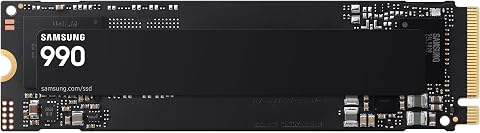 Samsung 990 1TB PCIe 4.0 NVMe Internal SSDView on Amazon →
- 8
 SanDisk Optimus 5100 1TB NVMe SSD, PCIe 4.0, M.2 2280View on Amazon →
- 9
 Kingston NV3 1TB M.2 2280 PCIe 4.0 NVMe SSDView on Amazon →
- 10
 SanDisk Optimus 5100 500GB NVMe SSD, PCIe 4.0, M.2 2280View on Amazon →
Why Sustained Speed Matters
For people handling large projects or frequent data transfers, short benchmark bursts may not reflect the speed they experience during a long write. A drive that slows once its cache is depleted can extend copying or export times, while heat-related throttling can further reduce performance in a compact desktop or laptop. The guide’s emphasis on workload, cooling and cache behavior addresses these practical differences.
Capacity also affects the buying decision: paying more for a 2TB or 4TB model may bring more room and, in some product lines, more consistent performance under heavy use. But that conclusion depends on the specific drive and workload. Buyers should compare published specifications and independent testing for the exact capacity they plan to purchase rather than assuming every larger model performs better.
Products Worth Considering

Apple MacBook Air 15-inch Laptop with M5 Chip, 16GB Memory, 512GB SSD, Midnight

Bose TV Speaker (2nd Gen) – Compact Soundbar with Bluetooth and HDMI‑ARC Connectivity, Clear Dialogue, Dolby Atmos, Deep Bass, Remote Contro

Amazon Kindle Paperwhite (2024, 16 GB) – 7-inch Display, Black
As an affiliate, we earn on qualifying purchases.
How NVMe Choices Differ
NVMe SSDs connect through M.2 slots using PCI Express lanes. The source describes PCIe 4.0 as a common performance tier and says PCIe 5.0 models can bring higher speeds alongside greater cooling demands. Actual performance depends on the drive, the number of lanes and the system’s supported PCIe generation; a faster-generation SSD installed in a slower-compatible slot may not reach its maximum throughput.
Some drives include DRAM to hold address-mapping data, while DRAM-less models can use Host Memory Buffer technology to borrow a small amount of system memory. These designs have different cost and responsiveness tradeoffs, and the right choice depends on use. The guide also notes that heatsinks or motherboard thermal pads can help manage heat during sustained work. These points are general buying guidance; the source does not provide measured thermal or latency comparisons for the 10 named products.
Missing Tests and Price Data
The supplied source is a buying-guide summary, not a set of disclosed test results. It does not state the publication date, test system, drive firmware, workload settings, retail prices, warranty durations or TBW figures. It also omits several of the 10 models promised by the guide. The characterizations of the Samsung 9100 PRO as more power-efficient and the Samsung 990 PRO as the best overall are therefore the guide’s conclusions, not independently established findings in the material provided.
Prices and product availability can change, and specifications can differ by capacity or region. The source does not clarify which exact versions were assessed or whether the listed products are current and available in 2027. Readers should verify manufacturer specifications, compatibility and recent independent benchmarks before buying.
Check Models Before Buying
The next step for prospective buyers is to match a drive’s capacity and interface to their motherboard or laptop, then compare sustained-write tests, thermal behavior, endurance and warranty terms for the exact model. For heavy workloads, benchmark results that show performance after cache exhaustion are more informative than peak figures alone. Current pricing and availability should also be checked at purchase time.
No further testing, updated ranking or product launch is described in the supplied material. Whether the guide will publish complete specifications and results for all 10 selections remains unknown.
Key Questions
Which SSD does the guide recommend overall?
It names the Samsung 990 PRO 2TB as its overall choice. The supplied material does not include comparative benchmark results to independently verify that ranking.
What is the guide’s budget pick?
The guide identifies the Kingston NV3 1TB as its budget option. It cautions that sustained write performance can fall after the drive’s SLC cache is exhausted, but provides no measured slowdown figures.
Why can an SSD slow during a large file transfer?
Some drives use a cache to handle short bursts of writes. Once that cache fills, write speeds can decline; heat-related throttling may also lower performance during sustained work.
Does a PCIe 5.0 SSD work in a PCIe 4.0 system?
Compatibility depends on the system’s M.2 slot and the drive. A drive operating in a slot with an older PCIe generation may be limited to that slot’s supported speed. Check the device and motherboard documentation before purchasing.
Source: ThorstenMeyerAI.com