TL;DR
AI tools can help engineers shape parts around specified loads and help monitor some nozzle-based 3D prints for common errors. The source says text-to-CAD is still research, and simulations or automated checks do not replace human review and physical testing.
A practical overview published by Thorsten Meyer AI on November 29, 2026, describes current AI uses across the 3D printing process: software can propose part shapes around specified loads, while a camera system has been shown to detect and correct some printing errors. The article says these tools do not make a part trustworthy on their own; human checks and physical tests remain necessary, especially for parts that carry weight or protect people.

Get business pricing on monitors, keyboards and dev gear
- Business-only prices and quantity discounts
- Tax-exempt purchasing
- Multiple users, one account, clear invoices
In generative design, engineers provide constraints such as loads, bolt locations and areas to keep clear. The software then proposes a shape that meets the inputs. The source reports that NASA engineers have described producing lighter, stiffer designs in hours rather than days. That result depends on how the problem is defined: omitted loads, fasteners or clearance needs can make a technically convincing design unsuitable for its intended use.
AI can also assist during printing. A camera-based system developed by researchers at Cambridge learned to identify and correct common nozzle errors while a print was underway. The account concerns material-extrusion printers, which build parts by laying down material through a nozzle. It does not establish that the system works across every printer, material or fault.
Computer simulation can estimate how a design responds to forces, but it is still a prediction. The source says NASA’s AI-designed parts undergo standard stress analysis and testing, and points to a NASA standard for printed flight hardware. It also describes text-to-CAD as research: generating code that runs does not show that the resulting part has correct dimensions, properties or performance.

Where Automation Saves Workshop Time
For engineers, generative design may shorten the time spent exploring shapes that meet specified requirements. For home users, the nearer-term application described is a printer camera that flags problems. These tools could reduce some manual work or catch some errors earlier, but their value depends on the quality of their inputs and the tasks they can reliably handle.
The limits matter most when a part has real consequences if it fails. A simulation can help identify likely weaknesses, and an automated system can recognize patterns, but neither establishes how a physical part will behave in every condition. The source’s practical guidance is to treat printer monitoring as an additional check, and to test parts that carry loads, protect people or are intended for flight.
Products Worth Considering

Samsung Odyssey G55C 32-Inch QHD 1000R Curved Gaming Monitor

Anker SOLIX C1000 Gen 2 Portable Power Station

Apple MacBook Air 15-inch with M5 chip, 32GB memory, 512GB SSD, Midnight
As an affiliate, we earn on qualifying purchases.
From CAD Model to Printed Layers
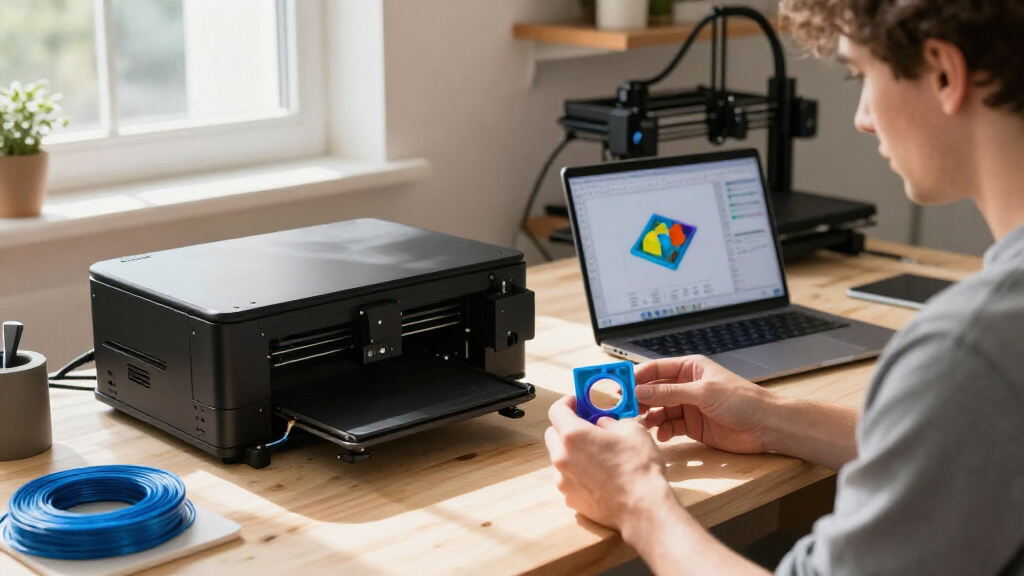
A printed part typically moves through several stages. It starts as a dimensioned model in computer-aided design (CAD). Engineers may then simulate how forces pass through it. A slicer divides the model into layers and creates printer instructions, often called G-code, before the machine builds the object one layer at a time.
The overview identifies AI assistance in design, checking and print monitoring, but describes no AI use at the slicer step. It also notes that print failures can prompt repeated fabrication attempts. The examples it cites include NASA Goddard material on generative design and research by Brion and Pattinson in Nature Communications on camera-based error correction. The account characterizes the latter as applying to material extrusion, a widely used method in which a printer deposits material through a nozzle.
The overview also flags legal limits in the United States: it says purely AI-made output receives no copyright and that only humans can be named as inventors. These points concern the legal treatment of AI-generated work; they do not establish whether a particular design is safe or technically sound.
Limits of the Current Evidence
The source does not provide performance figures for the generative-design examples or the camera correction system, such as error rates, test conditions or the range of materials and machines evaluated. It also does not specify how broadly the camera approach generalizes beyond the common nozzle errors it was trained to spot.
For text-to-CAD, the article gives no release date or readiness timeline for a dependable consumer or engineering tool. More broadly, the examples do not show that AI can independently validate a design or certify a finished part. The comparison basis for the reported time savings is not detailed in the supplied material.
Testing Remains the Final Check
The next step for anyone using these tools is to review the specific design constraints, inspect the print and test the finished part for its intended use. Engineers working on safety-sensitive hardware will need to continue following applicable analysis and testing requirements; the source says NASA’s flight hardware process includes those checks.
Further evidence would be needed to establish how reliably camera systems correct faults across printers and materials, and whether text-to-CAD tools can produce parts that meet engineering requirements. Until those capabilities are demonstrated for a specific application, human review and physical testing remain the stated safeguards.
Key Questions
What can AI do in 3D printing today?
The source describes software that proposes part shapes from specified constraints and a camera system that can detect and correct some errors during nozzle-based printing. These are specific forms of assistance, not a complete automated design and manufacturing process.
Can AI design a part from a sentence?
The overview characterizes text-to-CAD as research rather than a dependable tool. It says that code running successfully does not prove the resulting part is correct.
Does simulation prove that a printed part is safe?
No. Simulation predicts how forces may affect a design. The source says parts that carry weight or have safety implications still need human review and physical testing.
Where might home 3D printer users encounter AI?
The source points to printer cameras that watch for problems during a print. It recommends treating this as an extra set of eyes and checking the first layers yourself.
Source: Thorsten Meyer AI