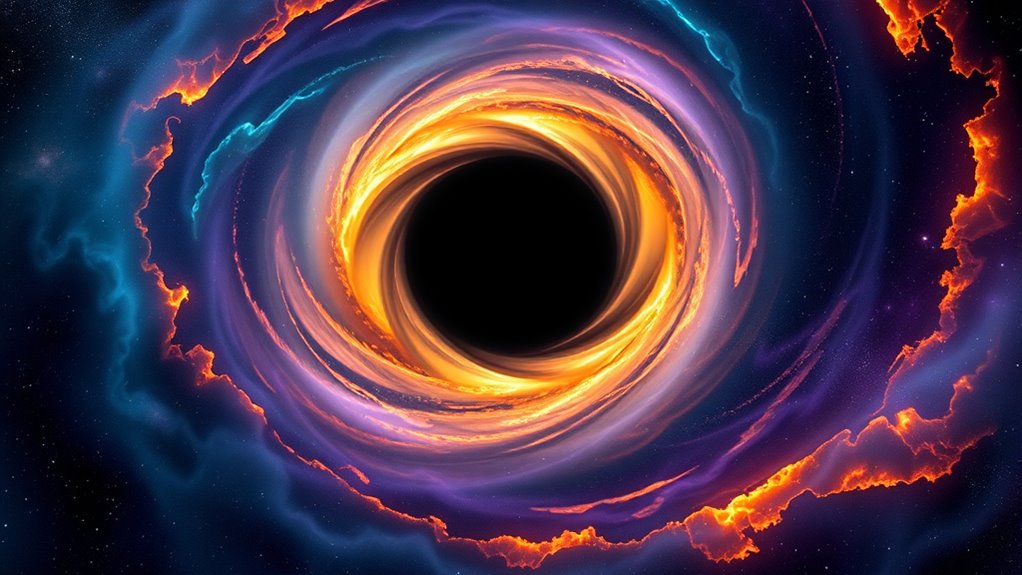

Black holes are incredible cosmic phenomena that form when massive stars collapse under their own gravity after exhausting nuclear fuel. They consist of a dense core surrounded by an event horizon, which is the point of no return where nothing can escape the black hole’s gravitational pull. At the center lies a singularity, an infinitely dense point where the laws of physics as we understand them break down. Discover more about their fascinating properties and implications for our universe.
Key Takeaways
- Black holes form when massive stars collapse under gravity after exhausting their nuclear fuel, leading to dense cosmic remnants.
- The event horizon marks the boundary of a black hole, beyond which escape from its gravitational pull is impossible.
- A singularity, located at the center of a black hole, is an infinitely dense point where current physics breaks down.
- Black holes cannot be seen directly; they are detected by observing their gravitational effects on surrounding stars and gas clouds.
- They vary in size, from stellar black holes formed by collapsing stars to supermassive black holes found at the centers of galaxies.
Black Holes 101
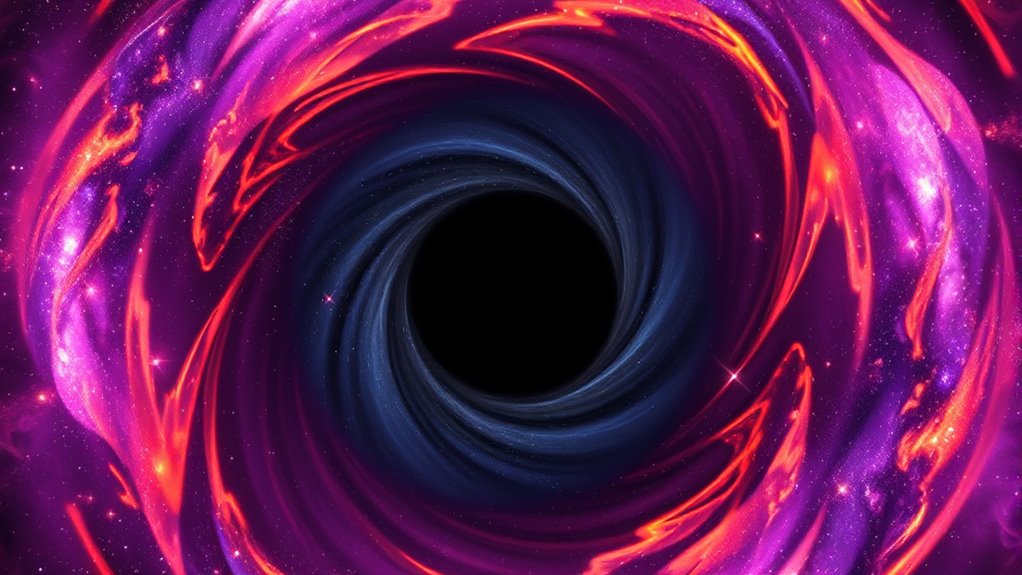
Have you ever wondered what happens when a star collapses under its own gravity? This cosmic phenomenon leads to the formation of a black hole, one of the universe’s most intriguing mysteries. When a massive star exhausts its nuclear fuel, it can no longer counteract the force of gravity. The outer layers of the star collapse inward, and if the remaining core’s mass is sufficient, it continues to collapse until it forms a black hole. At this point, you encounter two vital concepts: the event horizon and the singularity.
The event horizon is the boundary surrounding a black hole. Once something crosses this threshold, it can’t escape the black hole’s gravitational pull. Picture it like a one-way street; once you enter, there’s no turning back. This boundary is essential because it marks the point at which the escape velocity exceeds the speed of light. You might think of it as the ultimate point of no return. If you were to get close to a black hole, the event horizon would be the last location where you could theoretically escape, but getting that close could be dangerous.
The event horizon marks the ultimate point of no return for anything crossing into a black hole’s grasp.
Now, let’s talk about the singularity, the heart of the black hole. When the star collapses, all its mass is concentrated into an infinitely dense point at the center. This singularity is where the laws of physics as we know them break down. If you could somehow approach it, the gravitational forces would become so intense that they might stretch you out into a thin strand of matter—a phenomenon known as spaghettification. It’s mind-boggling to think about how the singularity challenges our understanding of space and time.
Black holes come in various sizes, from stellar black holes formed by collapsing stars to supermassive ones that sit at the centers of galaxies. You might wonder how we can even detect these invisible giants if they don’t emit light. Astronomers observe the effects of their gravity on nearby stars and gas clouds, allowing them to infer the presence of a black hole. Additionally, scientists are continually exploring the role of gravity in shaping the behavior of these enigmatic objects.
Frequently Asked Questions
Can Black Holes Be Used for Time Travel?
You can’t use black holes for time travel in a practical sense, but wormhole speculation suggests that they might create shortcuts through spacetime. If you could navigate a wormhole, you might experience temporal distortion, allowing for travel to different points in time. However, the science is still theoretical, and many challenges exist. So, while it’s an intriguing idea, you should take it with a grain of caution and continue exploring the possibilities.
What Happens to Information That Falls Into a Black Hole?
When you think of a black hole, picture a cosmic whirlpool sucking everything in. Once information falls into a black hole, it seems to vanish, leading to the information paradox. However, quantum effects suggest that this information might not be lost forever. Instead, it could be stored in some form, potentially escaping when the black hole evaporates. So, while it feels like a dead end, there might be more to the story.
Are There Different Types of Black Holes?
Yes, there are different types of black hole classifications. You’ve got stellar black holes, which form from collapsing stars, and supermassive black holes, found at galaxy centers. Intermediate black holes are also theorized, bridging the gap between the two. Each type features its own unique characteristics and types of singularities, where gravity is so intense that the laws of physics as you know them break down. Understanding these differences expands your grasp of the universe’s mysteries.
How Do Scientists Detect Black Holes if They Can’t Be Seen?
Detecting black holes is like searching for a shadow in the dark; you can’t see them directly, but their effects reveal their presence. Scientists use gravitational lensing, where light bends around a black hole, to spot them. They also observe accretion disks—hot, glowing materials spiraling into the black hole—providing clues about their existence. By studying these phenomena, you can uncover the hidden secrets of these cosmic giants.
Can Black Holes Collide and Merge Into Larger Ones?
Yes, black holes can collide and merge into larger ones, forming what scientists call black hole binaries. When two black holes orbit each other, they generate gravitational waves, ripples in spacetime that we can detect. As they spiral closer, they eventually merge, releasing an incredible amount of energy. This process not only creates larger black holes but also provides valuable insights into the universe’s fundamental physics. You’d be amazed by the cosmic dance!
Conclusion
In the cosmic dance of the universe, black holes serve as both a doorway and a destination. They symbolize the unknown, urging you to embrace curiosity and fearlessness as you explore the mysteries of existence. Just like a deep, dark well, they invite you to peer into the abyss of knowledge, reminding you that even in darkness, there’s a spark of wonder. So, venture forth, and let the enigma of black holes inspire your journey through the stars.