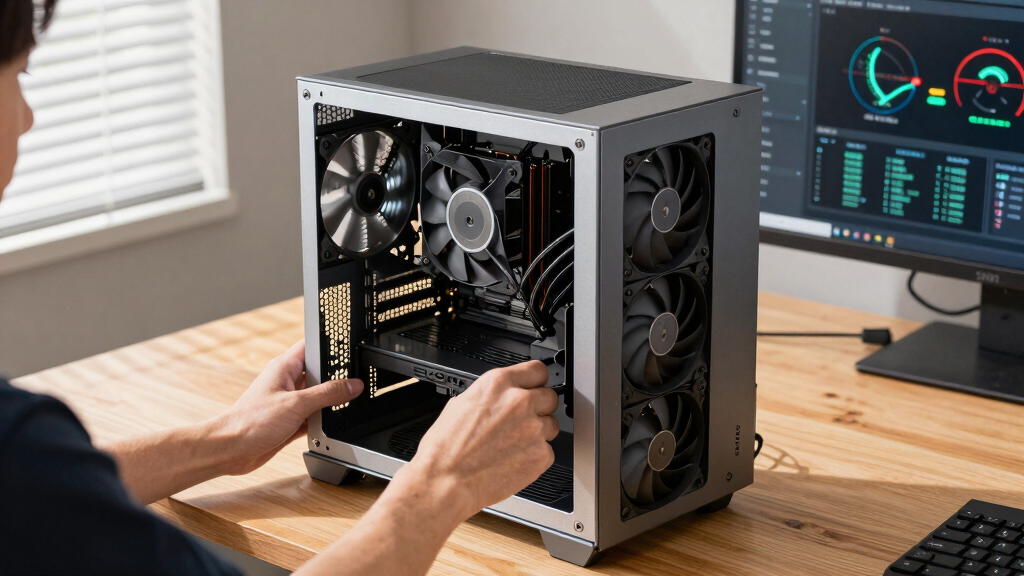

📊 Full opportunity report: Best Quiet Case Fans + the Airflow Setup That Actually Works on ThorstenMeyerAI.com — validation score, market gap, and execution plan.

Get business pricing on monitors, keyboards and dev gear
- Business-only prices and quantity discounts
- Tax-exempt purchasing
- Multiple users, one account, clear invoices
TL;DR
This article identifies the best quiet case fans in 2026 and explains the airflow setup that achieves optimal cooling with minimal noise. It emphasizes large, slow-moving fans and proper placement for high-power workstations.
In 2026, the most effective approach to quiet, high-performance PC cooling involves using large, slow-moving fans combined with a specific airflow configuration that maximizes efficiency and minimizes noise, confirmed by recent testing and expert consensus.
The article highlights that larger fans, such as 140mm models, moving air at lower RPMs, produce significantly less noise than smaller, faster fans while maintaining the same cooling capacity. The Noctua NF-A12x25 and NF-A14 are identified as top-performing, durable, and quiet fans, though they come at a premium price. Arctic P12 Pro and P14 fans offer nearly comparable performance at a fraction of the cost, making them excellent value choices for budget-conscious builders. For ultra-quiet setups, be quiet! Silent Wings 4 fans provide near-silent operation, ideal for office environments or noise-sensitive users. When cooling radiators or dense heatsinks, static-pressure fans like the Arctic P12 Pro and Noctua NF-F12 are recommended to push air through restrictive fins efficiently. The key principle confirmed is that moving large volumes of air slowly results in quieter operation without sacrificing cooling performance.Best quiet case fans
+ the airflow that works.
The best fan won’t help if it’s pointed the wrong way. The whole recipe: big fans, running slowly, in a clean front-to-back path, with slightly more intake than exhaust. Build a config in Part 2 and watch the pressure balance respond.
Why Proper Fan Selection and Airflow Matter in 2026
Choosing the right case fans and airflow setup directly impacts the performance, noise level, and longevity of high-power workstations. Properly configured, these setups enable continuous operation without disturbing environments or sacrificing component lifespan, which is critical for AI and computational workloads. The emphasis on larger, slower fans aligns with industry trends toward quieter, more efficient cooling solutions, making this guidance relevant for builders seeking high performance with minimal noise. Implementing these principles can reduce energy consumption and extend hardware lifespan, offering long-term benefits for professional users and enthusiasts alike.As an affiliate, we earn on qualifying purchases.
Current Trends in Quiet PC Cooling for High-Performance Workstations
Over recent years, advancements in fan design and understanding airflow principles have shifted the focus toward larger, slower fans to achieve quiet operation. The 2026 consensus confirms that moving air at lower RPMs with bigger fans provides the best balance of cooling and noise reduction. Previously, smaller fans running at high speeds were common but often noisy and less efficient. The development of specialized static-pressure fans for radiators and dense heatsinks has further refined cooling strategies. The industry now emphasizes tailored airflow configurations, including positive pressure setups and strategic fan placement, to optimize both noise and thermal performance. This evolution reflects a broader trend toward quieter, more energy-efficient high-performance PC builds, especially for AI and data-intensive workloads."Moving large, slow fans is the most effective way to reduce noise while maintaining excellent cooling in high-performance workstations."
— Thorsten Meyer, PC cooling expert
best airflow setup for high-performance PC
As an affiliate, we earn on qualifying purchases.
As an affiliate, we earn on qualifying purchases.
Remaining Questions About Long-Term Durability and Compatibility
While the performance of these fans is well-documented, long-term durability under continuous high loads varies among brands and models. Compatibility with specific case sizes and radiator setups may also influence effectiveness, and some users report minor mechanical noise at higher RPMs. Further testing over extended periods and across different hardware configurations is ongoing to confirm these fans' performance in diverse real-world scenarios.As an affiliate, we earn on qualifying purchases.
Next Steps for Builders and Enthusiasts in 2026
Manufacturers are expected to release updated fan models with even quieter operation and higher efficiency. Builders should monitor new releases and firmware updates that optimize fan curves further. Additionally, testing community setups and sharing airflow configurations will help refine best practices. For now, adopting large, slow fans with proper placement remains the most effective strategy for achieving quiet, reliable cooling in high-performance workstations.static pressure case fans for radiators
As an affiliate, we earn on qualifying purchases.
As an affiliate, we earn on qualifying purchases.
Key Questions
What are the best fans for quiet PC builds in 2026?
The Noctua NF-A12x25 and NF-A14 are considered top-tier for their quiet operation and durability. Arctic P12 Pro and P14 offer excellent value, while be quiet! Silent Wings 4 are ideal for ultra-quiet environments.
How should I configure airflow for a quiet, high-performance PC?
Use large, slow-moving fans for intake and exhaust, ideally 140mm models, and ensure positive pressure inside the case. Place static-pressure fans on radiators or dense heatsinks, and tune fan curves to keep RPM low while maintaining adequate cooling.
Will these fans work with my existing case and radiator?
Most of these fans are compatible with standard 120mm and 140mm mounting points. Always check your case's specifications and radiator dimensions before purchasing. Compatibility with fan connectors and power headers should also be verified.
Are larger fans always quieter than smaller ones?
Generally, yes. Larger fans can move the same amount of air at lower RPMs, producing less noise. However, proper placement and tuning are essential to maximize noise reduction and cooling efficiency.
What is the main principle behind achieving quiet cooling?
The key is to move a large volume of air slowly rather than a small volume quickly. This reduces noise while maintaining effective cooling, especially important for high-power workstations running AI workloads.
Source: ThorstenMeyerAI.com
Halloween Picks
halloween
As an affiliate, we earn on qualifying purchases.