For most first-time buyers, the Canon EOS R50 kit is the best overall mirrorless camera for beginners here, thanks to its more capable autofocus and beginner-friendly touchscreen. The EOS R100 with the standard 18–45mm lens is a simpler choice for stills, while the R100 bundle with a 75–300mm lens suits buyers who already know they want extra reach. The main tradeoff is paying for easier shooting and stronger video features versus choosing a basic camera and putting more of the kit toward lenses. Several listings use the same R100 camera body, so bundle contents and lens naming deserve close attention. Read on for the full comparison and help matching a kit to what you plan to shoot.

Get business pricing on monitors, keyboards and dev gear
- Business-only prices and quantity discounts
- Tax-exempt purchasing
- Multiple users, one account, clear invoices
Key Takeaways
- The EOS R50 is the strongest all-around starting point in this group because its Dual Pixel AF II, vari-angle touchscreen, and 4K video features offer more room to grow than the R100.
- The EOS R100 listings share a basic camera platform; differences in lens descriptions and included accessories matter more than the repeated bundle wording.
- The 75–300mm R100 bundle is the reach-focused option, but a telephoto lens adds bulk and is less useful for everyday indoor or close-range shooting.
- The R50 accessory bundle favors convenience with a shoulder bag and two memory cards, while the core R50 kit keeps the decision centered on the camera and standard lens.
- For a first camera, easy controls and a lens that fits your subjects often matter more than collecting bundle extras; choose the R100 for straightforward stills or the R50 for broader creative flexibility.
| Canon EOS R100 Mirrorless Camera with RF-S18-45mm f/4.5-6.3 IS STM Lens Kit |  | Best Simple Starter Kit | Sensor: 24.1MP APS-C CMOS | Processor: DIGIC 8 | Included lens: RF-S 18-45mm f/4.5-6.3 IS STM | VIEW ON AMAZON | See Our Full Breakdown |
| Canon EOS R100 Mirrorless Camera with RF-S 18-45mm Lens Bundle |  | Best for a Viewfinder-First Beginner | Sensor: 24.1MP APS-C CMOS | Processor: DIGIC 8 | Included lens: RF-S 18-45mm f/4.5-6.3 IS STM | VIEW ON AMAZON | See Our Full Breakdown |
| Canon EOS R100 Mirrorless Camera with 18-45mm & 75-300mm Double Lens Bundle |  | Best for Learning Wildlife and Telephoto Photography | Sensor: 24.2MP APS-C CMOS | Included lenses: RF-S 18-45mm f/4.5-6.3 IS STM and RF 75-300mm f/4-5.6 | Video: 4K; listed frame rates include 24fps and 30fps | VIEW ON AMAZON | See Our Full Breakdown |
| Canon EOS R100 Mirrorless Camera with 18-45mm Lens | 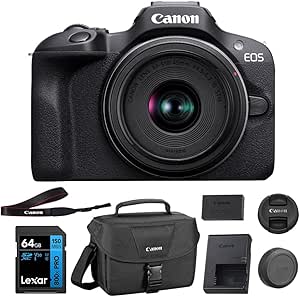 | Best Ready-to-Shoot Accessory Bundle | Sensor: 24.1MP APS-C CMOS | Included lens: 18-45mm | Autofocus: Dual Pixel CMOS AF with face, eye, animal, and vehicle detection | VIEW ON AMAZON | See Our Full Breakdown |
| Canon EOS R50 Mirrorless Camera RF-S 18-45mm F4.5-6.3 IS STM Lens Kit | 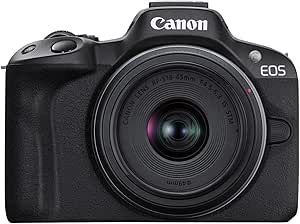 | Best Overall for Beginners Who Want Room to Grow | Sensor: 24.2MP APS-C CMOS | Autofocus: Dual Pixel CMOS AF II, 651 zones | Continuous shooting: 12fps electronic first curtain; 15fps electronic shutter | VIEW ON AMAZON | See Our Full Breakdown |
| Canon EOS R100 Mirrorless Camera with 18-45mm F4.5-6.3 IS STM Lens Bundle |  | Best Accessory Bundle for First-Time Camera Owners | Sensor: 24.1MP APS-C CMOS | Lens: RF-S 18-45mm F4.5-6.3 IS STM | Autofocus: Dual Pixel CMOS AF with face and eye detection | VIEW ON AMAZON | See Our Full Breakdown |
| Canon EOS R100 Mirrorless Camera with RF-S 18-45mm STM Lens Bundle |  | Best R100 Bundle for Learning Photography | Sensor: 24.1MP APS-C CMOS | Processor: DIGIC 8 | Lens: RF-S 18-45mm F4.5-6.3 IS STM | VIEW ON AMAZON | See Our Full Breakdown |
| Canon EOS R50 Mirrorless Camera Kit with 18-45mm Lens, 4K Video, Dual Pixel AF II, Vari-Angle Touchscreen, Shoulder Bag, and 2x 64GB Cards |  | Best for Beginner Vloggers and Video Creators | Sensor: 24.2MP APS-C CMOS | Lens mount: Canon RF | Lens: 18-45mm | VIEW ON AMAZON | See Our Full Breakdown |
| mirrorless cameras for beginner | Sensor | Autofocus | Video | Display |
|---|---|---|---|---|
| Canon EOS R100 Mirrorless Came | 24.1MP APS-C CMOS | Dual Pixel CMOS AF, 143 zones; eye, face, animal, and vehicle detection | 4K at 24fps; Full HD at 60fps; HD at 120fps | 3-inch LCD, 720 × 480 pixels |
| Canon EOS R100 Mirrorless Came | 24.1MP APS-C CMOS | Dual Pixel CMOS AF, 143 zones | 4K at 24p; Full HD at 60p | — |
| Canon EOS R100 Mirrorless Came | 24.2MP APS-C CMOS | — | 4K; listed frame rates include 24fps and 30fps | 3-inch LCD |
| Canon EOS R100 Mirrorless Came | 24.1MP APS-C CMOS | Dual Pixel CMOS AF with face, eye, animal, and vehicle detection | 4K at 24fps; Full HD at 60fps; HD at 120fps | — |
| Canon EOS R50 Mirrorless Camer | 24.2MP APS-C CMOS | Dual Pixel CMOS AF II, 651 zones | Oversampled 4K at 30fps; Full HD at 120fps | Vari-angle touchscreen |
| Canon EOS R100 Mirrorless Came | 24.1MP APS-C CMOS | Dual Pixel CMOS AF with face and eye detection | — | 3-inch LCD, 1,040,000 dots |
| Canon EOS R100 Mirrorless Came | 24.1MP APS-C CMOS | — | — | 3-inch LCD, 1,040,000 dots |
| Canon EOS R50 Mirrorless Camer | 24.2MP APS-C CMOS | Dual Pixel AF II | 4K oversampled | Fully articulating touchscreen |
More Details on Our Top Picks
Canon EOS R100 Mirrorless Camera with RF-S18-45mm f/4.5-6.3 IS STM Lens Kit
I’d place this R100 kit high for beginners who want a straightforward camera-and-lens starting point without a large bundle to sort through. Its 24.1MP APS-C sensor gives room to crop and make detailed prints, while the included 18-45mm zoom covers everyday scenes, portraits, and travel. Dual Pixel autofocus with face, eye, and animal detection can help keep common subjects in focus as you learn. Compared with the R50 kit, though, the R100 is a more basic camera: it shoots 4K at 24fps, has a lower-resolution fixed LCD, and lacks in-body stabilization. The lens has optical stabilization, but its f/4.5-6.3 aperture is less suited to dim rooms than a brighter lens. I’d choose it for uncomplicated stills and occasional video, not demanding creator work.
Pros:- 24.1MP APS-C sensor provides detailed images with useful cropping latitude.
- Included stabilized 18-45mm lens covers common everyday subjects.
- Face, eye, and animal detection simplify focusing on people and pets.
- Compact kit design is easier to carry than a two-lens bundle.
Cons:- 4K recording is limited to 24fps.
- Low-resolution LCD makes image review less clear than on the R50.
- No in-body image stabilization, and the kit lens is relatively slow in low light.
Best for: First-time interchangeable-lens camera buyers who mainly photograph family, travel, pets, and daytime scenes.
Not ideal for: Beginners who want a flexible touchscreen, stronger video features, or reliable handheld shooting in dim light.
- Sensor:24.1MP APS-C CMOS
- Processor:DIGIC 8
- Included lens:RF-S 18-45mm f/4.5-6.3 IS STM
- Autofocus:Dual Pixel CMOS AF, 143 zones; eye, face, animal, and vehicle detection
- Continuous shooting:Up to 6.5 fps
- Video:4K at 24fps; Full HD at 60fps; HD at 120fps
- Display:3-inch LCD, 720 × 480 pixels
- Connectivity:Bluetooth, Wi-Fi, USB, and HDMI
Our verdict“Choose this R100 kit for a portable, uncomplicated start in still photography; pick the R50 instead if video and a more flexible screen matter more.”
Canon EOS R100 Mirrorless Camera with RF-S 18-45mm Lens Bundle
This R100 bundle makes sense for a beginner who prefers composing through a viewfinder and wants the familiar 18-45mm range for everyday photography. Its 2.36-million-dot OLED EVF offers a clear way to frame shots outdoors, where a screen can be harder to see, while the 24.1MP APS-C sensor and 6.5fps burst rate cover casual stills well. The listed LCD resolution is substantially higher than on the other R100 kit described here, so it may also be more pleasant for reviewing images. Against the Canon EOS R50, however, this is the simpler choice: autofocus has fewer zones, video tops out at 4K 24p, and the screen specification does not indicate a vari-angle design. The slow kit lens can also constrain indoor shooting. I’d favor it for viewfinder-led learning, not frequent video or low-light work.
Pros:- OLED electronic viewfinder supports eye-level framing in bright conditions.
- 24.1MP APS-C sensor offers detailed still images.
- Included 18-45mm lens provides a useful everyday focal-length range.
- Dual Pixel autofocus and 6.5fps shooting suit casual family and travel photography.
Cons:- 4K video is limited to 24p, behind the R50’s 30fps option.
- The 18-45mm lens has a modest maximum aperture for indoor and evening scenes.
- Battery life is described as limited for long shooting sessions.
Best for: New photographers who often shoot outdoors and want to learn framing through an electronic viewfinder.
Not ideal for: Video-first beginners or people who need a vari-angle screen, faster subject tracking, or better low-light lens performance.
- Sensor:24.1MP APS-C CMOS
- Processor:DIGIC 8
- Included lens:RF-S 18-45mm f/4.5-6.3 IS STM
- Viewfinder:2.36-million-dot OLED EVF
- Autofocus:Dual Pixel CMOS AF, 143 zones
- Continuous shooting:Up to 6.5 fps
- Video:4K at 24p; Full HD at 60p
- Connectivity:Wi-Fi and Bluetooth
Our verdict“Pick this R100 bundle if a clear viewfinder is central to how you want to learn; choose the R50 for more capable autofocus and video.”
Canon EOS R100 Mirrorless Camera with 18-45mm & 75-300mm Double Lens Bundle
The clearest reason to choose this R100 bundle is the 75-300mm telephoto lens: it gives a beginner a way to photograph distant wildlife, field sports, or stage events that the single-lens R100 kits cannot reach. The 18-45mm lens remains useful for landscapes and everyday scenes, so the pair teaches how focal length changes framing. That range makes this a more flexible starter set than the basic R100 kit, but it also asks more of a new owner: carrying and changing lenses takes practice, and the long lens is less convenient for casual outings. Compared with the EOS R50, the body is less capable for fast action and video, with 4K listed but no frame rate specified here. The R100’s entry-level controls keep the package approachable, yet the slow wide zoom and lack of in-body stabilization limit dim-light shooting.
Pros:- Two lenses cover everyday wide-to-standard scenes and distant subjects.
- 75-300mm telephoto lens extends reach for wildlife and outdoor events.
- 24.2MP APS-C sensor supports detailed still images.
- Electronic viewfinder helps with eye-level framing and tracking distant subjects.
Cons:- The two-lens setup adds bulk and requires lens changes.
- The 18-45mm lens’s f/4.5-6.3 maximum aperture is limiting in low light.
- Compared with the R50, the R100 offers a more basic feature set for action and video.
Best for: Beginners interested in wildlife, outdoor sports, or distant subjects who are ready to learn lens changes and focal length.
Not ideal for: Travelers seeking one compact setup or beginners who mostly shoot indoors and want a brighter lens or stronger video tools.
- Sensor:24.2MP APS-C CMOS
- Included lenses:RF-S 18-45mm f/4.5-6.3 IS STM and RF 75-300mm f/4-5.6
- Video:4K; listed frame rates include 24fps and 30fps
- Display:3-inch LCD
- Viewfinder:Electronic
- Connectivity:Wi-Fi
- Memory support:SD and microSD
- Included accessories:Battery, charger, neck strap, and lens caps
Our verdict“Choose this bundle if distant wildlife or sports are a real goal; a single-lens R100 kit is simpler for general beginner photography.”
Canon EOS R100 Mirrorless Camera with 18-45mm Lens
This R100 package is for the beginner who wants the core camera kit plus a couple of practical extras from the start. The 64GB SD card and shoulder bag reduce the need to source basic carrying and storage accessories separately, while the 24.1MP sensor and 18-45mm lens provide a familiar setup for learning everyday photography. Its autofocus detects faces, eyes, animals, and vehicles, which can help when subjects move unpredictably. Compared with the two-lens R100 bundle, this kit is easier to carry and less involved; compared with the R50 kit, it gives up the vari-angle touchscreen and more advanced autofocus. The R100’s 4K is capped at 24fps, and there is no in-body stabilization, so handheld video and dim-light shooting need realistic expectations. I’d choose this for a simple starter package, not a creator-focused upgrade path.
Pros:- Includes a 64GB SD card and shoulder bag for a more ready-to-carry setup.
- 24.1MP APS-C sensor supports detailed everyday photographs.
- Subject detection covers faces, eyes, animals, and vehicles.
- 18-45mm lens is a practical range for general scenes and travel.
Cons:- 4K recording is limited to 24fps.
- No in-body image stabilization for handheld video or adapted lenses.
- Less flexible for self-recording than the R50’s vari-angle touchscreen.
Best for: First-time camera owners who want a basic R100 setup with a storage card and shoulder bag included.
Not ideal for: Beginners who need a screen that flips for self-recording, more advanced tracking, or smoother 4K frame rates.
- Sensor:24.1MP APS-C CMOS
- Included lens:18-45mm
- Autofocus:Dual Pixel CMOS AF with face, eye, animal, and vehicle detection
- Continuous shooting:Up to 6.5 fps
- Video:4K at 24fps; Full HD at 60fps; HD at 120fps
- Included accessories:Shoulder bag and 64GB SD card
Our verdict“Choose this R100 bundle if the included card and bag suit your needs; select the R50 if you want a more adaptable camera body for video.”
Canon EOS R50 Mirrorless Camera RF-S 18-45mm F4.5-6.3 IS STM Lens Kit
I’d rank the R50 above the R100 kits for beginners who expect to shoot a mix of stills, action, and video. Its Dual Pixel CMOS AF II with 651 zones and subject tracking give it a stronger chance of holding focus on moving people and animals, while bursts reach 12fps with the electronic first curtain or 15fps electronically. The vari-angle touchscreen is also more useful than the R100’s basic LCD for low-angle shots and self-recording. Video is another clear step up: the R50 offers oversampled 4K at 30fps and Full HD at 120fps. That added flexibility comes with tradeoffs: there is no in-body stabilization, and the included 18-45mm lens shares the R100 kits’ modest aperture, so dim scenes may call for another lens. For a learner willing to use its broader feature set, it offers more room to develop than the simpler R100.
Pros:- 651-zone autofocus with subject tracking is better suited to moving subjects than the R100 system.
- Vari-angle touchscreen supports self-recording and awkward shooting angles.
- Oversampled 4K at 30fps and Full HD at 120fps provide more video flexibility than the R100.
- Fast burst rates help capture action and fleeting expressions.
Cons:- No in-body image stabilization.
- The included f/4.5-6.3 lens can limit results in dim light.
- The additional autofocus and video options may feel like more camera than a basic stills learner needs.
Best for: Beginners who want one camera for family and travel photography, moving subjects, and self-recorded or social video.
Not ideal for: Buyers who want the simplest controls, prioritize low-light shooting with the kit lens, or need stabilization in the camera body.
- Sensor:24.2MP APS-C CMOS
- Autofocus:Dual Pixel CMOS AF II, 651 zones
- Continuous shooting:12fps electronic first curtain; 15fps electronic shutter
- Video:Oversampled 4K at 30fps; Full HD at 120fps
- Viewfinder:2.36-million-dot EVF
- Display:Vari-angle touchscreen
- Connectivity:Built-in Bluetooth and Wi-Fi
Our verdict“Choose the R50 if you want a beginner-friendly camera that can handle action and video better than the R100; choose an R100 kit for a simpler setup.”
Canon EOS R100 Mirrorless Camera with 18-45mm F4.5-6.3 IS STM Lens Bundle
This bundle suits a smartphone upgrader who wants a ready-to-go camera kit rather than a bare body. The 24.1MP APS-C sensor gives you room to crop and retain detail, while the 18-45mm lens covers everyday scenes, family photos, and travel. A case, memory card, charger, and cleaning kit reduce the number of extras you need to source at the start. Compared with the Canon EOS R100 with RF-S 18-45mm STM Lens Bundle, the core camera setup is similar; this version stands out for its listed cleaning kit and travel case. The tradeoff is that both R100 bundles share a modest standard zoom range, and the fixed rear LCD is less flexible for self-recording than the EOS R50’s vari-angle touchscreen. Its 4K recording is also listed at 24 fps.
Pros:- 24.1MP APS-C sensor captures detailed stills
- 18-45mm zoom is useful for everyday and travel photography
- Bundle includes a case, memory card, charger, and cleaning kit
- Dual Pixel autofocus includes face and eye detection
Cons:- The 18-45mm lens has limited reach for distant subjects
- Fixed 3-inch LCD is less adaptable for vlogging than the EOS R50 screen
- 4K video is listed at 24 fps
Best for: Smartphone upgraders and families who want an entry-level camera with basic travel and care accessories included.
Not ideal for: Vloggers who need a front-facing screen, or photographers who want a longer-reaching kit lens without buying another lens.
- Sensor:24.1MP APS-C CMOS
- Lens:RF-S 18-45mm F4.5-6.3 IS STM
- Autofocus:Dual Pixel CMOS AF with face and eye detection
- Maximum video resolution:4K (2160p), 24 fps
- Display:3-inch LCD, 1,040,000 dots
- Viewfinder:Electronic
- Connectivity:Bluetooth and Wi-Fi
- Weight:1.1 pounds
- Included accessories:Battery, charger, case, memory card, lens caps, and cleaning kit
Our verdict“Choose this R100 bundle if you want a lightweight starter kit with useful accessories and do not need a flexible screen or longer lens reach.”
Canon EOS R100 Mirrorless Camera with RF-S 18-45mm STM Lens Bundle
This bundle keeps the camera setup straightforward while adding a photography eBook for beginners who want guidance alongside the hardware. The R100’s 24.1MP APS-C sensor, electronic viewfinder, and 6.5 fps continuous shooting provide a practical foundation for learning composition and capturing everyday action. Its 18-45mm lens is a sensible first zoom, though it will not reach as far as the longer-lens bundle elsewhere in this roundup. Compared with the other Canon EOS R100 18-45mm bundle, this package lists an eBook and a 64GB SDXC UHS-I U3 card, while the other specifies a cleaning kit and travel case. The camera itself remains similar: neither R100 option offers the EOS R50’s vari-angle touchscreen or Dual Pixel AF II. That makes this a better match for still-photo learners than aspiring vloggers.
Pros:- 24.1MP APS-C sensor offers room to crop photos
- Electronic viewfinder helps with composing in bright conditions
- 6.5 fps continuous shooting can capture brief action
- Includes a 64GB card, camera bag, and photography eBook
Cons:- The standard zoom has limited reach for distant subjects
- Single card slot offers no in-camera backup option
- Autofocus is less advanced than the EOS R50’s Dual Pixel AF II
Best for: New photographers who want an entry-level interchangeable-lens camera and a learning resource in the box.
Not ideal for: Beginner vloggers who need an articulating screen, or wildlife and sports shooters who need more lens reach and advanced autofocus.
- Sensor:24.1MP APS-C CMOS
- Processor:DIGIC 8
- Lens:RF-S 18-45mm F4.5-6.3 IS STM
- Continuous shooting:6.5 fps
- Video resolution:1080p and 4K (2160p)
- Display:3-inch LCD, 1,040,000 dots
- Storage:64GB SDXC UHS-I U3 card
- Connectivity:Bluetooth and Wi-Fi
- Weight:1.1 pounds
Our verdict“Pick this R100 bundle if you are learning still photography and value an included guide more than a flexible vlogging screen.”
Canon EOS R50 Mirrorless Camera Kit with 18-45mm Lens, 4K Video, Dual Pixel AF II, Vari-Angle Touchscreen, Shoulder Bag, and 2x 64GB Cards
The EOS R50 is the strongest fit here for beginners who expect to record themselves as well as take photos. Its fully articulating touchscreen makes it easier to frame a shot from in front of the camera or at awkward angles, while oversampled 4K and Dual Pixel AF II give video creators a more capable starting point than either R100 bundle. The included shoulder bag and two 64GB cards also make this kit more ready for a day of shooting. Compared with the Canon EOS R100 with RF-S 18-45mm STM Lens Bundle, the R50 offers more video-friendly controls and autofocus, but it is a less basic choice for someone focused mainly on learning still photography. The kit remains limited by its standard zoom’s reach, and the listed 2-pound weight is higher than the R100 bundles.
Pros:- Vari-angle touchscreen supports self-recording and flexible framing
- Oversampled 4K video provides a capable starting point for content creation
- Dual Pixel AF II supports responsive subject focusing
- Includes a shoulder bag and two 64GB SDXC cards
Cons:- Listed 2-pound weight is higher than the R100 bundles
- The included 18-45mm lens has limited reach for distant subjects
- Battery life may constrain extended recording sessions
Best for: New vloggers, social video creators, and travel shooters who need a screen they can face toward themselves.
Not ideal for: Beginners seeking the lightest, simplest still-photo kit, or buyers who want a longer-range lens included.
- Sensor:24.2MP APS-C CMOS
- Lens mount:Canon RF
- Lens:18-45mm
- Autofocus:Dual Pixel AF II
- Video:4K oversampled
- Display:Fully articulating touchscreen
- Included storage:Two 64GB SDXC cards
- Included items:Shoulder bag
- Weight:2 pounds
Our verdict“Choose the EOS R50 kit if video and self-recording matter more to you than the R100’s simpler, lighter setup.”

How We Picked
I ranked these eight kits around the needs of a new photographer: how approachable the camera is, how reliably it can focus on common subjects, what room it offers for video and skill growth, and whether the included lens suits everyday use. I gave more weight to camera-body capability than to accessory count, since a bag or extra card cannot make a camera easier to focus or operate. I also looked at practical kit differences, including whether a telephoto lens serves a clear purpose for the buyer.
The EOS R50 kits rank ahead of the R100 kits for buyers who want more capable autofocus, touch controls, and video flexibility. The R100 remains a sensible route for straightforward still photography, but the eight listings include several near-duplicate versions of that camera, so they do not represent eight meaningfully different bodies. I treat those listings as kit variations and rank them by how clearly their lens and accessory mix serves a beginner, rather than implying that similar names signal different camera performance.
| mirrorless cameras for beginner | Autofocus | Connectivity |
|---|---|---|
| Canon EOS R100 Mirrorless Came | Dual Pixel CMOS AF, 143 zones; eye, face, animal, and vehicle detection | Bluetooth, Wi-Fi, USB, and HDMI |
| Canon EOS R100 Mirrorless Came | Dual Pixel CMOS AF, 143 zones | Wi-Fi and Bluetooth |
| Canon EOS R100 Mirrorless Came | — | Wi-Fi |
| Canon EOS R100 Mirrorless Came | Dual Pixel CMOS AF with face, eye, animal, and vehicle detection | — |
| Canon EOS R50 Mirrorless Camer | Dual Pixel CMOS AF II, 651 zones | Built-in Bluetooth and Wi-Fi |
| Canon EOS R100 Mirrorless Came | Dual Pixel CMOS AF with face and eye detection | Bluetooth and Wi-Fi |
| Canon EOS R100 Mirrorless Came | — | Bluetooth and Wi-Fi |
| Canon EOS R50 Mirrorless Camer | Dual Pixel AF II | — |
Factors to Consider When Choosing Mirrorless Cameras For Beginners
Before choosing a kit, decide what you want the camera to make easier. A beginner may care most about keeping a moving child in focus, learning exposure with physical controls, filming short videos, or having a lens ready for distant subjects. The sections below cover choices that can prevent a mismatched first purchase.
Choose the Camera Body Before Comparing Bundle Names
Camera listings can make similar kits look like distinct models, even when the body at the center is the same. Start by confirming the exact camera body, then compare lenses and included accessories. A bundle with more items is not automatically a better fit if those extras will stay in a drawer. For a new photographer, a body with controls that feel clear can make learning exposure less frustrating. Look for a setup you can carry and operate regularly, not a list of add-ons that sounds impressive. If two listings name the same R100 body and standard lens, check the actual contents rather than treating small wording differences as a performance upgrade.
Match Autofocus to the Subjects You Photograph
Autofocus matters most when a subject moves or when you need to react quickly. For posed portraits, food, and landscapes, a basic focusing system may be adequate; for children, pets, or casual action, stronger subject tracking can reduce missed moments. A beginner-friendly camera should also make it easy to select a subject without digging through menus. Do not judge autofocus from a single feature label alone: lens choice, light, and subject movement affect results too. If your subjects are usually still, spending more for advanced tracking may bring less practical benefit than choosing a lens that suits your framing. If you regularly photograph unpredictable motion, camera-body capability deserves more weight in your decision.
Think About Lens Range Before Buying a Two-Lens Kit
The standard 18–45mm lens is a flexible starting point for travel, family pictures, and everyday scenes, but it will not cover every subject equally well. A longer telephoto lens can frame distant sports or wildlife without moving closer, yet it is bulkier and less convenient for spontaneous indoor pictures. New photographers sometimes buy a longer lens because more zoom sounds useful, then find it stays at home. Consider where you shoot and how much space you have to move before choosing extra reach. If you are unsure, start with the standard lens and keep a short list of the shots it cannot handle. That evidence can guide a later lens purchase more effectively than guessing at every future need.
Decide Whether Video Features Are Part of Your Plan
Photo-first buyers may not need the same video controls as someone planning to record tutorials, family clips, or social content. A touchscreen that moves to face the user can simplify framing when filming alone, while dependable autofocus helps keep a face sharp as it moves. Check the camera’s recording options against how long and where you expect to film; a 4K label alone does not describe the whole video experience. Also think about audio, holding the camera steady, and storing larger video files. A camera with capable video features can be useful, but those features add little if you only want occasional still photos. Choose for the work you expect to do, not every possible format you might try someday.
Prioritize Handling and Learning Features
Small cameras are easier to pack, but very compact controls can feel cramped for some hands. A clear touchscreen and accessible exposure settings can help you learn without relying on automatic mode for every shot. Beginners often focus on sensor specifications and overlook the simple question of whether they can change focus, exposure, and playback settings comfortably. If possible, handle a camera in person or check its dimensions and control layout before ordering. Plan to learn one setting at a time, such as exposure compensation or focus area, rather than trying to master every menu at once. The camera you enjoy carrying and using is more likely to help you improve than a more advanced model that feels awkward.
Spend on Useful Accessories, Not Bundle Volume
A spare memory card can be handy, and a bag can make carrying a camera safer, but accessory bundles vary in usefulness and quality. Before treating included extras as added value, check that the bag fits the camera and lens you intend to carry and that the cards meet your recording needs. A second card can reduce the risk of running out of space during a day out, though it does not replace a regular backup routine. Beginners may get more from a comfortable strap, a protective case, or a basic cleaning cloth than from accessories they cannot identify or use. Keep some of your budget and attention for learning, storage, and the lens that best suits your subjects. The camera body and lens should remain the deciding factors.
Frequently Asked Questions
Should I choose the EOS R50 or EOS R100 as my first mirrorless camera?
Choose the EOS R50 if you want more help tracking moving subjects, a vari-angle touchscreen, and broader video capability as you learn. The EOS R100 makes more sense if your main goal is straightforward still photography and you want a simpler entry into the Canon system. Neither body is automatically the right pick for every beginner: your subjects and interest in video should guide the choice. If you expect to photograph pets, children, or yourself on camera, the R50’s added flexibility is easier to justify. If you mostly shoot stationary scenes and portraits, the R100 may cover your needs without paying for features you will rarely use.
Are the several EOS R100 listings different cameras?
The listings in this roundup are all presented as EOS R100 kits, so the main camera body is not the key distinction. Their descriptions vary around the standard 18–45mm lens and included bundle contents, and one listing adds a 75–300mm telephoto lens. Check the exact product details before buying, especially if a bundle name uses slightly different lens wording. Do not assume that a longer or more detailed listing title means the camera itself has better autofocus or controls. If the body and lens are the same, choose based on genuinely useful extras and the subjects you plan to photograph.
Is the R100 two-lens bundle a good first kit if I want to photograph wildlife?
It can be a reasonable starting kit if you expect to photograph distant animals and understand that a longer lens is larger and more specialized. The 75–300mm lens offers more reach than the standard zoom, which helps when you cannot get close to a subject. Wildlife photography also depends on light, focus technique, patience, and the animal’s distance, so the extra lens does not guarantee sharp results. For family gatherings or indoor pictures, the longer lens may feel cumbersome and may not be the one you reach for most. Choose the two-lens bundle for a clear need for distant framing, not simply because it includes more glass.
Do I need the R50 bundle with a bag and two memory cards?
The accessory bundle is useful if you need a way to carry the camera and extra storage from day one. It does not change the R50 camera’s core imaging or focusing capabilities, so compare the bundle with the standard R50 kit based on the accessories you would otherwise buy. Check that the bag has room for the camera, lens, and any small items you plan to carry. Also verify the memory-card specifications if you expect to record video, since storage needs can differ between stills and video. If you already own compatible cards and a suitable bag, the core kit may be the cleaner choice.
Is an 18–45mm lens enough for learning photography?
For many beginners, yes: that range covers common everyday scenes, family pictures, travel, and some portrait framing. Working with one lens can also help you learn how distance and composition change the result, rather than relying on zoom for every adjustment. Its range will feel limited for distant wildlife, field sports, or very tight close-ups, so note the situations where you need more reach or a different perspective. You can add a lens later after those limits become clear in your own pictures. Starting with the standard zoom is often more practical than carrying a second lens you have not yet learned when to use.
Conclusion
Best overall: I recommend the Canon EOS R50 kit for beginners who want a capable camera that can handle stills, moving subjects, and video as their interests develop. Best value: the EOS R100 with the standard 18–45mm lens is the straightforward pick for photo-first buyers who do not need the R50’s extra controls and tracking flexibility. Best premium: choose the R50 accessory bundle if you want the stronger body alongside a bag and extra memory cards in one purchase. Best for beginners: the R100 standard kit keeps the setup simple, while the R50 is easier for newcomers who want autofocus and touchscreen assistance. Best for specific needs: the R100 two-lens bundle suits buyers who specifically need telephoto reach for distant subjects. I would choose by body capability first, then lens fit, and treat bundle extras as a final tie-breaker.
Halloween Picks
halloween
As an affiliate, we earn on qualifying purchases.