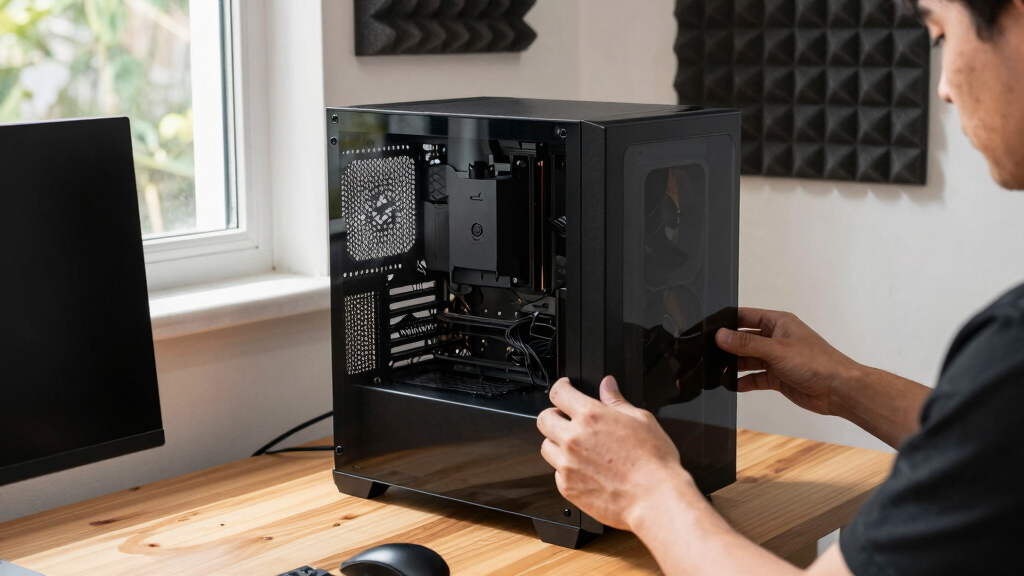

📊 Full opportunity report: Best Low-Noise PC Cases for Airflow and Sound Dampening on ThorstenMeyerAI.com — validation score, market gap, and execution plan.

Get business pricing on monitors, keyboards and dev gear
- Business-only prices and quantity discounts
- Tax-exempt purchasing
- Multiple users, one account, clear invoices
TL;DR
This article reviews the best PC cases in 2026 that optimize airflow and sound dampening. It emphasizes the trade-offs and recommends models for different priorities, especially for high-power workloads.
In 2026, the top PC cases for balancing airflow and noise reduction are identified, with a focus on high-power workstation needs. These cases are chosen based on their cooling performance, sound dampening features, and design suitability for demanding workloads.
The article highlights that for sustained high-power workloads, open-mesh cases with large fans often outperform sealed, sound-dampened cases in both cooling and noise levels. It discusses specific models like the Fractal Design North, Meshify 3, Torrent, and others, noting their strengths in airflow and noise reduction. The trade-off between sealed silent cases and open ventilation is explained, emphasizing that airflow is critical for high-performance, continuous workloads, and that larger fans operating at lower RPM can provide both quieter and cooler operation. The piece also covers key features to consider, such as front ventilation, fan size, clearance, and dust filters, to optimize case choice for individual needs.Best low-noise PC cases
for airflow & dampening.
Sound dampening and airflow pull in opposite directions — and for a sustained AI load, the choice lands somewhere most people don’t expect. Flip the toggle in Part 2 to see why a sealed “silent” case can end up louder than an open one.
Why Proper Case Selection Matters for Performance and Noise
Choosing the right PC case directly impacts system cooling, noise levels, and overall stability, especially for high-power AI workstations. An airflow-optimized case can prevent overheating and reduce fan noise, improving longevity and user comfort. Conversely, a poorly ventilated case may lead to higher temperatures and louder operation, potentially limiting performance and increasing maintenance needs. Understanding this balance is essential for builders and professionals relying on sustained high workloads.low noise PC case with high airflow
As an affiliate, we earn on qualifying purchases.
As an affiliate, we earn on qualifying purchases.
Evolution of PC Case Design for High-Performance Workstations
Traditionally, silent cases with foam insulation and solid panels aimed to minimize noise at the cost of airflow. However, recent developments show that for continuous, high-power workloads, open mesh designs with large fans outperform sealed silent cases in cooling and noise reduction. The market now offers a range of options tailored to different priorities, reflecting a deeper understanding of thermal dynamics and acoustic management in modern high-performance PCs. This shift is driven by the demands of AI, gaming, and professional workloads that generate sustained heat."For high-power workloads, airflow often beats silence because trapped heat causes fans to work harder, making noise worse."
— Thorsten Meyer, tech reviewer
sound dampening computer case for gaming
As an affiliate, we earn on qualifying purchases.
As an affiliate, we earn on qualifying purchases.
Remaining Questions About Case Performance and User Needs
It is not yet fully clear how specific case models perform under different ambient conditions or with various configurations, especially regarding long-term dust management and fan durability. User preferences for aesthetics versus thermal performance also vary, and future updates may introduce new models or features that alter the current recommendations.As an affiliate, we earn on qualifying purchases.
Upcoming Developments in PC Case Design and Market Trends
Expect continued innovation in case airflow technology, including more efficient fan designs and modular panels. Manufacturers may also develop hybrid cases that better balance sound dampening and ventilation. Monitoring market releases and user feedback will be essential for identifying the best options as new models emerge in 2026.As an affiliate, we earn on qualifying purchases.
Key Questions
Are mesh cases always better for high-power workloads?
Not necessarily. Mesh cases generally offer better airflow and cooling, which benefits sustained workloads, but they may allow more noise to escape. The choice depends on whether noise or cooling is the priority for your setup.
Can silent cases be used for high-performance AI workstations?
Yes, but with limitations. Silent cases with foam insulation are better suited for moderate workloads or environments where noise reduction is critical. Under sustained high loads, they may trap heat and cause fans to run faster, increasing noise and temperature.
What features should I look for in a case for a high-power workstation?
Look for large fans (140mm or larger), ample ventilation, dust filters, enough clearance for tall coolers and multiple GPUs, and the ability to manage airflow effectively. Consider your noise tolerance and whether you prefer open mesh or sound-dampening panels.
Will future cases improve noise reduction without sacrificing airflow?
Likely, as innovations continue in fan technology, materials, and modular design. However, current understanding suggests a fundamental trade-off remains, and balancing airflow with noise dampening will always involve some compromise.
Source: ThorstenMeyerAI.com
Fall Picks
fall essentials
As an affiliate, we earn on qualifying purchases.