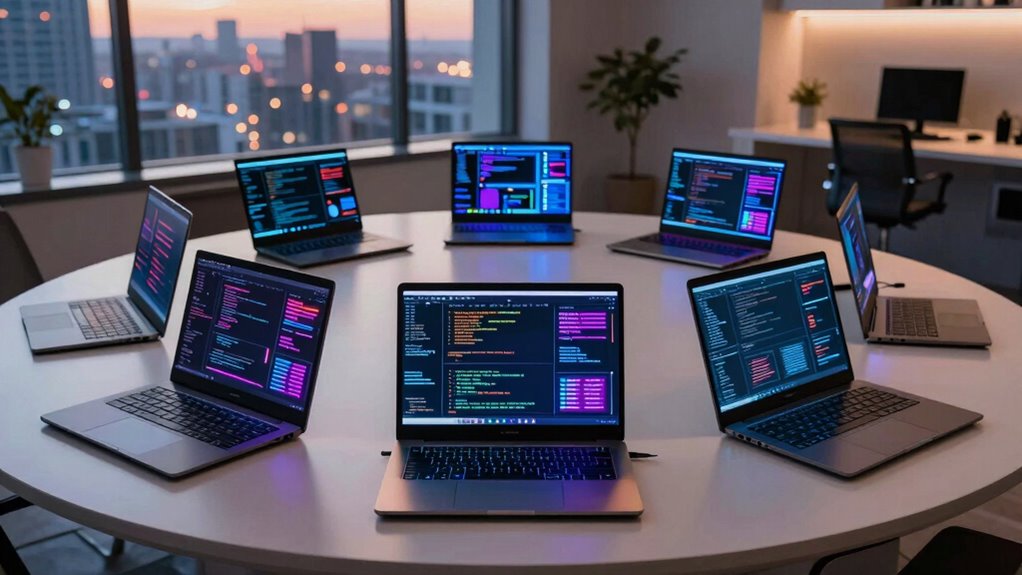

Choosing among laptops for data science means weighing memory and sustained compute against portability, screen space, and graphics needs. My lead pick is the Dell Precision 7780 for large datasets and GPU-oriented work, while the ASUS Vivobook 15 with 48GB RAM offers a more practical balance for demanding notebooks and multitasking. For a more desk-friendly analysis setup, the HP 17-inch gives you a roomy display and 32GB of memory without workstation-class hardware.

Get business pricing on monitors, keyboards and dev gear
- Business-only prices and quantity discounts
- Tax-exempt purchasing
- Multiple users, one account, clear invoices
The tradeoff is clear across this lineup: the Dell has by far the largest memory capacity and a discrete professional GPU, but it is exceptionally heavy. The ASUS models pair a fast Core i9 with generous memory, yet use integrated graphics and modest-resolution FHD screens. Lenovo brings useful ports and an anti-glare 16-inch panel, though its listed 16GB RAM may constrain larger workloads. I rank each by the kind of data-science work it can realistically support, not by the longest specification list.
Complete the kit


Key Takeaways
- The Dell Precision 7780 is the only option here with a discrete NVIDIA RTX 3500 GPU and 128GB RAM, making it the strongest fit for local GPU workloads and large in-memory datasets.
- The ASUS Vivobook 15 configuration with 48GB RAM and a 2TB SSD offers the most convincing middle ground for CPU-heavy notebooks, multitasking, and local data storage.
- The Lenovo ThinkPad E16 has the lineup’s most practical mix of ports, a 16:10 anti-glare display, and an eight-core Ryzen processor, but its listed 16GB RAM is the main constraint.
- The HP 17-inch is the screen-space choice, pairing a 17.3-inch IPS panel with 32GB RAM; it is better suited to a desk than daily commuting.
- The two ASUS listings have similar Core i9 and integrated-graphics foundations, so compare the exact memory and storage configuration rather than expecting a major compute difference.


| laptops for data science | Processor | Memory | Storage | Graphics |
|---|---|---|---|---|
| Dell Precision 7780 Mobile Wor | Intel Core i9-13950HX, 24 cores | 128GB | 2TB SSD | NVIDIA RTX 3500 Ada, 12GB GDDR6 |
| ASUS Vivobook 15 Laptop | Intel Core i9-13900H | 48GB DDR4 | 2TB SSD | Intel UHD Graphics |
| HP 17-inch Laptop with AMD Ryz | AMD Ryzen 5 7430U, 6 cores, up to 4.3GHz | 32GB DDR4 | 1TB PCIe NVMe SSD | Integrated AMD Radeon |
| Lenovo ThinkPad E16 AMD Ryzen | AMD Ryzen 7 7735HS, 8 cores / 16 threads | 16GB DDR5 | 1TB PCIe NVMe SSD + 500GB HDD | Integrated Radeon 680M |
| ASUS Vivobook Core i9-13900H L | Intel Core i9-13900H | 16GB, 32GB, or up to 48GB DDR4, by configuration | 1TB or up to 2TB PCIe M.2 SSD, by configuration | Intel UHD Graphics |
More Details on Our Top Picks
Dell Precision 7780 Mobile Workstation 17.3-inch FHD Laptop, Intel Core i9-13950HX, 128GB RAM, 2TB SSD, NVIDIA RTX 3500 12GB, Windows 11 Pro
The Dell Precision 7780 is the clear capability leader in this group. Its 24-core Core i9-13950HX, 128GB RAM, and 12GB professional NVIDIA RTX 3500 give it headroom for large in-memory datasets, parallel analysis, GPU-accelerated workflows, and several heavyweight applications running together. None of the other four combines that much memory with a discrete GPU; the ASUS models rely on Intel UHD graphics, and the HP and Lenovo use integrated Radeon graphics.
That extra capability comes with a substantial portability penalty: this workstation weighs 4.99 kg, far more than the roughly four-pound ASUS and Lenovo options. The 17.3-inch FHD display gives useful workspace, but the listed resolution is still 1920×1080, so buyers who want a sharper, high-resolution panel should look elsewhere or plan on an external monitor. Battery life is not specified, another reason I see it primarily as a workstation that moves between desks rather than a dependable all-day travel machine.
I place it first for buyers whose projects can use its CPU, memory, or GPU, not because every data-science student needs a workstation. For ordinary coursework, SQL, and CPU-based notebooks, the ASUS 48GB configuration is a more proportionate choice. The Dell makes sense when local workload size is the limiting factor and portability is secondary.
Pros:- 128GB RAM gives the most room in this lineup for large datasets and concurrent workloads.
- NVIDIA RTX 3500 Ada graphics with 12GB GDDR6 supports GPU-accelerated work beyond the integrated graphics in the other picks.
- 24-core Core i9-13950HX is suited to heavily parallel CPU tasks.
- Thunderbolt 4, Ethernet, HDMI, and five USB ports support a capable desk or lab setup.
Cons:- At 4.99 kg, it is by far the least convenient laptop here to carry regularly.
- The 17.3-inch panel is FHD rather than a higher-resolution screen, limiting visible workspace.
- Battery runtime is not specified, so mobile endurance cannot be judged from the supplied details.
Best for: Data scientists training or testing GPU-capable models locally, handling very large in-memory datasets, or running several demanding tools at once.
Not ideal for: Students and mobile workers who prioritize a light bag, long unplugged sessions, or standard CPU-based analysis that does not use a professional GPU.
- Processor:Intel Core i9-13950HX, 24 cores
- Memory:128GB
- Storage:2TB SSD
- Graphics:NVIDIA RTX 3500 Ada, 12GB GDDR6
- Display:17.3-inch FHD, 1920 x 1080
- Operating system:Windows 11 Pro
- Weight:4.99 kg
- Connectivity:Thunderbolt 4, Ethernet, HDMI, Wi-Fi 6E, Bluetooth 5.3
Our verdict“Choose the Precision 7780 when its 128GB memory and discrete RTX GPU serve your workload; otherwise, the lighter ASUS configurations are easier to justify.”
ASUS Vivobook 15 Laptop, 15.6-inch FHD, Intel Core i9-13900H, 48GB RAM, 2TB SSD, Windows 11 Pro, Blue
For many data-science workloads, the ASUS Vivobook 15 with 48GB RAM is the most balanced machine in this set. Its Core i9-13900H can serve CPU-heavy Python or R work, while 48GB gives notebooks, datasets, browsers, and development tools more room than the Lenovo’s listed 16GB or the HP’s 32GB. The 2TB SSD also offers generous local space for project files and datasets.
It is not a smaller substitute for the Dell workstation in every respect. The Vivobook has Intel UHD integrated graphics, so it lacks the RTX 3500’s GPU capability for supported machine-learning and compute tasks. Its 15.6-inch FHD screen is also less spacious than the HP’s 17.3-inch panel. At 3.8 pounds, though, it is far easier to carry than the Dell, and its USB-C, USB-A, HDMI, and fingerprint reader make it a practical general-purpose work laptop.
This listing specifies 48GB RAM and 2TB storage, which makes it a more decisive recommendation than the other ASUS listing when memory capacity is the priority. Battery life is not provided, so I would not pick it on the assumption of long unplugged work sessions. For CPU-based analysis and multitasking, however, it offers a stronger ready-to-go configuration than the Lenovo while avoiding the Dell’s workstation bulk.
Pros:- 48GB RAM supports heavier multitasking and larger in-memory work than the Lenovo’s listed 16GB.
- Core i9-13900H and 2TB SSD suit CPU-centered analysis and local project storage.
- At 3.8 pounds, it is much easier to transport than the Dell or HP 17-inch.
- Fingerprint reader, webcam privacy shield, HDMI, and USB-C add useful everyday features.
Cons:- Intel UHD integrated graphics are not a replacement for the Dell’s discrete RTX GPU.
- The 15.6-inch FHD display offers less workspace than the 16-inch Lenovo or 17.3-inch HP.
- Battery life is not specified in the supplied listing.
Best for: Analysts, graduate students, and developers who want substantial RAM and SSD capacity for CPU-focused data work without carrying a full mobile workstation.
Not ideal for: People who need an NVIDIA GPU for local model training, want a larger or sharper display, or need confirmed long battery runtime.
- Processor:Intel Core i9-13900H
- Memory:48GB DDR4
- Storage:2TB SSD
- Graphics:Intel UHD Graphics
- Display:15.6-inch FHD, 1920 x 1080
- Operating system:Windows 11 Pro
- Weight:3.8 pounds
- Security:Fingerprint reader and webcam privacy shield
Our verdict“For a strong CPU-and-memory configuration without workstation weight, this Vivobook is my best all-around choice for many data-science users.”
HP 17-inch Laptop with AMD Ryzen 5, 32GB RAM, 1TB SSD, FHD IPS Display, Windows 11 Pro
The HP 17-inch is the screen-space pick. Its 17.3-inch FHD IPS display gives code, a notebook, and reference material more room than the 15.6-inch ASUS screens, while the listed 32GB RAM is a sensible baseline for multitasking and many course or analytics projects. That makes it a comfortable desk companion for buyers who prefer a single laptop screen over an external monitor.
Its Ryzen 5 7430U is a six-core processor, not the higher-tier Core i9 found in both ASUS models or the 24-core CPU in the Dell. For routine data preparation, visualization, and learning, that distinction may matter less than memory and workflow; for sustained heavy computation, the ASUS Core i9 or Dell workstation is the stronger fit. Integrated Radeon graphics also put it behind the Dell for GPU-oriented work.
The HP’s main compromise is mobility. At 4.58 pounds, it is heavier than the ASUS Vivobooks, and its large panel does not raise the 1920×1080 resolution. The listing gives battery life of up to nine hours, but actual runtime varies with workload and settings. I rank it above Lenovo for users who value more included memory and display area, while Lenovo is the more connected, slightly smaller-screen alternative with Ethernet and a 1920×1200 panel.
Pros:- 17.3-inch IPS display provides more physical workspace than the ASUS 15.6-inch panels.
- 32GB RAM is a stronger listed starting point for multitasking than Lenovo’s 16GB.
- 1TB NVMe SSD provides fast local storage for datasets and project files.
- The listing specifies up to nine hours of battery life and includes a webcam privacy shutter.
Cons:- At 4.58 pounds, it is less portable than either ASUS Vivobook or the ThinkPad E16.
- Ryzen 5 7430U is less powerful on paper than the ASUS Core i9 and Dell Core i9 HX processors.
- Integrated Radeon graphics do not match the Dell’s discrete GPU for supported accelerated workloads.
Best for: Desk-based learners and analysts who value a large integrated screen, 32GB RAM, and a straightforward setup for everyday data tasks.
Not ideal for: Frequent commuters, buyers running GPU-heavy models locally, or users who need the highest CPU throughput in this group.
- Processor:AMD Ryzen 5 7430U, 6 cores, up to 4.3GHz
- Memory:32GB DDR4
- Storage:1TB PCIe NVMe SSD
- Graphics:Integrated AMD Radeon
- Display:17.3-inch FHD IPS, anti-glare
- Operating system:Windows 11 Pro
- Weight:4.58 pounds
- Battery:Up to 9 hours, usage dependent
Our verdict“Pick the HP when screen area and 32GB memory matter more than carrying weight or high-end compute.”
Lenovo ThinkPad E16 AMD Ryzen 7 7735HS Laptop, 16GB DDR5, 1TB SSD + 500GB HDD, 16-inch IPS Display, Windows 11 Pro
The ThinkPad E16 stands out for its work-oriented combination of ports and screen format. Its 16-inch 1920×1200 anti-glare IPS display has a taller 16:10 layout than the FHD ASUS and HP panels, which can show more lines of code or spreadsheet rows at once. The Ryzen 7 7735HS is an eight-core, 16-thread chip, and the laptop includes Ethernet, HDMI 2.1, two USB-C ports, and Wi-Fi 6E—handy for office, lab, or docking setups.
The limiting detail for data science is the listed 16GB DDR5 memory. It is adequate for learning, moderate notebooks, and many SQL or visualization tasks, but large datasets and simultaneous tools can push it sooner than the 32GB HP or 48GB ASUS. Its 1TB SSD plus 500GB HDD provides storage flexibility, although the HDD is not as responsive as solid-state storage for active project files.
Compared with the HP, Lenovo gives you a sharper, taller display and more useful wired connectivity, but less listed RAM and a smaller screen. Compared with the ASUS, it trades some processor and memory headroom for an anti-glare 16:10 panel, Ethernet, and a broad port selection. The nearly four-pound weight and unspecified battery runtime mean it is not a standout travel choice; I see it as a sensible office-oriented machine if the 16GB configuration meets your workload or can be expanded as appropriate.
Pros:- 16-inch 1920×1200 anti-glare panel offers more vertical workspace than the FHD alternatives.
- Eight-core Ryzen 7 7735HS supports parallel CPU workloads.
- Ethernet, HDMI 2.1, two USB-C ports, and Wi-Fi 6E suit varied work environments.
- Fingerprint reader, IR facial recognition, TPM 2.0, and webcam privacy shutter add practical security features.
Cons:- The listed 16GB RAM is the lowest fixed memory configuration among the named primary setups here.
- The 500GB HDD is slower for active datasets and project work than an SSD.
- At 3.99 pounds with no battery-life figure supplied, it is not the strongest travel option.
Best for: Students and office-based analysts who value a 16:10 anti-glare screen, Ethernet, and varied ports for a docked or lab setup.
Not ideal for: Users routinely loading large datasets into memory, running many heavy applications together, or seeking a lightweight laptop with confirmed battery endurance.
- Processor:AMD Ryzen 7 7735HS, 8 cores / 16 threads
- Memory:16GB DDR5
- Storage:1TB PCIe NVMe SSD + 500GB HDD
- Graphics:Integrated Radeon 680M
- Display:16-inch WUXGA IPS, 1920 x 1200, anti-glare
- Operating system:Windows 11 Pro
- Weight:3.99 pounds
- Connectivity:Wi-Fi 6E, Bluetooth 5.3, Ethernet, HDMI 2.1, two USB-C
Our verdict“Choose the ThinkPad E16 for its screen, ports, and office fit, but favor a 32GB-or-higher configuration for more demanding data work.”
ASUS Vivobook Core i9-13900H Laptop, 15.6-inch FHD Display, 16GB/32GB/48GB RAM, 1TB/2TB SSD, Windows 11 Pro, Blue
This ASUS Vivobook Core i9 shares the same Core i9-13900H and Intel UHD graphics listed for the 48GB Vivobook 15, so its data-science appeal depends heavily on which memory and storage configuration is selected. The range reaches 48GB RAM and 2TB SSD, but the product title also names 16GB and 32GB options. Buyers should verify the exact selected configuration rather than treating the maximum as standard.
When equipped with ample RAM, its fast H-series processor can handle CPU-centered analysis, local notebooks, and multitasking. Its 15.6-inch FHD display is familiar and its 3.9-pound weight is manageable beside the HP or Dell, though it is slightly heavier than the other ASUS listing. Like that Vivobook, it has no discrete GPU, so it cannot match the Dell Precision for local GPU-accelerated work. Its 34Wh battery is a modest listed capacity, and no real-world runtime is supplied.
I rank it below the clearly specified 48GB ASUS configuration because the listing spans several memory and SSD combinations. If the selected version has 48GB and 2TB, it resembles that model closely; if it has 16GB or 32GB, its value for memory-intensive work changes. The privacy webcam shield and fingerprint reader are useful, but they do not offset uncertainty about the exact configuration. This is the flexible choice for buyers who can confirm their chosen variant and want a Core i9 without moving up to Dell workstation size.
Pros:- Core i9-13900H is suited to demanding CPU-focused analysis and development tasks.
- Listed configurations extend up to 48GB RAM and 2TB SSD.
- Fingerprint reader and webcam privacy shield support everyday security.
- At 3.9 pounds, it is substantially lighter than the Dell workstation and HP 17-inch.
Cons:- The listing spans 16GB, 32GB, and 48GB memory options, so the selected configuration needs verification.
- Intel UHD integrated graphics trail the Dell’s discrete RTX 3500 for GPU workloads.
- The 34Wh battery capacity is listed, but runtime is not; the FHD screen offers less workspace than the 16-inch Lenovo.
Best for: Buyers who can confirm and select the 48GB or other suitable configuration and want a Core i9 laptop for CPU-based data-science work.
Not ideal for: Anyone who cannot verify the chosen RAM and SSD configuration, needs a discrete GPU, or prioritizes long battery life.
- Processor:Intel Core i9-13900H
- Memory:16GB, 32GB, or up to 48GB DDR4, by configuration
- Storage:1TB or up to 2TB PCIe M.2 SSD, by configuration
- Graphics:Intel UHD Graphics
- Display:15.6-inch FHD, 1920 x 1080
- Operating system:Windows 11 Pro
- Weight:3.9 pounds
- Battery:34Wh lithium-ion
Our verdict“This Vivobook is a capable CPU-first option when the chosen memory and storage configuration is confirmed, but the specified 48GB Vivobook 15 is the clearer recommendation.”

How We Picked
I ranked these laptops by how well their listed hardware maps to real data-science workloads: coding, notebook use, data cleaning, running local databases, training smaller models, and managing several tools at once. Memory capacity comes first for many of those tasks because datasets, browsers, development environments, and notebooks compete for RAM. Processor capability follows, then graphics, storage, screen usability, and portability.
I also separate workloads that are often grouped together. CPU-based Python, R, SQL, and statistical analysis do not automatically benefit from a powerful graphics card; local deep-learning training and GPU-accelerated workflows can. That distinction is why the Dell ranks highest for capability but is not my default recommendation for every buyer. Its discrete GPU and 128GB RAM have clear value for demanding work, while its nearly 5 kg weight is a real cost in mobility.
For the other four, I looked at the balance between processor, listed memory, display, and practical connectivity. The ASUS Vivobooks offer Core i9 processors and large memory configurations, but integrated Intel UHD graphics limit their fit for GPU-heavy tasks. The HP’s 32GB RAM and large display make it more comfortable for desk-based analysis, while its Ryzen 5 U-series processor is less oriented toward heavy sustained compute than the ASUS Core i9 chips. Lenovo earns consideration for its 16-inch 1920×1200 anti-glare screen, Ethernet, and broad ports, but I do not treat its 16GB as equivalent to 32GB or 48GB.
Where a listing does not specify battery life, I do not assume long unplugged runtime. The ASUS and Lenovo descriptions also list particular memory and storage configurations alongside upgrade or alternate configurations, so I call out the stated configuration rather than presuming every variant has the same parts. I did not rank by branding or claimed suitability alone: the role each machine can serve, its listed configuration, and its limitations drive the order.
| laptops for data science | Processor | Graphics |
|---|---|---|
| Dell Precision 7780 Mobile Wor | Intel Core i9-13950HX, 24 cores | NVIDIA RTX 3500 Ada, 12GB GDDR6 |
| ASUS Vivobook 15 Laptop | Intel Core i9-13900H | Intel UHD Graphics |
| HP 17-inch Laptop with AMD Ryz | AMD Ryzen 5 7430U, 6 cores, up to 4.3GHz | Integrated AMD Radeon |
| Lenovo ThinkPad E16 AMD Ryzen | AMD Ryzen 7 7735HS, 8 cores / 16 threads | Integrated Radeon 680M |
| ASUS Vivobook Core i9-13900H L | Intel Core i9-13900H | Intel UHD Graphics |
Factors to Consider When Choosing Laptops For Data Science
I would start with the workload, not the processor label. Data science can mean modest classroom notebooks, large local data processing, or GPU-based model training; those jobs put different pressure on a laptop. Use the points below to decide which tradeoff matters most for your routine.
Match RAM to dataset size and multitasking
Memory is often the first practical limit when a project keeps data in memory while an IDE, browser, notebook server, and other tools remain open. For learning, SQL, and smaller analysis tasks, 16GB can work. For heavier multitasking and larger local datasets, 32GB is a more comfortable starting point; the ASUS 48GB configurations offer more headroom, while the Dell’s 128GB is for unusually demanding local work. Check the exact configuration: the first ASUS listing includes several RAM choices, and the Lenovo is listed with 16GB.
Choose CPU power for the work you actually run
More CPU cores can help parallel workloads, but not every notebook or library uses every core. The Core i9-13900H ASUS models are compelling for CPU-heavy development and analysis, while Lenovo’s eight-core Ryzen 7 offers a capable middle ground. The HP’s Ryzen 5 7430U is positioned for everyday productivity rather than the highest sustained compute in this group. The Dell’s 24-core Core i9 HX is the most ambitious CPU option, but its bulk only makes sense if your workloads use that added capacity.
Know when a discrete GPU matters
Many data-cleaning, statistics, SQL, and general Python tasks run mainly on the CPU. A GPU matters when your software and workflow can make use of GPU acceleration, such as some deep-learning training or supported numerical workloads. Here, only the Dell lists a discrete GPU: an NVIDIA RTX 3500 Ada with 12GB of graphics memory. The ASUS, HP, and Lenovo use integrated graphics, which is adequate for ordinary display and productivity needs but not an equivalent local training platform. Buyers can also use cloud or remote GPU resources rather than carry a heavy workstation.
Treat display size and resolution as different choices
A larger screen can keep code, plots, and documentation visible together, while resolution and aspect ratio affect how much usable content fits. The HP offers the largest panel at 17.3 inches, but it is still FHD. Lenovo’s 16-inch 1920×1200 16:10 display adds vertical workspace and an anti-glare finish, which can help with code and spreadsheets. The ASUS and Dell use 1920×1080 panels. If you work at a fixed desk, an external monitor may be more useful than carrying a larger laptop every day.
Balance local storage, ports, and portability
SSD space helps keep projects and datasets available locally, but raw capacity is not the same as memory for active analysis. The ASUS 48GB model lists a 2TB SSD; HP and Lenovo list 1TB SSDs, with Lenovo adding a 500GB HDD that is better treated as secondary storage. For a desk or lab, Ethernet and video outputs matter: Lenovo includes RJ-45 Ethernet, while the Dell adds Thunderbolt 4 and a wide port selection. For regular commuting, compare the weight directly: the ASUS models are around 3.8–3.9 pounds, versus 4.58 pounds for HP and 4.99 kg for Dell.
Check configuration and runtime details before choosing
Product listings can cover more than one hardware configuration. The first ASUS listing names RAM and SSD ranges, so verify the selected option before relying on the maximum capacities described. Lenovo’s stated 16GB memory is a meaningful difference from the 32GB HP and 48GB Vivobook. Battery information is incomplete for several options, and the ASUS with a 34Wh battery does not include a runtime estimate. Do not treat an unspecified battery figure as evidence of all-day use; plan around your access to power and the workloads you expect to run.
Frequently Asked Questions
How much RAM do I need for data science?
For learning, lighter notebooks, and SQL work, 16GB can be enough, though it leaves less room for larger datasets and several applications at once. I would favor 32GB for broader day-to-day flexibility, and 48GB or more when local projects keep substantial data in memory. In this lineup, the ThinkPad is listed with 16GB, the HP with 32GB, the ASUS 48GB configuration with 48GB, and the Dell with 128GB.
Do I need an NVIDIA GPU for data science?
No. Many common workflows in Python, R, SQL, and statistical analysis are CPU-based and can run well without a discrete GPU. A supported NVIDIA GPU is useful for certain accelerated workloads, including some local machine-learning training. The Dell Precision 7780 is the only laptop here with a discrete NVIDIA RTX 3500; the other options use integrated graphics. Cloud computing can also provide GPU access without requiring a workstation laptop.
Which laptop in this comparison is best for students?
For a student doing a mix of coursework, notebooks, and multitasking, I would start with the ASUS Vivobook 15 listing that specifies 48GB RAM and a 2TB SSD. It offers more memory than the Lenovo’s listed 16GB and is much easier to carry than the Dell. A student with more modest projects who values a taller anti-glare screen and Ethernet may prefer the ThinkPad, while GPU-heavy work changes the answer toward the Dell.
Is 16GB RAM enough on the Lenovo ThinkPad E16?
It can be enough for introductory programming, smaller datasets, SQL, and moderate analysis, especially when you avoid keeping many demanding applications open at once. Its eight-core Ryzen 7 and 16:10 display make it a capable work setup, but 16GB is the lowest listed memory capacity here. If your projects involve large in-memory data or frequent multitasking, I would favor a 32GB or 48GB configuration instead.
Should I prioritize a bigger screen or a lighter laptop?
That depends on whether you work mostly at a desk or carry your computer between classes, offices, and home. The HP’s 17.3-inch screen gives the most physical display area, while Lenovo’s 16-inch 1920×1200 panel offers extra vertical space in a somewhat smaller format. The ASUS models are lighter at about 3.8–3.9 pounds, though their 15.6-inch FHD screens show less at once. A separate monitor can solve screen-space limits at a fixed desk without making the laptop itself larger.
Conclusion
My recommendation depends on what is holding your work back. Choose the Dell Precision 7780 if you need 128GB RAM, a discrete RTX GPU, or the most local compute capacity here—and can accept its nearly 5 kg weight. For most CPU-focused analysts and students who want strong multitasking without workstation bulk, I would choose the ASUS Vivobook 15 with its specified 48GB RAM and 2TB SSD. Pick the HP 17-inch for a larger desk-based screen and 32GB memory, or the Lenovo ThinkPad E16 for its 16:10 anti-glare panel and practical connectivity if 16GB fits your workload. The first ASUS listing is best for buyers who want configuration flexibility and can verify the exact option before ordering. In short, match RAM and graphics to your projects, then decide how much screen space and portability you are willing to trade.
Columbus Day / Indigenous Peoples' Day Picks
long weekend sales
As an affiliate, we earn on qualifying purchases.