If you’re looking for the top enclosed 3D printers of 2025 for safer, quieter, and better-quality prints, I’ve got you covered. Models like the FlashForge AD5M Pro, ELEGOO Centauri Carbon, and Creality K1C offer fast speeds, auto-calibration, large build volumes, and support for high-temp materials. These machines combine safety, reliability, and advanced features perfect for hobbyists, educators, and professionals alike. Keep going to discover which models stand out and how to choose the best fit for your needs.
Key Takeaways
- Enclosed 3D printers improve safety by containing fumes, noise, and moving parts, making them ideal for indoor use.
- Many models feature auto-calibration, high-speed printing, and stable operation for higher print quality.
- Advanced capabilities include high-temperature material support, multi-color printing, and remote monitoring.
- Large build volumes and durable enclosures accommodate professional, educational, and hobbyist needs.
- Top models in 2025 combine safety, speed, precision, and user-friendly features for reliable, high-quality 3D printing.
FLASHFORGE AD5M Pro 3D Printer with High Speed & Auto Calibration
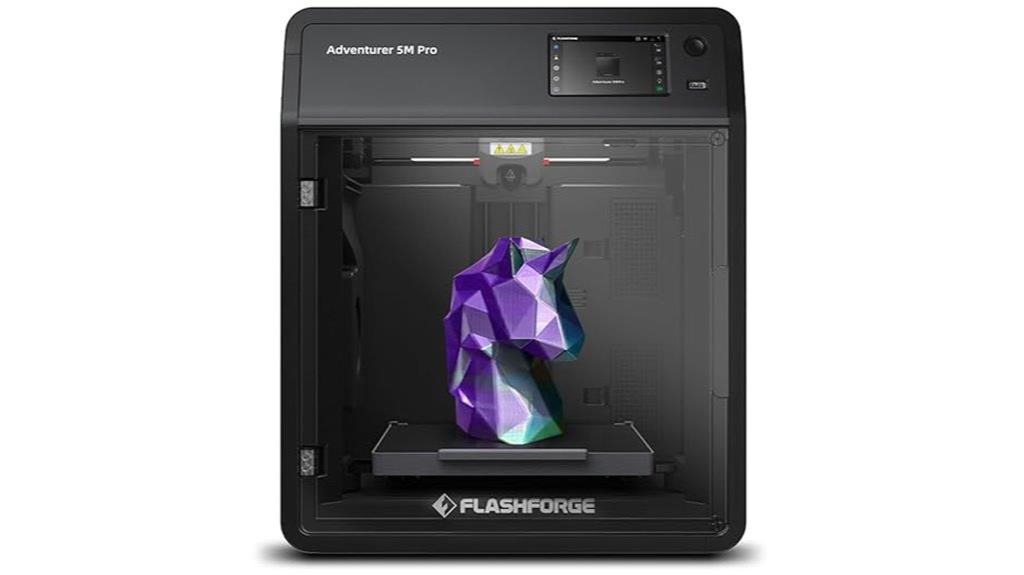
If you’re looking for a reliable enclosed 3D printer that combines speed and ease of use, the FlashForge AD5M Pro stands out as an excellent choice. It features a full enclosure that reduces noise and plastic smell, making it perfect for home or classroom environments. Its auto-leveling system ensures perfect first layers without manual calibration, saving time and frustration. Capable of printing at speeds up to 600mm/sec, most projects finish in under an hour. The magnetic removable bed simplifies print removal, while a built-in camera allows remote monitoring. With a durable metal build and user-friendly interface, the AD5M Pro offers high-quality, fast, and safe 3D printing.
Best For: hobbyists, educators, and professionals seeking a fast, reliable, and easy-to-use enclosed 3D printer for home, classroom, or office use.
Pros:
- Auto-leveling system ensures perfect first layers with minimal setup
- High-speed printing up to 600mm/sec reduces project completion time
- Full enclosure minimizes noise and plastic smell for a safer, quieter environment
Cons:
- Loud cooling fans may generate noticeable noise during operation
- Connectivity issues with certain Mac OS systems and cables can complicate setup
- Noise levels and initial setup may require some adjustments for optimal quiet operation
ELEGOO Centauri Carbon 3D Printer
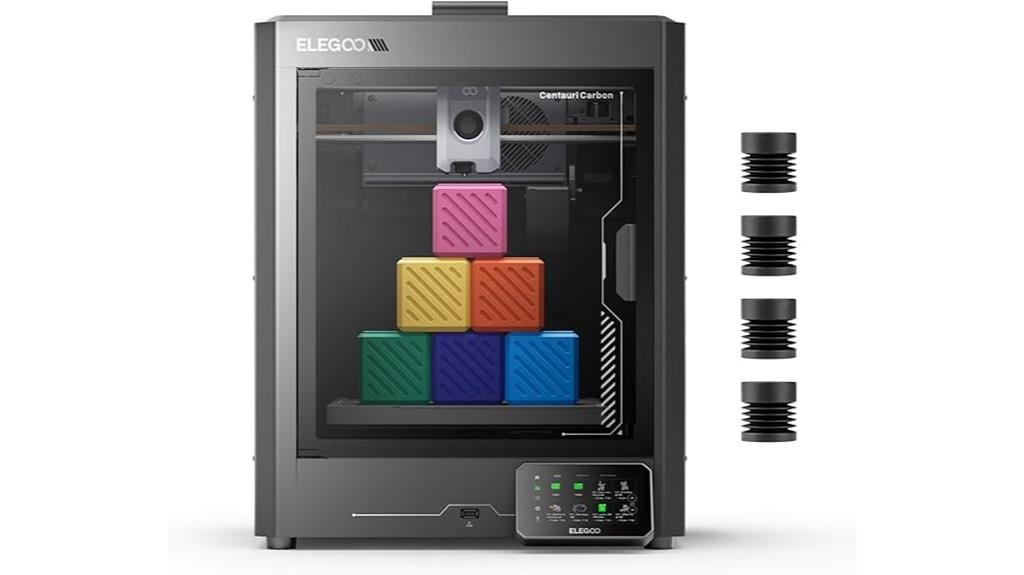
Looking for a 3D printer that combines high-speed performance with user-friendly features? The ELEGOO Centauri Carbon is fully assembled and pre-calibrated, so you can start printing immediately. Its intuitive touchscreen, auto bed leveling, and large 256x256x256 mm build volume make it accessible for all skill levels. Designed for rapid production, it reaches speeds up to 500 mm/s with stable, vibration-free printing thanks to its rigid aluminum frame. It’s optimized for advanced filaments like carbon fiber, thanks to its high-temperature hotend and enclosed chamber. Real-time monitoring, dual LED lighting, and excellent bed adhesion ensure high-quality, reliable prints every time.
Best For: hobbyists, educators, and small-scale professionals seeking a high-speed, user-friendly 3D printer capable of handling advanced filaments for durable, high-quality parts.
Pros:
- Fully assembled and pre-calibrated for immediate use, reducing setup time
- High-speed performance up to 500 mm/s with stable, vibration-free printing
- Optimized for advanced materials like carbon fiber reinforced filaments with a high-temperature hotend
Cons:
- Relatively heavy at 38.5 pounds, which may limit portability
- Limited build volume of 256x256x256 mm may not suit very large projects
- Customer ratings are moderate at 4.2 stars, indicating potential room for improvements or user experience issues
QIDI MAX3 3D Printer with Large Printing Size
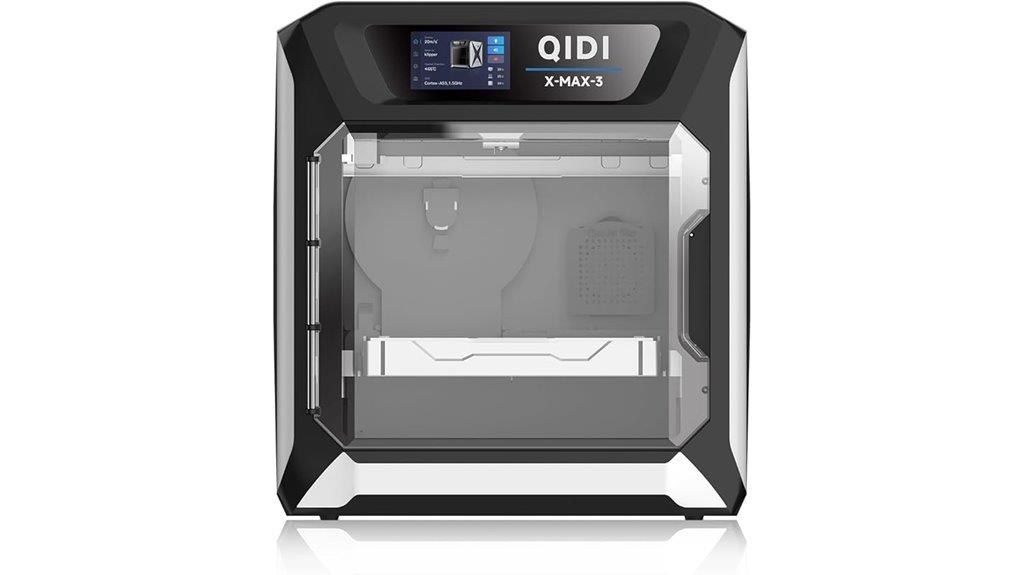
The QIDI MAX3 stands out for those needing a large-format 3D printer capable of high-speed, high-precision builds. With a massive build volume of 12.8×12.8×12.4 inches, it handles large projects effortlessly. Supporting speeds up to 600mm/s and advanced features like auto-leveling and Klipper firmware, it’s ready for professional and hobbyist use alike. Its all-metal frame, high-quality components, and enclosed chamber guarantee stability, durability, and safety. Compatibility with diverse filaments, including carbon fiber and high-performance materials, makes it versatile. The intuitive interface and expandability further enhance its appeal for users demanding efficient, high-quality large-scale printing.
Best For: hobbyists, professionals, and educational institutions seeking a large-format 3D printer capable of high-speed, high-precision, and versatile material printing.
Pros:
- Large build volume of 12.8×12.8×12.4 inches supports big projects and prototypes.
- Supports high-speed printing up to 600mm/s with advanced features like auto-leveling and auto-calibration.
- Durable all-metal construction with high-quality components ensures stability, longevity, and consistent results.
Cons:
- The large size may require significant space and setup considerations.
- Advanced features and material compatibility may involve a steep learning curve for beginners.
- More expensive than smaller or less feature-rich 3D printers, which could be a barrier for casual users.
FLASHFORGE Adventurer 5M 3D Printer with Auto Leveling and High-Speed Printing

Designed for users who prioritize speed and ease of use, the FLASHFORGE Adventurer 5M 3D Printer stands out with its ultra-fast printing capabilities and fully automatic bed leveling. Its CoreXY architecture allows speeds up to 600mm/s and rapid warm-up in about 35 seconds, making high-volume projects efficient. The all-metal frame guarantees durability and precision, while features like a quick-change nozzle and dual fans boost print quality. The dual-sided PEI platform simplifies removal, and remote monitoring via the Flash Maker app adds convenience. Overall, this printer combines speed, reliability, and user-friendly design, making it an excellent choice for both rapid prototyping and professional production.
Best For: users seeking a high-speed, reliable 3D printer that offers automatic bed leveling and easy operation for rapid prototyping and professional projects.
Pros:
- Ultra-fast printing speeds up to 600mm/s with rapid warm-up in 35 seconds
- Fully automatic bed leveling ensures consistent first layers and adhesion
- Detachable nozzle and dual-sided PEI platform simplify maintenance and print removal
Cons:
- The all-metal frame, while durable, may be heavier and less portable
- Higher initial cost compared to basic 3D printers with manual leveling
- Requires regular maintenance of nozzles and platform for optimal performance
Creality K1C 3D Printer
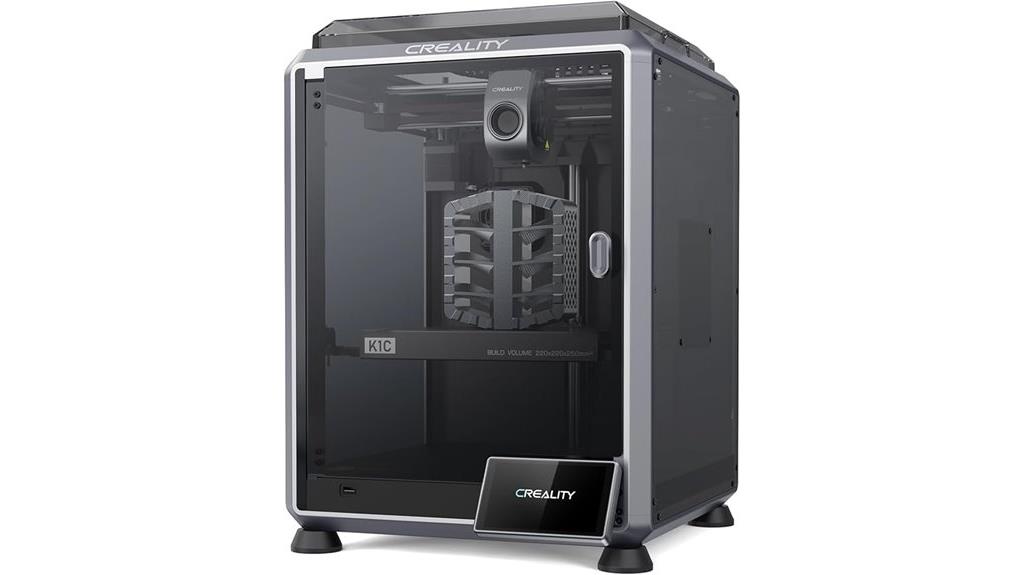
If you’re after a 3D printer that combines lightning-fast speeds with exceptional build quality, the Creality K1C stands out as a top choice for 2025. Its CoreXY system reaches speeds up to 600mm/s with 20,000mm/s² acceleration, making it over 12 times faster than typical printers. The enclosed chamber, sturdy construction, and large build volume support high-temp filaments and big models like 29.5cm Groot figures. Features like silent mode, auto calibration, and an AI camera improve usability and monitoring. Despite some filament handling and nozzle replacement challenges, its speed, stability, and advanced features make it ideal for enthusiasts seeking high performance.
Best For: enthusiasts and professionals seeking a high-speed, durable 3D printer capable of handling large models and advanced materials with minimal noise and high precision.
Pros:
- Extremely fast printing speeds up to 600mm/s with high acceleration, significantly reducing print times.
- Robust enclosed design and large build volume support high-temp filaments and sizable projects.
- Advanced features like auto calibration, AI camera monitoring, and quiet operation enhance usability and reliability.
Cons:
- Filament handling and nozzle replacement can be challenging and may require disassembly.
- Potential issues with extruder blockages and filament feed problems upon delivery.
- Upgrading components like the gearbox or cooling systems is often recommended for optimal performance.
Creality K1C 3D Printer
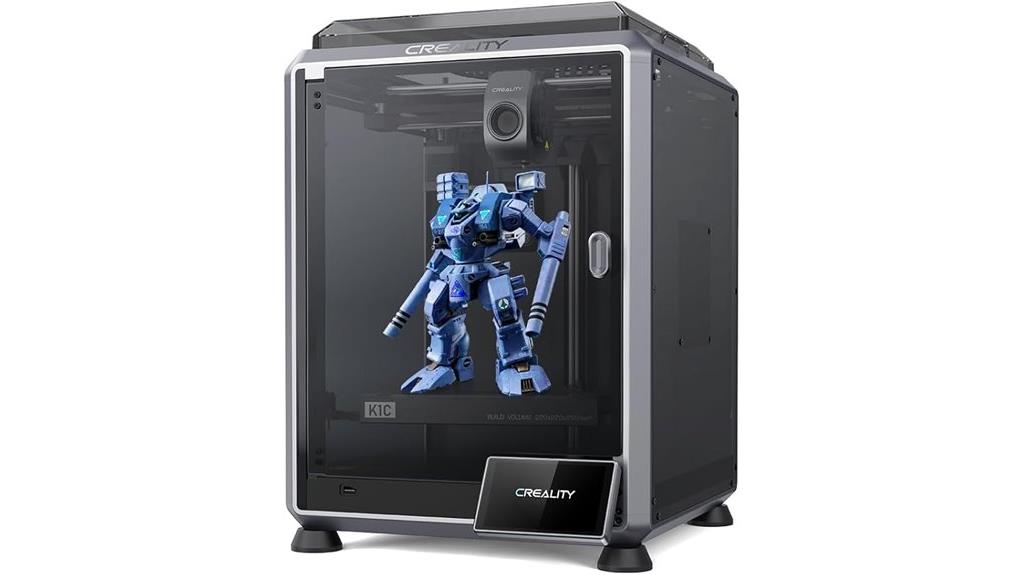
Looking for a high-speed enclosed 3D printer that can handle demanding projects with ease? The Creality K1C is exactly that, offering a blistering 600mm/s print speed and rapid acceleration, making it 12 times faster than standard models. Its large build volume of 8.66×8.66×9.84 inches allows for efficient, high-quality production. It’s pre-assembled for quick setup, with auto calibration features like Z offset and leveling that eliminate manual frustration. The direct extruder supports high-temp materials, including carbon fiber filament. Plus, AI-powered monitoring guarantees real-time quality control, making the K1C a top choice for professional-grade, safe, and fast printing.
Best For: professionals and enthusiasts seeking ultra-fast, high-precision 3D printing with reliable monitoring and high-temperature material support.
Pros:
- Exceptional 600mm/s printing speed with rapid acceleration for efficient production
- Auto calibration features including Z offset and leveling simplify setup and operation
- Supports high-temperature materials like carbon fiber filament with a clog-free direct extruder
Cons:
- Large size and weight may require ample space and sturdy support surface
- Higher price point reflecting advanced features may not suit casual users
- Limited to certain high-temperature filaments; requires careful handling of high-performance materials
FLASHFORGE AD5M 3D Printer with CoreXY, High-Speed, Auto Leveling, Direct Drive Extruder, Quick-Swap Nozzle, 220×220×220mm
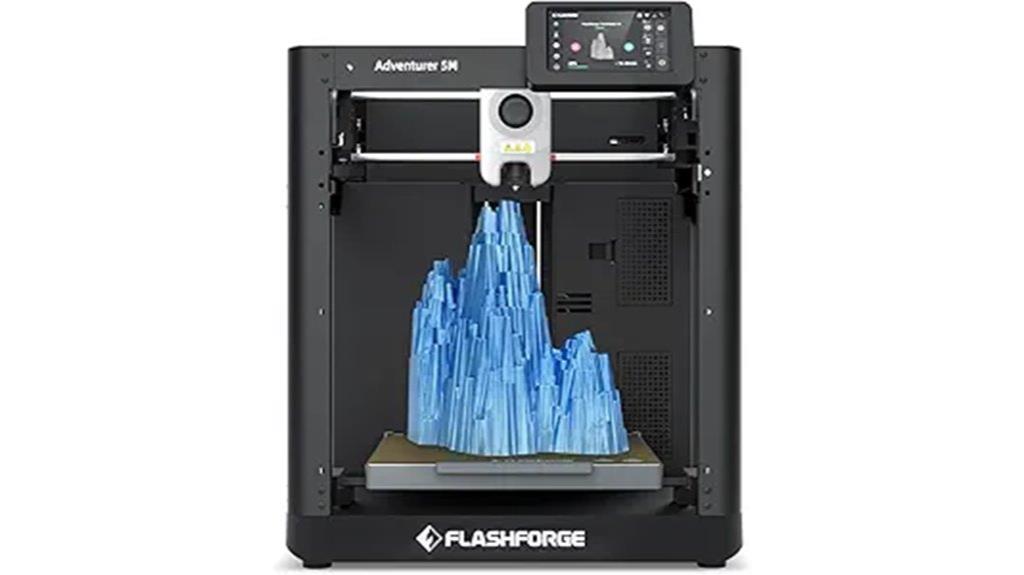
The FlashForge AD5M stands out for its blazing-fast CoreXY printing capabilities, making it an excellent choice for those who need rapid prototyping and high-volume production. It can reach speeds up to 600mm/s with 20,000mm/s² acceleration, ensuring quick turnaround times. The 220×220×220mm build volume supports a variety of projects, while the high-temp direct drive extruder handles materials up to 280°C. Auto bed leveling with a pressure sensor guarantees consistent first layers, and the Quick-Swap nozzle system allows easy switching between sizes. Overall, the AD5M combines speed, precision, and versatility, making it a top contender for efficient, high-quality enclosed 3D printing.
Best For: makers, engineers, and educators seeking a fast, reliable, and versatile 3D printer for rapid prototyping and high-volume production with easy setup and high-quality results.
Pros:
- Exceptional high-speed printing up to 600mm/s with rapid acceleration for quick turnaround times
- Automatic bed leveling with pressure sensor ensures consistent first-layer adhesion and ease of setup
- Open-source firmware and hardware support upgrades, flexible material options, and a high-temp direct drive extruder supporting up to 280°C
Cons:
- Smaller build volume (220×220×220mm) may limit larger projects
- Proprietary file formats (.gx) and compatibility issues with standard G-code can complicate workflows
- Outdated WiFi interface and camera quality may hinder remote monitoring and connectivity
FLASHFORGE Adventurer 5M 3D Printer with Auto Leveling & High-Speed Printing
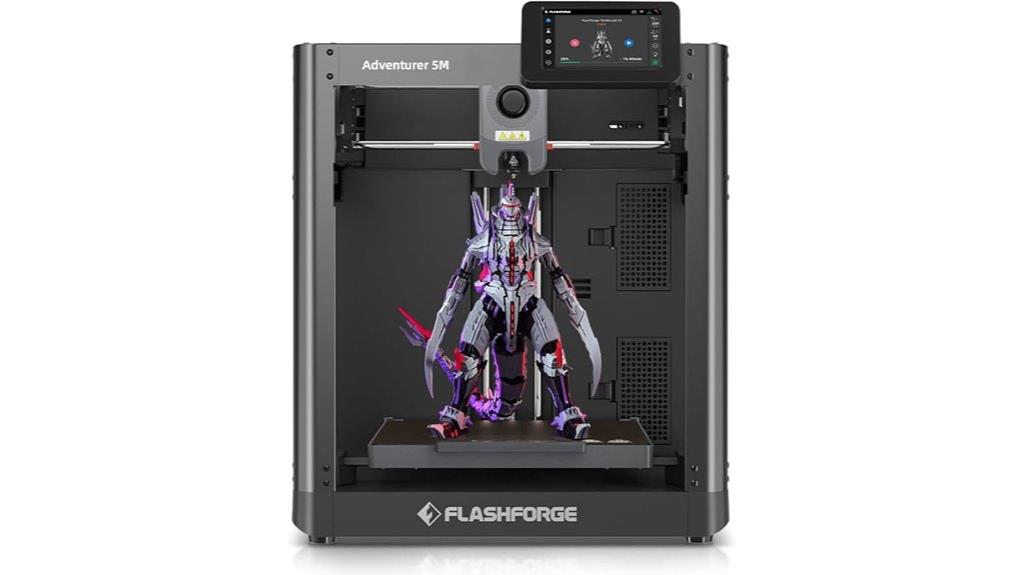
The FLASHFORGE Adventurer 5M stands out as an excellent choice for both beginners and experienced users who want reliable, high-speed 3D printing with minimal hassle. Its fully automatic one-click leveling system guarantees perfect first layers every time, while compatibility with multiple nozzle sizes offers great versatility for different projects. With a max speed of 600mm/s and a sturdy CoreXY structure, it delivers fast, high-quality prints across various materials like PETG. Quick-detachable nozzles make maintenance simple, and the PEI steel build plate guarantees easy removal of finished prints. Plus, remote management via the Flash Maker app adds convenience and control, making it a top-tier enclosed 3D printer.
Best For: hobbyists and professionals seeking high-speed, reliable, and versatile 3D printing with minimal setup and maintenance.
Pros:
- Fully automatic one-click leveling for flawless first layers
- Supports multiple nozzle sizes for diverse project needs
- High-speed printing up to 600mm/s with excellent print quality
Cons:
- May be more expensive than entry-level 3D printers
- Larger footprint could require significant workspace
- Advanced features might have a learning curve for complete beginners
QIDI PLUS4 3D Printer
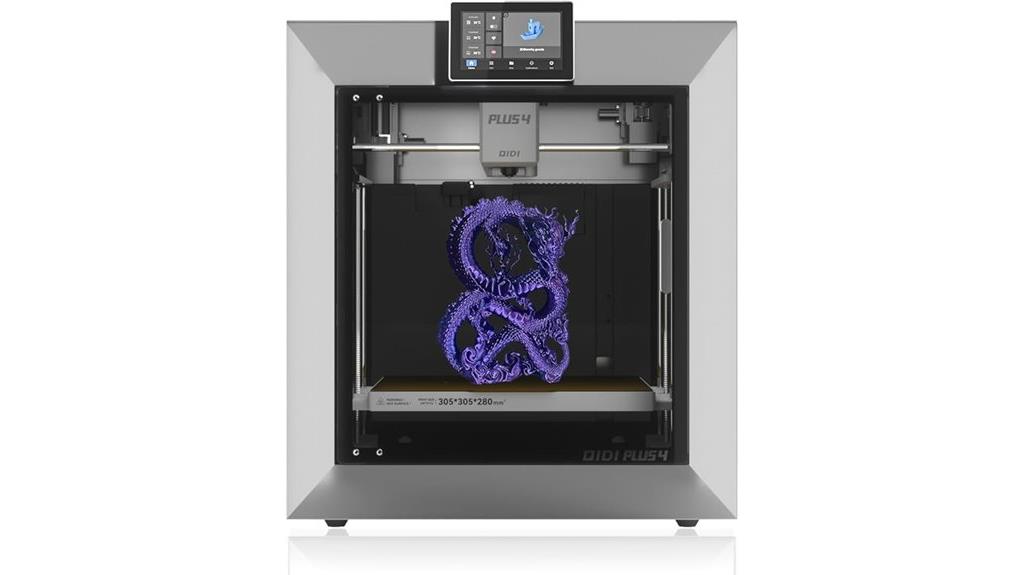
If you’re searching for an enclosed 3D printer that combines large build capacity with fast, high-quality performance, the QIDI PLUS4 is a top choice. It offers a generous 12 x 12 x 11-inch build volume, perfect for printing multiple models simultaneously. With a maximum speed of 600mm/s thanks to its Core XY structure, it ensures rapid production without sacrificing detail. The advanced heating system maintains stable temperatures for high-temp filaments like ABS and PEEK, while user-friendly features like remote monitoring, filament wrap, and break detection enhance safety and efficiency. Its durable construction and upcoming multi-color expansion make it ideal for professional and creative projects alike.
Best For: professionals and enthusiasts seeking a large-capacity, high-speed 3D printer for complex, multi-model projects with reliable high-temperature filament support.
Pros:
- Large build volume of 12 x 12 x 11 inches allows for printing multiple or sizable models simultaneously.
- High-speed printing up to 600mm/s with precise Core XY structure boosts productivity.
- Advanced heating and insulation systems ensure stable temperatures for high-temp filaments like ABS, PC, and PEEK.
Cons:
- The large size may require substantial space and sturdy setup area.
- Complex features and advanced operation might have a steep learning curve for beginners.
- The upcoming multi-filament automatic feeding box is not yet available, limiting multi-color printing options currently.
QIDI Q1 Pro 3D Printer with Auto Leveling and Camera

For those seeking a user-friendly enclosed 3D printer that combines speed, precision, and convenience, the QIDI Q1 Pro stands out with its auto-leveling feature and integrated camera. It uses dual Z-axis motors and a lightweight CoreXY system to achieve high-speed printing up to 600mm/s with rapid acceleration. The fully enclosed chamber, reaching 60°C, improves print adhesion and reduces warping for materials like ABS and PETG. Smart sensors monitor filament flow and detect runout or tangles, preventing failures. With a 1080P camera, mobile control, and quick setup, the QIDI Q1 Pro offers a safe, reliable, and advanced printing experience.
Best For: hobbyists, educators, and small-scale professionals seeking a fast, precise, and user-friendly enclosed 3D printer with remote monitoring capabilities.
Pros:
- High-speed printing up to 600mm/s with rapid acceleration for efficient production.
- Fully enclosed chamber with auto-leveling and smart filament sensors for ease of use and reliability.
- Integrated 1080P HD camera and mobile app control for real-time monitoring and remote management.
Cons:
- The maximum chamber temperature of 60°C may limit certain high-temperature material prints.
- The advanced features and open-source platform may require some technical knowledge for customization.
- Optional air filtration system requires 3D printing the filter box, adding extra setup steps.
Creality 3D Printer K1 SE Fully Assembled
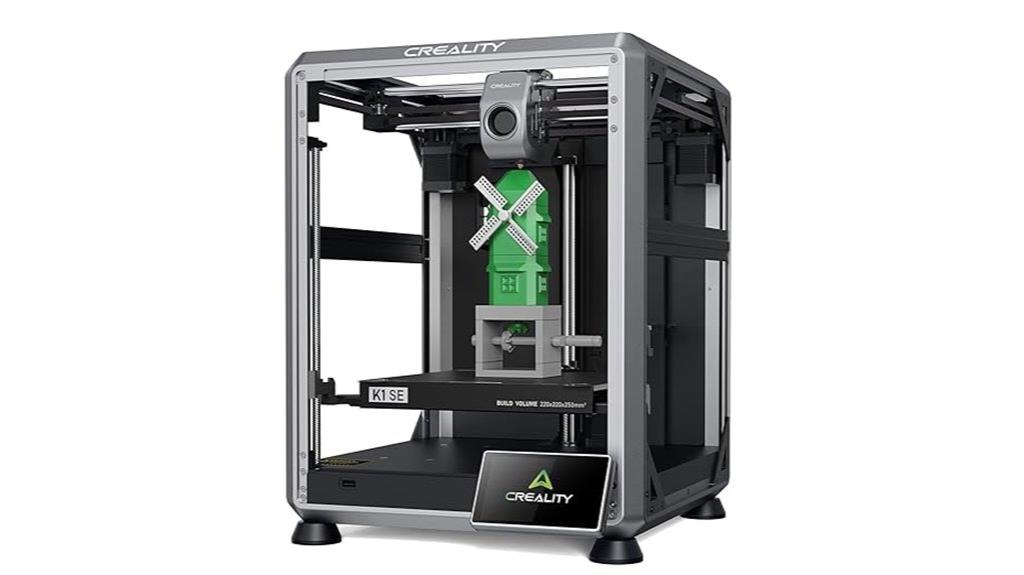
Designed for beginners and educational use, the Creality K1 SE Fully Assembled stands out with its rapid setup and user-friendly features. It’s ready in just three minutes, thanks to pre-assembly and auto-calibration, making it perfect for new users. Its all-metal frame and enclosed design guarantee stable, high-quality prints while reducing vibrations. The printer supports speeds up to 600mm/s and handles various filaments like TPU, PLA, and ABS up to 300°C. With simple controls, reliable power loss recovery, and quick filament swaps, it offers a seamless experience for hobbyists, students, and educators seeking fast, safe, and consistent 3D printing.
Best For: hobbyists, beginners, and educators seeking a reliable, fast, and easy-to-use 3D printer with minimal setup and high-quality results.
Pros:
- Rapid setup with pre-assembled design and auto-calibration, ready in 3 minutes
- Supports high-speed printing up to 600mm/s with stable, high-quality output
- User-friendly interface and reliable features like power loss recovery and easy filament swaps
Cons:
- Limited build plate options and may require glue for bed adhesion
- Occasional hardware failures after prolonged light use reported by some users
- Less suitable for highly detailed miniatures compared to resin printers
Creality K1 SE 3D Printer with Auto Leveling and High Speed
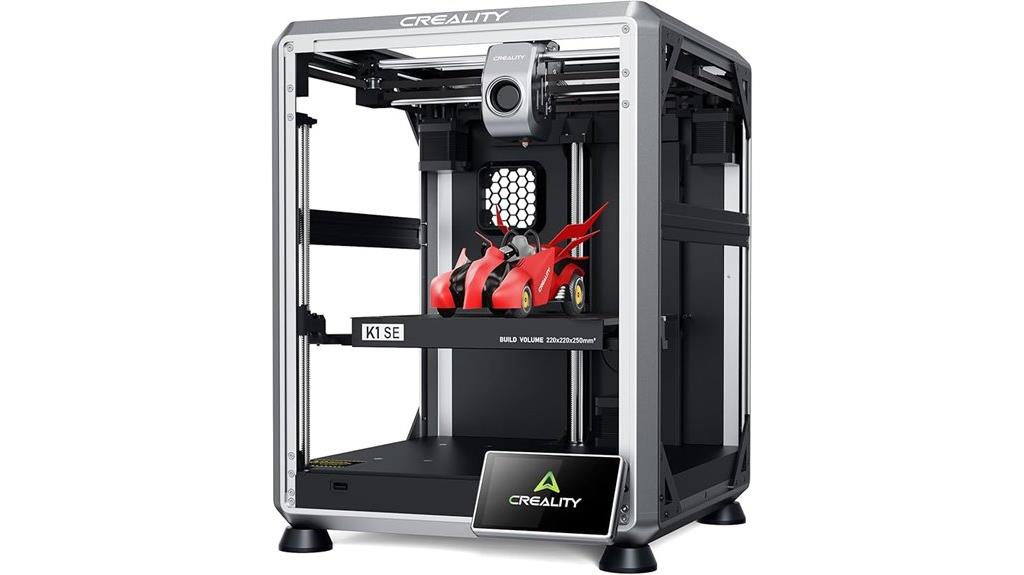
The Creality K1 SE stands out as an excellent choice for enthusiasts who prioritize speed and ease of setup, thanks to its high-speed CoreXY system and pre-assembled design. It arrives ready to print in about three minutes, similar to setting up a smartphone. Its rigid aluminum alloy frame minimizes vibrations, ensuring stability at speeds up to 600mm/s. The hotend heats rapidly in just 75 seconds, supporting various filaments like ABS and TPU. With auto calibration, open-source firmware, and advanced features like input shaping, it offers a seamless, high-performance printing experience suitable for hobbyists and semi-professionals alike.
Best For: hobbyists and semi-professionals seeking a fast, reliable, and easy-to-setup 3D printer with high-speed capabilities.
Pros:
- Rapid pre-assembly and setup within approximately three minutes, similar to smartphone setup.
- High-speed printing with CoreXY system achieving speeds up to 600mm/s while maintaining quality.
- Auto calibration and open-source firmware support advanced customization and simplified bed leveling.
Cons:
- Some users report hardware failures due to assembly quality issues, such as wiring and connector durability.
- Mixed customer support experiences can affect troubleshooting and service.
- Larger dimensions and weight may require dedicated space and handling considerations.
Anycubic Kobra S1 Combo 3D Printer
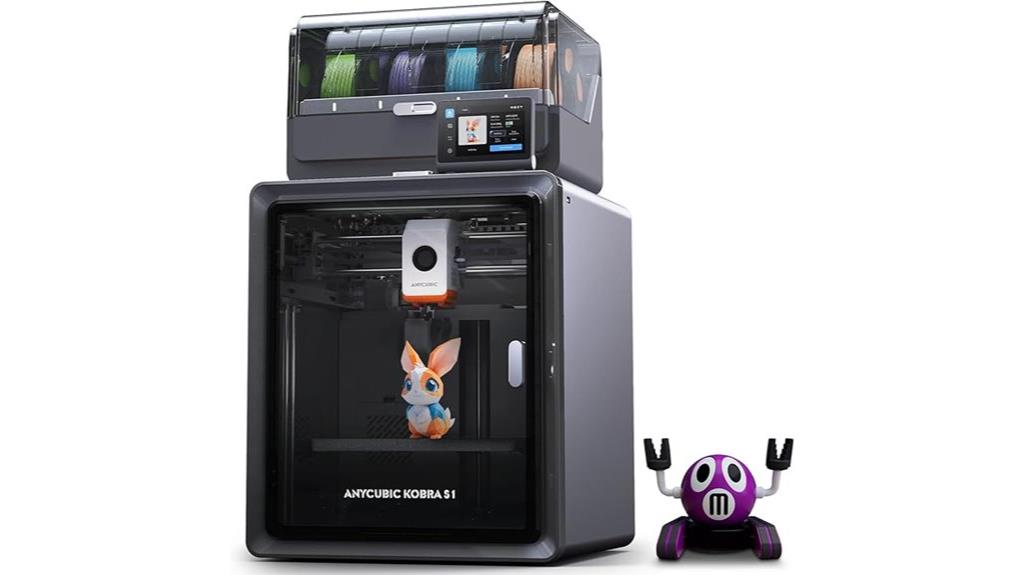
If you’re seeking a 3D printer that combines high-speed performance with precise multi-color capabilities, the Anycubic Kobra S1 Combo stands out. Its fully enclosed coreXY design offers a 250x250x250mm build volume, supporting ultra-fast printing speeds up to 600mm/s with resonance compensation for accuracy. The printer supports up to 8-color printing using two Ace Pro units, and the full metal hotend reaches 320℃, enabling diverse filament use like ABS and ASA. Quiet operation at 44dB, remote monitoring via a built-in camera, and seamless integration with Anycubic software make it a versatile, safe choice for high-quality, multi-color printing.
Best For: Enthusiasts and professionals seeking high-speed, multi-color 3D printing with precise color control and versatile filament options in a quiet, user-friendly machine.
Pros:
- Supports ultra-fast printing speeds up to 600mm/s with resonance compensation for high accuracy
- Capable of multi-color printing using two Ace Pro units, supporting up to 8 colors simultaneously
- Fully enclosed coreXY design with a large 250x250x250mm build volume and a full metal hotend reaching 320℃
Cons:
- The advanced features and multi-color capability may require a learning curve for beginners
- The dual Ace Pro units and high-speed operation could increase overall cost and maintenance complexity
- Enclosed design makes manual filament changes and maintenance slightly more cumbersome compared to open-frame models
Factors to Consider When Choosing a 3D Printer Enclosed
When choosing an enclosed 3D printer, I consider several key factors to guarantee it meets my needs. The quality of the enclosure material, precise temperature control, and the printer’s size all directly impact performance and usability. I also pay attention to noise levels and whether the printer supports a range of materials for versatility.
Enclosure Material Quality
Choosing the right enclosure material is essential because it directly affects a 3D printer’s safety, performance, and durability. Durable, heat-resistant materials like metal, tempered glass, or high-quality plastics are ideal. Metal enclosures, such as aluminum or steel, offer superior durability, better heat retention, and vibration damping, making them a top choice for long-term stability. Tempered glass panels provide clear visibility and monitoring capabilities while maintaining strength against heat and impacts. High-quality plastics like polycarbonate or ABS offer good insulation and chemical resistance but may be less durable under mechanical stress over time. The material impacts not only safety and temperature stability but also noise reduction and the enclosure’s overall lifespan. Selecting the right material guarantees your printer remains reliable and safe throughout its use.
Temperature Control Precision
Maintaining precise temperature control in enclosed 3D printers is essential for achieving consistent extrusion and strong layer adhesion. It minimizes warping and reduces print defects, especially when working with high-performance filaments like ABS and PETG. Enclosed chambers with active heating and cooling systems help keep ambient temperatures stable, which is vital for quality results. Accurate regulation of nozzle and bed temperatures prevents filament degradation, stringing, and surface imperfections. Advanced thermostats and sensors allow real-time monitoring and automatic adjustments, ensuring temperatures stay within ideal ranges throughout the print. This consistency reduces thermal fluctuations that can cause layer separation, cracking, or surface issues. Ultimately, precise temperature control directly impacts print quality, making it a key factor to take into account when choosing an enclosed 3D printer.
Size and Space Needs
Selecting an enclosed 3D printer involves carefully considering its size and the space available in your workspace. These printers range from small, compact models around 15 inches in all dimensions to large-format units exceeding 25 inches, affecting where you can place them. If your workspace is limited, such as a small desk or corner, you’ll want a printer no taller or wider than about 16 inches. Larger enclosed printers with build volumes over 12 inches require more room for safe operation and maintenance, including clearance around the device. Also, consider the printer’s footprint for storage and mobility, especially if you need to move or store it regularly. Matching the size to your project needs and space guarantees a practical, efficient setup without sacrificing functionality.
Noise Level Management
The noise levels produced by enclosed 3D printers can vary markedly depending on their design and features. Most operate around 50dB or lower, creating a quieter environment ideal for homes or offices. Sound-dampening materials like insulated panels and vibration isolation help reduce noise from fans and moving parts. Some models feature adjustable or silent fans, allowing you to control noise without sacrificing cooling performance. Keep in mind that noise can spike during high-speed printing or when fans run at full capacity, so choosing a printer with effective noise management is essential. A well-designed enclosure helps contain sound within the unit, preventing leakage and maintaining a peaceful workspace. Prioritizing noise control guarantees your printing experience remains quiet and stress-free.
Material Compatibility Range
When choosing an enclosed 3D printer, understanding its material compatibility range is crucial because it determines which filaments you can effectively print with. Enclosed printers typically support a wider variety of materials, including high-temperature filaments like ABS, ASA, and composites, thanks to better temperature control. The chamber enclosure helps maintain stable environmental conditions, making it easier to print warping-prone materials like PETG and nylon. Compatibility with specialty filaments such as carbon fiber-reinforced or glow-in-the-dark options often depends on the hotend temperature and chamber atmosphere, which enclosed printers can better provide. Some models feature advanced hotends reaching over 300°C, broadening their material scope to high-performance and engineering-grade filaments. Features like active chamber heating and precise temperature sensors further expand a printer’s compatibility range.
Frequently Asked Questions
How Do Enclosed 3D Printers Improve Safety for Indoor Use?
Enclosed 3D printers improve safety by containing fumes and particles, preventing them from spreading into your indoor space. I feel more confident using them because the enclosure reduces exposure to potentially harmful emissions and hot components. It also minimizes the risk of accidental contact with moving parts or hot surfaces. Overall, the enclosure creates a secure environment, making indoor printing safer and more manageable for me.
What Maintenance Is Required for Enclosed 3D Printers Over Time?
Ever wondered what it takes to keep your enclosed 3D printer running smoothly? Regular maintenance includes cleaning the build chamber and replacing the filters, checking for filament jams, and lubricating moving parts. I also recommend inspecting the cooling fans and updating firmware periodically. Doing these simple tasks ensures consistent print quality and prolongs your printer’s lifespan. Wouldn’t you agree that a little upkeep goes a long way?
Are Enclosed 3D Printers Suitable for Professional or Industrial Applications?
Absolutely, enclosed 3D printers are suitable for professional and industrial applications. I’ve found they offer increased safety, better temperature control, and higher print quality, which are essential in demanding environments. Their enclosed design reduces hazards and improves consistency. Whether you’re producing detailed prototypes or small batch manufacturing, these printers provide reliability and precision, making them a solid choice for serious work.
How Does Enclosure Design Affect Print Material Compatibility?
Enclosure design directly impacts print material compatibility by controlling temperature, humidity, and airflow, which are essential for specific filaments. I’ve found that well-designed enclosures support materials like ABS and PETG by maintaining stable conditions, reducing warping and improving adhesion. However, some enclosures may limit ventilation, so I always check if the design suits the filament I plan to use, ensuring ideal print quality and safety.
Can Enclosed 3D Printers Operate Silently in a Home Environment?
Think of an enclosed 3D printer as a whispering ghost—quiet but powerful. Yes, they can operate silently in a home environment, especially with advanced noise reduction features. I’ve found that many models now use soundproofing and low-noise fans, making them almost inaudible. So, you won’t be disturbed during your creative sessions. It’s like having a silent partner working quietly behind the scenes, ensuring smooth, peaceful printing.
Conclusion
In the end, choosing the right enclosed 3D printer is all about finding what fits your needs best. These models offer safer, higher-quality prints, making your creative process smoother. Remember, Rome wasn’t built in a day—and neither is a perfect setup. Take your time, weigh your options, and you’ll find a machine that helps bring your ideas to life with confidence and precision. Happy printing!